Tag Archives: Tim Ashe

We Have an Early Contender for the Least Surprising Political Development of 2026

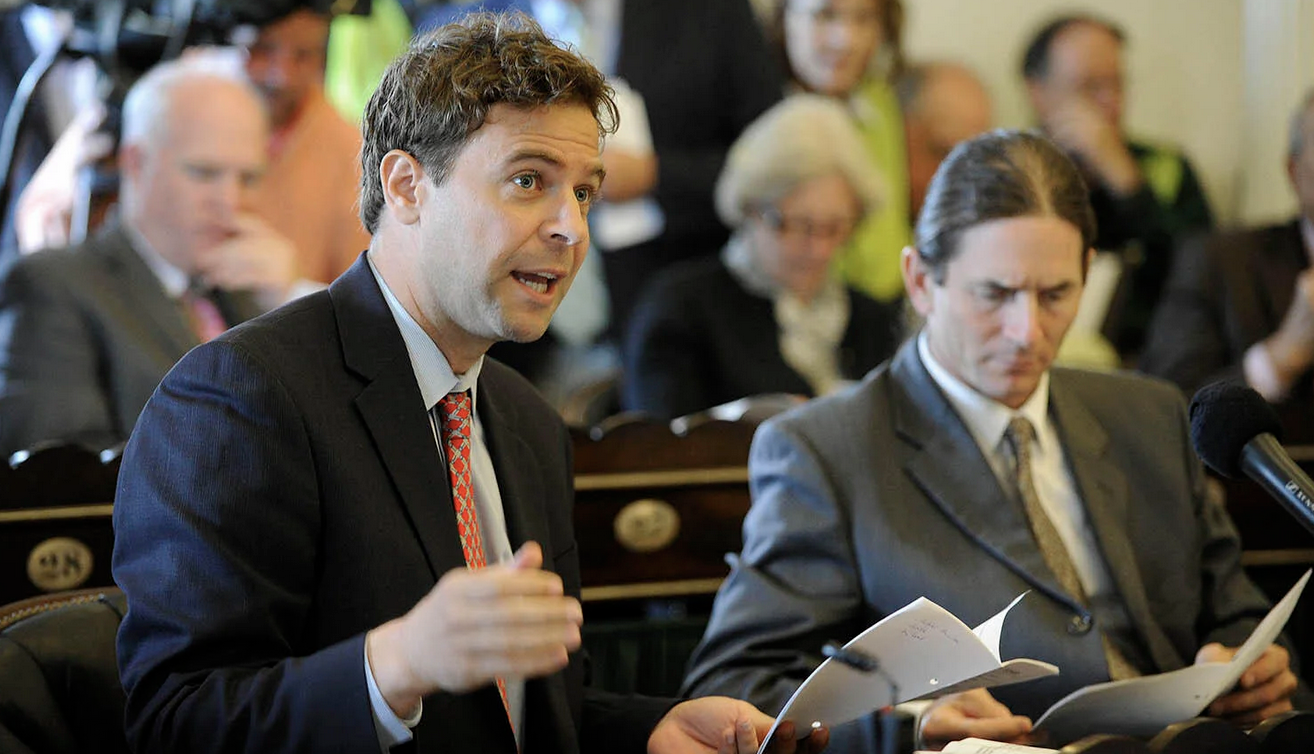
The inevitable has occurred, to the surprise of no one paying the slightest attention. Former Senate pro tem Tim Ashe, pictured here alongside some guy, has declared his candidacy for State Auditor*. This has been inevitable since current Auditor Doug Hoffer hired Ashe as his chief deputy back in 2021. It became extra-double inevitable when Hoffer made it clear he would not run for re-election in 2026.

*Credit where credit’s due: Political blogger Matthew Vigneau spotted Ashe’s candidacy filing on December 22, a full ten days before Ashe officially announced. He deserves credit for getting the story first, not that any mainstream media outlet ever gives proper credit to bloggers.

Both men wear the same political label as Democrat/Progressives. Both hail from Burlington. Both have ties to Bernie Sanders. Both are the kind of policy/financial nerds who would make good small-a auditors. All indications are they have worked well together in the capital-A Auditor’s office.

So yeah, of course Ashe is running for Auditor. And assuming the Vermont Republican Party can’t do any better than nominating the likes of H. Brooke Paige, he’s almost certainly going to win.

But the most politically impactful thing about this announcement has nothing to do with the man. It’s all about that D/P thang.

Continue reading

Nothing New Under the Sun

In case you thought the unhousing of Vermonters from a motel shelter program was a new thing, VTDigger comes along with a history lesson that manages to deepen my anger at and understanding of our current situation. It seems that we went through the exact same thing only 10 years ago.

And apparently we didn’t learn a damn thing, because we’re doing it again.

The circumstances were different, but the outcome was the same. Funding for an emergency motel voucher program was cut, and a large cohort was suddenly tossed out on the street. Some were given tents and sleeping bags in lieu of actual shelter.

One big difference between now and then: The Democrats ran the roost. They held the governorship as well as the Legislature, and they still managed to screw our most vulnerable. That sheds some light on the capacity of today’s Democratic leaders to defund the program and accept the consequences. They’ve done it before, so why not now?

Continue reading

Lookin’ For Some New Moose

2022 is looking like a critical campaign season for the Vermont Progressive Party, full of peril and possibilities.

The peril is obvious. The two state senators who identify as Progressive/Democratic, Anthony Pollina and Chris Pearson, are stepping out of elective office. Cheryl Hooker, one of three senators who wear the Democratic/Progressive label, is also retiring. (The others are Phil Baruth and Andrew Perchlik.)

If the Progs don’t pick up seats somewhere, that would leave them with fractions of Baruth and Perchlik as their entire Senate caucus. That wouldn’t be good.

The Progs have some possibilities for shoring up their numbers. They have real hopes in the newly created Chittenden Central district, which includes the liberal parts of Burlington and Essex, and all of WInooski. Rep. Tanya Vyhovsky of Essex is running in the Democratic primary, and should stand a decent chance given the political nature of the district.

Other Democrats could pick up the Dem/Prog label, which would help. At least a couple of Pollina’s potential successors, Anne Watson and Jeremy Hansen, seem inclined to do so. Windham County senate candidate Wichie Artu seems cut from similar cloth.

We may also see, for the first time in years, a slate of Progressive candidates at the top of the ballot.

Continue reading

Après Balint, La Sécheresse

The Vermont Senate’s seniority-heavy lineup is about to become a serious problem. That’s because current Senate President Pro Tem Becca Balint, seen above possibly contemplating the task of herding the caucus cats, is leaving the Senate to pursue a bid for Congress. And win or lose, she won’t be in the Senate beyond this term.

Which means the Senate will have to replace her no later than next January. And I’m here to tell you exactly how shallow the talent pool is. And that’s because so many senators have overstayed their sell-by dates.

Out of the 30 senators, a full 16 are basically too old to step into the top spot*. They’re not necessarily too old to be effective lawmakers, but they’re clearly on the downslope and I doubt that any of them would even want the job.

*For the record: Brock, Clarkson, Collamore, Cummings, Kitchel, Lyons, MacDonald, Mazza, McCormack, Nitka, Pollina, Sears, Sirotkin, Starr, White.

Before I get accused of ageism, let me expand on that cold assessment. Most of the senior senators are comfortable in their roles. They are not looking to take on a new level of responsibility. Heading the Senate caucus is a big, troublesome job. You’re always putting out fires or facing the press or twisting a fellow senator’s arm. It’s also something you tend to take on when you’re set on climbing the political ladder, not when you’re fat and happy.

Look at the last several Pro Tems. John Campbell was 47 years old when he assumed the office. Peter Shumlin and Peter Welch were in their primes, and clearly had their eyes on higher positions. There were a couple of short-time Republicans in the mid-90s; John H. Bloomer served from 1993-95; Stephen Webster succeeded him for a single term. Bloomer was 63 when he became Pro Tem; he had had a successful political career and would certainly had continued if he hadn’t been killed in a car crash in January 1995. Webster was 52 when he succeeded Bloomer; he would continue his political career well beyond his time as Pro Tem.

Before them, and four years of Peter Welch, there was Doug Racine, a relative youngster when he became Pro Tem. Tim Ashe was in his early 40s, and Balint was 53. All these folks, save Webster, were far younger than today’s cohort when they led the chamber. It’s no job for old men. It is a job for the ambitious. Of the past seven Pro Tems who survived their tenures, only two (Webster, Campbell) did not seek higher office. And Campbell got the job largely because of his lack of ambition; senior Senators had a very free hand under his, cough, “leadership.”

Continue reading

Balint Jumps In

As expected, Senate President Pro Tem Becca Balint has joined the race for Congress. To get to the payoff right away, I still list Lt. Gov. Molly Gray as the early favorite. But Balint will be a tough, engaging campaigner. And she’ll have to be.

Let’s start with the job she already has. No sign that she’ll step away from the Pro Temship, which would be a disaster for the Legislature; there are no obvious candidates to take her place in a very tricky job. And this is going to be one hellacious session. No time for a rookie leader.

But if she remains as Pro Tem, Balint will have a really difficult job that will take up a lot of time and energy. This session won’t be easy. Can she campaign during the session? Can she wait until June and still manage to be competitive? Can she raise money? Not only in Vermont, but nationally?

Besides all that, when you’re the House or Senate leader, you can’t define your own political profile. Your job is to get a majority together on crucial votes without alienating anyone you might need down the road. Your task is crafting acceptable compromises, not spearheading the charge.

So it ain’t gonna be easy. But Balint is a gutsy, energetic, determined individual — to me, the single most impressive person in the Legislature — and I won’t be surprised if she wins the Democratic primary.

Continue reading

Tim Ashe Respectfully Requests You Ignore That Stupid Thing He Tweeted

Oops, that’s the other Ash

Tim Ashe, former Senate President Pro Tem and current deputy state auditor, stepped right into it Sunday afternoon. He immediately tried to step back, but the shit was plastered all over his shoe.

Ashe, who is widely expected to run for [insert office here] sometime soon, put out a Tweet criticizing Democrats (not directly by name; he might be running in a party primary any day now) for failing to enact paid family leave.

Nice try. The problem is, as anyone who’s been following Vermont politics for more than about five minutes knows, is that under his leadership the Senate was the biggest obstacle in the path of paid leave. For several years running, as Democrats were trying to enact paid leave and a minimum wage increase, the House favored leave and the Senate favored wage. Each effectively stood in the way of the other. And Ashe repeatedly raised objections to paid leave.

After a bunch of Tweeters called him out, Ashe quickly deleted the tweet. Unfortunately for him, screenshots are a thing.

Continue reading

Son Of Hey, Let’s Have Some Fun With the Chittenden Senate District!

After I wrote my post about the Chittenden Senate district, I found out that Sen. Kesha Ram has decamped to the suburbs. Specifically, the tony confines of Shelburne. Her Legislative bio still says “Burlington,” but oh well.

This dramatically changes the calculus for reapportionment, or at least my version of it. Rather than try to amend the original post, I decided to start afresh here.

For those just joining us, Vermont is preparing the once-a-decade task of redrawing legislative districts to reflect population changes. The Legislative Apportionment Board will draw up a proposal in time for the House and Senate to approve it or make changes during the 2022 session.

Thanks to a 2019 law, districts cannot include more than three House or Senate seats. This will mean dismembering the six-seat Chittenden district, which is a good thing. Multi-member districts are basically incumbent-protection schemes.

Because Chittenden County is growing while many other areas are shrinking, the district will get at least one more seat and possibly two. (By sheer population, it warrants 7 1/2.)

Adding a Chittenden seat means taking one away somewhere else, so let’s assume the new district will have seven seats, not eight. That means shifting one sizeable community out of the district. Colchester is currently in the Grand Isle district, and it’s likely to stay there in order to protect eternal incumbent Dick Mazza.

But for purposes of this thought experiment, I’m going to focus entirely on Chittenden County and try to describe districts that would be as even as possible population-wise, and keep communities intact whenever possible. On my map, no district would have more than two seats — and the lines could easily be drawn so that each district would have a single senator.

Continue reading

The Gray Eminence

Lt. Gov. Molly Gray is, as far as I can tell, an unprecedented phenomenon in Vermont politics. (Someone with longer tenure than I may recall a comp.) In a state where “Wait Your Turn” is the norm, she entered the arena at the age of 36, ran for a statewide office, defeated a strong field in the Democratic primary, and defeated Republican Scott Milne by a comfortable margin in the general election. Considering the dominance of Democratic men in higher offices, her gender makes the accomplishment even more impressive.

Somehow, I don’t think we’ve fully appreciated how rare and special this was. In February 2020, as she was preparing to launch her campaign, she was an almost complete unknown. (Well, she was an assistant attorney general, but there are dozens of those.) Nobody in the Statehouse had a clue, nor did they take her seriously at first. The betting favorite, and it wasn’t close, was then-Senate president pro tem Tim Ashe.

Once in the race, Gray ran a nearly flawless campaign despite having no experience in electoral politics. That’s immensely difficult to do.

But Gray has often received more criticism than credit. (Yes, including from me.) There are good reasons for some of that; but much of it has to do with two things about Gray that are rare in our politics: Her age and her gender. And that’s troubling.

Continue reading

Ashes, Ashes, We All Fall Up

So, only nine months after losing the Democratic primary for lieutenant governor in spectacular fashion, former Senate President Pro Tem Tim Ashe has landed a new gig. He’ll be Doug Hoffer’s deputy state auditor.

I’ve had more than my share of fun at Ashe’s expense (including the irresistible headline above), but I have to say this job is a perfect fit all around. Ashe is good at finances and numbers, and he knows state government as thoroughly as anyone.

And it provides a side-door re-entry into statewide politics, something that seemed unlikely to happen so quickly after he got his ass handed to him in the primary.

OK, I’ll stop mentioning the primary now.

The first thought that crossed my mind is that maybe, after several years of rumors, Hoffer is actually planning to retire next year and he wanted to give his fellow Progressive/Democrat the inside track to succeed him. It makes all the sense in the world, assuming that Hoffer is thinking politically. As he basically never does, so grain of salt and all that.

Another political thought: Ashe might lend a little more Statehouse heft to the auditor’s office. Hoffer has had a hard time getting the Legislature to take him seriously. In my experience, every time Hoffer testifies before a legislative committee, they politely thank him and then ignore what he had to say. Ashe might help, at least in the Senate. He has many friends in Vermont’s most self-regarding deliberative body, especially among the senior Senators who occupy virtually all the committee chairships.

This hire is also good news for the Progressive Party, which saw its two real contenders for statewide office lose badly last year (Ashe and Dave Zuckerman). Ashe now has the opportunity to re-establish himself in Montpelier, and blaze a trail to a second bid for statewide office.

And a reminder: Although it seems like he’s been around for almost ever, Ashe is still only 44 years old. Time is on his side.

But even if you leave politics aside, it’s a good fit for Hoffer, for Ashe, and for the office of auditor. Kudos all around.

The Progressive Regression

My recent post about the Vermont Democratic Party drew more reaction than just about anything I’ve ever written… with the notable exception of the Latin Motto controversy. Almost all of it was positive, and much of it came from young folks who feel like they got the cold-shoulder treatment from the party.

At least a couple of people asked me to do the Progressive Party. And while I did briefly address their failings in my post-election “Winners and Losers” piece, there’s more to be said.

Short take: 2020 was a disastrous year for the Progs. They managed to hold onto their seven-seat caucus despite three retirements and one upset defeat, which is noteworthy. But otherwise, the bad far outweighs the good.

Let’s start with the electoral defeats of two prominent Prog-identified pols. Tim Ashe finished a distant second to Molly Gray in the Democratic primary for lieutenant governor, and Lt. Gov. David Zuckerman lost by 41 points to Gov. Phil Scott.

It’s hard to understate how big a setback this is for the Progs. They’ve suffered a huge loss of influence in the Senate, with Ashe’s departure as President Pro Tem and Zuckerman relinquishing the gavel. Also, Ashe and Zuckerman were the Progs’ top two hopes for statewide office. They had built their political careers over more than a decade of success, but they’re off the charts (at least for now).

Also, the magnitude of their losses calls into question whether the Progressive label is statewide electoral poison. Ashe lost by 11 points to Molly Gray, who was a complete political unknown at the beginning of the year. Zuckerman faced impossible odds in taking on Phil Scott during the pandemic; but even so, 41 points???

Continue reading