Tag Archives: Seven Days

Dear Mr. Feliciano: You are cordially invited to bug the hell out.

Nice little scoop hauled in by Paul Heintz in his “Fair Game” column this week. No, not the lead story about the IBM reverse-sale to GlobalFoundries; but the second item, about a Sooper Secret Meeting (that managed to stay secret for less than a week) at which Dan the Libertarian Man was asked by State Sen. Joe Benning to exit the race and endorse Republican Scott Milne.

According to Heintz, “participants pledged to keep the confab confidential,” which ha ha ha. I think we can assume that Benning didn’t send Paul a press release; the more likely scenario is that somebody else in the meeting, or who knew about the meeting, leaked a few details to Heintz, who then gave Benning a call.

At which point, Benning could have issued a denial. But, in this scenario, he apparently thought to himself “What the heck,” and acknowledged the whole “confidential” thing:
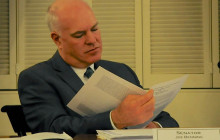
The Fixer. )Image pilfered from VTDigger.)

The Fixer. (Image pilfered from VTDigger.)

“I went through the pros and cons of [Feliciano’s] being in the race,” Benning recalled. “I suggested to him that the poll numbers were not in his favor and that if he stayed in the race, the only thing for sure that would happen is Peter Shumlin would walk back in without any kind of contest.”

… “I said that even if he left the race at this stage, it’s still an uphill battle for Scott Milne,” Benning continued. “But in the event that he had any interest in a future in Republican politics, I would imagine folks on our side of the aisle would be a lot happier if there was no split in the ticket in this race.”

Well, if he had dropped out, he’d have had no choice but to pursue “a future in Republican politics,” because he’d be dead to the Libertarian Party, who would have been justifiably outraged to lose their candidate to a GOP power play.

Ethically speaking (ha ha ha), this was an iffy move. It takes guts, or gall, to call another party’s candidate into a meeting and urge him to bug out.

Politically speaking, however, Benning was right.

Remember when Feliciano looked like he was going to steal the right wing away from Milne? When his write-in bid for the Republican nomination was taken seriously, was endorsed by two of the VTGOP’s four statewide officers, and Milne actually bought TV ads to fend off the “threat”?

When there was open speculation about Milne withdrawing in favor of Feliciano?

Believed to be Dan Feliciano at his campaign headquarters.

Believed to be Dan Feliciano at his campaign headquarters.

Well, that ship sailed long ago. Feliciano has done nothing to show he’s captured anything more than a single-digit sliver of the right wing: he’s way down in the poll that actually included him, and more importantly, his fundraising performance makes Scott Milne look like George W. Bush.

Which leaves us with this. If Milne exited the race and endorsed Feliciano, the latter would get the dead-ender vote but Milne would still be on the ballot, in the Republican slot, and would still garner a whole lot of votes from loyal Republicans. Feliciano’s best case: he’d be this year’s Tony Pollina, managing to outpoll a very weak major party candidate (Gaye Symington) but getting nowhere close to the winner. His worst case: he’d get into the low double digits, pulling Milne down to about 30% and making Governor Shumlin look like a landslide winner.

There’s no way Feliciano could pull very many centrist, “sick of Shumlin” votes; his views are too far from the middle.

Milne, on the other hand, has the inherent — and substantial — advantage of carrying the Republican standard. Even though he’s run an awful campaign, he still gets a solid 35% in the polls. He hasn’t convinced very many undecideds, but he’s retained virtually all of the Republican base.

So here’s how it looks to This Political Observer: Shumlin gets in the low-to-mid 50s either way. If Milne is the active opponent, he gets into the low 40s, with Feliciano retaining most of his meager support even if he stops campaigning. (He’s still on the ballot.)

But if Feliciano is Shumlin’s active challenger, then Milne gets about 30% and Feliciano maybe 15. Or Milne 25 and Feliciano 20. Whatever. And the difference is mainly a matter of style points — of how your party will look in the history books.

Of course, this whole kerfuffle is not really about November 4. It’s about what comes after: a potential relitigation of last fall’s intra-party battle for control of the VTGOP. Last year, Phil Scott’s Moderator faction won a narrow victory. Clearly, there are those within the party who’d like a second bite of that wormy, bruised apple.

In this context, Benning’s acknowledgment makes sense. In the short run, he’s trying to further establish Feliciano as a fringer. But beyond the election, it’s a message to the True Believer faction of the VTGOP: backing Feliciano was a mistake, and we’re still in charge.

As usual, this is all speculation on my part. I certainly haven’t gotten any leaks from Benning or any other Republicans. But it makes sense to me. And this is my damn blog.
Ride with Uber. Chances are, you’ll get there in one piece

Ah, Uber… the latest high-tech industry disruptor. The “ride-sharing” service that’s just like a cab company without all that pesky regulation. The service that actively, and aggressively, resists any attempt to regulate its business. Now operating in the Burlington market, as the Freeploid reported last week:

Uber will provide rides through the low-cost service called uberX, which uses local drivers in their own cars. Burlington is now the 216th city on the Uber map, and the company will build up to 24/7 on-demand service.

The ‘Loid’s April Burbank went on to detail the city’s response to Uber, which arrived at a time when Burlington was already pondering how to update its taxi regulations, and to dutifully reproduce the complaints of local cab operators and Uber’s reassurances that its services are reliable and safe.

Safe. Hmm. That’s an issue that Burbank failed to explore further. And neither did Seven Days’ Alicia Freese, in a pair of stories that focused on Uber’s successes in other markets and the uncertain reaction from local regulators. All this, even though a quick Google search will reveal a host of problematic experiences and near-brushes with abduction and assault, to which Uber’s standard reaction is “Oops, sorry, here’s your money back, now go away.”

Let’s review some recent trouble spots on Uber’s record, shall we?

A woman in Los Angeles boarded an Uber vehicle for a ride home from a party. Instead, the driver took her 20 miles out of the way…

…arriving in a dark, empty parking lot in the middle of the night despite her repeated protests. When she tried to exit the car, her driver locked the doors—only when she caused a commotion and screamed did he finally return her home. What should have been a quick ride took over two hours.

Uber’s initial response: a  partial refund for an “inefficient route.” It later made a full refund. Meanwhile, the woman is staying in a hotel because the driver is still out there somewhere and knows her home address.

A couple weeks ago, an Uber driver in San Francisco got into an argument with his passengers, stopped the car, attacked one of the riders with a hammer blow to the head, and drove away.

Oh, and here’s a thing: a Chicago TV station sent out a bunch of passengers to take rides in Uber cars, “and found not a single driver knew his way around the city.” And worse:

NBC5 then ran background checks on each of the drivers and discovered ticket after ticket — for speeding, illegal stops and running lights. One driver had 26 traffic tickets, yet still passed Uber’s background check.

The station then tested Uber’s driver-screening program by submitting an application from a reformed criminal with “a three-page rap sheet.” She was hired four weeks later, to which she said:

“I was kind of baffled, still am baffled how they let me in,” Locke said. “If I had been offered a job like this, knowing that my life of crime was in burglaries and robberies, …I would pick somebody up, take them to their airport, and my second thought would be: Go back to that house.”

The NBC5 report contains a whole lot of other nasty stuff, including an Uber driver who hit and killed a six-year-old — and who turned out to have a prior conviction for reckless driving; a driver accused of sexual assault by a passenger; and a driver whose car was totaled, and who found that neither Uber’s insurance nor his own would pay for the damages.

Thousands of people have had good experiences with Uber, and any industry has its problems. But Uber’s whole business model is built on avoiding responsibility for those problems. It fights regulation; it doesn’t buy commercial auto insurance for drivers; it classifies its drivers as independent contractors to shift liability away from the company.

It’s the ultimate in caveat emptor: let the buyer beware, let the contractor beware, let bystanders beware. In fact, let everybody beware except Uber itself. And Uber skims the profits.

City officials should think long and hard about the totality of Uber’s track record before allowing it to operate. That consideration should include the above incidents, and Uber’s clearly inadequate driver-screening process, which Seven Days and the Burlington Free Press either overlooked or didn’t think worthy of its readers’ attention.

One man’s cheap shot is another’s cogent criticism. Or, why I bag on the Free Press so much

Those who follow Vermont media accounts on Twitter may have enjoyed a little Columbus Day entertainment by way of a Tweetfight between staffers at the Burlington Free Press and Seven Days, which the Freeploid has long looked down at, but which has become a powerful competitor in the battle for print advertising.

It began with Freeploid vet Mike Donoghue taking a little poke at WCAX:

This was a reference to WCAX mistakenly broadcasting a crime scene photo including the body of a murder victim, which the Freeploid wrote up at great length. Seven Days’ Mark Davis Tweeted a reply about the ‘Loid “firing cheapshots at WCAX.” To which the Freeploid’s Adam Silverman replied “Is someone from Seven Days really one to talk about cheap shots?”

Davis pointed out the “thinly veiled glee” the Free Press was exhibiting over a competitor’s mistake. Donoghue and Silverman accused Seven Days of ignoring the story, to which Paul Heintz replied that he hadn’t gotten a call back from WCAX.

This exchange included two contraditory Tweets from Donoghue. First, he accused Seven Days of ignoring the story because the two entities are media partners; and then he insinuated that WCAX won’t return calls from Seven Days because of some unstated offense.

Which is it, Mike? They’re in bed together, or they can’t stand each other?

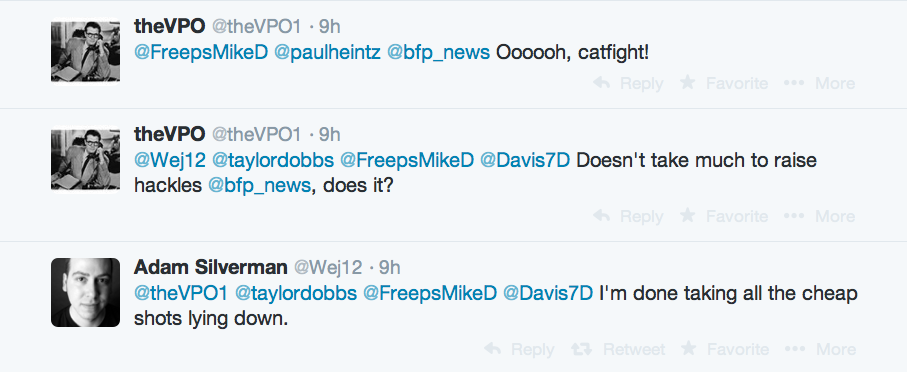
Anyway, that’s when I lobbed a couple of spitballs from the back of the class, and Silverman went all Charlie Bronson.

Screen Shot 2014-10-13 at 11.47.41 PM

I can just see him grabbing his crotch as he hit “SEND.”

Which brings me, finally, to the point of this post: an explanation of why I so often criticize the Free Press. Or, in the words of Mr. Silverman, why I deliver so many cheap shots.

Basically, it’s all about the words of Voltaire, best known as delivered by Peter Parker’s Uncle Ben:

With great power comes great responsibility.

The Burlington Free Press is the number-one print publication in Vermont. It ought to be the unquestioned leader in serious journalism. But, because Gannett keeps sucking out its precious bodily fluids to satiate the endless thirst of stockholders, we’re left with a depleted newspaper that can’t serve its readers well but still occupies the largest niche in the Vermont news market.

It doesn’t occupy that niche in any satisfying way, but there it sits, and because of the structure of the news marketplace, nobody can dislodge it.

The Burlington Free Press has great power. To be charitable, it does an inconsistent job of exercising that power. To be less charitable, it’s an almost daily disappointment. So when somebody like Mike Donoghue or Aki Soga positions himself as a guardian of the public trust — and yet expects to be insulated from the kinds of accountability or transparency he expects of everyone else (including WCAX) — well, it makes the rest of us throw up in our mouths a little. Likewise, when Jim Fogler or Michael Townsend serve up a column’s worth of bullshit and expect us to gobble it down like steak.

Too often, the Free Press comes across as arrogant and condescending. And its performance fails to justify its overweening sense of superiority. That’s why the Free Press gets so much criticism. And the occasional cheap shot. Expect both to continue.

The Burlington Free Press: Your Shameless Hometown Daily

Last week, I called attention to a bit of hypocrisy from Vermont’s Largest Newspaper: Veteran reporter Mike Donoghue Tweeting a complaint that WCAX had poached his story without attribution. Which was a clear example of Pot/Kettle Syndrome, since the Freeploid has a reputation among journalists as a serial story poacher. Like ESPN, the ‘Loid likes to pretend it’s the only news source in its market.

At the time, I pointed out just one recent example of the Freeploid failing to give credit to another outlet, to wit Paul “The Huntsman” Heintz at Seven Days.

Well, they’re at it again.

On September 3, Seven Days published an article about John Barone, superintendent of schools in Milton, receiving his advanced academic degrees from an institution known to be a diploma mill.

And hey, whad’ya know, on today’s Freeploid front page, there’s a story about John Barone, superintendent of schools in Milton, receiving his advanced academic degrees from an institution known to be a diploma mill.

And it gives no credit to Seven Days.

If you think that’s a coincidence, I’ve got a bridge you might be interested in buying.

And the Free Press had the brass-plated balls to COPYRIGHT the story.

I’m sure they have some ass-covering explanation for this, but I ain’t buying.

Burlington Free Press, serial story-poacher.

Bunched knickers at the Freeploid

The Burlington Free Press’ Mike Donoghue is shocked, shocked, that someone would dare steal his scoop.

Screen Shot 2014-09-11 at 2.18.28 PM

Donoghue is referring to his excellent story on the Louis Freeh accident, in which he broke the news that an eyewitness saw Freeh’s vehicle force three other drivers to swerve out of his way. Which raises the question, why isn’t Freeh facing any charges for reckless driving or endangerment or some such?

And how Mike’s knickers are in a twist because Channel 3 poached his story.

I feel his pain.

As does every non-Gannett journalist in Vermont, who would tell you that the Burlington Free Press is the number-one violator of this ethical principle. The Freeploid likes to pretend, in fact, that it is the only journalistic outlet in the state. It is very quick to grab credit for its own “gets,” and extremely — extremely — reluctant to grant the same credit to others.

Let’s just take one recent example. Terri Hallenbeck, reporting on Governor Shumlin’s campaign launch: 

According to the governor’s office, Shumlin has spent 141½ days in the past two years outside of Vermont, which includes 54 personal days off and 35 days on business for the Democratic Governors Association, of which Shumlin is chairman.

“According to the governor’s office,” my ass. That story came straight out of Paul “The Huntsman” Heintz’ column in Seven Days. Which was entitled “On the Road Again: Shumlin’s 141.5 Days Outside Vermont.”

So, rather than give proper credit to Heintz and Seven Days, Hallenbeck called the governor’s office for confirmation. Which gave her an excuse to avoid giving credit where credit is due. Well, to be fair to Hallenbeck, I suspect that her editors made her do it.

In any case, I say anyone at the Burlington Free Press who whines about story-poaching needs to look in the goddamn mirror.

Oh, so THAT’S where all our gunk is going

The recent blue-green algae bloom that caused a shutdown of the public water system in Toledo, Ohio has brought overdue public attention to our own algae troubles in Lake Champlain. (With an undertone of sneering about the industrial Midwest’s environmental stewardship.) Various media outlets have asked the musical question, “Could it happen here?” And they’ve dutifully reported the bland reassurances of local officials and the warning cries from advocacy groups.

But one media outlet took a unique step, and discovered that hell yes, it’s already happening here.

Or near here, anyway. In last week’s edition of Seven Days, Kathryn Flagg surveyed the landscape for traces of blue-green… and her search took her to the upper end of the lake – over the border in Quebec.

Though drinking water from Lake Champlain on this side of the border has never tested positive for the toxins associated with blue-green algae, some Québec residents routinely receive notices that their water is not safe to drink.

… “I’ve lived in Bedford since 2004, and it happens every summer,” said Aleksandra Drizo, a research fellow at the University of Vermont…

Wow, I thought to myself. That’s really bad. A lot worse than Toledo, right?

And then I thought, Wait a minute. Doesn’t Lake Champlain flow north?

Flagg’s article didn’t say, but another story in Seven Days confirmed my thought.

So… our gunk is poisoning their water.

Which ought to make us clean, natural and green Vermonters ashamed and embarrassed. We’re exporting our environmental damage. And because our gunk is (at least partly) flowing northward, we don’t suffer the consequences.

That’s appalling. And it’s one more sign that Vermont’s pure-green reputation isn’t nearly as deserved as we like to think.

Extreme Makeover, Freeploid Edition

Gannett is taking the inevitable next step in its pursuit of profit: spinning off its newspaper business, formerly the heart and soul (such as it was) of the corporation. The publishing arm will start with a clean slate, unlike some other spinoffs that loaded corporate debt onto the new entity; but it also strips away whatever fiscal protection was offered by Gannett’s moneymaking broadcast properties.

For readers of the Burlington Free Press wondering what its future will look like, I suggest media coverage of its sister paper, the Tennesseean. The Nashville daily is being transformed into a “beta” newsroom, a new-world model for affiliated papers to follow. The topline looks good: The Tennesseean promises a larger reporting staff and more local journalism.

But the attic is full of spiders, and if I were a senior Freeploid employee, I’d be preparing to be “future endeavored” into a lousy job market. The best summary, with plenty of links, comes from the Poynter Institute. And it includes such gems as:

— The newsroom will, indeed, have more reporters — but fewer others, including far fewer editors. The total staff will shrink from the current 89 to 76. That’s a 15% cut.

— Every newsroom staffer will have to reapply for new jobs and no one is guaranteed a new gig. Out goes seniority! I bet those redefined jobs will offer lower pay and lousier bennies. Also, senior staff had better be as up-to-date with the digital world as your average twenty-something J-school grad, or they’ll be out on their ears. With, according to Nashville Public Radio, “a small severance package.” Lovely.

— The lack of editors will put the onus on reporters to produce “publication-ready copy” because there won’t be enough editors to give stories a second look. Expect a lot more typos, bad grammar, and stories rushed to publication.

Every reporter I know has seen stories ripped to shreds by unskilled, or agenda-driven editors. But there’s a reason that traditional journalism demands mediation between writing and publication: it’s the quality control. It is, literally, the most significant difference between traditional media and the likes of Yours Truly. I write what I know and feel, based on experience, and I can post anything I want to. The editorial system breeds a certain level of professionalism, which is why the Freeploid can expect to be paid for its content and I cannot. (I’d like to be, hint hint, but I can’t expect it.)

— “Audience analytics” will rule the roost. Executive Editor Stefanie Murray, the Tennesseean’s own Jim Fogler, says “We’re going to use research as the guide to make decisions and not the journalist’s gut.” Wonderful; we’ll be setting our journalistic priorities based on pageviews and reader surveys. Er, I mean “audience surveys,” because “reader” is so 20th Century.

I realize that newspapers face a difficult future. Their old sources of advertising are drying up, and digital ads don’t fill the gap. Unless you’ve got something else going for you, like donor support (VPR, VtDigger) or a healthy, ad-rich print operation (Seven Days), you’re dependent on ad revenue. (The traditional paper got at least two-thirds of its revenue from ads, not readers.) The Tennesseean is one more experiment in creating a sustainable future. But the minions of Gannett are furiously lipsticking this pig — presenting the “new” Tennesseean as a model of intensive, community-oriented journalism. It’s not. It’s another effort at slashing costs to maintain profit margins.

The Freeploid has a whole lot of experienced senior staffers who work very hard. Their experience can lend context and depth to their reporting. If the Tennesseean’s “beta” test goes well, in terms of profitability, expect the winds of change to blow strong through the Freeps’ offices in the near future.