Tag Archives: Scott Milne

We eagerly await good tidings from the VTGOP

As you might know, although they did little to publicize the fact, the Vermont Republican Party had its fall fundraising dinner last Friday. The guest of “honor” was Islamophobic national-security nutbag Peter King, undistinguished Congressman from New York.

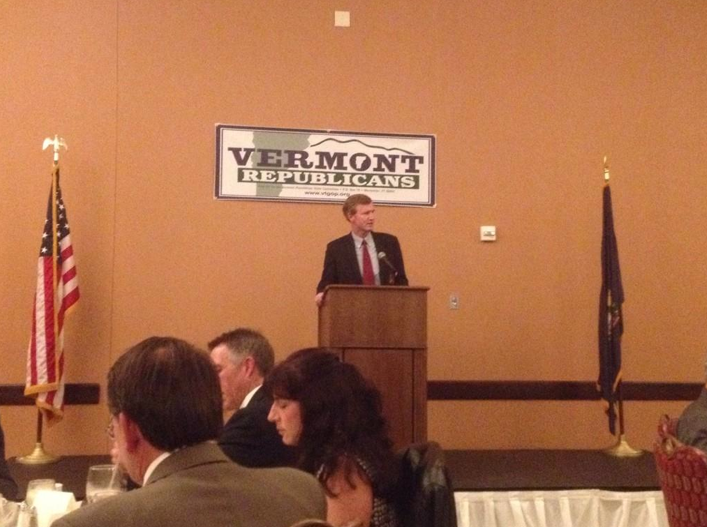
During the course of the evening, the operator of the VTGOP Twitter account posted four photos form the event. All four showed one of the evening’s speakers at the podium; all four were taken from angles that showed very little of the crowd. One example:

Screen Shot 2014-09-29 at 1.29.38 PM

Okay, so we know there were at least three people in the audience. Which is more of the crowd than you can see in any of the other photos, all of ’em focused on the podium.

No crowd shots, VTGOP?

What, too embarrassing? In my mind’s eye, I’m picturing a few dozen people crowded around the front tables, with plenty of empty seats farther away.

You may think my surmise unfair, just another example of theVPO’s liberal bias. But riddle me this, Batman:

— Right up to the day of the event, the VTGOP was sending out reminders that tickets were still available. The last one was sent at 10:43 a.m. Friday, less than seven hours before go-time.

— Since the Twitter posting of those four photographs, we’ve heard not a peep from the VTGOP about the success of the fundraiser. Or anything else, for that matter.

— This, in spite of the fact that I’ve been sending them gentle reminders via Twitter:

Screen Shot 2014-09-29 at 1.38.41 PM

And still no response.

I see a pattern. Last December, the VTGOP was very free with very generous pre-event estimates for its Chris Christie fundraiser. After the event, not a peep. Then in the spring, the Vermont Democrats hosted Sen. Elizabeth Warren; shortly after the event, the Dems announced attendance and fundraising totals.

Now another Republican event comes along, and once again, they’re being tight-lipped about the actual results.

As I said in one of my subsequent Tweets to @VTGOP, “I’ll take that as bad news.”

If the Vermont Republican Party does release totals for tickets sold and dollars raised, I’ll be happy to report them in this space, with whatever comments they provide. And if the totals are respectable or better, I’ll be happy to retract my cynicism and congratulate them on a successful event.

I’m not holding my breath.

When public policy becomes personal

Let’s look at the two guys likely to headline the Republican ticket, such as it is, in Vermont this year: gubernatorial candidate Scott Milne, and incumbent Lieutenant Governor Phil Scott. Both are men of moderate reputation and widely seen as “nice guys.” Both have shown a disinclination to take hard-and-fast political stances.

But for each of them, there’s one exception to the general tone of moderation. Milne and Scott have each spoken loudly and strongly on one issue respectively. For each, it’s an issue that has left the realm of abstract policy and directly impacted their own fortunes. In the case of our Lieutenant Governor, it’s public campaign financing; for Milne, it’s the approval process for new developments, most especially Act 250.

It’s funny how a personal stake can turn a moderate into a firebrand. But it does call into question their ability to govern dispassionately. One of the most important things I want to know about candidates is this: Can they make decisions based on the public good, even if they’re going against their own personal interest? Can they set their interests aside?

Both top Republicans are in danger of failing that test.

As for Scott, after years of building a politiical career on being inoffensive and avoiding the tough call, he has become a late-blooming opponent of public campaign financing. When he was a state Senator, Scott wasn’t particularly against the idea, and he had his chances. And during his tenure as Lieutenant Governor, he’d never spoken out about it.

Until now, when a publicly-financed candidate threatens to give him a real race. Now he’s decided that public financing is an unfair burden on taxpayers, forcing them to effectively support a candidate they may personally oppose. Which ignores the whole social-good function of publicly financing ANYTHING — roads, welfare, education, police, military. Every one of us pays taxes to support something that we personally would not choose to spend money on. Public financing is a drop in that particular bucket.

As for Milne, he’s hot and bothered over the development approval process because of his big personal stake in Quechee Highlands, a proposed housing/retail project slated for a large parcel near Exit 1 of I-89. (This story was broken earlier this week by my colleague BP at Green Mountain Daily.) How hot and bothered? In an essay published last August in the Valley News, his opening salvo was:

All who care about Vermont’s future, fairness in government and how communities settle disputes should pay heed to what is happening a few miles from the Connecticut River at Quechee Highlands.

Wow. That’s putting it pretty strongly. “Vermont’s future” depends on Milne getting his way on this project. Lacking in perspective much?

He goes on to slam the regional planning commission for denying an Act 250 permit for the project. In the process, he reveals substantial ignorance about the mission and workings of those commissions. Most notably, he wrote that the commissions’ purpose “should be to help promote development that creates a foundation for economic health.”

Er, Scott. Hate to break it to you, but those Act 250 bodies are meant to balance development with conservation, not to promote development. And your little project, I have to say, would be built in an area with precious little road infrastructure. The corridor between Exit 1 and Woodstock is already a mess, and the vicinity of Exit 1 is especially bad. The original proposal was for an entirely retail project, which would have been a traffic nightmare. Milne and co. later revised it to mixed-use, residential plus “less than 37 percent retail.” Which is still quite a lot of retail in a 168-acre development. (The retail is clearly aimed at cashing in on the proximity to I-89. The site is less desirable for housing because of freeway noise.)

At the time, one of the pillars of Milne’s argument was that while the regional board had said “no,” the town of Hartford was in favor of the project. And he asserted that the town’s view should have greater weight.

Since then, Hartford has changed its tune. In May, the Hartford Selectboard amended its master plan to bring it into compliance with the regional commission’s plan. Before the Selectboard’s vote, Milne warned that QH would be “dead” if the changes were adopted. He’s already pursuing appeal of the regional commission’s ruling; he’s now threatening to take Hartford to court as well:

“I’m going to try to figure out if I’m going to do anything, and if I do, it’s probably going to involve more lawyers, and it’s just going to continue to brand Vermont as a bad place to do business,” said Milne.

Sheesh. Rejection of Milne’s project will “brand Vermont as a bad place to do business”? Mr. Milne seems to have an awfully… shall we say, expansive… view of himself and the importance of his project.

And it wasn’t long after the Selectboard action that Milne began publicly mulling a run for Governor, having previously given no hint of ever desiring a political career.

Now, I don’t think Scott Milne wants to be Governor so he can save Quechee Highlands. But it’s clear from his own statements that he has very strong pro-development views. And if he were to become Governor, he’d clearly push for substantial changes in the Act 250 process that would shift its focus from conservation to, in his own words, “help promote development.”

That’s a pretty radical take on Act 250, is it not? It’s looking like Milne is not that much of a moderate, at least on this very crucial issue. It calls into question his ability to dispassionately consider issues in which he has a personal interest. It also calls into question the entire foundation of his campaign, which portrays him as a centrist who can build bridges and work with the Democrats.

Shumlination

Might seem like an oxymoron, but a radio guy has created the second-best visual representation of Governor Shumlin’s fundraising power. (VPR’s Taylor Dobbs by name.) It’s a simple bar graph: Shumlin’s money totals are indicated by two impressively erect columns reaching for the sky; Scott Milne’s are two thin smears on the bottom line.

I say “second-best” because the best comes from the legendary cartoon “Bambi Meets Godzilla.”

BambiGodzilla

There are a couple of big takeaways from the size of Shumlin’s warchest: (1) He came into 2014 with enough money to virtually guarantee re-election. He’ll exit 2014 with enough money to virtually guarantee victory in any race he chooses to enter for at least the next four years. And (2) It’s not Lenore Broughton who’s responsible for bringing big money into Vermont politics. It’s Peter Shumlin. And Peter Welch and Patrick Leahy and Bernie Sanders.

Oh, and (3) a very interesting collision is shaping up for the 2015 legislative session, with VPIRG focusing its energy on campaign finance reform and our top Democrats greatly benefiting from the system as it is.

Let’s go deeper, shall we?

First point: Shumlin departed the 2012 campaign having spent only $346,000 to beat Randy Brock. He had a surplus of $915,000. Which meant he started 2014 with basically a million-dollar head start. That’s more than had ever been spent in any state-level campaign in Vermont with, I believe, three exceptions: Jim Douglas in 2008, and Brian Dubie and Peter Shumlin in 2010.

He had a huge lead. And he has continued to raise money. And to spend very little of it. Chances are, he’ll exit 2014 with an even larger kitty — it wouldn’t surprise me if he has $1.5 million in the bank on December 31. If he tries at all, he could make it $2 million or more.

(Scott Milne has talked of Vermonters becoming fatigued by campaigns that cost $2-3 million. Which misses the point because while Shumlin’s campaign might possibly raise that much, it’ll spend only a tiny fraction of that. This will not be anything like a $2 million campaign. It may not even top a half mill.)

Which gives him an even bigger edge next time around, and ensures that he will be a prohibitive favorite for re-election in 2016 and beyond — or, if he decides to run for something else, he will be the prohibitive favorite for that race.

Unless, of course, he has to run against Peter Welch for any Senate seat that might open up between now and 2020. (Safe to assume Shumlin wouldn’t challenge Pat Leahy or Bernie Sanders, right?) Because Welch has even more money on hand, and even less reason to spend any of it.

My conclusion: the only reason Shumlin is raising money at all is to (a) make it prohibitive for anyone to run for Governor as long as he’s in office and (b) block out any potential competition for a future Senate race.

Bringing me to point #2. Lenore Broughton did her best to influence the 2012 election by spending a million bucks on Vermonters First. It was a complete flopperoo, and if her latest finance filing is any indication, she has no plans to repeat the experiment. Her case is incessantly cited by top Democrats as a rationale for campaign finance reform, but she was an outlier. And a failed outlier at that.

The real, structural change to the financing of Vermont politics is that our Governor and our members of Congress have taken fundraising to a whole new level. They are drawing from the bottomless pool of money at the national level, while everyone else in Vermont is still playing at the state level.

This fact hit home for me when I looked at the latest filing from the Coca-Cola Nonpartisan PAC for Good Government. It’s 29 pages long! The typical filing by a state-level PAC is more like five or six pages. In terms of money, it’s the difference between the Vermont Lake Monstera and the New York Yankees. And, to stretch the analogy further, that’s the field Shumlin et al. are playing on.

So if you want to complain about the influx of money into Vermont politics, don’t complain about Lenore Broughton; complain about Peter Shumlin, Pat Leahy, Peter Welch, and yes, Bernie Sanders. No one, Republican, Democrat, or Progressive, could hope to mount a competitive race when the incumbents have such an overwhelming advantage.

Third, VPIRG’s annual summer outreach program is about campaign finance reform. Last summer’s was about GMO foods, and it set the stage for easy passage of a GMO labeling bill this year. If you read the polls, campaign finance reform is a popular cause, just as GMO was. How will Shumlin and the Dems react when VPIRG drums up a groundswell of public support for a ban on contributions by corporations and lobbyists? Should be an interesting legislative battle in the new biennium.

Unlike many of my friends on the left, I don’t see many signs that the money is having a corrupting effect on the Administration. But it sure does look bad, especially when the Governor does something like strongly opposing a tax on soft drinks and then rakes in thousands of dollars from Coca-Cola, as the Burlington Free Press’ Terri Hallenbeck Tweeted today. I will say this: if you believe Shumlin is being corrupted by big money, what about Pat Leahy and Peter Welch? (I’ll give Bernie a pass on corporate donations, since he’s gotten most of his money in small amounts from individuals. But he’s still playing with millions, while most Vermont politicians get by with a few thousand at most.)

The Milne/Boies connection

Big, important, can’t-miss story at Green Mountain Daily: my colleague BP has explained why an out-of-state family suddenly donated $10,000 to Scott Milne’s gubernatorial campaign — and, as a bonus, revealed Milne’s deep involvement in a high-stakes development project in the Upper Valley. It’s a story that Vermont’s professional media has completely whiffed on.

Milne, reports BP, is one half of B&M Realty and Development. The “B” is David Boies III, son of the David Boies best known for his advocacy on marriage equality.

B&M’s big project is Quechee Highlands, a 168-acre mixed-use development that would be built along I-89 near Exit 1. Reportedly, Milne has already invested $4 million in the deal, which has run into trouble with local and state regulators, and Milne himself has angrily threatened an all-out legal battle. Kind of at odds with his pleasant, moderate image, eh?

The most recent blow to QH was a decision in late May to modify local land-use rules in a way that would force changes to QH. That’s what touched off Milne’s threat — and it’s roughly contemporaneous with his sudden and late decision to run for Governor. Hmm.

Anyway, I highly recommend you click the link and read BP’s story.

Scott Milne’s first campaign finance report is in

Drumroll please…

Milne raised a total of $20,420 so far.

(Apparently he needs a little practice with the form; he reported $20,420 in gifts over $100, and another $20,420 in gifts under $100, for a grand total of, yep, $20,420. Oh,well.)

The fundraising total includes $900 from the candidate or immediate family. And $355 in loans forgiven.

The good news is, he’s only spent $600 so far (printing and T-shirts), so he’s still got some money left.

Odd factoid: Pretty much half of his total comes from a single, out-of-state family: the Boieses. David II, David III, Robin, Mary, and Jonathan Boies gave $2,000 apiece to Milne for Governor. Boies II is the famous lawyer of marriage-equality fame; the others are his wife and children. Go figure.

And only $1800 of his campaign kitty came from Vermont donors. $1200 of that is from people named Milne. Let’s say the candidate has yet to establish broad appeal, shall we?

Odd factoid #2: Virtually all of Milne’s donations came in on the same day: last Friday, July 11. Until then, his campaign had raised a mere $5,100.

Milne fever… catch it!

Early afternoon thoughts on campaign finance filing day

First, a couple newsworthy Tweets from VPR’s Peter Hirschfeld. He reports that the Scott Milne campaign will report roughly $20,000 in contributions, and that Phil Scott will report about $50,000. Milne’s total is awfully pitiful; Scott’s still got a ways to go to catch up with Dean Corren, who qualifies for up to $200,000 in public financing.

As of 1 p.m., neither candidate had actually filed. Other notes:

— The aforementioned Corren reported just under $20,000 in donations from 862 donors. No single donation is worth more than $50. That’s an impressive show of organization and appeal.

— If you want a snapshot of the relative financial pull of the Democrats and Republicans, take a look at their respective House campaign operations. The Dems have raised a daunting $108,000 for their House campaign kitty and spent almost all of that. Notable on the expense ledger are salaries for two campaign staffers — just for the House campaign. (The Repubs, at last check, had one paid staffer for the entire state party. Might be two.) The Republicans’ House campaign operation has raised a paltry $12,000 and spent about 5K.

— Most of the House Dems’ money has come from two sources: State Representatives financially supporting a joint campaign, and corporations and their PACs. Big bucks from MVP Health Care, the Association of Vermont Credit Unions, the Vermont Realtor PAC, New England Cable and Telecommunications Association, and the Corrections Corporation of America (yuck), among others.

— You know which PAC has taken in more money than the Republicans’ House campaign? The Common Sense Leadership PAC, the brainchild of House Minority Leader Don Turner. He’s raised $26,000 for this cycle and spent $12,000. None of it on donations to House candidates. He has paid $2700 to consultant Shayne Spence, and $900 to Johnston Consulting. Why he’s wasting money on Darcie Johnston’s “expertise” only he can say. Turner raised $10,000 of his money in $2000 increments from two stalwart Republican families: the Vallees and the Pizzagallis.

— In the closely-watched State Senate race in Windham County, Joan Bowman has reported donations totaling $1500. But about three-quarters of that is from herself or her family. Bowman is one of four Democrats running for two Senate nominations in August: the others are incumbent Jeanette White, former Douglas Administration cabinet member “Artful” Roger Allbee, and newcomer Becca Balint. It’ll be interesting to see how much Balint takes in; from the outside, it looks like she and Bowman are in a face-off for the non-White, non-Allbee votes.

Bill Doyle doesn’t have to lift a finger, and isn’t. He’s sitting on a balance of $6,500 from previous campaigns. He’s raised $100 this year and spent nothing. I think he’s rightly confident.

Pat McDonald, the former Republican State Rep who’s now running for one of Washington County’s three seats, has racked up a noteworthy $10,000 in donations. She’s spent about half of that.

Doug Hoffer has raised a modest $4400 and spent most of it. Well, he is essentially unopposed in his bid for a second term as Auditor. The bulk of his spending was in two contributions to the state Democratic organization: $1500 to the party, and $2250 to the Dems’ “coordinated campaign.” I guess Doug’s taking this “Prog running as a Prog/Dem” thing seriously.

— Former Republican Representative Oliver Olsen, on the comeback trail as an Independent, is raking in the cash (by House standards). He’s raised $5,700, and spent almost nothing.

— Who hasn’t been a candidate in four years, but keeps on filing campaign finance reports? Matt Dunne, that’s who. He filed as “not a candidate” and reported a carry-over surplus of $2,856.54.

— Former Democratic State Senator Bill Carris, who resigned for health reasons in 2012 (Eldred French was appointed to fill out his term), has liquidated his campaign funds. He had $9400 on hand, and distributed it to a variety of candidates and the state Democratic Party. Notable gifts: $2000 to Senate President Pro Tem John Campbell, $1000 to French’s re-election campaign, and $1800 to his son William Tracy Carris, who’s also running for a Democratic nomination in Rutland County, which has a total of three Senate seats.

— Perhaps the most active of Republican groups so far, at least in terms of supporting candidates, is the Green Mountain Republican Senatorial Committee, which has raised over $15,000 and given healthy start-up contributions of $1500 each to Senator Kevin Mullin and Senate candidate Brian Cullamore, both of Rutland county; and $1,000 apiece to Senator Norm McAllister and Senate hopefuls Dustin Degree, Pat McDonald, Joy Limoge, and Bob Frenier.

I’ll be watching the filings all afternoon. (What a life.) More updates later. Stay tuned!
 

That “unconventional” Milne campaign is beginning to look awfully typical

When Scott “Mr. Bunny” Milne first announced his candidacy for Governor, I had some hope that he could be a different kind of candidate: exemplifying the new, more inclusive VTGOP, and also just providing a breath of fresh air in the stale provinces of same-ol’, same-ol’ campaign tactics and rhetoric.

Welp,things aren’t looking so good.

First of all, he dipped into the VTGOP’s “talent pool” — more like a puddle, really — for his campaign manager. Brent Burns, who barely managed to last a year on the party staff, will head the Milne campaign for a reported fee of $5,000 per month. It’s cheap by Darcie Johnston standards, anyway.

And if this week’s public statements are any indication, Milne is being dragged back into a standard-issue, kneejerk negative kind of campaign. He keeps this up for a few weeks, we won’t be able to tell him from Randy Brock. Blergh.

Today, VTDigger posted an opinion piece by Milne, outlining the rationale for his candidacy. It’s full of Republican blather about restoring balance to government, even as he fires wild volleys at the Democrats which, if true, ought to disqualify them from any leadership role whatsoever. He talks of the Dems’ “headling march into the unknown,” their effort to make Vermont “the most radical state in the union every day,” and their “wild dreams” as opposed to Milne’s level-headed, “common sense” approach. “Common sense” being a patented dog whistle for Vermont Republicans, basically meaning “let’s not do anything, and let’s do it slowly.”

And then he pines for the days when he “could comfortably sleep at night, knowing that the ship of state was stable.” So, we’re supposed to believe that Shumlin’s irresponsibility has turned Milne into an insomniac, like a passenger on the Titanic whose slumber is shattered by visions of giant icebergs? That kind of rhetoric might warm the cockles of Jack Lindley’s tiny heart, but it won’t do anything to win moderates and independents to Milne’s cause.

Milne also promises that most ancient of conservative canards, “a business approach to government.” As I’ve written before, over and over again, business and government are two different things. Every time a conservative, or rich man turned politician, tries to run government like a business, he discovers that it’s impossible. Businesses are responsible to shareholders and/or customers; governments are responsible to everybody, and have to do a lot of things the private sector would never do. So please, put that tired bit of rhetoric to bed.

Today also brought another installment of the Burlington Free Press’ breathless coverage of What Will IBM Do? The Freeploid gave plenty of space to Milne’s off-the-rack criticism of Governor Shumlin for allegedly chasing Big Blue away. Milne claimed that Shumlin was a big meanie who once dared confront an IBM executive over Vermont Yankee — in 2008! But that wasn’t enough exhumation for Mr. Bunny; he also dug up the dead horse of the Circumferential Highway, for God’s sake, and beat it around some more.

He also slammed the Governor for spending his time on the GMO bill “while thousands of families’ livelihoods are at risk.” As if the Governor can’t walk and chew gum at the same time. I’m just surprised Milne didn’t bring up Shumlin’s recent four-day vacation.

It’s all typical Republican nonsense; IBM’s decisions are being made on a global level with an eye toward maximizing profit. No amount of deal-cutting or road-building or smiley faces will have the least effect on the future of the Essex Junction facility.

And of course, Milne isn’t offering any solutions profounder than a smiley face: “My tone would have been a more business-friendly tone.”

Ah yes. A friendlier tone. That’d make all the difference.

Milne’s past is irrelevant, but it sure doesn’t help

Hey, remember last month’s filing deadline, when Scott Milne finally made his gubernatorial candidacy official? At the time, he said he’d hold a formal campaign kickoff event around the Fourth of July.

Well, it’s the Third of July, and what’s this? 

Seeking to put his past behind him, Republican gubernatorial candidate Scott Milne on Thursday disclosed a series of health, legal and substance abuse issues he’s faced over the years.

In a written statement distributed to reporters, Milne said he was arrested three times in college — twice for driving under the influence of alcohol and once for “possession of a small amount of pot and cocaine.” He also disclosed that he suffered a stroke in 2006, but said he has since made a full recovery.

Ouch.

Double ouch with nuts.

I guess he might postpone the kickoff until this blows over.

Look, as far as I’m concerned, anything Scott Milne did three decades ago is irrelevant. (For any conservative Republicans, e.g. The Hack, who might latch onto this as anti-Milne fodder, I’d only ask, didja vote for W?) As is the ischemic stroke eight years ago, from which he’s made an almost full recovery.

Those facts don’t matter. But everything around them does. As a relative newcomer to politics, and as a very late starter in the campaign calendar, Scott Milne doesn’t have any time to mess around. He can’t afford any slipups, blunders, or obstacles in his effort to mount a last-minute, under-resourced challenge to a deep-pocketed incumbent. He can’t afford to give any potential supporters any additional reason to doubt his prospects. He can’t afford to generate doubts about his political savvy.

And yet, here we are.

The first question would be, why didn’t he clear the air before now? He officially became a candidate almost a month ago, but he’d been out there as the most likely Republican nominee for several weeks prior to that. He had to know this stuff would come out at some point; why not get it out of the way immediately?

It makes you think he’s politically tone-deaf. And that — not his past offenses or health issues — is a heavy, potentially fatal, blow to his chances.

What Scott Milne should do

The New Candidate For A New Millennium, Scott “Mr. Bunny” Milne, is off to an inauspicious start. He doesn’t have a campaign website yet, so there’s no established way for supporters to, like, give him a campaign contribution. He has yet to hire a single staffer. And he acknowledges that he has yet to formulate positions on some key issues.

Plus, at last Saturday’s VTGOP confab, he was a tad underwhelming. The Freeploid’s Terri Hallenbeck:

He then launched into a story about raising rabbits as a kid and how his out-of-state relatives enjoyed watching them breed, prompted by the premise that he got his rabbit cages in Wolcott, the town where Berry lives. In the parking lot afterward, Milne wondered how well the rabbit story had gone over with his audience. He has three months before the primary to weed the rabbits out of his political speeches.

Aww, bunnies.

So the novice candidate is off to a bumpy start. Understandable, but time is a commodity in short supply chez Milne. So what should he do? How can this longshot candidate elevate his slim-to-none chance of upsetting Governor Shumlin, or at least help to promote a new, more inclusive type of Vermont Republican Party? I’ve got ideas, and as usual, I doubt he’ll take ’em.

First thing: attach himself at the hip to popular Lt. Gov. Phil Scott. Do joint campaign appearances as often as possible. Announce common initiatives and policy ideas. Scott usually likes to hoe his own row, but he should be amenable to a little partisanship this year, since Governor Shumlin done left him at the altar and endorsed Progressive Dean Corren.

He should spend a lot of time talking with key business leaders. But not the Usual Suspects, no sirree. I’m talking about Vermont Businesses for Social Responsibility. I’m talking about some of the relative centrist business types who’ve abandoned the VTGOP in favor of Shumlin. I’m talking about Bruce Lisman; for all his faults, he does have a solid good-government orientation. Heck, he even has a few good ideas. Milne ought to make an overt play for the Campaign for Vermont crowd, and point out where the Shumlin Administration has fallen short on their key issues.

In terms of policy, he’s done a good thing by proclaiming himself a single-payer skeptic instead of an outright opponent. He would do well to refine his message by taking a stand in favor of universal coverage as a goal in some form or other. He should talk more about that, and less about cost concerns.

There’s lots of room for criticism of Governor Shumlin on health care. But it should be put in terms of managerial competence, not the usual tax-and-spend bumpf. Milne can legitimately question Shumlin’s ability to deliver, based on past and current track record. He can position himself as a champion of responsible governance in the tradition of George Aiken. That’s the true heart of moderate Republicanism, and it’s a message that could appeal to centrists and independents.

On many issues, I’d argue that Milne doesn’t have to develop specific proposals. As a general principle, he can position himself as a competent manager willing to work with the almost certain Democratic majority to find solid, responsible solutions. This is different than the VTGOP’s constant call for “balance in Montpelier.” This is a call for a new, inclusive approach to government.

Milne could even slip to Shumlin’s left on taxation. The Governor is a resolute foe of raising taxes on the wealthy. Milne could outline a thorough tax-reform plan including the school funding mess and a rebalancing of the entire system. Some new revenues could be drawn by cutting loopholes and deductions for top earners. If those revenues are balanced by lower taxes elsewhere (a plan promoted by the Democratic legislature in 2013 but blocked by the Governor), Milne would probably offend some of the dead-enders, but he’d gain respect across the board.

And yes, as I’ve written before, the wealthy get off relatively cheaply in Vermont’s current tax structure. If you include all taxes on working-age Vermonters, the wealthy pay a smaller percentage of their incomes in taxes than any other group — including the bottom 20%.

On some issues, Milne can articulate a more traditionally conservative view if he establishes himself as an independent thinker in other areas. For instance, he could posit a more balanced cost/environmental approach to renewable energy — but only if he acknowledges the truth of climate change and our responsibility to address it in tangible, concrete ways.

He can continue the good-management theme on a variety of smaller trouble spots, such as the current DCF mess (but please don’t talk about Challenges for Change) and the whistleblower brouhaha: part of being a good, sharp-eyed manager is to welcome the input of employees with valuable perspective.

Any of these suggestions can be modified or swapped out for better-fitting parts. But I think I’ve outlined a way for Scott Milne to establish himself as a credible alternative to Governor Shumlin, and as the harbinger of a new and more appealing VTGOP.