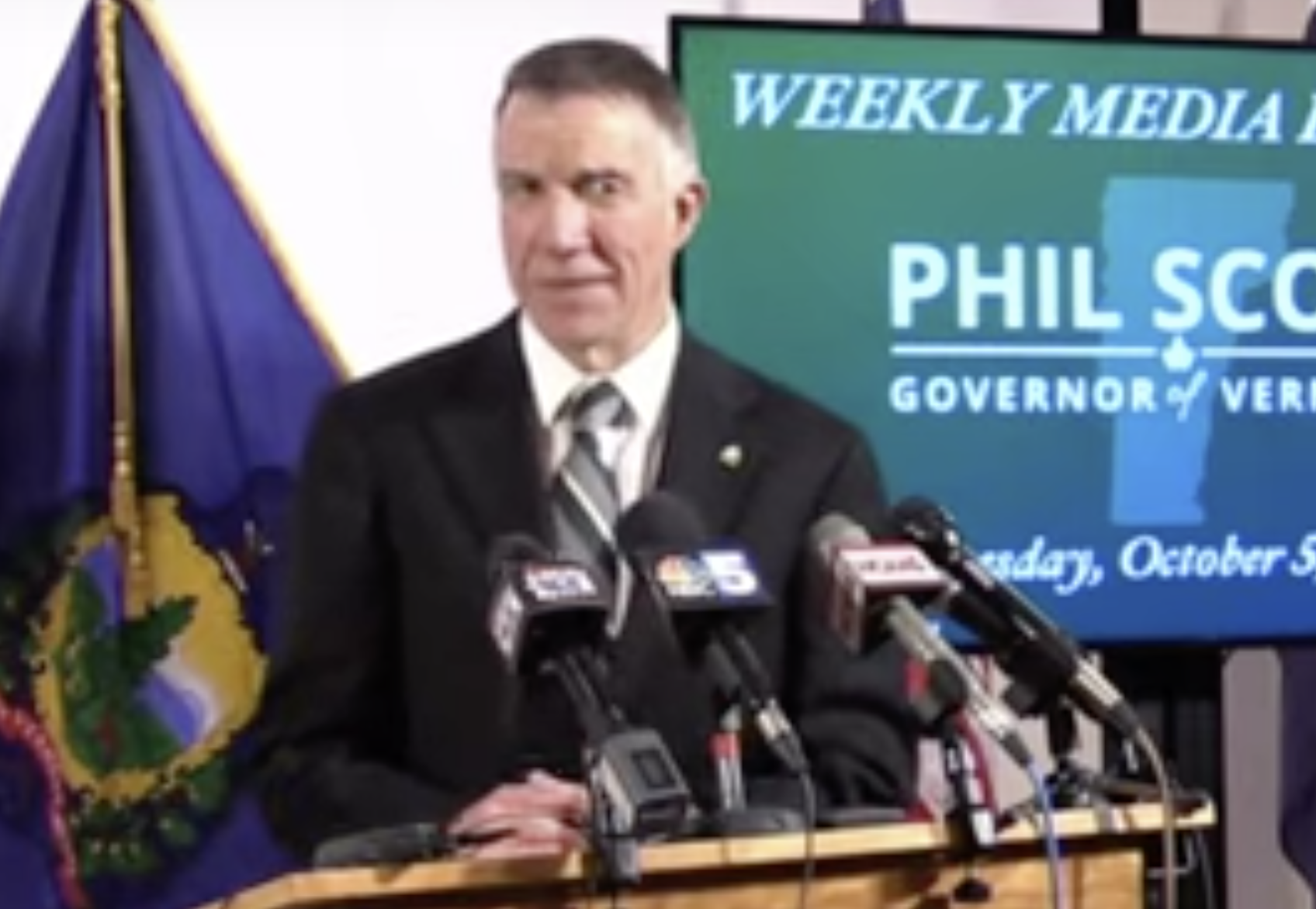
The inevitable has finally happened. Gov. Phil Scott has bested Howard Dean’s all-time record for gubernatorial vetoes — and he did it in less than half the time it took Dean.
On Tuesday, Scott issued his second and third vetoes of 2021, bringing his total to 22 in four-and-a-half years in office. Dean was in office for 12 years, and racked up a total of 20 vetoes. (In its story on Tuesday’s vetoes, Seven Days did not mention the record.)
Tell me again how nice a guy Scott is, and how much he values cooperation across the aisle.
This obligatory session-ender by VTDigger’s Xander Landen was so sticky-sweet that it should have had a warning label for diabetics. Everybody’s just getting along so well. Kind words all around, regardless of party.
Gov. Phil Scott, who has so far issued only one veto — an historic low for him — praised House Speaker Jill Krowinski and Senate President Pro Tem Becca Balint: “It’s been a good dialogue, good discussion, very open, and they adhere to their word and everything’s been working fine.”
Balint said that she and Krowinski made progress on “establishing healthier patterns” in working with Scott, and she’s feeling “optimistic” about carrying the Kumbaya over to a 2022 session that will involve some touchy issues. Sen. Phil Baruth noted “historic” levels of tripartisan cooperation.
(There’s also a love-in involving Scott, Sen. Patrick Leahy and U.S. Rep. Peter Welch. At his Tuesday presser, Scott all but endorsed Leahy for re-election in 2022, and Welch recently credited Scott with doing an “absolutely tremendous job” on Covid-19.)
Scott, Balint and Krowinski are right to feel satisfied. They avoided the intra- and inter-party battles of the past, and dealt with a number of issues successfully. And they had to do it remotely, which was tough on everyone.
But they also ducked some tough issues. Balint and Krowinski made a conscious effort to avoid sending Scott bills he was likely to veto. That might be a good short-term strategy for the pandemic session, but it’s the kind of thing that has made the Democratic majorities seem toothless throughout Scott’s governorship.
So, a good collegial session in 2021 probably won’t carry over to next year unless legislative leadership is willing to set aside a whole bunch of issues. And for strictly political reasons, that will be harder to do in an election year than in this extraordinary session.
It’s almost a given in #vtpoli circles that Gov. Phil Scott will run for U.S. Senate. The question is when — in 2022, against Pat Leahy or [insert Democrat here], or 2024 against Bernie Sanders or [insert Democrat here]. Many believe Scott would be unbeatable against anyone but St. Patrick or Bernie. Or even including St. Patrick and Bernie.
It’s the best available speculative topic we’ve got, given the placidity of our political scene. We just had the least contentious legislative session in years, and it’s left Scott and the Democrats practically singing “Kumbaya.” There’s no fun in handicapping the 2022 race for governor, assuming Scott wants a fourth term. The biggest “drama” about the next election cycle is whether Doug Hoffer will retire as auditor and clear the way for his newly-minted deputy Tim Ashe, but that’s not exactly clickbait, no offense.
So, speculation abounds. And all of it is likely to remain just that. Because it says here Scott isn’t running for Senate next year or anytime thereafter.
The usual caveat: I’ve got a spotty record as a prognosticator, to put it kindly. Grain of salt. But I do have reason to believe.
Well, it’s Monday, and once again we’ve got a full crop of stupidity in the public sphere. I didn’t intend for this to be a weekly feature, but hey, if they keep serving up the meatballs, I’ll keep swinging for the fences.
This week, the stupid was strong in positions of prominence. We’ve got a U.S. Senator, a State Senate committee, a state’s attorney, and not one but two agencies in the Scott administration. So let’s not keep these important slash self-important folks waiting.
To begin, we’ve got our first-ever Provisional Veepie and our first-ever Sub-Veepie. The P.V. is the I’ma Throw Everybody Under the Bus Award, which goes to none other than St. Patrick Leahy. It’s provisional because it’s about an anonymous second-hand quote from Politico, so there’s a chance that Leahy didn’t say, or mean, this. But if he did, what a doozy.
The article reports that Leahy is expected to run for re-election next year. It includes this line: “The 81-year-old has also indicated to them that he believes he’s ‘the only Democrat that can win the seat,’ said a person briefed on the conversations.”
Woof. Way to simultaneously diss every Democrat in Vermont, Senator.
A strange hush has fallen over the #vtpoli landscape. The Legislature is set to adjourn at the end of the week, and yet we hear no arguing, no complaining, no House/Senate or even Legislature/Governor sniping, no last-minute knifings of inconvenient bills. The governor hasn’t vetoed anything yet, and he’s barely made any veto threats.
This is looking like the quietest, least contentious session in years. Now, maybe this is a consequence of The Year Of Zoom, with reporters unable to lurk outside closed doors and buttonhole people in the hallways and trade rumors with lobbyists. But when you look at the available record, there’s no evidence of the usual endgame drama.
I mean, just look at VTDigger’s Bill Tracker. It shows no gubernatorial vetoes, five bills signed by Gov. Scott, four bills awaiting his action, 11 passed the House and Senate with differences being resolved*, and seven that have passed one chamber and not the other. The Bill Tracker is not comprehensive, but it is a thoughtful compilation of high-profile issues before the Legislature. And it shows a pretty decent record of accomplishment with few apparent flashpoints.
*Most differences are fairly minor, and agreement this week seems certain.
Earlier this week, after Liz Cheney was purged by the House’s minority caucus, Gov. Phil Scott was asked about the sorry state of the national GOP. His response, per WCAX: “It appears as there’s a sign that is being placed in the window saying you need not apply and if you don’t adhere to those values or that litmus test, you are no longer welcome.”
A natural follow-up, which went unasked, would have been “In that case, what about the Vermont Republican Party, whose leadership is as intolerant as the national crowd?”
Take, for example, Jay Shepard, Republican National Committeeman and generic Mike Pompeo knock-off. He is one of two VTGOP representatives to the national Republican Committee, which makes him a very big fish in the shallow pool of our conservative politics.
Shepard styles himself a genius of inside politics. He runs Junction Consulting, a conservative firm offering its expertise in campaigns, fundraising and so forth. During the 2018 election cycle, his firm got nearly $200,000 from the Republican State Leadership Council to run ads against select Vermont Democratic lawmakers. Hmm, a Republican committee funneling funds to a Republican committeeman. Sounds a little grifty to me.
Well, Shepard’s got himself a new grift. He’s using the VTGOP email list to pump a national group that he co-founded. So, if you signed up for information about what Vermont Republicans are up to, congratulations. You’re getting Shepard’s fundraising pleas for the group, plus a regular email newsletter from its rhetorician-in-chief.
Said group is the American Council for Education and Knowledge. Named, as is customary in right-wing circles, to apply a mainstreamy veneer on a collection of far-right ideologues. As if that’s going to fool anyone.
And what, pray tell, awaits if you click on the link above?
For starters, how about “The time has come to restore the American God, His natural law, and His code of ethics to their proper roles in everyday life.”
Yep, “the American God.” Just like it says in the Bible.
First, from VTDigger’s Erin Petenko, sales of Vermont homes to out-of-staters reached historic levels last year, presumably driven by the pandemic, and
Second, from Seven Days‘ Anne Wallace Allen, the home building industry has given up on large swaths of Vermont and concentrated its activity in high-flying Chittenden County.
We had a big affordable-housing problem back when we thought coronavirus was something you caught from a tainted beer. It’s gotten worse since then, and the trends are all in the wrong direction.
That $37 million affordable housing bond we proudly enacted in the pre-Covid days of 2017 looks like a drop in the bucket. And Sen. Michael Sirotkin’s proposal for an even bigger Housing Bond 2.0, which has languished in the Legislature for the past two years*, is looking more and more vital.
*Thanks in no small part to the opposition of Treasurer Beth Pearce, whose aversion to public debt rivals the Scroogiest of conservatives.
In my previous post, I wrote about the series of Covid-triggered political windfalls enjoyed by Gov. Phil Scott. There’s one point I made in passing that deserves a bit more consideration.
The governor is dead set against raising revenue or increasing the size of state government, but he’s perfectly happy to take whatever the feds will give him.
Yeah, the governor is a fiscal hypocrite. He hasn’t raised an eyebrow over the federal government’s rampant deficit spending. And he is benefiting mightily from the ongoing tsunami of Biden Bucks.
And yet he wouldn’t be caught dead raising taxes in Vermont or spending outside his comfort level. He refuses to countenance any increase in the size of state government.
Now, there’s one big structural difference. States can’t deficit spend, and the feds can. But, if only as a fig leaf to cover his tacit opportunism, he might want to express the merest hint of concern over the fact that Covid relief and Biden’s infrastructure plan are classic examples of Keynesian economics — spending our way out of trouble with no concern for long-term fiscal ramifications.
In purely political terms, the Covid pandemic is the best thing that’s ever happened to Gov. Phil Scott. He got to be seen as a decisive leader simply by outperforming the likes of Donald Trump. Throughout the 2020 campaign, he enjoyed a twice-weekly platform on live statewide television and radio. He absolutely dominated every news cycle, and walked to victory in something bigger than a landslide.
And now, state government is swimming in federal relief cash — with more likely on the way. Trump’s CARES Act provided the equivalent of 20 percent of Vermont’s GDP. President Biden’s American Rescue Plan Act is pumping in even more. And if Biden gets his infrastructure bill through, Vermont will get a third massive infusion in less than two years’ time.
The CARES Act alone floated Vermont through 2020 “in aggregate,” as state economist Jeffrey Carr put it. There was pain aplenty, to be sure. But there were winners as well, and the impact was greatly softened by the federal government’s ability (and willingness) to deficit spend. The governor is dead set against raising revenue or increasing the size of state government, but he’s perfectly happy to take whatever the feds will give him.
On Tuesday, Scott unveiled his billion-dollar plan to use a big chunk of the federal ARPA money. It includes just about everything on everybody’s wish list, and provides a huge boost to state initiatives that Scott insisted we couldn’t afford on our own. And the money will be spent over the next four years, which will make it extremely difficult to run against Scott in the next two cycles.
Legislative leadership is rightly getting an earful from teachers, state employees and union supporters over the emerging make-workers-pay pension reform plan. But let’s not overlook the fact that Gov. Phil Scott is playing no role whatsoever in devising a solution to this very large problem.
As he has done on issue after issue throughout his governorship, he is sitting back and letting the Legislature do the hard work and take the punishment. Then, after all their blood, sweat and tears, he saunters in, gives a thumbs-up or thumbs-down, and ambles away. If it’s thumbs down, the Legislature gets another try at guessing what will be acceptable to him.
This isn’t my idea of leadership. But who can blame the gov, considering that it works so well for him?
Over and over again, Scott sits out a tough policy debate — and the Democrats let him get away with it. They bargain against themselves. They begin with a position that’s more than halfway to his side, and they only give ground from there. The governor doesn’t get exactly what he wants, but the Democrats get far less. And they look weak in the process.
You’d think the Democrats would have learned by now. But no, here they are doing the same damn thing on pensions — and in the process, betraying one of their core constituencies.