Tag Archives: Peter Hirschfeld

I Tried to Tell You About Sam Douglass (and There’s a Lot More Like Him)

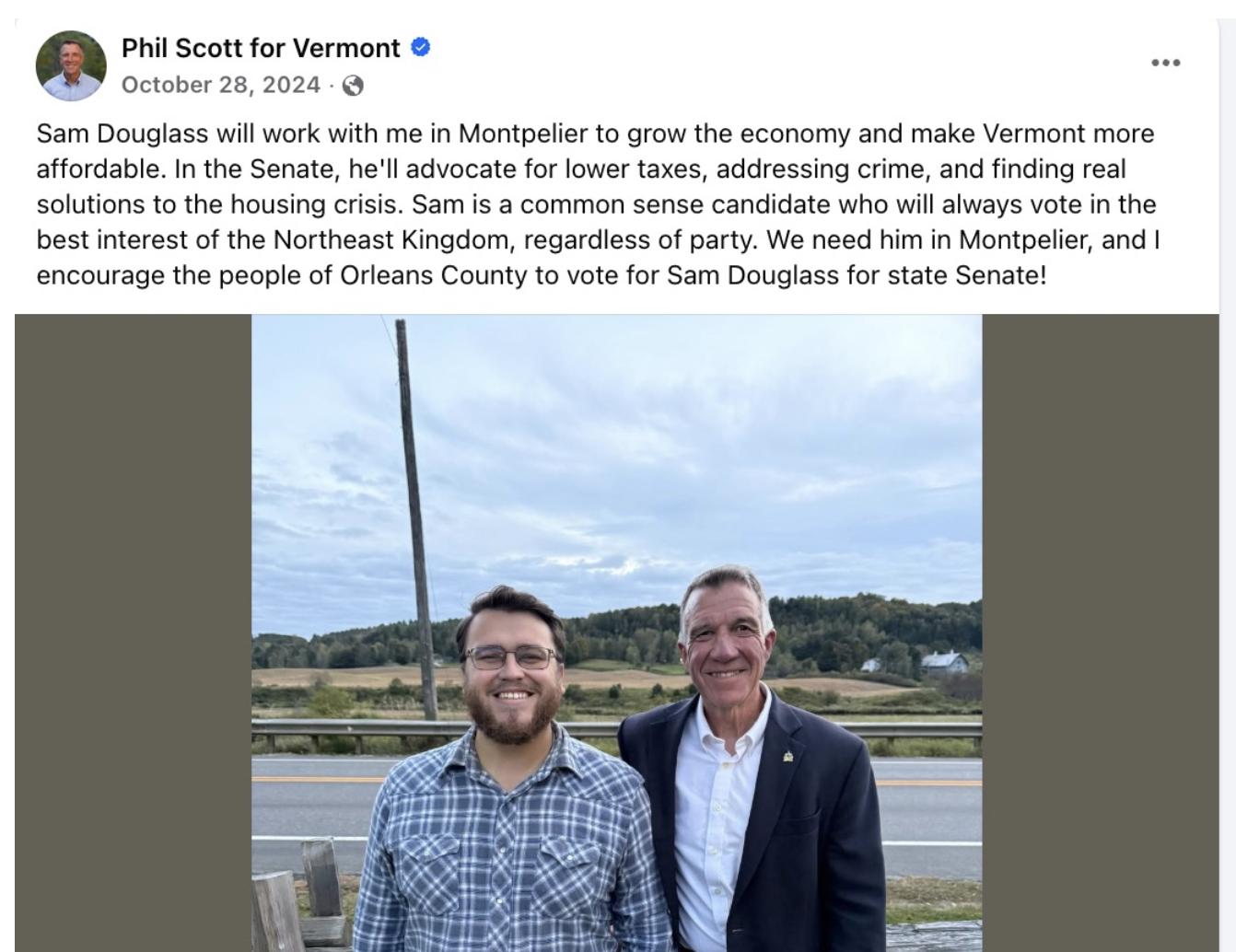
Gov. Phil Scott couldn’t act fast enough to distance himself from newly-disgraced state Sen. Samuel Douglass. Within hours of a Politico report that identified Douglass as an active participant in a racist, misogynist, anti-Semitic Young Republican group chat that reads like a bunch of adolescent boys trying to out-gross each other, Scott had called for Douglass’ resignation — along with Democratic and Republican legislative leaders.

That’s nice, but Douglass’ politics have been obvious for years. His extreme views were out there for anyone to find, long before our “moderate” governor lent his support to Douglass’ 2024 campaign, long before Scott’s buddies in the Burlington-area business community dumped tens of thousands of dollars into Douglass’ campaign treasury.

Scott must have known what kind of person he was endorsing. Unless he pulled a Sergeant Schultz because he needed Douglass-style Republicans to win elections and eat into Democratic majorities.

I know this because, as far back as 2022, I wrote about Douglass’ extreme views. My post wasn’t based on any deep investigative dives; it was the product of simple searches of social media and YouTube. It was all out there for anyone to find. Too bad no one in political authority or our news media bothered to look. Until Politico gift-wrapped the story and dumped it in our collective laps. Now, suddenly, everyone is paying attention.

Continue reading

News You Should View, That’s What College Papers Are For Edition

Over the summer, I kinda got out of the habit of checking in with the three campus newspapers in our catchment because they don’t regularly publish anything when the students are away. But hey, it’s fall, and one college paper has stepped up to the plate to give full coverage to a big story that’s landed on its doorstep. Also in this space: Another potential deportation that makes no sense, another town facing a water shortage, a telling indicator of the soft market for office space, and one story that deserve dishonorable mention. If you’re here for the snark, skip down near the end.

Trump administration trying to bribe Dartmouth. Our authoritarian-minded chief executive has taken a new tack in his war on academia. He’s offering financial incentives to select institutions that adopt his ideological agenda. Which would be the death knell of academic freedom, but hey, if you want an omelet you gotta break some eggheads.

One of the nine bribery targets is Dartmouth College, which has already flown its Trump-friendly colors in a few unsettling ways. And there’s The Dartmouth, its student newspaper, with broad coverage of how the Ivy League’s party school might respond.

Continue reading

Well, of Course It Was “a Change of Posture”

Gov. Phil Scott made a move this week that promises to pay off big time in purely political terms. If it actually accomplishes anything in the real world, that’ll be a bonus.

After insisting for weeks that his administration wasn’t making any plans to help the city of Burlington with its intertwined problems of homelessness, substance use, public safety, and perceptions of the city’s health, Scott announced at his Wednesday press conference that his administration is holding meetings with various Queen City stakeholders with an eye toward unveiling just such a plan “over the next couple of weeks.”

Vermont Public’s Peter Hirschfeld asked if this wasn’t “a change in posture” for Scott and his team. The governor replied that “maybe the perception” of his posture had changed, but the posture itself remained the same.

Which is obvious bullshit, but did you really expect him to openly acknowledge “a change in posture”? Of course not.

I mean, look. A few weeks ago he was brushing aside a reporter’s description of Burlington as “the economic engine of the state” and couldn’t recall the last time he walked down Church Street. Last fall, when his administration brought its dog-and-pony Capital for a Day to Chittenden County, the governor attended some events in the suburbs but skipped the ones in Burlington. And now he’s holding a series of summits with city luminaries? Yeah, that’s a change in posture and a pretty dramatic one.

Setting aside that bit of casual mendacity, it’s a really smart move. And it positions him to pull off a masterstroke that will cement his reputation as a practical centrist. Especially to the Burlington area’s donor class. You know, the Barons.

Continue reading

It’s Such a Fine Line Between Prudence and Appeasement

Gov. Phil Scott continues to tiptoe the line when it comes to the rank berserkitude of the Trump administration. He got a lot of press coverage for his refusal to approve Immigration and Customs Enforcement’s request for Vermont National Guard personnel for administrative assistance. Since then, it’s been pretty much prudence slash appeasement.

Frankly, I don’t give him much credit for the ICE decision. They only wanted 12 people to basically do secretarial work. (I guess someone’s got to fetch the coffee.) It was such a small-stakes request that I wondered why ICE even bothered. Were they trying to get a foot in the door for bigger asks down the line? Or were they doing Scott a favor by making a request he could safely refuse?

Whatever, Scott’s subsequent actions make it clear that we shouldn’t be giving him a membership card in The Resistance anytime soon. In context, the ICE decision looks more like a brief tactical pivot than a sign that he takes Trump seriously as an existential threat to democracy.

Continue reading

News You Should Have Been Able to View But Weren’t Given the Chance

My weekly roundup of the best of Vermont journalism will again be posted late, most likely Wednesday. The delay in posting is because of the Legislature holding its final vote on H.454, the education reform bill, on Monday. Had to leave the decks cleared for that. And before I can get to the best of Vermont journalism, I have to begin with a massive media fail that reflects our sadly depleted news ecosystem.

Last week, a House-Senate conference committee was meeting to try to hash out a compromise education reform bill. The six conferees (three Senate, three House) met multiple times. Every meeting was warned in advance and was open to the public. And we got virtually no coverage at all of their highly impactful deliberations.

Now, I know legislative hearings can be a big fat drag. You can spend hours on an uncomfortable chair, sharing a tiny room with too many people, and wind up with nothing at all to report.

But this wasn’t your average legislative hearing, not at all.

Continue reading

“Governor Nice Guy” Is Out There Pickin’ Fights With the Legislature

Gotta start using air quotes around that appellation for our chief executive, because he seems to be going out of his way to antagonize the Legislature and prepare the fields for another bushel of his administration’s chief cash crop, gubernatorial vetoes. It’s funny, after all that talk about coming to the table and working across the aisle, he’s back in his comfort zone: confrontational mode.

You know, if Phil Scott was a politician — which he continually insists he is not — I’d say he had absorbed the lessons of the 2024 election and decided the path to victory was in demonizing his opponents. It’s smart politics. But it’s anything but nice.

Exhibit A: VTDigger reports that the Scott administration has finally, belatedly, delivered its full public education reform plan in actual legislative language.

On February 25. Almost two months into a five-month session. Three days before the Legislature adjourns for Town Meeting Week. Little more than three weeks before crossover, when any policy bill must have been passed by one chamber if it’s to have any real chance of passing the other this year. It’s just not possible for lawmakers to give due consideration to such a massive reorganization in such a short window of time.

Continue reading

Whistling Past the Elephant in the China Shop (UPDATED)

Update. Within 24 hours of this post going live, the governor announced his first (and so far only) concrete response to the Trump presidency: an interagency task force to assess the potentiial impacts of Trump tariffs on goods imported from Canada and Mexico. Must have been a complete coincidence, right?

You might think that the deliberately shambolic start of the second Trump presidency would have been a major topic at Gov. Phil Scott’s January 30 press conference. After all, in a very short period of time Trump has issued a blizzard of executive orders, many of dubious legality and/or constitutionality, that are designed to radically recast or possibly euthanize the federal government. The one most directly pertinent to governing the state of Vermont was Trump’s since-withdrawn threat to put an immediate halt to a wide range of federal payments. (The threatened imposition of tariffs on Canadian imports would have had a profound effect on Vermont, but they hadn’t been bruited as of January 30 and have since been put on hold.)

You might think the specter of Trump would have dominated Scott’s presser, but you’d be wrong. The topic of the day was, shocker, “affordability,” especially with regard to Scott’s housing plan and his extremely modest tax reduction plan. Which, at $13.5 million, would average out to a scant $20 a year for every Vermonter.

(Of course, it wouldn’t be distributed evenly. The three elements of his plan are (1) an expansion of the Democrats’ child tax credit, (2) an end to state taxation of military pensions, and (3) an end to state taxation of Social Security benefits. The latter two, aimed largely at retirees, seems an odd way to address Vermont’s demographic challenges. Our biggest demographic shortfall is in mid-career adults, who are mainly too old to benefit from a tax credit on young children and not old enough to benefit from the other two provisions.)

Neither Scott nor his officials voluntarily addressed how Trump setting fire to the federal government might impact Vermont. None of the assembled reporters asked a single question about it until the 44-minute mark in a 47-minute presser. Almost an afterthought, then. But Scott’s response was highly informative — for what he didn’t say, more than for what he did.

Continue reading

Kicking the Can All the Way to 2050

We already knew Gov. Phil Scott has called for a full-scale retreat from fighting climate change. But in his January 30 press conference, he made it clear he not only wants to eliminate any mandatory emissions reduction targets this side of 2050, avoid any potential legal challenge over the state’s failure to meet 2025 or 2030 targets, extract all the teeth from the Climate Action Council, implement a much more permissive measuring stick for emissions, and weaken the Renewable Energy Standard, but he overtly stated he wants no further action at all for another two years.

Yep. He had already tasked his officials with devising a plan to meet the 2050 emissions targets. But in his presser, he specified the delivery date for that plan.

December of 2026.

Sure, let’s put a freeze on climate policy while his administration takes its sweet damn time coming up with a 25-year plan — and finalizes it after the next election. When Scott might well be on his way out of the corner office. If this term is his last, this marvelous two-year effort is bound for the dustbin of history.

But really, the point is not to create an actionable blueprint. It’s to take himself off the hook for climate action anytime soon.

Continue reading

Sh*t My Governor Says

The topline of yesterday’s Covid presser was all about the schools. Id est, how the Scott administration is imposing policies and expectations on the schools but refusing to lift a finger to help them handle the additional workload.

But there were several other statements we shouldn’t allow to pass unmocked. So here’s a sampler, a Children’s Treasury if you will, of dumb stuff said by the governor plus a couple of entries from Finance Commissioner and Number Cruncher Extraordinaire Michael Pieciak.

We’ll start with Scott playing pure politics, something he likes to accuse other people of doing. As he continues to resist calls for tighter anti-Covid measures, he was asked what he’d do if the Legislature passed such measures and sent them to his desk.

“I don’t think it’s necessary,” he said. “If they want to come back into session and they want to introduce a mask mandate, they want to limit travel, they want to shut down bars and restaurants, they want to limit gatherings, they want to cancel Christmas, I mean, that’s up to them.”

The deliberate exaggeration of opposing views is classic passive-aggressive Phil Scott. But cancel Christmas? When did the governor start watching Fox News?

Continue reading

Who gets to tell the Statehouse story?

This is a follow-up to my recent post about the gender imbalance in Vermont’s political press corps. We’re almost entirely men. And that does have an effect on what stories are told and not told.

Next question: Does it also have an effect on who gets to tell the stories? That is, who gets quoted in articles about Vermont politics and policy? Do we quote men more often than women? Unlike many corridors of power elsewhere, women are well represented in the highest ranks of Vermont government. Three of the four top legislative leaders are women; the four chairs of the powerful money committees are women, as are several other chairs; and the Scott administration is perhaps the most gender-balanced in Vermont history.

There’s one way to check on this, and it involves a ton of scutwork. I went through every frickin’ article written by 11 reporters who regularly cover the Statehouse in one full month, counting up the quotes. I chose May of this year because it included the legislature’s home stretch, a period when interest peaked and coverage was frequent. The 11 reporters included ten men and VTDigger’s education reporter Lola Duffort. She spent a lot of time in the Statehouse in May, and it seemed useful to include a woman even if she’s not technically a Statehouse reporter.

This turned out to be a tougher exercise than I thought. Counting up the quotes is simple enough, but people are often mentioned without being directly quoted. I decided on a standard that involved some subjective judgment: Does the person have agency in the story? Do they play an active role, or are they brought up in passing?

There’s a gray area here, and if anyone tried to reproduce my research they’d get slightly different numbers. But I’m confident that the overall trends would remain.

That’s one caveat. Another is the potential effect of small sample size. Some writers produced more material than others. A month is about the minimum time you’d need to produce representative numbers. If anyone wants to do a full session or a year, have at it.

The month of May was an outlier in some respects. A lot of coverage concerned the House/Senate dispute over issues like minimum wage, paid family leave, cannabis and guns. Stories tended to focus on the two leaders, Speaker Mitzi Johnson and President Pro Tem Tim Ashe. Both were usually quoted, which may have led to better gender balance overall.

Also, Gov. Phil Scott was largely a passive presence in May. He simply waited for the legislature to act — and if they didn’t, he got to stay on the sidelines. Many stories mentioned Scott but gave him no agency. Often, his views were cited by way of spokesperson Rebecca Kelley, which is a score in the female column each time.

Finally, just for the record, no one from the TQIA sections of the LGBTQIA community was quoted. I didn’t keep track of people of color, but as far as I can recall only two were quoted: Rep. Nader Hashim and Sen. Randy Brock.

Enough preliminaries. Let’s do the numbers.

I’ll start with myself, in my former role as political columnist for Seven Days. I wrote five columns in May. I cited 13 male government officials (elected or administrative) and 10 female. In the “other” category of advocates, lobbyists, non-government, I quoted six men and seven women. My overall total: 19 men, 17 women.

My colleague Kevin McCallum was the King of Quotes, citing far more people than any other reporter. (Which is a positive indicator of his work ethic and diligence.) He wrote 17 stories which quoted 44 male officials and 33 female, plus 12 male “others’ and 14 female. Total: 56 men, 47 women.

The third member of the Seven Days Statehouse crew was the now-departed Taylor Dobbs. Officials: 30 men, 21 women. Others: Four men, one woman. Total: 34 men, 22 women.

Gettin’ a little sketchy there.

I surveyed Paul Heintz’ work as well. He was the political editor in May, but he did write eight stores. Small sample size warning applies. Officials: 12 men, five women. Others: 14 men, nine women. Total: 26 men, 14 women. A couple of factors skewed his total: Some of his stories were about Vermont’s all-male congressional delegation, and he wrote a sizable story about an EB-5 court proceeding in which all the principals were men. I think we’d need a larger sample to truly determine whether or not he’s really an oinker.

That’s it for the Seven Days political team. On to VTDigger. And the moment you’ve been waiting for…

Political columnist Jon Margolis wrote eight pieces in May. He didn’t quote very many people, so again, small sample size, but he skewed heavily toward men. He quoted 16 men and seven women, plus five anonymous people — one of whom was identified as male. Margolis already ranked high on the Oinker Suspect List because of his comment about Mitzi Johnson supporting paid family leave because it’s a women’s issue and she’s “entirely female,” plus his anonymous quote about how “Tim [Ashe] has an Emerge problem,” referencing Emerge Vermont, the organization that trains women Democrats to run for office. The implication being, Ashe has to deal with uppity Emerge alums like Sens. Ruth Hardy and Becca Balint. Poor guy.

Margolis’ numbers are too small to be probative, but they confirm the impression that he’s maybe a bit of a pig. I’ll also mention that his first column in June was about the replacement of Columbus Day with Indigenous Peoples’ Day, in which he both-sidesed the mass murder of native people.

Columbus did not introduce slavery to this hemisphere, where the natives had been enslaving one another, making war on one another, torturing one another, and sometimes eating one another for centuries.

True enough. There were wars and conquests and atrocities among the natives, just as there were back in Europe. But the indigenous people never committed actual, how shall I put it, genocide. They never conquered an entire continent by killing or displacing its resident population. That’s a massive difference in scale. And if Margolis had spoken with members of the Abenaki community for his column, he might have acquired a bit more nuance in his views.

But I digress.

As for Digger’s Statehouse reporters, things get a little complicated because there were a lot of co-authored stories. Those pieces had to be considered separately.

Xander Landen wrote 19 stories. Officials: 29 male, 21 female. Others: Six male, four female. Total: 35 male, 25 female. Hmm.

Colin Meyn wrote nine pieces. Officials: 22 men, 11 women. Others: Three men, six women. Total: 25 men, 17 women. Also hmm.

Kit Norton was sole author of only four stories. He co-wrote several, and was also responsible for a chatty daily Statehouse digest distributed by email. I only reviewed his posted articles. Officials: Six men, seven women. Others: Three men, two women. Total: Nine each.

Some combination of Landen, Meyn, Norton and Anne Galloway co-wrote nine stories. Officials: 21 men, 17 women. Others: No men, three women. Total: 21 men, 20 women.

Lola Duffort wrote 16 stories in May. Officials: 11 men, 14 women. Others: 18 men, 12 women. Total: 29 men, 26 women.

I also took a look at Vermont Public Radio’s two Statehouse regulars, Bob Kinzel and Peter Hirschfeld. Their stores are written for radio, but the transcripts are posted on VPR’s website. Kinzel wrote three stories in May (he spent a lot of time hosting “Vermont Edition”). He quoted nine men and two women. Small sample size, but ouch.

Hirschfeld produced 11 pieces in May. He quoted 22 men and 19 women.

That’s about it. Seven Days, VTDigger and VPR are the only outlets that produce significant quantities of in-depth state government reporting. The three major TV stations, to their credit, cover the Statehouse much more frequently than stations in other states. But their reports are usually quick hits lacking the depth or breadth of Vermont’s three top news organizations. (The Burlington Free Press no longer covers the Statehouse on anything like a regular basis.)

Conclusions? Some of the numbers indicate a potential problem with gender balance in some reporters’ work, but none of the results are strong enough to constitute definitive proof. Except maybe SOOOEEE PIG PIG PIG Margolis, who is, at least for now, Vermont’s only regular political columnist. Kinda sad, that.

But I will say that some reporters would be advised to check themselves. Maybe do a deeper dive on their own work, see how they did over a period of several months. If there’s a consistent male/female imbalance of 60/40 or greater, they probably have some implicit bias issues.

Also, the relative gender balance in Duffort’s reporting is one more data point for the importance of increased gender balance in the Statehouse press corps.