Tag Archives: Miranda Gray

VSEA Alleges “Authoritarian Environment” in the Economic Services Division

The Vermont State Employees Association isn’t exactly the International Workers of the World. It generally tries to avoid rocking the boat, and comes in for a fair bit of criticism from more progressive elements of the labor movement in Vermont.

Which made it all the more remarkable when two top VSEA officials went before the House Human Services Committee last Thursday to deliver harsh accusations against the Department of Children and Families’ Economic Services Division in general and its top official, Deputy Commissioner Miranda Gray, in particular. Gray, they said, has created “an authoritarian, top-down environment in which fear is used as a weapon,” leaving employees “demoralized and fearful.”

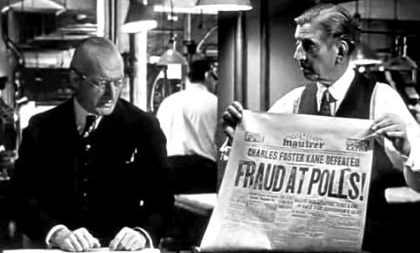
VSEA President Aimee Bertrand (pictured above), a longtime ESD employee, told her own tale of harassment, retaliation, and punitive actions that led her and the union to file an unfair labor practice charge with the Vermont Labor Relations Board. That filing, she said, led to further retaliatory actions. All of which would appear to violate terms of the union’s contract and/or state law.

It was a stunning event. I’ve been in and around the Statehouse for over a decade, and rarely have I seen such dramatic testimony. I don’t think I’ve ever seen such serious accusations made by VSEA against a unit of state government.

You may not have noticed any of this, because the media coverage was pitifully inadequate.

Continue reading

How Not to Debunk a Myth

The latest edition of “Brave Little State,” Vermont Public’s question-answerin’ podcast, addresses a widely-held belief that our homelessness problem is largely caused by people moving to Vermont to take advantage of our motel voucher program. And addresses it poorly, incompletely, and at great length.

The episode is entitled “Is Vermont’s motel program a ‘magnet’ for out-of-staters experiencing homelessness?” There is no evidence for the notion. In fact, there is a body of research showing that people in distress don’t cross state lines in any real numbers in hopes of accessing better benefits. Reporter Carly Berlin, whose work is co-published by Vermont Public and VTDigger, gets there eventually, but takes a godawful long time to do so. In the process, she manages to distort the basic issue, omit crucial aspects of the story, and get some key facts wrong.

The fundamental problem isn’t with Berlin or her many co-producers and overseers. (A total of seven Vermont Public staffers are cited in the closing credits.) The problem is that the issue was subordinated to the format. This wasn’t a story about homelessness and benefits; it was A Reporter’s Journey In Search Of Truth, filtered through the highly developed process of long-form public radio storytelling pioneered by Ira Glass’ “This American Life” and refined in this age of public media serial podcasting. The end goal of the production is more esthetic than journalistic.

This question can easily be resolved, but that’s not how you build a podcast. A long-form narrative needs a build, a measure of suspense, unexpected twists and turns, even if the actual path is pretty straightforward. Which is how you wind up with a 38-minute-long piece of audio that kind of bungles the assignment.

Continue reading

I Think We Should Call This “Winters Hall”

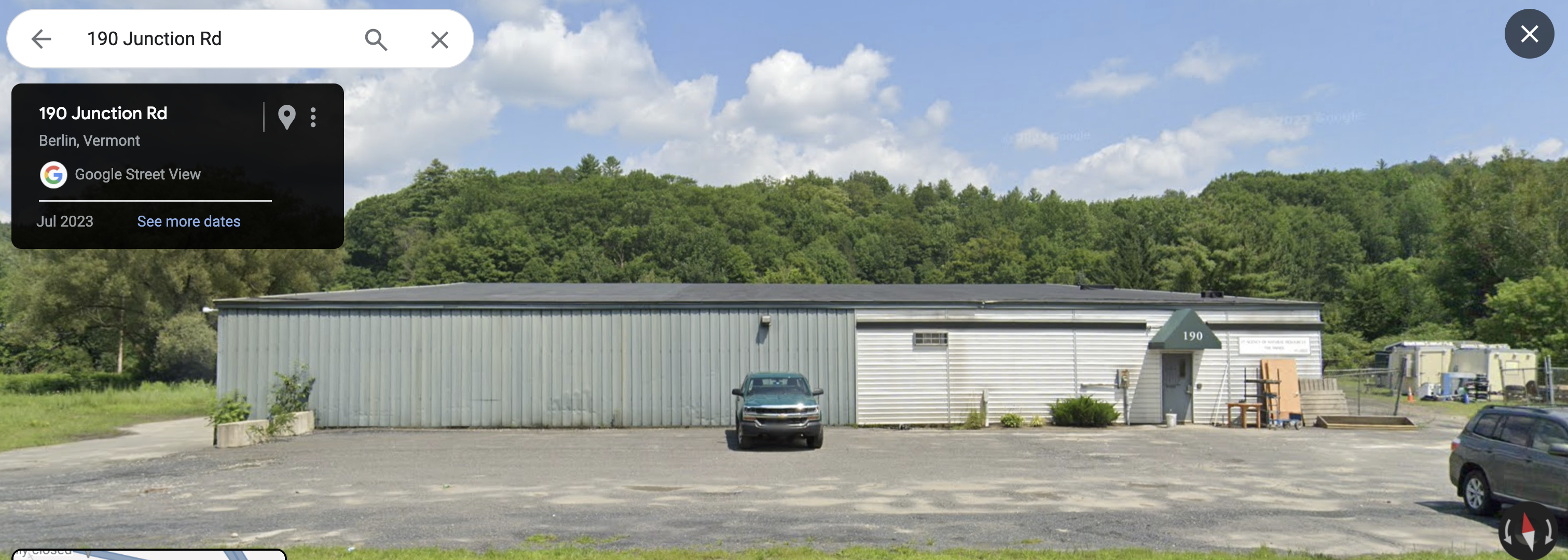
This, my friends, is what the Scott administration thinks is an acceptable shelter space for dozens of our most vulnerable Vermonters. This is the Agency of Natural Resources Annex building, technically in Berlin but closer to Montpelier than anything. Starting tonight, if the administration has its way, this will be one of four nighttime-only temporary shelters meant to house a total of roughly 500 people being booted from their state-paid motel rooms. For no good reason. Bureaucratic mumbo-jumbo, pitched in multisyllabic words intended to drain all the human emotion from the matter.

(Note: Vermont Legal Aid is going to court to try to block the mass exiting operation. I kind of doubt they’ll succeed; this plan is cruel, obnoxious and heartless, but it’s within the purview of state decision-making authority. But we can hope.

Otherwise, what are we looking at here?

I haven’t been inside the Annex, so I can’t witness to the quality of the decor. Probably not great; it’s been used for general storage by various state agencies, which have apparently been busily clearing out all the stuff that’s been sitting around. I can’t swear to the bathroom or shower facilities, although I have heard that the building contains two single-stall bathrooms. For dozens of people?)

Food service? Refrigeration? Privacy? Personal storage? Need we ask?

Did I mention it’s in the Winooski River flood plain and that it was flooded last summer?

Opens at 7:00 p.m. Closes for the day at 7:00 a.m. It’s about a half-hour walk from the Statehouse. (Bitter irony alert: It’s almost directly across the river from a tent encampment that’s been occupied by unhoused folk throughout the winter.) There is no bus service on this industrial roadway that probably gets more heavy-truck traffic than anything else. Perhaps some, or many, of the residents will find day shelter in the Statehouse’s welcoming cafeteria. They sure won’t gain access to the governor’s own offices in the closely-guarded, entry-by-pass-only Pavilion Building.

Continue reading

Pointed Questions and Jazz Hands

The Legislature’s Joint Fiscal Committee tried something different today. It didn’t really go that well.

The committee called a hearing that was kinda meant to embarrass the Scott administration over its utterly inadequate response to our crises of homelessness and affordable. Well, it was cast as part of the JFC’s responsibility to track the progress being made (or not) under Act 81, the Legislature’s last-minute extension of the General Assistance housing program approved in June 2023. But the intent was to put administration officials under a bright light and watch them squirm.

Problem was, said officials (including Miranda Gray of the Department of Children and Families and Agency of Human Services Deputy Secretary Todd Daloz, pictured above) came prepared with reams and reams of jargon. They filibustered the hearing. It wasn’t 100% successful, but it limited the committee’s capacity to ask questions. It also had the truly unfortunate effect of almost completely sidelining input from providers of shelter and services to the unhoused. On the agenda, the administration was allotted 45 minutes of the 90-minute hearing and three provider witnesses got a combined 30 minutes. In actual fact, the administration occupied an hour and fifteen minutes, while provider testimony was crammed into the final 10 minutes of the affair.

There were still some embarrassing moments for the administration and some good information from the providers. The hearing wasn’t a bust, but it was far less effective than it could have been.

Continue reading

The Striking House/Senate Divide on Homelessness Policy

You don’t need to know the details of what’s going on in the House and Senate to realize how different the two chambers are when it comes to providing for the homeless and creating a better social safety net. All you have to know is that last week, when the House was addressing how to fix the system, they called on expert advocates Anne Sosin (seen above) and Brenda Siegel. And when the Senate Appropriations Committee was trying to fine-tune the current program, it called on two Scott administration officials directly involved in the policy failures of the last several years.

Siegel had submitted written testimony (downloadable here) to Senate Appropriations and was present in person at the Friday hearing, and yet the committee didn’t invite her to speak. They depended instead on the architects of doom: Miranda Gray, deputy commissioner of the Department of Children and Families’ Economic Services Division, and Shayla Livingston, policy director for the Agency of Human Services.

Appropriations wrapped up its disgraceful week with a brief hearing on Friday morning, in which it quickly finalized the details of a half-assed emergency housing plan and sent it on to the full Senate, which rubber-stamped it within a half hour.

The short version of the House/Senate divide: The House is trying to build a robust bridge to a comprehensive system to help the unhoused. The Senate is patching and filling the current system with an eye more on the bottom line than the human need.

Continue reading

Less “Lean Management” Than “Mean Management”

There have been numerous examples over the years of Phil Scott’s failure to build an effective bureaucracy in spite of his promises to lower the cost of government and improve the delivery of services The latest, and perhaps most outrageous, is the unconscionable handling of the extended emergency motel voucher program. As reported by VTDigger, the Scott administration is now requiring recipients to recertify once a week — and is making it damn difficult to comply by woefully understaffing its call centers and offices.

There are two possible explanations for this. Either the administration is doing its best to torpedo an extension it never wanted in the first place, or it has deliberately resource-starved the Department of Children and Families to the point where DCF can’t properly do its job. Either way, it’s inexcusable. As is the desperate display of blame-shifting put on by DCF functionary Miranda Gray.

It’s not our fault, she told VTDigger. It’s recipients’ fault for not being persistent enough or not answering the phone when DCF gets around to calling them back. It’s a caseworker’s fault for not communicating with DCF (through its terrible call center). Recipients who can’t get through by phone should go to a field office (but at least one recipient was forced to wait for hours and hours at a field office). It’s the Legislature’s fault for setting the rules (yes, they opened the door to weekly check-ins but (a) the admin sets the rules and (b) the mismanagement of the call system is all on YOU).

Meanwhile, recipients are waiting hours upon hours and living constantly in fear of losing their shelter. All because YOU couldn’t fully staff a call center after increasing your own workload by mandating weekly check-ins.

Also meanwhile, no one has received a damn dime from a disaster relief fund for the self-employed and independent contractors. And some of the applications seem to have been bungled. Wow, more management failure. And another administration official busily pointing the finger elsewhere.

Continue reading