The last pre-election round of campaign finance reports is in, not that anyone in the media noticed. To me, the single biggest note is that the Barons of Burlington and their allies are continuing to throw big money at John Rodgers, Republican candidate for lieutenant governor and alleged rural populist. In the first half of October, Rodgers raised $20,250; in the second half, he took in an extraordinary $69,259, almost erasing the cash advantage held by incumbent Prog/Dem David Zuckerman throughout the campaign. Not quite, but almost.
Of that $69,259, a full $58,199 was in increments of $1,000 or more.
That’s more than 83% of Rodgers’ total takings between October 16 and 31.
Son of the soil, my Aunt Fanny.
Here’s another way to slice the bologna. During the period, Rodgers took in a scant $2,560 in gifts of $100 or less. That’s a mere 3.7% of his total.
Which is S.O.P. for Rodgers’ campaign as a whole. He’s raised $212,443 so far, but only $8,809 in gifts of $100 or less. That’s only 4.1% of his total.
In the closing weeks of a campaign, candidates and other political actors are required to report mass media expenditures of $500 or more to the Secretary of State within 48 hours. This is designed to publicly expose any large-scale floods of money in a campaign’s closing days. Of course, this depends on somebody in the press paying attention to mass media filings, and so far nobody has. Well, nobody but Your Obedient Serpent.
The most interesting note from recent filings is that Gov. Phil Scott and his ticketmate, Republican LG nominee John Rodgers, filed a total of 17 separate mass media reports on a single day, Monday October 28. Fourteen of them reported major buys of radio ad time, all conducted jointly and with the expenses split evenly between the two campaigns. Two others reported a joint $4,390 TV buy carried out by the Vermont production firm Hen House Media. The 17th filing reported a $2,740 Scott-only TV buy through Hen House which, pardon the pun, is chicken feed for a gubernatorial campaign.
The other 14 reports add up to $36,855 spent on commercial radio. The big winner was VOX AM-FM, which sold an impressive $11,460 in Scott/Rodgers spots on its Burlington-area stations. The rest: $8,000 to the Radio Vermont Group (primarily WDEV), $6,000 to Rutland-based Catamount Radio (105.3 Cat Country, Z97.1 et al), $5,000 to Great Eastern Radio (Frank, Froggy, and the Penguin), $1,006 to Yankee Kingdom Media of Wells River, and $1,000 to Sugar River Radio.
A couple of notes. First, and it pains me to say this as a longtime radio voice, but the medium is dying. I’m old and I worked for decades in radio, and if I don’t listen anymore, then who does? (The only radio I regularly consume is content made available in podcast form.) So why are Scott and Rodgers going so big into radio for their big closing push? It’s a media strategy from a generation ago.
Second, why wait until now? All those ads are going to clutter the airwaves and severely test the patience of those who still listen. Why not start the ads a couple weeks ago?
Third, why is Scott making such an effort to boost Rodgers when the stakes are so much higher in the Legislature?
Well, it’s not literally last call, but in practical terms it’s pretty damn late. Thanks to universally accessible mail-in voting, the longer a candidate waits to spend money, the less impactful it will be. As a result, some candidates (whose fundraising perhaps outpaced expectations) seem to be shoveling money out the door as quickly as they can.
First, a note about the calendar. In the home stretch of a campaign, the deadlines come thick and fast. Candidates are required to file on October 1, October 15, and November 1. Also, in the 45 days before an election they’re required to report any mass media expenditures of $500 or more within 24 hours. The rationale, I believe, is to provide as much clarity as possible about late-stage campaign activity. The problem is, gaining clarity would require (a) each voter diligently poring over the reports, or (b) robust media coverage of campaign spending. The former is an impossible ask, and the latter is largely a thing of the past given the tremendously reduced ranks of our political press corps.
Anyway. There’s little earthshaking in the new reports; they only cover two weeks. But there are some items worthy of note, and here they are.
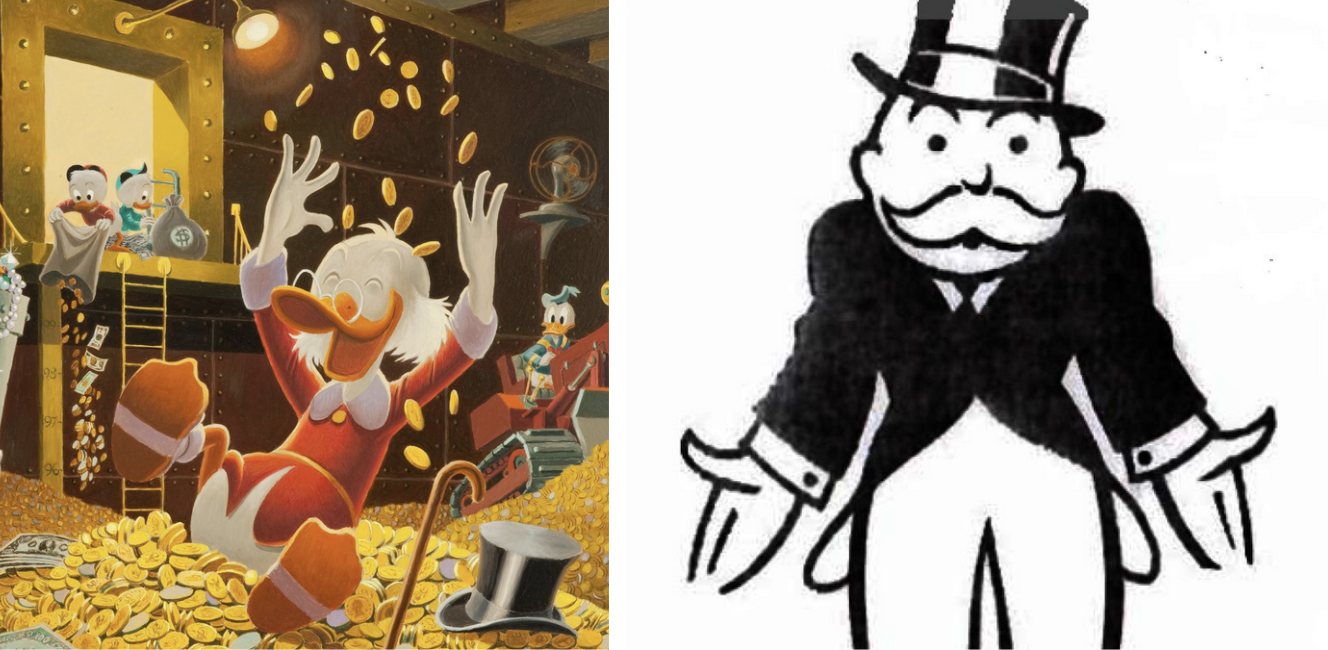
Pictured above is a curious sort of politician: He presents himself as a simple farmer, a rural populist who gives voice to the voiceless — meaning people who live outside the Burlington area. But John Rodgers, former Democratic state lawmaker turned Republican nominee for lieutenant governor, has seen his campaign picked up off the mat by major backing from Chittenden County elites. The Barons of Burlington, you might say.
These same people are writing batches of four-figure checks to a handful of Republican candidates for state Senate who have some chance of winning. The goal, clearly, is to kill the Democratic/Progressive supermajority in the Senate and end the truly historic string of veto overrides in the current biennium. It’s a longshot; the Republicans would need a net gain of four seats to end the supermajority. But if Rodgers wins, they’d only need three because the potential tie-breaking vote would be in their back pocket.*
*Correction: THe tie-breaking vote might be useful but not for veto overrides. If there’s a tie on an override, it’s already lost.
A few months ago, this Barons of Burlington thing was kind of cute. Like, can you really expect to swing an election with a sprinkling of large donations? Now, it’s looking like a serious, coordinated effort beyond anything I’ve seen in my 12+ years of walking this beat. I mean, all these people writing identical checks to the same handful of candidates? It’s beyond anyone’s notion of coincidence.
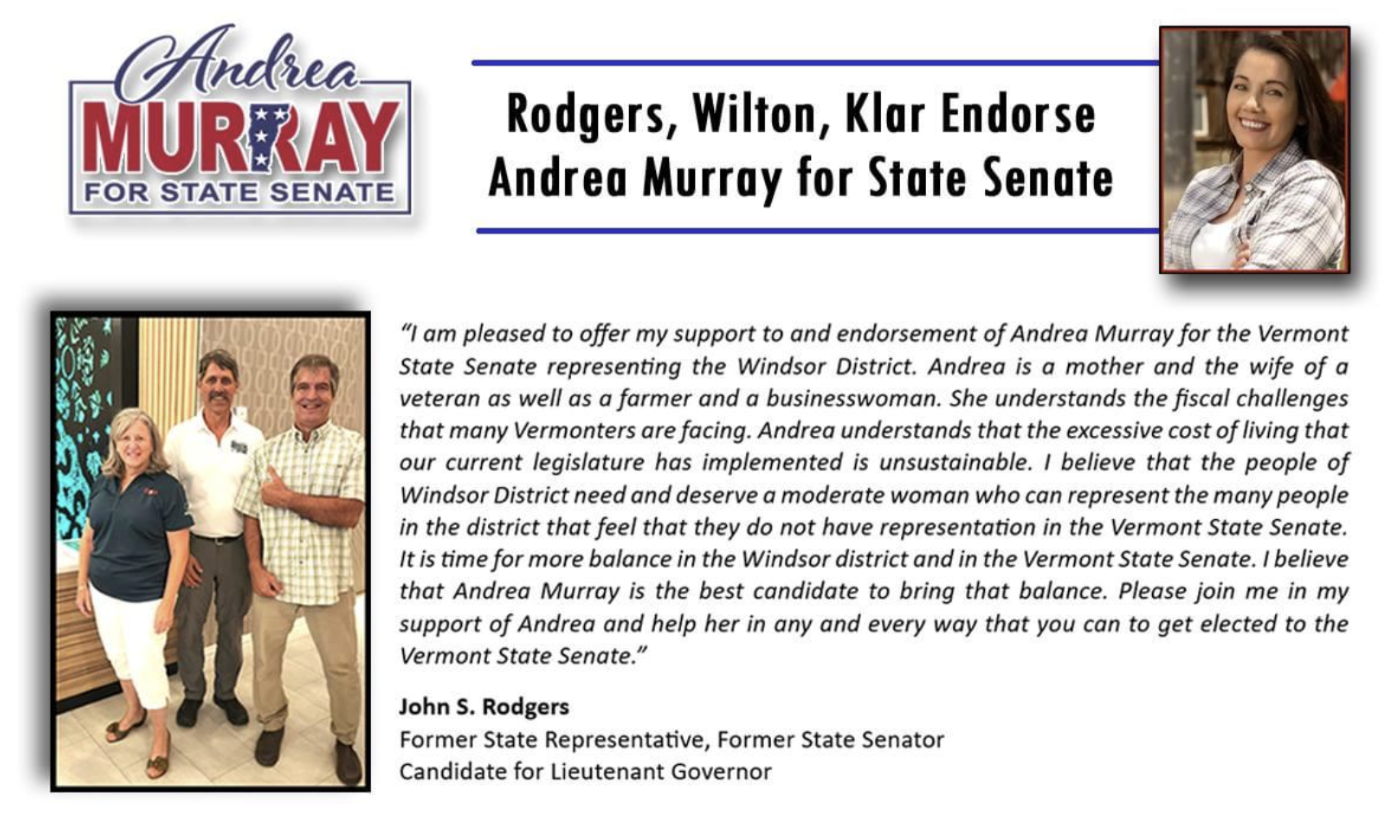
She’s a far-right Republican candidate for state Senate in solid blue Windsor County — a district that hasn’t elected a single Republican to any of its three seats since 1994.
Nineteen ninety-four. That’s 30 years ago. Fifteen elections ago. Forty-five Democratic winners ago. In recent years, Republicans have consistently lost by roughly two-to-one margins.
Murray is, naturally, presenting herself as a common-sense Republican who merely wants to bring “balance” to Montpelier. In fact, on her campaign website she offers three rationales for her candidacy, and the first is that she “will work across the aisle.” She’s also got prominent Republicans running interference for her. As noted previously, LG candidate John Rodgers has endorsed her as “a moderate woman.” She also claims the backing of former governor Jim Douglas, the cheapest date in #vtpoli.
Let me tell you about this “moderate.” Less than a year ago she was trying to get rid of longtime Windsor County Republican chair John MacGovern, whose sole offense was that he didn’t like Donald Trump. If Murray can’t get along with MacGovern, I’d like to see her definition of “work across the aisle.”
So why do I almost feel sorry for her? Well, she’s dumped a bunch of her own money into the campaign and spent much of it on an out-of-state consultancy that’s doing her absolutely no favors. And like I said, she’s going to walk into a buzzsaw on Election Night.
The Republicans’ candidate for lieutenant governor, John Rodgers, is seen as a potential winner for the victory-starved VTGOP: a centrist politician who served in the Legislature as a Democrat and might pull moderate voters away from incumbent Progressive/Democrat David Zuckerman.
Well, maybe we should pump the brakes on that one. Because to judge by the above graphic, Rodgers has taken a Wile E. Coyote-style dive into the deep end of conservative Republicanism.
Two things of note. First, he’s endorsing Andrea Murray, a far-right candidate for state Senate in deep-blue Windsor County. He promotes Murray as “a moderate woman,” which is a goddamn lie. Murray and her husband August were described by the Valley News’ Jim Kenyon as the “ringleaders” of the move to get rid of John MacGovern as chair of the Windsor County Republicans. MacGovern is a very conservative fellow and a very active Republican, but he is not a fan of Donald Trump. That was too much for the Murrays and their ilk; they undertook a long, noisy, divisive, and ultimately successful effort to oust MacGovern. They were so het-up over MacG’s apostasy that they actually filed a lawsuit against him and the Vermont Republican Party. A suit that was basically laughed out of court, but whatever happened to Ronald Reagan’s 11th Commandment?
There is more, much more, to say about Ms. Murray, but that will have to wait for an upcoming post. For now, let’s move on to point two about Mr. Rodgers.
So the Tunbridge Fair — err, the Tunbridge World’s Fair — happened last week. And as is its tradition, WDEV Radio broadcast live from the Fair’s gazebo and conducted debates for the top statewide offices. It’s been an early and quasi-obligatory stop on the campaign trail for many a year.
Well, WDEV was there, but many top politicians were no-shows. Gov. Phil Scott, for instance. Also U.S. Rep. Becca Balint and U.S. Senator Bernie Sanders. The only actual debate featured the two candidates for lieutenant governor, incumbent Progressive/Democrat David Zuckerman and Republican John Rodgers. (It was reportedly a spirited affair; you can listen here. The LG debate is in the second hour of the show.)
Otherwise, empty chairs abounded. Instead of debates, we got long interviews with the candidates who bothered to attend.
The fine fellow above, pictured with a fish he caught last year on Shadow Lake, is former state senator John Rodgers, Republican candidate for lieutenant governor. I know about the fish because it’s featured in one of a series of low-budget official campaign videos in which Rodgers is interviewed by one Rick Lafayette, a.k.a. the lead singer of Kikker, a Vermont metal cover band. Yeah, this guy:
Hey, I didn’t even wait to start digressing this time, I did it right off the top.
Anyway, Rodgers is running against Progressive/Democratic incumbent David Zuckerman. As most of you know, in Vermont we elect the governor and LG separately. And throughout Phil Scott’s seven-plus years in the corner office, a Republican has never been lieutenant governor. This doesn’t matter at all because the LG has no actual, uh, power or authority — except for one big thing, which ought to keep Scott and his allies awake at night.
The LG is in the line of succession. If something were to happen to the govrnor, then good ol’ Progressive Farmer Dave would succeed him. You’d think, then, that Scott would be going all-out to make sure Zuckerman is out of the way. You know, secure the Phil Scott political legacy.
The September 1 campaign finance reports crystallized something we already knew: This is shaping up to be an unsurprising political season because there’s such a deep divide between those on top and those trying to get a leg up. The former include Gov. Phil Scott and a whole bunch of Democrats; the latter include every other Republican minus a few who’ve been blessed by the patronage of Burlington’s business elite.
The exception to the Democratic rule: Esther Charlestin, who entered September financially underwater in her long-odds (and getting longer every day) gubernatorial campaign. Somehow, the financial gap between Scott and Charlestin managed to grow in August.
This isn’t a typo: Charlestin has raised only $21,137 and spent $22,309. On primary night, Charlestin told VTDigger she would “go hard” in the general campaign, which meant knocking on doors, seeking endorsements, and “raising a lot more money.”
But she didn’t do that. For the entire month of August, Charlestin raised $4,505, which isn’t anywhere close to “a lot more money.” I can’t say how much of this is her doing and how much is Democratic donors turning their backs; Charlestin didn’t score any donations above $250, and that came from longtime Progressive stalwart Martha Abbott. Hey, Dems: Do you like your candidate or don’t you?
Meanwhile, Scott continues to raise far more money than he needs, and spend money like he’s got an actual battle on his hands instead of an almost certain walkover.
Tuesday’s primary election turned out to be a snooze. The most interesting development was how much money was wasted trying to unseat a small number of Democratic incumbents. They all won, as far as I can tell.
Firmly atop the Futility Rankings is former TV anchor Stewart Ledbetter, who finished fourth in the race for three state Senate seats in the Chittenden Central district. He raised almost $60,000 and spent a bit under $40,000 (tentative). He “earned” 3,159 votes, which cost him and his well-heeled donors about $12.56 apiece. Bargain!
Elsewhere in the “beat the Democrats” game, House Ways & Means Chair Emilie Kornheiser brushed off a challenge from business-backed Dem Amanda Ellis-Thurber, while the Waterbury duo of Reps. Tom Stevens and Theresa Wood defeated “affordability” Dem Elizabeth Brown, who spent gobs of cash and didn’t really come close to pulling off an upset.
Two quick takeaways: If there’s an anti-tax revolution brewing in the hinterlands, it did not show itself in the results. At all. And those allegedly smart business leaders just squandered a whole lot of money trying to push the Democratic caucuses toward the center. They might have scored one small victory, as Danforth Pewter chief Bram Kleppner took a Democratic nomination for House in Burlington. But that’s about it.