Because I usually finish what I start, the “Drafts” section of this site’s back office is mercifully brief. It contains exactly one unfinished blogpost. That one is more than four years old, and I long ago despaired of ever pulling it off.
Its title is “We Have No Idea How Well State Government Performs.” I honestly believe that statement is true, but I’ve never finished it because it would be an absolute bear to research — to try to catalogue examples of state government failing to work as it should, when I suspect that most examples remain safely concealed in a bureaucratic mountain that gets little meaningful independent oversight.
But three recent news items provide solid evidence in support of the working theory that our state government is not nearly as efficient or effective as it could be.
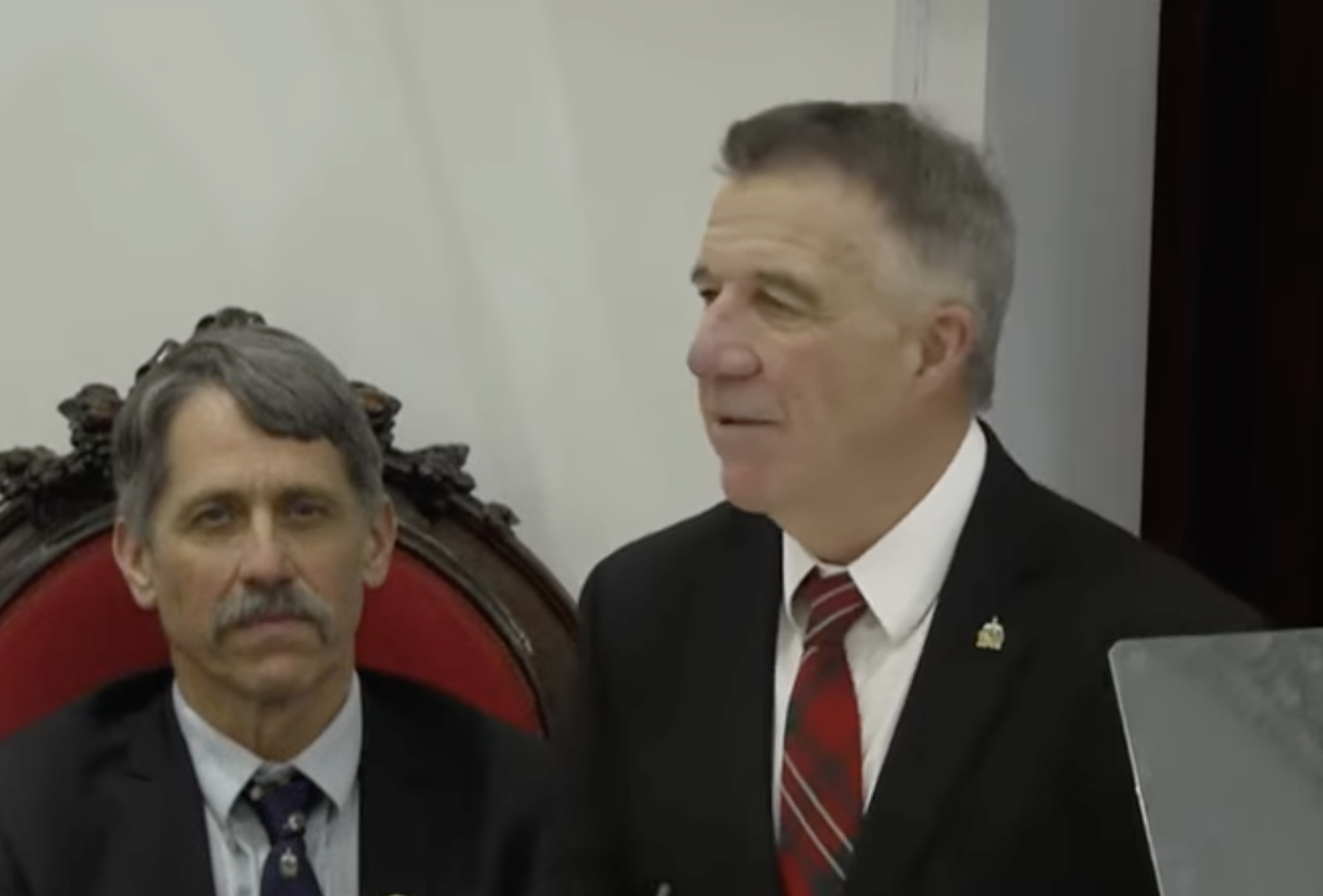
Listening to Phil Scott talk is like bathing in a vat of Malt-o-Meal: Sleep-inducing, no stimulative properties, somehow comforting and discomfiting at the same time. If you don’t believe me, just look: Scott’s buddy Lt. Gov. John Rodgers is fixin’ to nod off.
Seriously, this is the second time in a month I took notes on a gubernatorial address only to barely scratch the surface of my legal pad. (Yes, I’m old.)
Which stands to reason. He was never an orator by any means and he’s been in office for nearly a decade. If he had anything new to contribute, he would have done so long ago.
He did try to pretend there was new wine in those old, moth-eaten wineskins but it wasn’t nearly enough to persuade. Every governorship has an expiration date, and this speech was one more sign that Scott’s has come and gone. Not that he won’t win another term if he tries, since all the top-tier Democrats seem to be scared out of their minds to confront him and far too many Dems are happy to keep on voting for him because, I don’t know, he handled Covid pretty well (six years ago) and he’s not Donald Trump?
I mean, he talked about permit reform as the fix for the housing crisis. He complained about the cost of public education. He emphasized enforcement in his approach to crime, juvenile offenders, and substance use. He called for rollbacks or repeal of Democratic initiatives on climate change. Blah blah blah.
Oh, and he had the brass balls to blame Peter Shumlin for our crisis in health care costs. Shumlin, who hasn’t been in office for a decade and who abandoned his single-payer plan in The Year of Our Lord 2014. Scott cited Shumlin’s failed effort and the regulatory regime he did implement as the wellspring of our health care woes.
To which I say, well, who the hell has been governor since January 2017 and why hasn’t he done anything to counteract the alleged poison of Shumlin’s doomed reform plan?
One of Scott’s core efforts to lipstick his pig of a record was his call for reinvention of how state government does its work. As precedent, he cited reforms initiated under Dick Snelling and continued under Howard Dean, and said it was time to refresh that effort for a new era.
You know what it reminded me of? When Scott was first running for governor in 2016, he touted lean management at every opportunity. Lean management, he said, was the key to unlocking huge savings in state government:
I believe we can reduce the operational cost of every agency and department by one cent for every dollar currently spent, in my first year in office. Saving one penny on the dollar generates about $55 million in savings.
The link above is to a piece I wrote in 2020, by which time the phrase “lean management” had long been assigned to the dustbin of bankrupt political schemes. When asked about it in early 2020, Finance Commissioner Adam Greshin said “It’s not necessarily about savings, it’s about maybe spending the same amount of money and providing better value.”
Okay, fine. But that’s not what candidate Scott promised. And if he had made good on his promise, that’d be more than half a billion dollars we could have returned to taxpayers or invested in addressing some of our many challenges.
That was the unfulfilled promise of Scott, the businessman who knew how to make government work better and cheaper. And just like all the other businessmen-turned-politicians before him, he found out that the real-life work of managing government was a hell of a lot harder than he thought.
And now he’s coming back with a vaguely-described plan to reinvent state government. I’ll believe it when I see it. No, wait, I won’t believe it when I see it — I’ll believe it when it produces real, tangible savings. Not holding my breath.
I think Phil Scott has had his chance. He’s had many chances, thanks to his easy-going Real Vermonter charm and the failure of top Democrats to mount the least resistance, to put in the effort needed to rough up his Teflon coat. But it sure looks like we’re stuck with him for a while yet.
I tell you what, the next governor is going to have a massive job on their hands to clean up all the messes Scott leaves behind and all the crises he’s allowed to get worse and worse.
Note: This is a sequel to my previous post, reflecting the newly-released September figures for the motel voucher program and the official reaction to it all.
Some people could have predicted this as far back as January if not farther. But the Scott administration and the Legislature insisted throughout the winter and spring that everything would be just fine if we ended the emergency housing motel voucher program on schedule at the end of June.
They were wrong, of course, and they had to cobble together a last-minute extension that minimized the scale of the own-goal disaster. Those who were dumped from the program before June 30 were excluded, and new restrictions were imposed on the remaining clientele that seemed designed to encourage slash bully slash force them to leave the motels as quickly as possible.
Well, during today’s meeting of the Joint Legislative Fiscal Committee, it became clear that administration and Legislature alike now know they have a real, sizeable, thorny problem on their hands, and that many a vulnerable Vermonter has paid a stiff price for their earlier choices. Shocker, I know.
There have been numerous examples over the years of Phil Scott’s failure to build an effective bureaucracy in spite of his promises to lower the cost of government and improve the delivery of services The latest, and perhaps most outrageous, is the unconscionable handling of the extended emergency motel voucher program. As reported by VTDigger, the Scott administration is now requiring recipients to recertify once a week — and is making it damn difficult to comply by woefully understaffing its call centers and offices.
There are two possible explanations for this. Either the administration is doing its best to torpedo an extension it never wanted in the first place, or it has deliberately resource-starved the Department of Children and Families to the point where DCF can’t properly do its job. Either way, it’s inexcusable. As is the desperate display of blame-shifting put on by DCF functionary Miranda Gray.
It’s not our fault, she told VTDigger. It’s recipients’ fault for not being persistent enough or not answering the phone when DCF gets around to calling them back. It’s a caseworker’s fault for not communicating with DCF (through its terrible call center). Recipients who can’t get through by phone should go to a field office (but at least one recipient was forced to wait for hours and hours at a field office). It’s the Legislature’s fault for setting the rules (yes, they opened the door to weekly check-ins but (a) the admin sets the rules and (b) the mismanagement of the call system is all on YOU).
Meanwhile, recipients are waiting hours upon hours and living constantly in fear of losing their shelter. All because YOU couldn’t fully staff a call center after increasing your own workload by mandating weekly check-ins.
Also meanwhile, no one has received a damn dime from a disaster relief fund for the self-employed and independent contractors. And some of the applications seem to have been bungled. Wow, more management failure. And another administration official busily pointing the finger elsewhere.
If you had a time machine and chose, not to kill Young Adolf Hitler or have lunch with Jesus or ride horsies with Alexander the Great, but to go back to 2016 and listen to a speech by gubernatorial candidate Phil Scott, you would hear some familiar phrases. “Cradle to Career,” “Affordability,” “Protect the most vulnerable,” stuff he still says all the time.
You would also hear something you couldn’t hear without a time machine because Scott doesn’t say it anymore: “Lean management.” Here’s his campaign pitch, with a specific target number attached:
I believe we can reduce the operational cost of every agency and department by one cent for every dollar currently spent, in my first year in office. Saving one penny on the dollar generates about $55 million in savings.
Yeah, well, then he got elected and things became much harder. This is what usually happens when a businessperson enters public office convinced that big savings are ripe for the picking, if only a little common-sense efficiency is applied.
The actual results have been embarrassingly puny. When asked about this back in February, after three years of Scott’s governorship, the administration pointed to $13 million in projected savings in his FY2021 (the year starting 7/1/20) budget. More than one-third of that total was due to the proposed closure of the Woodside juvenile facility, which had nothing to do with lean management.
Actual results: Not $55 million in the first year, but something less than $10 million in year four.
And you have to subtract, from whatever the actual savings were, the costs of training hundreds of state workers in lean management processes. (By the administration’s own accounting, 671 workers and managers in all.)
A moment of silence for the advancement hopes of Linda Myers, veteran Republican lawmaker now offered up as her caucus’ sacrificial lamb. House Minority Leader Don Turner promised a challenger to Speaker-in-Waiting Mitzi Johnson; it just isn’t possible that the 76-year-old Myers was the first name on his list.
Nothing against Ms. Myers, a pillar of her community and, by all accounts, a good person. But when I consulted The Google for traces of legislative accomplishment or leadership, I found astonishingly little.
As far as I can tell, she’s never held a position in the Republican caucus leadership, which tells you a lot about how she’s perceived by her colleagues. She’s been “parked for years” (in the words of one Statehouse observer) as vice chair of the House Committee on Corrections and Institutions, her service not terribly memorable but not malign enough to prompt her removal.
Well, I hope she enjoyed her vice chairship; after she loses the race for Speaker, she might very well lose the position. (A desirable post, since the committee oversees capital expenditures.) More often than not, there are consequences for such a challenge.
That wacky Senate Rules Committee, under the steady hand of First Mate Gilligan President Pro Tem John Campbell, is considering a bold move.
Well, “bold” by their frame of reference. The committee met yesterday and discussed setting up an Ethics Panel along the lines of the weaksauce House version. Mind you, they didn’t decide anything; they’re just considering it.
And, well, if they do actually set up an Ethics Panel, I might file the inaugural complaint (just as I did, fruitlessly, with the House Ethics Panel last year). My complaint would be, ahem, against the Senate Rules Committee. The intrepid Paul Heintz:
The Senate Rules Committee, which has a long history of meeting secretly, held Thursday’s discussion behind closed doors in the Senate Cloakroom. Seven Days has repeatedly asked to be informed of such meetings and was told about it in advance by a member. [Senate Secretary John] Bloomer posted public notice of the meeting Thursday morning on the legislature’s website, just hours before it took place. One other reporter, from the Burlington Free Press, attended.
Is it just me, or is there something fundamentally ironic about a “Rules” Committee repeatedly failing to abide by open-meetings requirements? Nothing says “transparency” like having “a history of meeting secretly.” And in a frickin’ closet, no less.
What’s this in my inbox? Why, it’s a heart-rending tale from the desk of Win Smith, co-owner of the Sugarbush ski resort and president of the Vermont Business Roundtable. And former Merrill Lynch executive. And reportedly a member of a secret Wall Street society described as “‘”a sort of one-percenter’s Friars Club’ whose annual dinners are filled with elitist, sexist and homophobic humor.”
(Bruce Lisman’s also a member, but I digress.)
Smith’s business partner in Sugarbush is, of course, State Rep. Adam Greshin, who wrote and lobbied for an amendment that forestalls a significant increase in Sugarbush’s sizable utility bills. And was, dubiously and privately, cleared by the House Ethics Panel.
Smith’s essay is being distributed to Vermont news outlets; I’m sure it will shortly be cluttering up your local paper’s content-hungry Op-Ed page. It’s a pretty amazing piece of work, managing to be both politically and literarily obnoxious. It’s a subtle retelling of stale conservative myths about poverty and government. You know the stuff: welfare mothers with Cadillacs, poor folks lulled into dependency by public-sector largesse, and the myth that “47% of Americans pay no taxes” and therefore have no stake in responsible government.
Smith begins with the sad story of “a childhood friend of mine” whose mother expressed her love by serving “large portions of tasty food.”
Unfortunately, Mom’s generosity had deadly results.
Well, the House Ethics Panel quickly disposed of my complaint against Rep. Adam Greshin. I can’t say I’m surprised that he was given a clean bill of ethical health, but I am disappointed.
Reminder: Greshin proposed, and actively lobbied for, an amendment to H.40 that would eliminate a planned increase in funding for Efficiency Vermont, which gets its money from a fee on utility bills. As co-owner of the energy-gobbling Sugarbush ski resort, Greshin stood to profit significantly if his amendment passed.
In my previous post, I covered the questionable process. The panel did its business behind closed doors, which seems an odd move for an ethics panel.
Now it’s time to consider the panel’s decision and reasoning, which leave a lot of room for dubious behavior.
Constant readers of this blog (Hi, Mom!) will recall that earlier this month, I wrote a letter to the House Ethics Panel asking for a review of Rep. Adam Greshin’s actions regarding H.40, the RESET bill. For less constant readers, my complaint centered on this: Greshin authored an amendment to H.40 stripping away an increase in funding for Efficiency Vermont. (EV had already gotten Public Service Board approval; until this year, legislative review was a mere formality.) He also aggressively lobbied the House and Senate for his amendment.
EV gets its money through a surcharge on utility bills. As co-owner of the Sugarbush Resort, a voracious consumer of electricity ($2 million/year), Greshin stood to gain considerably if his amendment passed.
Well, the Ethics Panel has responded. And as expected, it was a whitewash. Greshin, so they say, did nothing wrong.
I’ll get to the substance of its decision in my next post. First, though, I need to address the process.
Between sending my letter and receiving the Panel’s reply, I didn’t hear anything about it. During the roughly one week between receiving my letter and drafting its ruling, the Panel conducted a review with help from Legislative Counsel. It also met with the House Energy and Natural Resources Committee, and with Greshin himself. (Correction: The panel met with counsel to the House Energy and Natural Resources Committee, but not with the Committee itself.)
None of those meetings were noticed publicly. I was not informed. I was not given the opportunity to be a party to the proceedings.
It seems that the House Ethics Panel has a closed-door policy.





 The Vermont Political Observer.