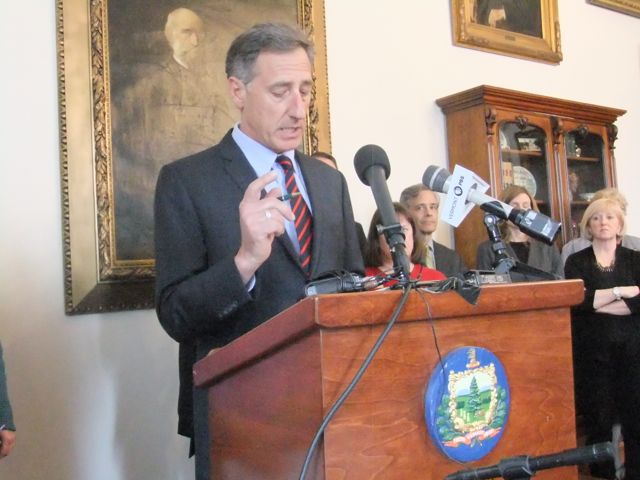
Single-payer price tag: the dollars matter less than what they bought

Another fine “Fair Game” column by Seven Days politimeister Paul Heintz, most of which is an attempt to put a price tag on Gov. Shumlin’s failed pursuit of single-payer health care.

The takeaway number: $2 million. But that comes with some major cutouts; if you changed the ground rules, you could come up with a much higher number.

Heintz sought that number for ten weeks before the administration finally came up with it. And after all that time, all they did was add up two numbers: $597,000 to ten consultants, and $1.33 million spent on the governor’s Office of Health Care Reform.

However… the consultants and the OHCR weren’t the only people who put in time on single-payer. Work was also done by staffers in “10 offices, departments and agencies.” There was lobbying and flackery on behalf of single-payer. And many millions were spent on the Green Mountain Care Board and other entities that might not have existed, or been nearly so expensive, if not for their work on single-payer.

So, $2 million. Or a lot more, your choice.

The big question, though: was that too much? And the answer is, it depends.

If it was spent well and wisely, then $2 million or even $20 million would be a perfectly reasonable investment in research on a huge policy initiative. If it was spent poorly, then $2 million or $2,000 would be a waste.

So it depends. If you oppose single-payer, it’s an outrage. If you favor single-payer and believe the governor did his best, it’s reasonable.

And if, like me and many other single-payer supporters, you have your doubts regarding the administration’s performance, then that $2 million figure will make you a bit more queasy about the whole enterprise.

Urp.

Burlington Mayoral Race Cools Down

(In honor of the hackneyed campaign headline, “_________ Race Heats Up,” the favorite of unimaginative headline writers desperate to gin up a little reader interest. And yes, the Free Press deployed it during the campaign for mayor of Burlington, which was never, ever, ever close.)

Well, if there’s any widespread revolt over Miro Weinberger’s alleged secret plot to pave the open spaces and fill the city with skyscrapers, it sure didn’t show itself on Town Meeting Day. Weinberger won a second term with 68% of the vote; the two challengers beating the anti-development drum managed less than 30%.

So, Monday Morning Quarterback, what does it mean? Glad you asked.

The accusations against Weinberger didn’t stick because (1) anti-development sentiment in Burlington represents a loud minority; most residents, I think, would like to see reasonable growth, (2) Weinberger consistently presented a reasonable approach and hasn’t given the voters any big reason to mistrust him, and (3) by all appearances, he ran the city competently in his first term. And after the Bob Kiss Experience, voters were happy to see simple managerial competence.

Corollary to point 3: the Burlington Progs are still suffering from the aftereffects of the Kiss Experience. Especially when their candidate is a hippie-lookin’ holdover from past Progressive administrations. It’ll take them a while longer to win back the trust of Queen City voters.

The Progs’ candidate, Steve Goodkind, refused to admit that Weinberger might actually be popular, heaven forfend; he credited the mayor’s “great machine.” By which he presumably meant Weinberger’s massive fundraising advantage.

That certainly didn’t hurt, but if we’ve learned anything from recent gubernatorial elections, it’s that Money Can’t Buy You Love. If there was widespread disaffection with Weinberger, the voters would have scrambled to the nearest available Scott Milne, no matter how underfunded or dubiously qualified. It’s tough to argue with 68% support.

On the other hand, there’s the City Council vote, which saw the Democrats lose ground and the Progs gain, probably leading to a Progressive council president. Was this a mixed verdict by the voters?

Yes and no, but mostly unclear. If the voters were convinced by the anti-development argument, it seems to me that they would have concentrated their ire on Weinberger. Also, and more saliently, the council results are tough to interpret because of the massive overhaul of ward boundaries. You’d really have to do a deep analysis of the vote, comparing it to previous elections.

One example: a new ward was created in student-dominated precincts. Students, as they are wont to do, stayed away in droves. (Overall turnout was 25%, but in Ward 8 it was under 10%.) As a result, Prog-leaning independent Adam Roof beat the Democrat despite getting less than 200 votes. That total would have earned him a brutal defeat in any other ward.

So the Progs had an unearned edge in Ward 8. I have no idea if that’s true across the city because I’m not a deep-numbers guy. I’ll leave that task to the experts.

The result does leave Weinberger facing a divided City Council with the Progressives likely enjoying a narrow organizational majority. He’ll have to work with the Progs and independents, which could mean a slightly more measured approach to development.

Of course, I’m not convinced that Weinberger ever had a secret plan to pave Burlington. By all indications, he wants to pursue a measured approach anyway. For the crowd that thinks “developer” is a dirty word, his intentions will always be suspect. But that crowd suffered a pretty thorough defeat in Burlington yesterday.

Super Dave stubs his toe

Pity poor VTGOP chair David Sunderland. He’s constantly on the lookout for ways to score a cheap political point at the expense of the Democrats. It’s a dirty job, but somebody’s got to do it. I guess.

So I guess it’s only to be expected that, once in a while, Sunderland will get it completely wrong. Exhibit A:

The link is to a brief story reporting Shumlin’s opposition to the idea of closing the Vermont Veterans’ Home.

That proposal was on a lengthy list of cuts totaling $29 million, produced last week by the Shumlin administration and the legislature’s Joint Fiscal Office. It was meant as an all-inclusive laundry list, with no endorsements implied or expressed. It includes obvious nonstarters like cutting the House from 150 members to 120, eliminating the Vermont Commission on Women*, and reductions to health care premium subsidies.

*I certainly hope that’s a nonstarter. And I’ll bet you dollars to doughnuts that it was a man who suggested it.

The list was presented as a starting point for discussion — and as evidence of how hard it is to cut the budget.

I see three possible explanations for Sunderland’s wrongheaded Tweet:

— He thought he saw an opening and pounced without thinking it through.

— He actually doesn’t know what the list is, even though it was one of the top political stories of the past week.

— He knows damn well that Shumlin hasn’t endorsed the list, but isn’t about to let the facts get in his way.

I’m willing to assume the first. The second would betray a surprising level of ignorance; the third is out of bounds, even by the loose relationship to the truth maintained by your average major party chair.

Shumlin’s numbers are down. In other news, Sun Rises In East.

That’s not a Gatorade bath, Governor: it’s a big ol’ bucket of cold water.

For the first time in Gov. Peter Shumlin’s tenure, more Vermonters disapprove of his job performance than approve of it.

A new VTDigger/Castleton Polling Institute survey shows that 47 percent of those surveyed disapprove of the job Shumlin, a Democrat, is doing as governor and 41 percent approve.

You know, the fact that his numbers are down is completely unsurprising. Indeed, when you consider that he only got 46% of the vote last November, the bigger surprise is that 41% of us still got Shumlin’s back.

Look at what’s happened since that disastrous November vote: Shumlin abandoned his signature proposal, single-payer health care; the state’s budget deficit continued to grow; the Democratic legislature rejected much of his third-term agenda; the government faces major challenges on school funding, Lake Champlain, and that darn budget.  It’s not exactly shocking that he’s down to 41%.

Still, the Governor is underwater for the first time in his tenure. That’s not good.

The VTDigger/Castleton poll is very thorough, and offers a wealth of subsidiary numbers. The one that ought to worry Shumlin the most: only 62% of Democrats view him positively. That means he’s lost nearly 40% of the loyalists.

His 37% support among independents looks worse — and indeed, that’s how it’s interpreted by Vermont Pundit Laureate Eric Davis. He notes that neither party can win without the independent voters, who form a majority of our electorate. But when President Obama’s approval hit a low of 40% shortly before the midterm elections, he had 33% support among independents. Shumlin does better than that. But even at his lowest point, the President still enjoyed broad support among Democrats. That’s no longer true for Shumlin.

And that’s why you hear a lot of speculation around Montpelier about a possible Democratic primary. There’s a great deal of disaffection on the left, and definitely room in the Democratic Party for a challenge to the incumbent. It still seems unlikely; Vermont politicos show a great deal of deference to incumbents, and Shumlin would remain a formidable figure in a primary.

What’s more likely, if the numbers keep getting worse, is that Shumlin himself might think better of another campaign. “More likely” but not likely; it’s hard to imagine Peter Shumlin retreating into a hidey-hole without a fight.

It is interesting, though, that House Speaker Shap Smith appears to be laying the groundwork for a statewide run. On his own initiative, he has assembled two high-powered, and heavily centrist-leaning, committees to tackle tough issues: education and economic growth. That’s a sign of someone who’s looking to (a) craft new approaches to those issues while also building consensus, and (b) establish connections and build credibility with the business community and others who might prove useful in a run for Governor.

The Vermont Republican Party certainly sees him as a threat, given their endless series of (largely ignored) press releases about the alleged failures of the “Shumlin-Shap Smith economy.”

On the other hand, we are less than five months past the 2014 election and 19 months away from the next one. A lot could happen. There are definite signs of progress in the legislature; not on the budget so far, but on a range of other issues, from education to energy to child protection to the environment.

If the legislature has a productive session and manages to close the budget gap in a reasonable way, the Governor will get at least some of the credit. If things start to look brighter in Vermont by this time next year, so will Shumlin’s approval numbers. He could still get his mojo back. And betting against him is never a good investment.

The curious incident of the GOP in the night-time

Gregory (Scotland Yard detective): “Is there any other point to which you would wish to draw my attention?”

Holmes: “To the curious incident of the press release in the night-time.”

Gregory: “Therre was no press release in the night-time.”

Holmes: “That was the curious incident.”

— Not Quite Sir Arthur Conan Doyle

The Vermont Republican Party can’t be counted on for much, but one thing that’s as regular as clockwork is the issuance of potboiler press releases attacking Democrats for political sins, real or imagined. Lately, the circular files of Vermont media have been filled by a series of missives about the Shumlin-Shap Smith Economy, and what a dreadful thing it is. There’s also been plenty of hash — much of it deserved this time — about the Jonathan Gruber billing caper.

But it’s been more than three days since Seven Days’ Terri Hallenbeck spilled the beans on the increased staffing of the Senate President Pro Tem’s office under current occupant John Campbell. And not a peep from the VTGOP.

I find that curious. Don’t you?

If the situation were reversed, and House Speaker Shap Smith was the one who’d padded his office staff to the tune of $72,000 In Taxpayer Dollars, it wouldn’t have taken the Republicans more than a few minutes to try to capitalize.

Why no castigation for Campbell?

Is it because he’s the next best thing to a Republican Pro Tem — allowing the blockage of many a piece of liberal legislation, reliably backing Phil Scott, packing the Committee on Committees with “centrist” figures? Hey, if a Senate majority is out of the VTGOP’s reach, then Campbell is the next best thing.

Is it because Campbell is such a nice guy? Or that he’s no threat to run for higher office? Or because of his rumored girlfriend?

I’m still waiting for the Republican attack on the wasteful spending of John Campbell. But I’m not holding my breath.

Not all businesses think alike. Or, Mr. Barlow, your table is ready.

We have a winner in theVPO’s first-ever giveaway.

In some secluded rendezvous…

In some secluded rendezvous…

As you may recall, earlier this week the Lake Champlain Regional Chamber of Commerce made an ass of itself: one day, its president issued a clarion call for action on Lake Champlain, and the next, its lobbyist strenuously insisted that the LCRCC would fight tax increases to fund cleanup efforts.

Hypocrisy, thine initials are LCRCC. Anyway, in light of that, I offered a free dinner to the first lobbyist who accepted a measure of financial responsibility for his/her group, industry, or membership.

Well, we have a winner, and it’s just who you might expect: Dan Barlow of Vermont Businesses for Social Responsibility.

Dan didn’t nominate himself; a friend in the media, who’d just love to see me spend my money, pointed out to me that at a Statehouse press conference yesterday, Barlow (speaking for VBSR) endorsed Gov. Shumlin’s proposal to close the Medicaid cost gap through a payroll tax. I wasn’t at the presser, but Barlow’s statement has been reported by VTDigger, which is good enough for me.

So Dan, if you want to strap on the ol’ feed bag, let me know.

This brings to mind something that’s been bugging me for a few days. On Monday, the usually impeccable Anne Galloway of VTDigger posted a story entitled “LEGISLATIVE MANDATES HAMPERING RECOVERY, BUSINESS GROUPS SAY.” The story recapped the usual litany of complaints about taxes and costs and regulations — and that hoary old chestnut, “uncertainty.”

Which is just bullshit. Life, by its very nature, is uncertain. Potential legislative changes are one of the smaller aspects of it. To cite just one obvious example: the price of oil. Who predicted its nearly 50% drop in recent months? That alone plunged a fatal dagger into Vermont Gas’ pipeline to Ticonderoga. Fuel costs are a much bigger factor in running a business than anything the legislature might reasonably do.

Galloway’s piece could have been written by a functionary in Jim Harrison’s back office, so one-sided was it. The only note of dissent was a brief comment by House Speaker Shap Smith in the very last paragraph.

Now, you could make an argument for this article as part of VTDigger’s ongoing coverage of the legislature: let’s take a look at how business groups are feeling about the course of the session. Other views will get a hearing elsewhere.

But even on that narrow pretext, the article falls short. By focusing on The Usual Suspects, it fails to reflect the range of views within the unmonolithic “business community.”

It doesn’t, for example, quote VBSR. Not even a little bit. It doesn’t quote business types like Small Dog’s Don Mayer or Fresh Tracks Capital’s Cairn Cross, who have much more nuanced views of the potentially positive role of government in economic development. It doesn’t mention former State Rep. Paul Ralston of Vermont Coffee Company, who’s chairing Shap Smith’s working group on improving the economy. It sure as hell doesn’t quote Ben Cohen or Jerry Greenfield.

EVen if you accept the premise that an overview of the business community is a worthwhile use of VTDigger’s media platform, this article was woefully incomplete. A rare FAIL for a diligent and trustworthy news source.

The Republicans? They got nothin’

On Wednesday, two of Vermont’s top Republicans took to the VPR airwaves to make their case to the people. And one of them said this about global warming, really, actually:

I think there’s science on both sides of the issue that both sides use against each other.

The Mystery Voice belonged to VTGOP Chair David Sunderland, who had just finished “explaining” how the VTGOP was different from the national Republican Party — more inclusive, less extreme. He doesn’t set a very good example, does he?

The occasion was VPR’s “Vermont Edition,” and neither Sunderland nor fellow guest Don Turner made much of an impression. They stuck to the standard Republican bromides: burdensome taxes and regulation; Vermont is a sucky place to live, work, and own a business; government is full of waste, but don’t ask us for specifics.

It was not a very inspiring performance. Next time, maybe they should send Phil Scott and Joe Benning instead.

The two men’s appearance consumed about 34 minutes of radio time, but I’ll focus on two key segments. Believe me, I’m not leaving out anything good — just the boring stuff, like their insistence that the VTGOP was a welcoming, inclusive, and diverse thing. Because, I guess, they’ve got a handful of young white men to go with their endless supply of older white men. Anyway, onward.

First, that great Republican bugaboo, out-of-control state spending. Sunderland and Turner performed a lovely bit of rhetorical contortionism, first saying that we can’t fix the budget right away:

Solving a budget deficit that’s been created over a period of four to six years is a tall task to take on in a single year, and I think it will take longer than a single year to overcome it.

And then immediately saying that we can balance the budget, no problem:

I think we need to look at what government programs are truly working and are truly efficient, weed out the waste and the abuse that’s in the current system, make our government more streamlined, get more effective in serving Vermonters. And I think by doing that, we’ll get a long way towards closing that gap and quite hopefully all the way.

The mic then passed to Turner, who first said this:

We have a committee working with our appropriations people, that started before the session began, and have started to scrub and comb through all areas of state government. We’ve initially focused on the high cost areas.

Wonderful! Surely all this scrubbing and combing produced a bumper crop of the “waste and abuse” that Sunderland believes is endemic in the public sector.

We believe that we need to keep spending level-funded. We go to each agency and say, Okay, you had this much money to spend last year, this is how much you’ve got to spend this year, how are you going to address that?

Oh, great Christ almighty. That old chestnut? You’ve been scrubbing and combing the budget, and all you can come up with is across-the-board cuts?

This is how it always goes with Republicans. They talk smack about wasteful government spending, but when asked for specifics, they offer broad generalities.

In other words, they can’t find the alleged “waste and abuse.”

Oh, I should slightly amend that. Turner did offer one specific budget cut, but it’s not a new item. He still wants us to kill Vermont Health Connect and go with the federal exchange. Funny thing, though: when he first announced the idea, he insisted we could save $20 million this year.

On Wednesday, he put the savings at between eight and ten million. Call it the Incredible Shrinking Budget Cut.

Now, let’s turn to a favorite talking point of our rebranded VTGOP: “We’re different from the national Republicans. Just don’t ask us how.” Mr. Turner?

I don’t know a lot about the national platform and I don’t participate in the national level, I participate very little in the national level. I think that’s the party’s role. What I’ve — I’m Don Turner, I represent Milton, and I am a much more moderate Republican than many maybe in Washington, and some in my caucus.

We in Vermont believe in helpin’ our neighbors, we believe in makin’ sure that the most vulnerable are addressed, we want to protect the environment, but we want to make sure people can afford to live here. Sometimes that means compromising on some of these issues, maybe more than we want to.

Yeah, another politician who starts droppin’ his G’s when he wants to be real folks. I am puzzled, though, by his lack of intellectual curiosity about his own party.

But if you thought that was weak, just wait till you get a load of Sunderland’s response:

Vermont is a unique place, Vermonters are a unique people within the nation. Likewise, the Vermont Republican Party is different than the national Republican Party.

At this point he was interrupted by host Jane Lindholm, who asked for a specific difference.

I think in, in Vermont we’ve tried very hard over the last 15, 16 months or so to really broaden the base of the party, to be open to different ideas, ah different viewpoints, and to welcome people we may not agree with 100% of the time, but we would agree with 80% of the time. And I think as long as we can agree that the focus of our state right now needs to be on growing our economy and creating jobs, making Vermont more affordable, bringing balance back to the discussion in Montpelier, then there’s a place for you in the Vermont Republican Party.

Okay, so. Sunderland completely punts on specifics. And his idea of an “inclusive” party is one that only insists on 80% loyalty instead of 100%.

At this point, immediately after Sunderland’s previous response, Lindholm took a question from a caller, who wanted to know about the VTGOP’s stand on global warming. Turner was, again, an ostrich with his head in the dirt.

You know, I have not spent a lot of time on global warming. I understand that this is a big issue nationally and so on. Vermont is so far ahead of the rest of the country on measures to help with this issue that I don’t think it should be a tip-top issue for us when we have all these other problems.

Well, those who are actually serious about global warming would say that it’s an existential threat to our species, and deserves to be “tip-top” in any list of issues. But what do I know.

This is where Sunderland weighed in with his Koch Brothers-approved know-nothingism.

I think there’s science on both sides of the issue that both sides use against each other. What I think is most interesting is, regardless of your opinion about it, there certainly is a market that Vermont can and should be exploiting to create jobs and grow our economy to address those very issues. So I think regardless, there’s a variety of different opinions within the party and outside the other parties about global warming, man’s impact on climate change, but I would like to see us focus on how our economy and how our state here in Vemront can grow and reflect the values of Vermonters.

There’s a hot mess if I ever saw one. He won’t acknowledge the reality of climate change, but he wants us to somehow capitalize on it even though it might not exist. He then casts another coating of doubt on the science, and finishes with an appeal to “the values of Vermonters.”

Good grief. I’m not particularly happy with what the Democrats are doing these days — weaksauce incrementalism, failing to squarely face serious challenges, and squandering the political capital they’ve gained over the last six years. But the Republicans? Judging by that performance, they have precious little to offer beyond the usual twaddle.

Free offer: Dinner’s on me

VPR’s John Dillon has captured and preserved a lovely bit of flamboyant hypocrisy from the fine folks at Your Chambers of Commerce. On the one hand:

Tom Torti, president of the Lake Champlain Regional Chamber of Commerce, told lawmakers last week that Vermont’s brand is defined by its clean environment. A polluted lake hurts the state economically because visitors will chose not to return, he said.

On the other hand:

A day later, Katie Taylor, a lobbyist for Torti’s organization was in a House committee. She delivered a different message.

…Taylor made clear the Lake Champlain chamber will fight a tax increase aimed at the tourism industry to pay for water pollution controls.

,,, Kendal Melvin of the Vermont Chamber of Commerce also opposed the half-cent rooms and meals tax increase. When one lawmaker asked her to recommend alternatives, she offered nothing.

Yeah, well, thanks for nothing.

Which brings me to my Free Offer. The first lobbyist who accepts financial responsibility, in whole or in part, for a problem or issue facing Vermont, will be treated to dinner by me at the restaurant of their choice. Hen of the Wood? Great. Leunig’s? Fine. J. Morgan’s? Predictable but acceptable. Slum it at Al’s Frys? Outstanding.

To meet my conditions, the statement has to go something like this: “We realize we have a real problem with _________ in Vermont, and we accept that our [industry/company/group/granfalloon] plays a part in solving this problem. We are willing to bear our share of the costs of ___________.” You can add as many bells and whistles as you like.

The lobbyist must represent an entity with “skin in the game” — exposure to increased costs in taxes or fees. This, unfortunately, disqualifies most public-interest groups.

The statement must be delivered in testimony to a relevant legislative committee, and submitted to theVPO in transcript or audio recording.

Caveats: Judging is by theVPO. Judge’s decisions are final. There will be a limit on the bar tab — a reasonable one.

This offer is good until the legislature adjourns for the year. C’mon, lobbyists — do the right thing, and earn yourself a free feed in the process!

The Campbell Assessment, updated

My previous post concerned apparent featherbedding by Senate President Pro Tem John Campbell. Traditionally, the Speaker and Pro Tem each get one full-time aide, at a salary in the $55,000 range. The Speaker is still there, but Campbell now has two full-time staffers drawing a combined salary of $111,000.

Since Campbell started padding his staff following his disastrous performance in the 2011-12 biennium, I called the difference “the price tag for John Campbell’s incompetence.” We could shorten that to The Campbell Assessment if you like.

In response, commenter Seth Hopkins pointed out that a state worker gets more than a salary; there are also public-sector-quality benefits. Since Campbell has added a second staffer, his payroll now includes full-time bennies for both.

What does that cost? The answer, from the state HR Department website:

The State’s total compensation package for employees features an outstanding set of employee benefits that are worth about 30% of your salary.

Okay, so add 30% to the cost of Campbell’s staff. That brings us to $144,000, more or less. It might end up being more than that; Campbell’s previous aide, Rebecca Ramos, piled up $23,000 in overtime and comp time in her last year on the job. But let’s stick with $144,000.

House Speaker Shap Smith’s aide earns $55,000. Add 30% for bennies ($16,500), and you get $71,500. So the baseline Campbell Assessment is $72,500.

But hey, he’s a great guy. You just can’t put a price tag on that. Can you?

We can now put a price tag on John Campbell’s incompetence

…thanks to Terri Hallenbeck, pinch-hitting for Paul Heintz in the Freyne Memorial Chair:

In the last two years, [Senate President Pro Tem John Campbell has] quietly increased his office’s staffing and more than doubled his payroll.

He’s done so — without any explicit policy change, nor anyone else’s approval — even as lawmakers consider cutting other state jobs to close yet another budget gap. Some say the situation reveals a disturbing lack of oversight. Others consider the money well spent, given that his enhanced staff has helped restore order under the oft-distracted and perpetually disorganized Campbell.

Aww, that’s nice. We’re spending a bunch of extra money because John Campbell can’t keep his shit together. And yet the Democratic caucus keeps re-electing him out of classic Vermonty loyalty to “my grandfather’s lightbulb.” 

Now, the amount of money isn’t that much in state budget terms — somewhere in the $50,000 to $70,000 range. The Pro Tem staff historically consists of one person paid roughly $50K per year. When Campbell hired Rebecca Ramos to pull his fat out of the fire after a disastrous 2012 Senate session, her starting salary was $70K. But in her last year on the job, she took home $103,000 thanks to a whole lot of overtime and unused comp time.

Campbell has replaced her — with not one, but two staffers, with total compensation of $111,000. By comparison, Hallenbeck reports that House Speaker Shap Smith’s sole staffer makes $55,000, and Lt. Gov. Phil Scott’s staffing cost is roughly the same.

I think we’re safe in concluding that the taxpayers of Vermont are shelling out an extra $60,000 or so to keep John Campbell in a job he can’t handle.

But he’s such a nice guy!

Postscript. As commenter Seth Hopkins pointed out, my $60,000 estimate is almost certainly low. Now that Campbell has hired two staffers, they’re presumably drawing the state benefits package — health care, pension, etc. So the real price of Campbell’s incompetence is more than 60K.