Category Archives: Taxation

That Military Pension Tax Exemption is Largely a Giveaway to the Affluent

I know some people are going to read this — or read the title and nothing more — and jump to the conclusion that I’m just a liberal bashing the troops. Nothing could be further from the truth. My dad served in World War II and came home with undiagnosed PTSD that derailed his life for several years. One of my uncles lied about his age, enlisted in the Navy at 15, and died on board a submarine in WWII. My grandfather-in-law died leading his unit through a French farm field in World War I without ever getting to see or hold his infant son (who eventually became my father-in-law). I respect the people who serve in the armed forces.

But this tax exemption for military pensions that just became law in Vermont has nothing to do with the troops. It’s the officer class who will reap most of the benefits, and most of them are quite comfortable already. I don’t recall anyone bringing this up during the years-long debate over the exemption, which has been strongly pushed by Gov. Phil Scott.

Hell, I wouldn’t know about this if not for political cartoonist and Vietnam vet Jeff Danziger, who emailed me about the military pension system — in particular, who qualifies and who doesn’t.

In order to earn a military pension, you have to serve 20 years in the military. This includes most officers and some NCOs. It excludes the grunts, the people who do the fighting and shoulder most of the risk. It would not have included my dad or my grandfather-in-law’s surviving widow and son — or former Lt. Danziger, who “only” served four years in the Big Muddy. (His Vietnam memoir, Lieutenant Dangerous, is highly recommended.)

In other words, the military pension exemption is largely a giveaway to the affluent.

Continue reading

I’ve Been Told That Elections have Consequences

Every spring there comes a moment when you suddenly realize, “Wow, the legislative session is just about over.” For me, that moment came last week, with a bunch of stories about progress on major bills. A look at the calendar made me realize that in many other years,adjournment would have already adjourned. We’re well into overtime already.

We’re also getting a pretty clear idea of what history will make of the 2025 session, and it’s exactly what we all could have predicted last November 6, when Republicans decimated the Democrats’ veto-proof legislative majorities. No longer was the majority secure in its ability to override vetoes.

And they have legislated accordingly, trying to pass major bills that would be acceptable to the all-time record holder for vetoes by a Vermont governor. Scott, meanwhile, has pursued his customary course: Sitting in the balcony, tossing Jujubes at the stage, and emitting a squid-ink cloud of uncertainty around what he’d be willing to accept.

The result is a disappointment to anyone hoping for progressive lawmaking, but an entirely predictable one. What else could the Legislature do, really?

Continue reading

Phil Phones It In

For weeks, Gov. Phil Scott has been asking legislative leadership to “come to the table” and reach common ground on the school funding situation. On Wednesday, they came to the table — and the governor was nowhere to be found. He stiffed ’em.

He stiffed ’em physically by not showing up, and he stiffed ’em intellectually by presenting yet another half-baked, fiscally irresponsible “plan” for buying down property tax rates.

To me, his no-show proves that he didn’t want a deal that might be politically difficult. He’d prefer that the Legislature override his veto of the Yield Bill so he can use it as a campaign issue in hopes of eroding the Dem/Prog supermajorities.

Look, if he wanted a deal, he would have been there. If there was going to be a serious effort at compromise, he would have had to be there. His officials couldn’t have conducted meaningful negotiations in his absence.

Continue reading

Turn On the Light and Yep, Cockroaches

Alison Novak, Seven Days’ education reporter and one of the brightest lights in Vermont journalism, has produced another scoop worthy of your attention. She reports that identical “Just Say No” signs have appeared in at least three Chittenden County communities where school budgets were up for vote: Essex, Milton, and South Burlington. The signs bear the imprimatur, in teeny-tiny print, of “CCGOP,” a.k.a. the Chittenden County Republican Committee.

It’s not illegal for an outside political group to try to influence local school votes, but it’s highly unusual. The CCGOP’s reaction to Novak’s inquiry was telling; some ducked and covered, while others offered what the reporter called “confusing — and sometimes conflicting — accounts,” as if they’d gotten caught with hands in the cookie jar. In fact, Milton’s own Republican Rep. Chris Taylor said he was “dismayed” by the signs, and found them “counterproductive” to civil discourse around the budget.

And when you take a closer look at the parties involved, well, let’s just say some familiar faces were on the list.

Continue reading

Scott Asks Legislature to Fix His Terrible, Terrible “Plan”

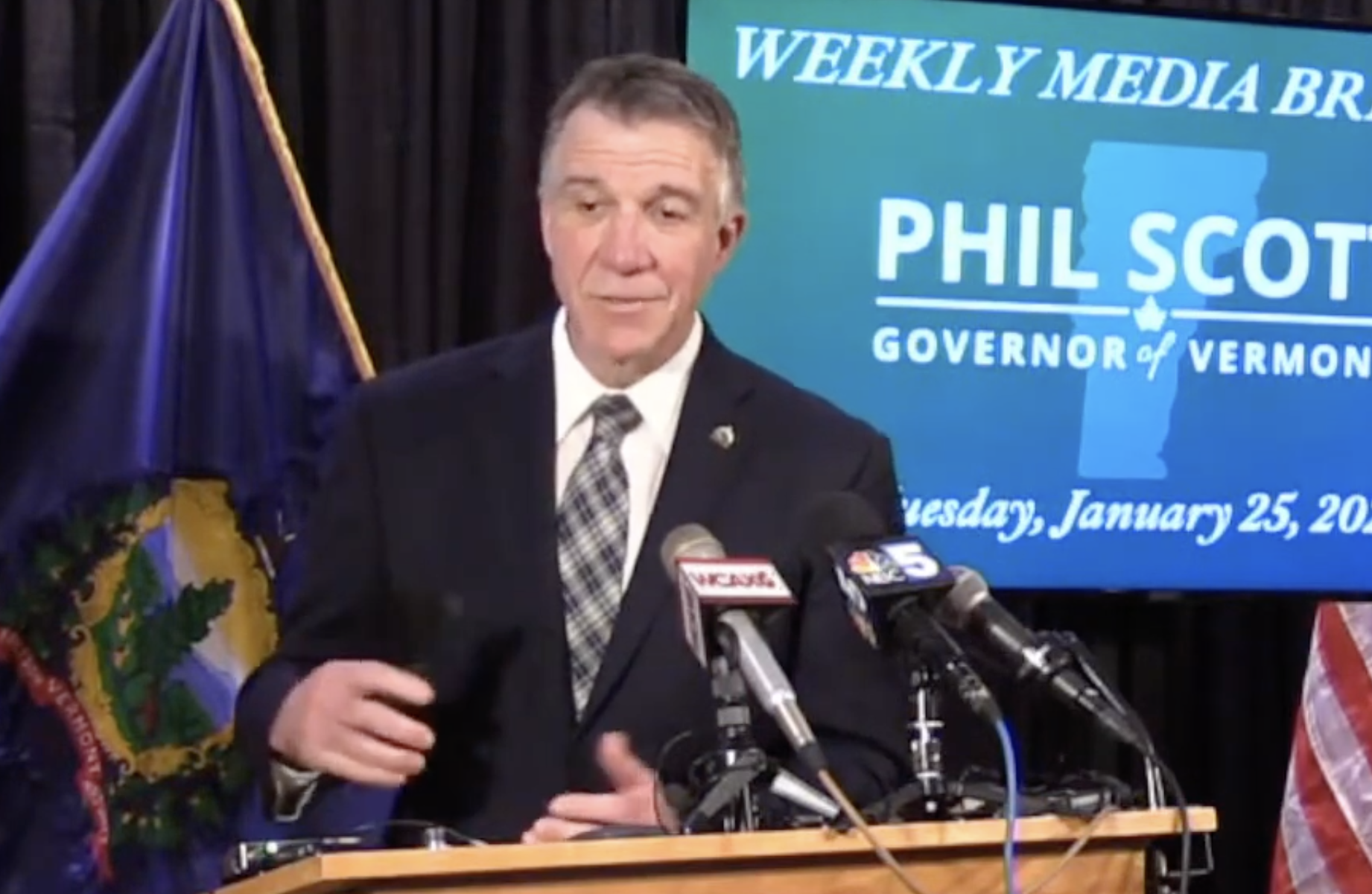
Gov. Phil Scott intended for his weekly press conference to be another rant against what the Legislature might do on housing reform. His basic message: Give me the bill that I want.

Which isn’t how things work when you have divided government, and the Dem/Prog supermajority has just as much claim to a mandate as the Republican governor. There’s give and take. There’s compromise. It’s called governance.

Eventually, the subject of Tax Commissioner Craig Bolio’s ill-fated trial balloon came up. You know, the one where he wanted to defer an unidentified bunch of school expenses for an unspecified number of years in order to artificially reduce property taxes this year? Yeah, the one that was shot down right quick by Treasurer Mike Pieciak due to concerns about what that kind of borrowing to pay for ongoing expenses, not any kind of capital investment would do to the state’s credit rating.

Scott, a fiscal conservative all his political life, seemed rather blasé at the prospect of triggering a credit downgrade that might hurt state finances for years if it bought him some short-term tax relief.

Continue reading

The Word “Cockamamie” Springs to Mind

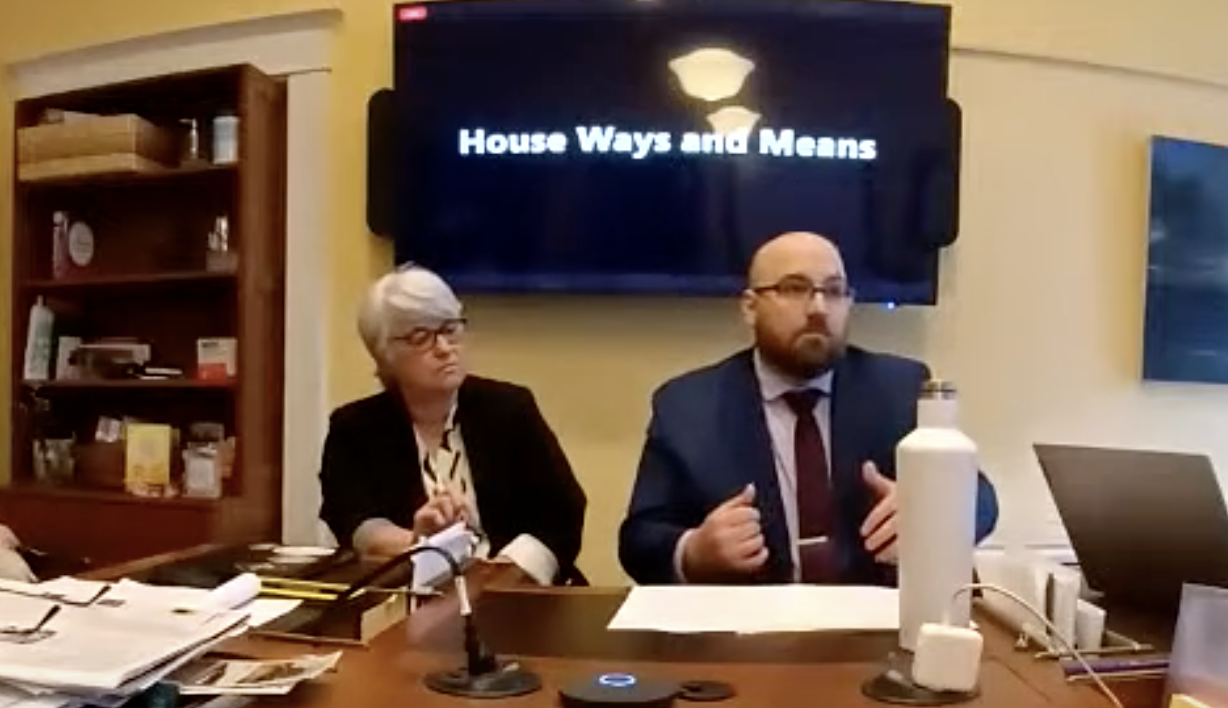
Sometimes when you’re a political appointee, you have to say stuff in public that you’ve been told to say. I’d like to think that’s what Tax Commissioner Craig Bolio was doing on Friday when he had the stones to approach the House Ways & Means Committee with a scheme that should never have seen the light of day.

Giving him the benefit of the doubt, Bolio was sent by his superiors to propose a painfully belated, half-baked plan (to call it a “plan” is being generous) that amounted to what Ways & Means chair Rep. Emilie Kornheiser later called a “payday loan.” Without the benefit of the doubt, I’d have to conclude that Bolio is unfit to hold a fiscally responsible position.

The idea, in short, was to reduce this year’s high property tax increases by deferring expenses over the next several years. Hey, let’s put our public schools on the layaway plan! What could possibly go wrong?

I wonder how Gov. Phil Scott would react if a Democratic or Progressive legislator made such a suggestion. Somewhere between “conniption” and “aneurysm,” I’m guessing.

Continue reading

Time for Another Great Idea to Be Quietly Smothered

It’s a good thing that Vermont’s left-leaning advocacy organizations are so inured to disappointment, because it’s about to happen again.

On Thursday, a coalition of groups announced they are banding together to promote a surtax on the wealthiest Vermonters. The Public Assets Institute estimates that a 3% surcharge on incomes over $500,000 would raise about $100 million to help meet Vermont’s needs, a substantial boost to the bottom line at a moment when we need serious public investment across a number of fronts.

Nice thought, but it ain’t gonna happen.

Gov. Phil Scott is against it. The Democratic Legislature has a long and storied history of aversion to broad-based tax increases for one or more of the following reasons: They’re afraid of being labeled as tax-and-spenders, which is a laugh because Republicans beat that drum constantly anyway; the fat cats who’d usually support Republicans are open to the Democrats because the VTGOP is so batshit; and/or their bloated caucuses include a substantial number of centrists who wouldn’t back a wealth tax.

This proposal might get a polite hearing in 2024, but that’s about all.

Continue reading

Phil Scott’s Tax Cut Hypocrisy

At his press conference yesterday, Gov. Phil Scott offered a mixed message to the state Legislature. He seemed to be holding an olive branch, but whether he’ll use it as a peace offering or a weapon remains uncertain.

His topic was the budget, and the differences between his plan and what’s on the table in the Statehouse right now. He cautioned against squandering our historic federal windfall, by which he means spending it in ways he doesn’t like. But he offered some praise for Senate budget writers on one important point:

I heard in Senate Appropriations yesterday they are concerned about creating cliffs by funding new programs with one-time money that will be difficult to address in the future. I couldn’t agree more.

It’s a point he’s made before. Use the one-time money for one-time investments, not to create or sustain programs that will remain on the books after the federal tsunami recedes.

I’ve got no beef with that concept. But the governor expresses none of that concern when it comes to cutting taxes. We’ve got the money right now, thanks to all the economic activity generated by all those federal dollars. We can afford some tax relief now, but any tax cuts we adopt this year will remain on the books indefinitely.

And he doesn’t care about that.

Continue reading

The Well-Off Are Flocking to Vermont

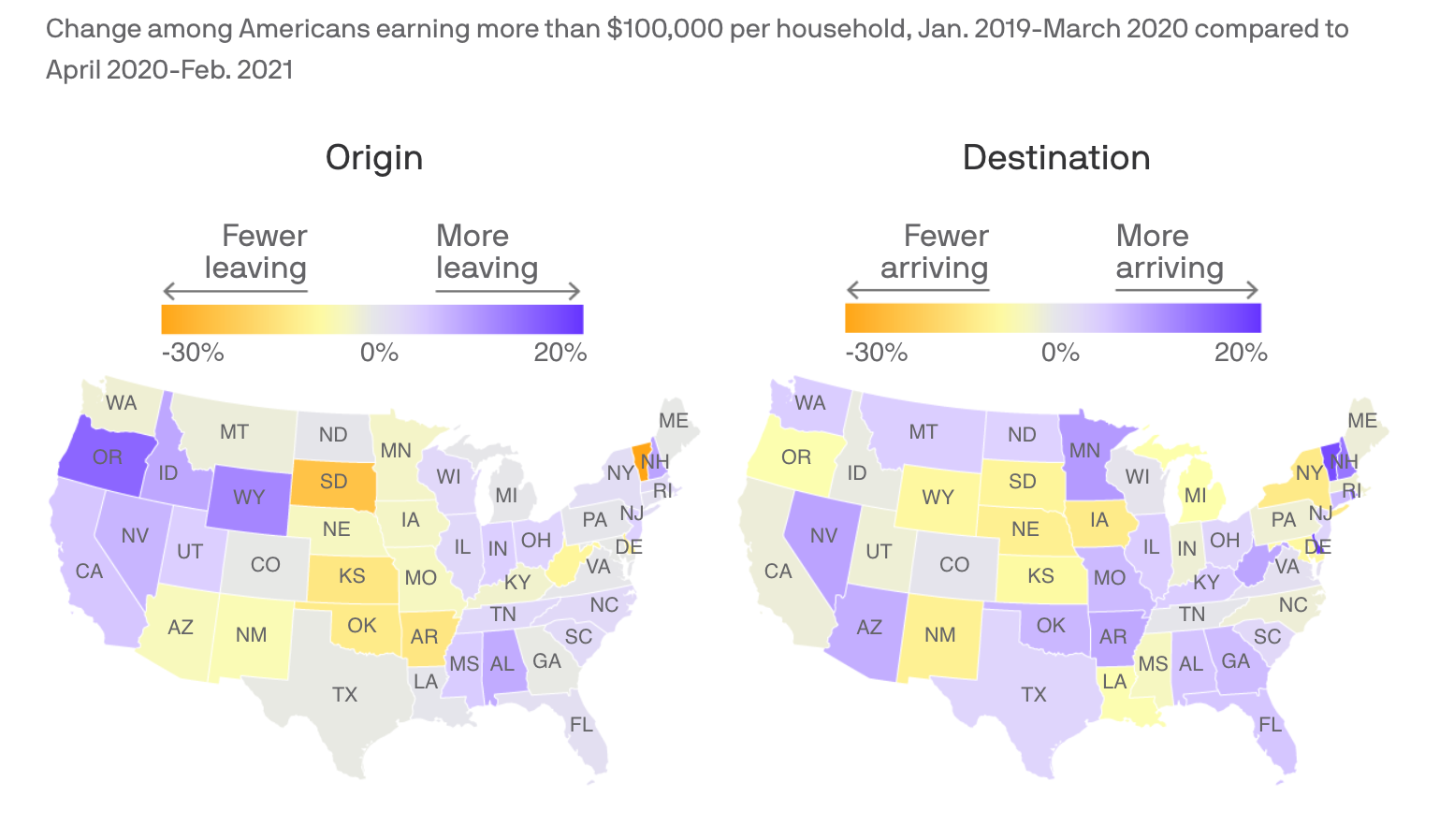
This graph is wonderful news for those who think Vermont’s economy needs to grow. (It is, as I’ve written before, very bad news for our housing supply.) The pandemic has made our state the most desirable in the nation for affluent Americans.

More desirable than our famously low-tax neighbor, New Hampshire. More desirable than the Sun Belt or the tax havens of Texas and Florida. We’re Number One, baby!

It’s too soon to tell if this dramatic shift will continue. But if it does, then it’s time to rethink our policies across the board, from taxation to education to broadband to economic incentives.

Continue reading

An Unsettling Incident in Senate Finance

Senate Finance Committee chair Ann Cummings is a mixed bag. She’s not the most imaginative or energetic policymaker; she barely bothers to campaign and waltzes to re-election every two years. She’s one of the many veteran senators with a very well-developed sense of entitlement.

On the other hand, she knows her stuff. That’s nothing to sneeze at when it comes to issues as complex as taxes and state revenue.

But that didn’t seem to be the case during a Thursday committee hearing. Quite the opposite; she was shockingly uninformed on one of the biggest financial issues facing state government in 2021. I couldn’t believe it at first, but then she did it again.

The subject was S.59, a bill introduced by Sen. Cheryl Hooker and four other senators. The bill is an attempt to address the glaring shortfalls in the state teachers’ and public employees’ pension funds — an issue brought to the forefront by Treasurer Beth Pearce this year. After having defended the funds throughout her tenure, she started ringing the alarm bell on funding shortfalls and advocating substantial changes.

The Dem-dominated Legislature now faces a choice between finding a big new pot of money for the funds, and imposing pain on two of the party’s most important constituencies. S.59 opts for the former; it would add a 3% income tax surcharge on Vermonters with incomes of $500,000 or more, and devote the revenue to filling the hole in the pension funds. Sen. Ruth Hardy, a member of Senate Finance and an S.59 co-sponsor, presented an initial look at the bill. It didn’t go well.

Pearce’s pivot has been the unexpected policy story of 2021 (so far). She’s been making the rounds of relevant legislative committees, laying out the problems and presenting lawmakers with the unpleasant policy choice described in the previous paragraph. On February 4, she offered her pension testimony to Senate Finance.

One week later, Cummings made it clear she didn’t have a clue about Pearce’s position or the status of the pension plans.

Continue reading