Category Archives: Opioid issues

A Band-Aid on a Broken Arm

Welp, Gov. Phil Scott has unveiled his 14-point “short-term action plan” (his words, underlining the lack of sustained commitment) to improve public safety in Burlington. And, unsurprisingly, it’s a combo platter of disappointing, punitive, and cheap. It’s more political than policy, aimed at demonizing Vermont’s biggest and most important city and avoiding his administration’s culpability for the problems that beset all of our communities.

Kudos to Seven Days’ Courtney Lamdin for spotlighting, near the beginning of her story, the most crucial shortcoming in Scott’s plan:

Conspicuously missing from the plan is an expansion of homeless shelter capacity in Burlington or elsewhere in Chittenden County, despite the dire need for it. The plan also ignores specific asks that Burlington city councilors made of Scott in a resolution they passed in August.

Yeah, ignoring dire needs is kind of Phil Scott’s jam. Remember in June, when I headlined a post about his veto of H.91 “Phil Scott Doesn’t Give a Fuck About the Homeless”? His Burlington “action” plan validates my point. He is, quite literally, the Levite averting his eyes as he walks by a wounded traveler. His plan is heavy on the punitive and light on the humanity. The goal is to remove the unfortunate from his view shed, not to actually help them. The best outcome for Scott’s plan is some short-term cosmetic improvement while the underlying economic and social causes of our problems continue to exact their toll.

Continue reading

Scott to Burlington: Eh

Gov. Phil Scott’s Thursday press conference was meant to deflect attention from his administration’s painfully slow approach to emissions reductions. The governor opted for his favorite diversionary tactic: Finding a straw man to punch. But the bigger takeaway from the event is his steadfast refusal to consider new policies — or even a drive up I-89 — in response to Vermont’s opioids crisis.

Let’s tackle climate first. Scott and Natural Resources Secretary Julie Moore (she of the excessively deliberate “progress” toward meeting our legally mandated 2025 emissions targets) asserted that an emissions-focused policy was wrongheaded. Instead, they said, there needs to be a balance between cutting greenhouse gases and making Vermont more resilient in the face of future climate disasters.

Scott backhanded “those who didn’t want us to focus on resiliency work” in the Legislature and claimed that “there’s been some pushback” on resiliency in the Vermont Climate Council.

I’d like some names, please.

There might be different opinions on the balance, but there is no one in the Legislature “who didn’t want us to focus on resiliency work.” As for the Climate Council, it was created by the Global Warming Solutions Act to further its statutory emissions targets. Resiliency isn’t the Council’s job. It’s like accusing FEMA of failing to enact permitting reform.

Enough of that. Now back to Burlington.

Continue reading

Pearl-Clutching in the Publisher’s Office

It’s been a long, long time since Seven Days began its life as a scrappy alt-weekly in the grand tradition of the Village Voice and the Boston Phoenix. Credit for sheer survival unlike those spiritual ancestors, but it’s safe to say that 7D is now the voice of comfortable Burlington, the Good Folk who habituate Leunig’s and the Flynn Center and love to amble undisturbed on Church Street and in Battery Park.

That’s my conclusion from co-founder Paula Routly’s latest Publisher’s Note, “Burlington Blues.” She’s far from alone in expressing dismay about crime, drugs and homelessness in the Queen City. But what’s missing in her column is the tiniest shred of compassion or empathy. She seems to be describing a plague or an infestation of vermin with no sense at all that there are living, struggling human beings on the other side of this equation.

Routly seems to expect that her “beautiful burg” will forever be a playground for the well-to-do, a clean, safe, secure landscape that can be enjoyed without a second thought. She doesn’t roll out the reactionary language of “lock ’em up” or call for the BPD to let loose a SWAT team, but she makes it clear that she just wishes The Unwashed would just go away, doesn’t matter where, somewhere, anywhere, and leave this “beautiful burg” to those who rightfully deserve it.

Continue reading

And While We’re At It, Why Not Bring Back Eugenics?

Can somebody do a wellness check on Bill Schubart, prominent denizen of Vermont’s shallow, brackish pool of “public intellectuals”? Because he just published an essay that brings to mind the toxic excesses of early 20th Century liberalism — you know, the fine folks who enthusiastically took up the eugenics movement.

No, he didn’t call for sterilization of the unfit. But he did advocate a return to the Good Old Days when there were asylums to warehouse the many, many types of people deemed “unfit” for proper society.

He did his level best to craft a frame of compassion around this appalling idea, but it didn’t work. When you start talking about removing certain people from society, you are headed down a dangerous road.

Continue reading

Why Don’t We Govern As If People Mattered?

Two stories on a common theme appeared Monday morning on VTDigger. The first was about a “spate” (their term) of deaths in Vermont’s prison system, mainly at the Springfield facility. The second was about another rise in opioid-related deaths that puts us on track to break the all-time record set in 2022.

In both, I heard echoes of the lamentable deal struck by the Legislature and Scott administration for a partial extension of the motel voucher program — an extension loaded with poison pills. Not only does the program leave 800 or so households without shelter, it also makes the voucher experience as unpleasant as possible for its clients from now on. Who are, just a reminder, some of Vermont’s most vulnerable. You know, the ones Gov. Phil Scott likes to say he’s committed to protecting. Echoes also of a fundamental approach toward human services programs for the poor: Make the experience difficult and unpleasant so recipients are incentivized to GTFO, one way or another.

It’s like a soup kitchen that dumps vinegar into its food because if it tastes good, people won’t be incentivized to get their own damn dinner. Mind you, not enough vinegar to make anyone sick; just enough to discourage them from partaking unless they’re truly desperate.

This approach is all too common in our social programs. It’s a lousy way to meet the needs of our most vulnerable. It’s morally questionable, and if you’re not into the “morality” stuff, it’s also counterproductive in terms of financials and outcomes. People suffer needlessly and face tougher barriers to achieving self-sufficiency, which I think is what we’re supposedly aiming for.

Continue reading

Here’s the Early Favorite for 2023’s Saddest Piece of Legislative Testimony

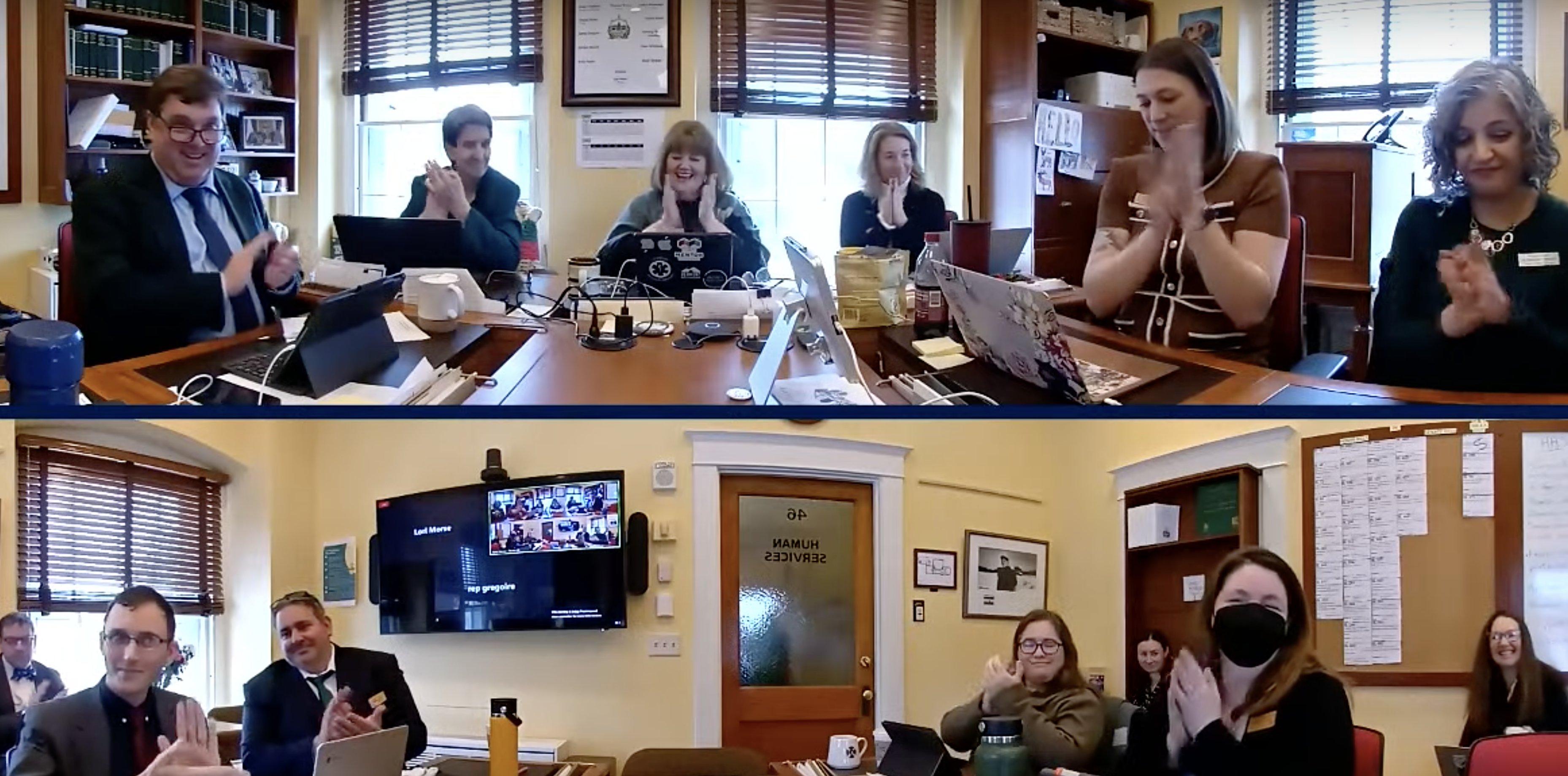
Pictured above: Members of the House Human Services Committee, giving themselves a round of applause after unanimously passing H.222, a bill that would do quite a few good things on overdose prevention. The bill would make it easier for providers to prescribe buprenorphine without going through the cumbersome process of getting prior authorization* from the state Health Department; improve access to needle and syringe disposal programs and pay for it with a fee charged to prescription drug makers; make it easier to site recovery residences; give reasonable protection against lawsuits for those who administer overdose treatments; and set up some studies on how to best administer treatment and reduce opioid-related deaths.

*Stick a pin in that. We’ll circle back to it in time, and you won’t want to miss it.

All reasonable. And all acceptable to the entire panel. The “Yes” votes included Republicans Anne Donahue and James Gregoire and right-of-center independent Kelly Pajala.

Which brings us to this guy.

Continue reading

Low People in High Places: The Latest in Stupid

Apologies from the Veepies Selection Committee, which has been overwhelmed with all the stupid and/or obtuse in our public sphere. I’m sure we missed a few, but here’s a selection featuring a whole lot of misplaced self-regard from those in positions of public trust.

FIrst, the Hey, Look, A Squirrel! Award For Attempted Misdirection goes to Jason Maulucci, spokesthingy for Gov. Phil Scott. When last we met, we were giving chief of staff Jason Gibbs a right roasting for maligning a public health expert who disagrees with the administration. Gibbs all but accused Dartmouth’s Anne Sosin of professional misconduct, saying she was “desperate to prove a false narrative” and that her analysis “conceals the full truth.” Those are serious things to say about an academic’s work product.

Maulucci, when asked for comment by VTDigger, defended Gibbs by ignoring the personal criticism of Sosin. Gibbs had merely “presented data from a neutral data tool” according to Jason Junior, who concluded with “There is nothing uncivil about pointing out facts.”

Exactly, Jason Junior. There is nothing uncivil about pointing out facts. But there is something extremely uncivil and downright unseemly about attacking Sosin’s integrity. Maulucci’s lame-ass defense doesn’t change that.

Still to come: a spate of ass-covering by the cops, and correcting a very racist public monument.

Continue reading

Where Are the Real People?

Two Senate committees, Judiciary and Health & Welfare, held a joint hearing Thursday morning about H.225, the “bupe bill.” It would legalize small quantities of buprenorphine, an opioid that’s often used as a substitute for, or a path away from, more dangerous street opiates. It passed the House by a lopsided 126-to-19 margin.

The fact that the hearing happened at all was a positive development. Last we heard, the bill was stuck in Senate purgatory with leadership wondering if they had time to properly consider it. The shape and substance of the hearing seems to indicate that the Senate will act on the bill. (The two-part hearing can be viewed here and here on YouTube.)

For one thing, the two committees met jointly. That’s not something they do very often. For another, they heard from a broad spectrum of witnesses — and Judiciary has set aside time Friday morning for committee discussion. By legislative committee standards, this is warp speed. (Also, Judiciary seems to be offended, but effectively chastened, by unfavorable media coverage of its obstreperousness, including multiple rants in this space. Suddenly the committee is expediting a number of bills that passed the House by huge margins.)

The witness list leaned heavily toward representatives of the justice system. Otherwise there was one UVM doctor, two Scott administration officials, two people who deal professionally with substance use disorder treatment; and former candidate for governor and lieutenant governor Brenda Siegel, the only witness on the docket without some sort of official imprimatur.

To me, there were two striking things about this hearing. First, the witness list was short on people with actual experience with substance use disorder and recovery. Second, there was a nearly complete lack of “real people,” i.e. non-credentialed members of the public.

This is standard operating procedure for legislative hearings. They tend to feature a relative handful of lobbyists, advocates, public officials and the like. And I think this is a serious problem for the lawmaking process.

Continue reading

Senate Looms Over Bupe Bill, Pillow in Hand

Funny thing happened when H.225, the bill to decriminalize possession of single doses of buprenorphine, moved over to the Senate after passing the House by a lopsided 126-19 margin. For those just tuning in, buprenorphine is a prescription opioid that can be used instead of riskier street drugs. Vermont’s death toll from overdoses has been climbing for years, and the decrim bill could save a lot of lives.

The bill reached the Senate on April 14. It was referred, not to the Health Care or Judiciary committees, but to the Rules Committee. It has languished there ever since, as the days in this session dwindle down to a precious few. (Legislative leaders are aiming for adjournment in mid-May which, despite the snow, is only three weeks away.)

And the Rules Committee has no meetings on its schedule.

This looks for all the world like a stalling tactic, as if leadership has decided (for whatever reason) to prevent the bill from reaching the Senate floor. And maybe that’s what it is, although Senate President Pro Tem Becca Balint says otherwise. Sort of.

“I’ve been meeting with the Chairs of Judiciary and Health & Welfare to try to find a path forward for this bill given the late date that it came over from the House. We did not want to vote it out of Rules until we had a sense of how long testimony and due diligence would take. Health & Welfare and Judiciary are planning a joint hearing on the bill this coming week. We know we are in the midst of a horrible surge in opioid-related deaths and we want to take all measures to help address this emergency. The Chairs want to be certain that this bill will have that impact.”

That’s a written statement received Thursday afternoon in response to my inquiry. Let’s take a closer look, and then invite an expert to make the case for immediate passage of H.225.

Continue reading