There’s something facile, something simplistic, about antiwar protests like the one at U.S. Rep. Becca Balint’s fundraiser last week. Because given the current situation, calls for a cease-fire or a unilateral Israeli cessation of hostilities are unrealistic. It’s just not gonna happen.
It can’t happen, at least not right now. The single goal of Hamas is the destruction of Israel. Hamas impoverished its own people in order to build an infrastructure of war and terror. It launched an attack on Israel knowing it couldn’t win, knowing it would trigger a destructive counterattack on combatant and non-combatant Palestinians alike.
And Israel is supposed to do what now? Stand down? Give peace a chance?
Voters are reportedly flocking to the polls in Ohio today, as part of a drive to enshrine reproductive rights in its constitution. A similar effort could not possibly have happened in Vermont thanks to our paternalistic, top-down system of government.
In case you haven’t heard the story, abortion rights advocates in Ohio mounted a successful petition drive to put a reproductive rights amendment on the state ballot in November. Republicans in control of state government, realizing the amendment was polling very strongly, ginned up their own ballot question to try to derail the November vote. “Issue 1” would raise the bar for constitutional referenda from 50% to 60%. (Last November, Michigan voters approved a reproductive rights amendment with 57% support.) Republicans then scheduled the Issue 1 vote for today in hopes of winning a low-turnout election. But early turnout has been very strong, and it looks like the Republican chicanery won’t work.
Point is, Ohio is on track to hand a stinging defeat to the anti-abortion movement thanks to a governmental process that doesn’t exist in Vermont because our founders decided to protect We, the People from ourselves. They did not create a mechanism for the public to gain access to the ballot.
Regarding reproductive rights, things have worked out just fine in Vermont because the Legislature was like-minded. But what if it wasn’t?
The Vermont Legislature has a well-established policy of avoidance when it comes to ethical standards. You see it in the weak-ass State Ethics Commission, which has no investigative or enforcement authority. You see it in the House and Senate ethics panels, which conduct their business behind closed doors (when they even bother to meet) and have never, ever taken action against one of their own.
And you see it in the useless financial disclosure rules they set for themselves. This has come to the fore with VTDigger’s multi-part exploration of lawmakers’ disclosures. It finds, no surprise to anyone who’s been paying attention, that the requirements are so minimal as to negate the purpose of disclosure, which is to reveal potential conflicts of interest.
Also, there’s no enforcement mechanism and no penalties for failing to disclose or failing to file at all. It’s amazing what happens when a group of people gets to set their own rules, isn’t it?
One of the excuses floated for this studied laxness is that Vermont Has A Citizen Legislature and lawmakers shouldn’t be expected to consent to fidiuciary proctoscopies in order to serve. They kinda-sorta have a point, although their citizenship doesn’t prevent abuses or change their obligation to serve the public interest.
But now the Legislature is taking a big step toward professionalism — at least when it comes to pay and benefits. Does this merit a revisit of ethics and disclosure rules? You bet it does.
Charity Clark stepped down today as Attorney General TJ Donovan’s chief of staff. The remarkably coy announcement of the move said she “has stepped down from her post to explore new opportunities” and would “make an announcement about her plans in the near future.”
Yuh-huh. She’s running for AG. She’s hinted as much, and it’s the most obvious reason for her sudden departure, which (a) apparently took immediate effect and (b) came only four days after Donovan announced he would leave office at the end of his term or possibly before.
I guess it ends all speculation that Clark might be elevated to acting attorney general should Donovan depart before Election Day, thus giving her the kinda-sorta incumbent’s edge. If so, it’s a noble and selfless move.
And it raises questions about Chris Winters, deputy secretary of state, who remains in office nearly three months after he announced his candidacy to succeed his boss, Jim Condos.
If Clark thought it best to resign before she even opened the doors on her campaign, why hasn’t Winters?
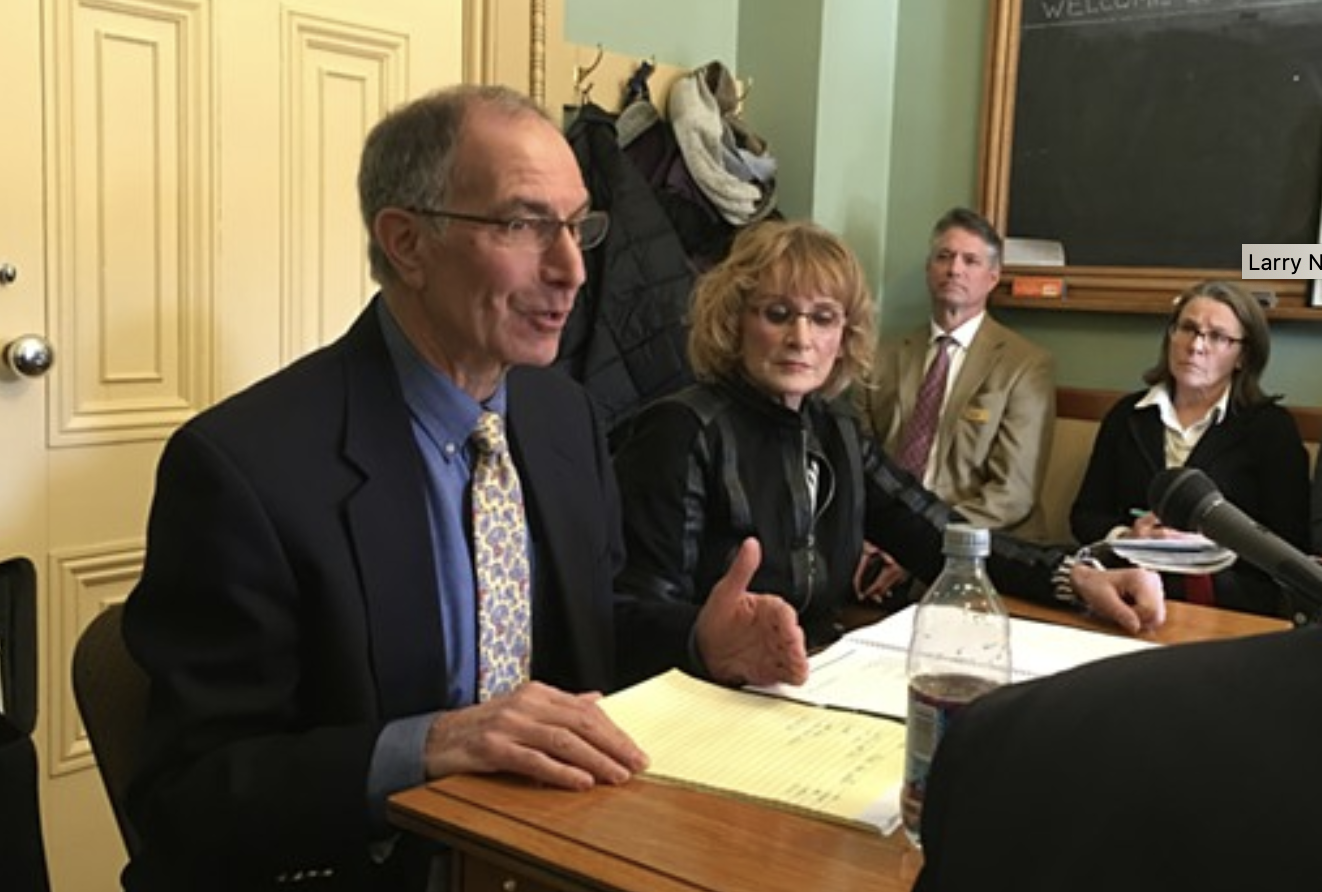
Let’s pour one out for Larry Novins, who just resigned as executive director of the Vermont State Ethics Commission. He earns full credit for lasting almost three years in a job with no resources, no power, and no real reason for existing besides allowing the Legislature to look like it gives a good goddamn about ethics.
Which, in reality, it doesn’t. Shame on all of ’em.
Novins’ departure was noted in a press release from the commission, which prompted absolutely zero coverage from the political press. It’s too bad, because he did his level best in service of a hopeless, thankless cause. That would be “governmental ethics in Vermont.” Nobody cares, man. Nobody cares.
The Ethics Commission has had a brief and undistinguished history, by design. It has managed to cling to existence despite the fact that it was clearly designed to fail, Norquist style. Its single accomplishment prompted a tsunami of negative reaction, and was ultimately scrubbed from the books.
And one other thing. All of the Commission’s work — all of it — is exempt from public records and open meetings law. If they did ever do anything, we wouldn’t know about it.
In case you think I’m exaggerating, here’s what Novins himself said in September 2019:
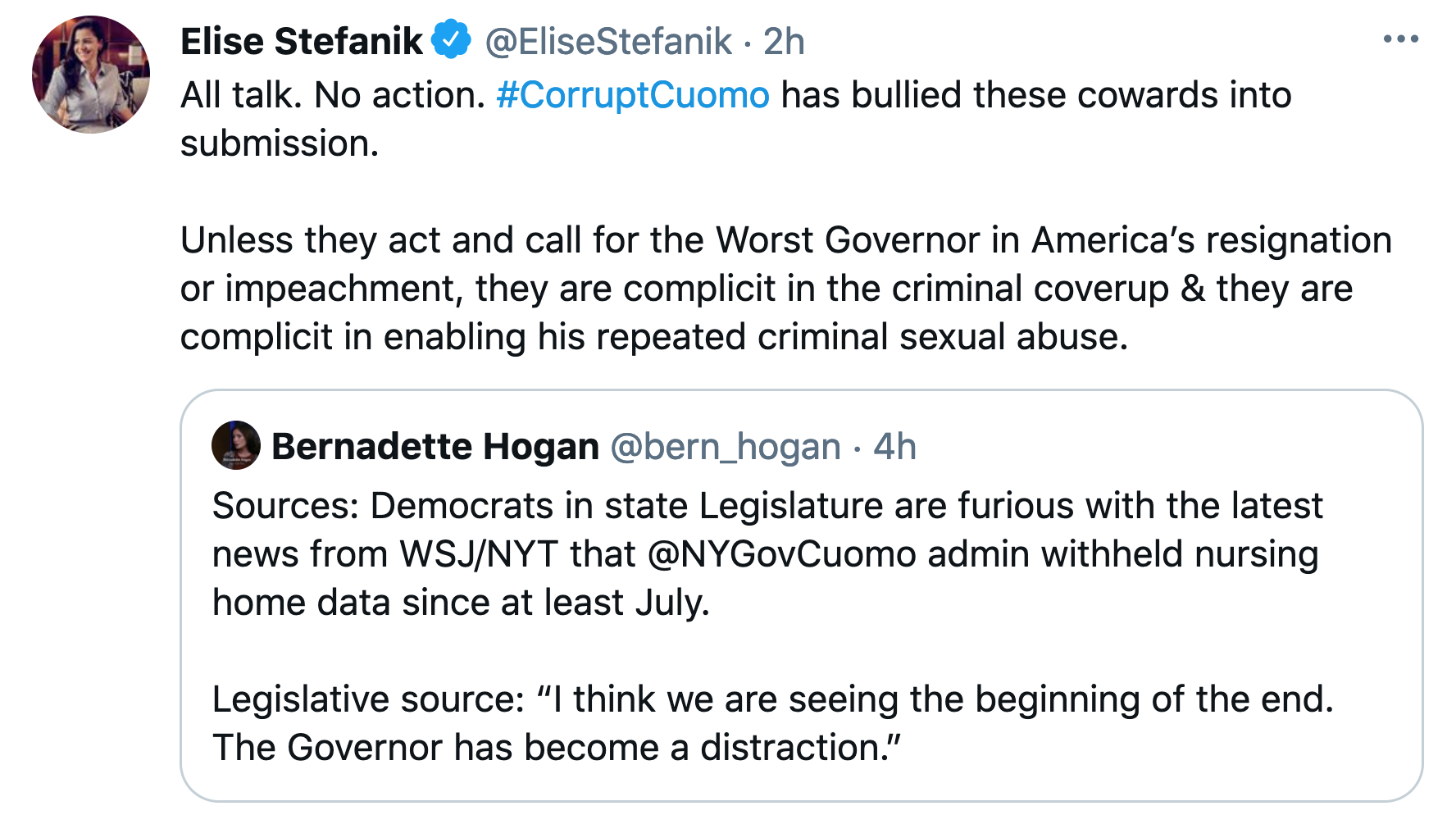
U.S. Rep. Elise Stefanik and… um…. What’s His Name
The distinguished representative of New York’s North Country has been on a tear lately, issuing tweet after tweet bashing Gov. Andrew Cuomo for making unwanted advances to women and for apparent dishonesty in reporting Covid casualties. A sampling:
Remind me again: Who’s that guy standing next to her in the photo above?
Hey, guess what! Vermont is one of only three states without any enforceable ethics standards in law. Let’s hear it for Vermont Exceptionalism!
The effort to change that state of affairs has been percolating along at a barely perceptible pace for years now. At every step along the way, it’s met with opposition by state lawmakers, who tend to be very protective of their rights and obligations. The basic argument is, “Vermont is better than that! We don’t need no stinkin’ ethics law!”
Which is like saying we don’t need speed limits because Vermonters are inherently safe drivers. The vast majority of public officials do their jobs right, just like the vast majority of Vermont drivers abide by the speed limit. But that doesn’t mean we don’t need police patrolling the roads.
The latest turn in this long, depressing saga came Friday afternoon, when the House Government Operations Committee approved H.135, a bill that makes a few minor changes in how the Ethics Commission does its business. Still secret, still unfunded, still toothless. The bill got unanimous support after committee leaders assured members that the bill didn’t really do anything.
Left for future debate are the tough items: Adopting a Code of Ethics in state law, deciding how enforcement will work, whether the Commission should have any powers, and whether it should have a big enough budget to maybe hire at least one full-time staffer. (Right now, the only paid person is Executive Director Larry Novins, and he’s part-time. You call the Ethics Commission, you’ll likely be shunted to voice mail.)
After the jump: A little history, and a look ahead.
In Thursday’s lieutenant governor debate, Republican Scott Milne launched an all-out attack on Democrat Molly Gray for her supposedly spendthrift agenda and, naturally, her spotty voting record. He scored some points in the process.
He also opened the door to an attack-oriented campaign at odds with his self-positioning as a moderate Nice Guy. And to considerations of each candidate’s personal history. He may live to regret that, since there are a few known skeletons in his otherwise unexplored closet. Let’s start by comparing the two candidates in their formative years.
While graduating from law school, becoming an attorney and establishing herself as a globetrotting professional deeply engaged in justice issues, Gray frequently failed to vote.
This is absolutely bloody brilliant. And I feel absolutely certain that Congressional Democrats don’t have the stomach to pull it off.
Let’s recap the situation as of midday, Tuesday December 17, 2019. The House of Representatives is due to vote sometime this week on articles of impeachment for That Most Impeachable Of Presidents, Donald Trump. In the normal course of events, the action would move to the Senate for a trial — and an acquittal, thanks to the LALALALA I CAN’T HEAR YOU Republican majority.
Where Lindsey Graham has promised not to listen to the evidence, thus pre-disavowing his duty as a juror. And where Majority Leader “Moscow” Mitch McConnell has openly acknowledged he’s conniving with Trump on trial rules and staging.
The game is fixed. So why play along?
The House should approve impeachment, and then sit on it. Don’t convey the articles to the Senate. There’s nothing that mandates immediate conveyance, and a lot of good arguments for playing keep-away.
For starters, the impeachment process has been the first time in living memory that the Dems have managed to wrest the spotlight away from whatever Trump is tweeting or helicopter-adjacent shouting. They’ve controlled the narrative, and will continue to do so this week.
After that, it’s in Republican hands once again — if the House gives it over to the Senate. The Dems would go back to playing defense.
Hey folks, pesky fly buzzing about. Time to get out the ol’ elephant gun.
Last week, Vermont’s own conservative writer, lobbyist and Trump apologist Guy Page took to the interwebs to downplay the significance of Our Felonious President’s dealings with Ukraine by making a completely baseless comparison to the actions of St. Patrick Leahy.
As Page would have it, while Trump exerted pressure on Ukraine to investigate Joe Biden’s dealings in that country*, Leahy also engaged in pressure tactics against that selfsame nation. In May 2018, Leahy and two fellow Senate Democrats sent a letter to the then-senior prosecutor of Ukraine expressing “great concern” that the prosecutor was impeding the Robert Mueller investigation, and urging him to cooperate. The Senators noted that they had been “strong advocates for a robust and close relationship with Ukraine.” Without saying so, they implied that their advocacy could be subject to change.
*Nice of Page to acknowledge Trump’s pressure tactics. Although he characterizes it as “Trump’s pursuit of justice,” ahem.
Aha! See? A classic case of “both sides do it.”
Ehh, not so fast, buddy boy. Trump and Leahy both communicated justice-related concerns with Ukrainian officials, to be sure. But that’s where the similarities end.









 The Vermont Political Observer.