Category Archives: climate change

Have Our “Most Vulnerable” Become Our “Most Disposable”?

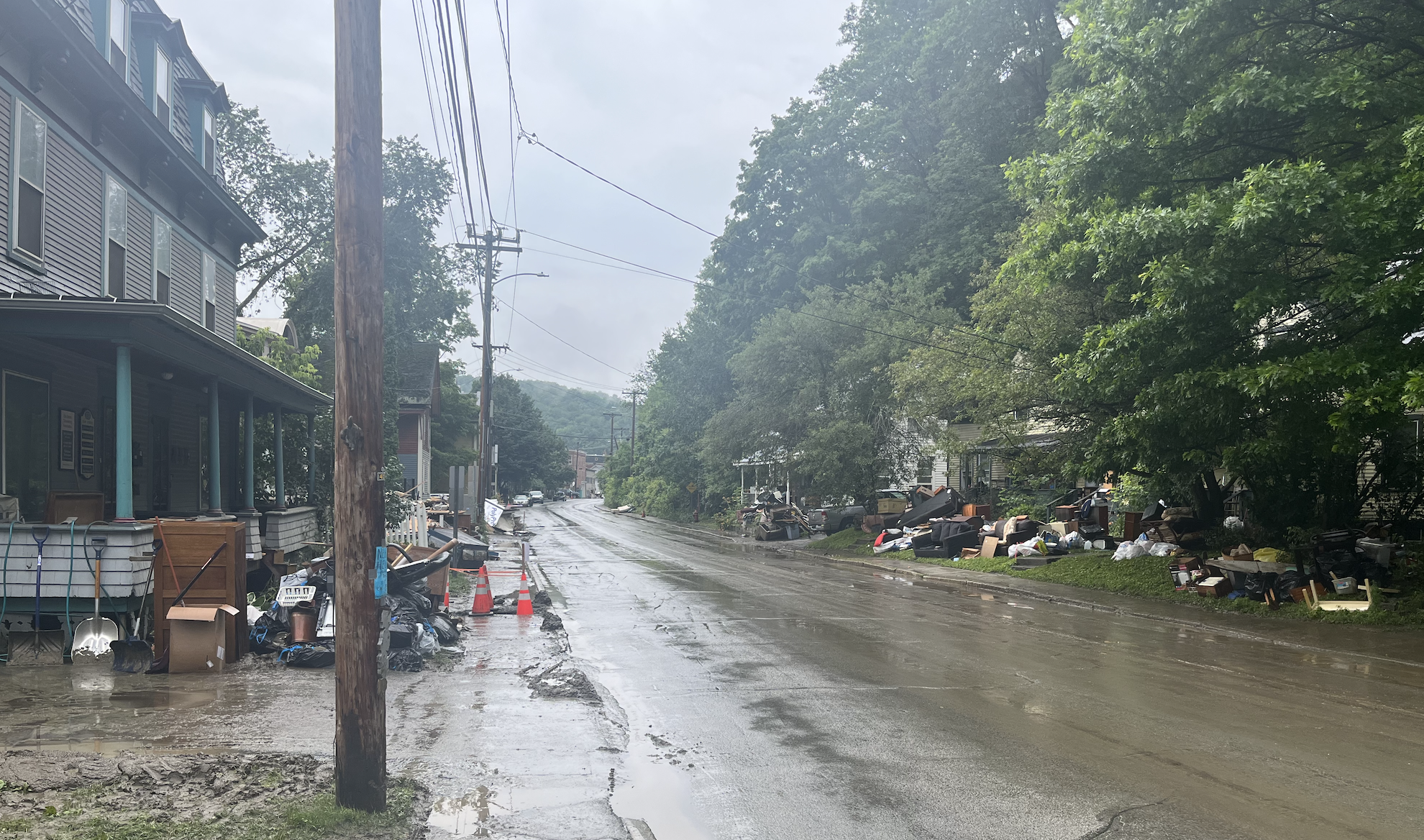
The scene above is on Elm Street in Montpelier, one block over from Main. It’s a low-lying stretch running parallel to the North Branch of the WInooski River. And it’s one of thousands of similar city and town streets where poor and working class people live.

Or used to, anyway. Where they live now, I have no idea.

Vermont’s cities and towns were largely built along waterways, which were used as open sewers for industries of all kinds. That’s why your typical Vermont town has its back to the river. Nobody wanted to be anywhere near it.

So, of course, that’s where the poor and working class people lived while their bosses took the high ground. You didn’t see any mounds of trash, each one representing a ruined life, in front of the stately homes on College Street, now did you?

And still today, the poor and working class people live in low-lying areas prone to flooding because that’s where the affordable housing is. Those areas are more and more flood-prone as climate change bears its fangs. It’s a huge and largely unspoken climate justice issue that we have yet to address in any comprehensive or meaningful way.

In the meantime, how many of those people have just joined the ranks of the unhoused — just as Our Betters have shut down eligibility to the motel voucher program except in rare circumstances?

Continue reading

This Is Our Monster

The first draft of history is being written about The Great Flood of 2023 or whatever we’re going to call this one. It’s all about doughty Vermonters stepping up in the face of adversity, banding together as communities, helping each other working day and night, and generally being the very definition of noble, selfless Vermonters.

There’s a lot of truth in that narrative. But.

Well, two buts. First, I’m not sure how different we are from anywhere else hit by a devastating event. Did the people of the Hudson Valley turn their neighbors away? Did the emergency responders in New Hampshire clock out at 5:00 after putting in an eight-hour shift? I don’t think so.

Second, and this is the big one. The Great Flood of 2023 should be the bellwether event that forever lays to rest the polite fiction that Vermont is immune from the growing effects of climate change, that this lovely little theme park is uniquely blessed by God or the Gods or Mother Earth and if only we commit to preserving its every jot and tittle, the Vermont of our fond imaginings will go on forever.

Nope. The monster we have created is on the move, and it cares not for your precious Vermont exceptionalism.

Continue reading

Vermont’s Renewable Energy Sector Has Taken a Dive Since 2016. Gee, What Happened at the End of That Year?

The good folks at Renewable Energy Vermont have issued a new report called “No Good Reason” which chronicles the extreme slowdown in solar energy projects since 2016. As seen in the above graph, Vermont’s rollout has slowed at the same time that solar is on the rise across America.

Two words missing from the report: “Phil Scott.”

Yep. the report shows that since 2016, state regulators have done their level best to delay and defeat solar energy development in Vermont. But while it assigns blame to the Public Utility Commission, the Department of Public Service and the Agency of Natural Resources, it skirts around naming the man responsible for appointing those officials and setting the policy course they all follow. Also unmentioned: political appointees like DPS Commissioner June Tierney, ANR Secretary Julie Moore, PUC Chair Anthony Roisman, and PUC Commissioner Margaret Cheney, a.k.a. the wife of U.S. Sen. Peter Welch.

Maybe REV is trying to be diplomatic. Myself, I think they’re cowards.

Still, it’s a great report that quantifies what’s been obvious for years: the Scott administration is happy to obstruct solar in Vermont and meet our renewable energy needs with power from Hydro Quebec.

The result: Vermont ranks 48th in the nation in meeting its electricity needs within its borders. Only Massachusetts and Delaware, small states that consume a lot more energy than Vermont, rank lower.

Continue reading

Dear Democrats: Congrats on Your Quick Dispatch of the S.5 Veto. Now, Could You Spare a Nickel of Your Political Capital for the Homeless?

This was the happy scene yesterday as Senate Appropriations Committee chair Jane Kitchel peremptorily ended discussion on the housing portion of the FY2024 budget, which makes no provision for extending the motel voucher program that currently shelters 80% of Vermont’s unhoused. Kitchel herself seems excited; the rest of them look like they’d rather be anywhere else.

This morning saw a much more celebratory occasion, as the House quickly dispatched Gov. Phil Scott’s veto of S.5, the Affordable Heat Act. And much as I hate to rain on the majority Democrats’ victory parade, I have to wonder why they couldn’t spare just a tiny bit of their abundant political capital to avoid the imminently avoidable humanitarian crisis that will unfold if the voucher program ends on schedule.

The 107-42 override vote in the House was an impressive display of political power. The Democrats easily walked over a governor who, at last check, enjoyed a 78% approval rating among the voters.

And yet, on the voucher issue, legislative Democrats made common cause with the Scott administration and threw 1,800 of our most vulnerable households under the bus. It’s a point of comparison that cannot be ignored.

Continue reading

Phil Scott Wants to Have His Cake and Veto It Too

Gov. Phil Scott’s veto of the Affordable Heat Act followed a familiar pattern for the most veto-happy governor in Vermont history. Rather than taking a conservative stance on policy, he focused on a flimsy process-oriented argument. It’s a tactic that allows him to claim the mantle of moderation even as he makes himself an obstacle to progressive ideas.

Just ask him, he’ll tell you he’s all for fighting climate change — but not this way.

The problem is, if we restricted ourselves to climate policies with the Phil Scott Seal of Approval, we’d miss our legally mandated targets for emissions reduc —

— oh wait, we are missing our legally mandated targets for emissions reductions!

Less than a week ago, Scott’s own Agency of Natural Resources issued its latest report and forecast on greenhouse gas emissions, which “predicts that Vermont will get halfway to its 2025 requirements and slightly less than halfway to its 2030 requirements.”

But that’s no big deal for an administration that thinks it’d be just fine to miss the 2025 and 2030 requirements as long as we hit the big one in 2050. ANR Secretary Julie Moore has said so herself. And the governor has expressed the same sentiment.

Continue reading

Turtle Season

In January, when a new legislative session begins, ambitious agendas are rolled out. Big bills are proposed. Committees are ready to get down to work. This year, hopes were especially high on the Dem/Prog side, thanks to their historically large majorities in the House and Senate.

And then stuff starts to happen. Things get complicated, or are perceived to be complicated. The days rush by like the old movie trope of a calendar’s pages flying in all directions. Now, suddenly, time is short, hopes are muted, compromises are made, bills are sidetracked, and the aspirations of a new session lay in tatters. Yes, it’s Disappointment Time.

Necessary stipulations: Lawmaking is hard. It takes thorough consideration. It takes time, a commodity that’s always in short supply. Building majority support is complicated work, even when a single party holds all the cards. The Vermont Democratic Party is not a monolith; lawmakers have their own beliefs and constituencies. Many a Democratic lawmaker would have been a Republican before the VTGOP went off the rails. Now they’re moderate Democrats who often don’t support the party’s agenda.

That said, the VDP puts forward a platform every two years and urges people to give them money and elect Democratic majorities so they can get stuff done, not so they can think about it and decide that maybe it’s not such a good idea after all and they need to give it more study. It’s definitely not so they can parrot Gov. Phil Scott’s assumptions about public policy, and there’s a hell of a lot of that going on right now.

So let’s take a look at some of the areas where the Brave Hopes of January have given way to the Turtling of March.

Continue reading

Duval Picks Up Moore’s Envelope, Rips It To Shreds, Flings Pieces Into the Air

The storm clouds are gathering. The forces are assembling. I don’t think it’s an exaggeration to say that the Scott administration is going to war against the Vermont Climate Council and any progressive climate legislation that the Statehouse majority might send to the governor’s desk.

Last week, we saw Natural Resources Secretary Julie Moore give a “back-of-the-envelope” guesstimate of the short-term costs of S.5, the Affordable Heat Act, which she herself acknowledged was probably inaccurate. Then, on Tuesday, there was an unusually aggressive riposte by Jared Duval, a member of the Climate Council. Duval pretty much ripped Moore’s testimony to little tiny bits. (Video of the hearing is here starting at the 1:40 mark; his written testimony can be downloaded here.)

Duval submitted a lengthy, detailed written statement that destroyed Moore’s testimony line by line and concluded that it was “inappropriately selective, improperly done, and deeply misleading.”

No punches pulled, then.

Continue reading

Top Administration Official Invites Senators to Disbelieve Her Testimony

Some people in the Scott administration strike me as experts in their field who don’t necessary buy official policy, but stick it out in hopes of influencing said policy. Natural Resources Secretary Julie Moore is at the top of that list, as is Health Commissioner Dr. Mark Levine. Sometimes when Moore is shilling the company line she seems less than 100% behind what she’s saying.

But inviting lawmakers to discount her testimony? That’s a new one.

Moore appeared on January 26 before the Senate Natural Resources Committee. The topic was S.5, the Affordable Heat Act, previously d/b/a the Clean Heat Standard. Moore was there to deliver dire news about the short-term costs of the Act and the lack of in-depth research on its consequences.

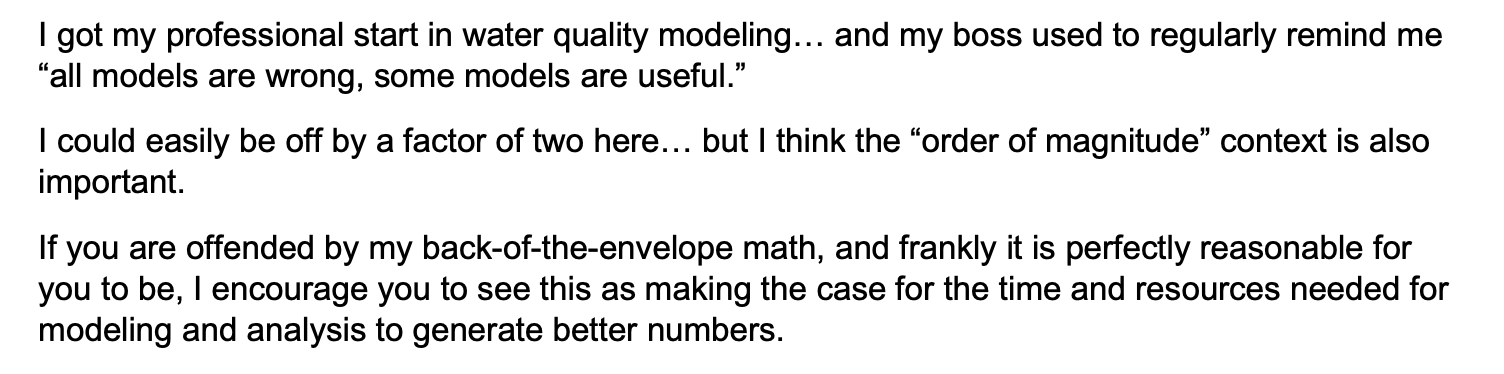
She acknowledged that her “back-of-the-envelope math” could “easily be off by a factor of two here.” She even said it would be “pefectly reasonable” for committee members to be “offended” by her guesstimates. VTDigger reported these remarks but failed to express how unusual, if not downright weird, it is for a state official to cast such doubt on their own testimony.

Mind you, these caveats weren’t off-the-cuff. They were part of her written testimony. Here’s the passage in full.

The administration is openly opposed to S.5 and, indeed, to any strong steps against climate change. In that context, one would suspect that administration officials would, if anything, exaggerate the negative impacts of S.5. And Moore openly courted that kind of suspicion.

Continue reading

Phil Scott’s Charmless Offensive

Since the beginning of his fourth term, Gov. Phil Scott has been busily drawing lines in the sand and daring the Legislature to cross them. It’s a strategy that seems to borrow much more from his years at Thunder Road than from his allegedly collaborative approach to governing.

But he’s not stopping with public defiance of the Democratic majority. He’s also putting out a series of aggressive policy stances that threaten to further inflame relations with majority Democrats. First there was the proposal to shift state retirees’ health insurance from Medicare to Medicare Advantage, the Potemkin Village of senior coverage. That proposal was cheekily unveiled during campaign season, when you might think he’d at least pretend to be friendly to the state employees’ union. Second, his proposal to spend $900,000 to study an issue that’s already being studied by the state’s Climate Council.

And third, the Department of Public Safety’s transparently political plan to publish a politically motivated (and dismally stupid) crime “heat map” that won’t help the public understand crime trends but will give the administration another cudgel for its attacks on criminal justice reform.

Continue reading

Get Ready for Fight Club in the Statehouse

The coming biennium may be the most combative in recent memory. The best comp might be Jim Douglas’ final years in office when he had huge budget battles with the Democratic Legislature and saw his veto of marriage equality overridden.

The stage is set. Phil Scott comfortably won re-election, and can rightly claim the overwhelming support of the Vermont electorate. Legislative leaders can equally assert a mandate, given the fact that the Democratic slash Progressive caucuses are at historic highs. Legislative leadership will have a nice margin for error on veto overrides.

On top of all that, the next couple of budget cycles are going to be tough. The federal tide of Covid relief funds has made it easy to pass budgets — until now. Tight budget times and both sides claiming mandates? That spells trouble by the bushelful.

Continue reading