Category Archives: Campaign finance

The Progressives are kinda screwed

Whiter the Progressive Party? I don’t know; there isn’t a clear path forward, and obstacles litter the landscape. They’ve gained strength in the legislature, mainly by running candidates on the P/D or D/P tickets; but they’ve just about reached the limits of that tactic, and may have hit a glass ceiling.

The Progs are anxious to make a splash in 2016, having sat out the last three gubernatorial elections in order to give Peter Shumlin a better shot at creating a single-payer health care system, hahaha. His abandonment of that goal, barely a month after his third re-election victory, plus the Dems’ habit of triangulating to the center on a host of issues, has left the Progs in a bitter mood. They’re itchin’ for a fight, and would especially like to field a credible candidate for governor.

That’s looking increasingly unrealistic. For starters, nobody seems to want to run.

This is an unintended side-effect of the Prog/Dem strategy, which has put several Progs in positions of legislative influence. Examples: Tim Ashe chairs the Senate Finance Committee; Anthony Pollina has a bully pulpit in the Senate; organic farmer David Zuckerman is vice chair of the Senate Agriculture Committee; and Chris Pearson is vice chair of the House Health Care Committee. One could argue that the Progs have been granted more influence than their sheer numbers would warrant. Or, in the words of Lyndon Johnson, the Democrats saw it’s better to have the Progs inside the tent pissing out, than outside the tent pissing in.

And indeed, it’d be hard to give up that level of influence to make a long-odds, short-funded bid for higher office.

Compounding the difficulty is that any high-profile Progressive would likely depend on public financing. That was a difficult enough pursuit in previous years (just ask Dean Corren or John Bauer). Now, it seems to have become completely untenable.

Continue reading

Sorrell vs. the record, part 2: Campaign reimbursements

Sorry for the delay in this continuing series; it’s tough work, slogging through a solid hour of Bill Sorrell. He is remarkably inarticulate for such a prominent figure.

SorrellDoggAnyway, I’m taking a closer look at Our Eternal General’s comments in an interview
with VTDigger’s Mark Johnson. I think it’s worthwhile because this was the first time Sorrell has been quizzed at length about allegations of campaign finance funny business and excessive coziness with high-powered lawyers soliciting state contracts.

Part 1 compared Sorrell’s remarks with the public record about the MTBE lawsuit. Today, we turn to Sorrell’s fuzzy reporting of expense reimbursements by his campaign fund to himself.

The matter was raised last spring by Seven Days’ Paul Heintz:

Several times a year, candidates must publicly disclose each campaign expenditure they make, “listed by amount, date, to whom paid, for what purpose,” according to state law.

A review of Sorrell’s recent filings shows that he has routinely ignored the rules. Sixteen times over the past four years, Sorrell’s campaign has reimbursed him for hundreds, and sometimes thousands, of dollars’ worth of expenses paid out of his own pocket. In each instance, the campaign provided only a vague explanation of what Sorrell bought with the campaign cash — and never once did it disclose who it paid.

Sorrell’s response: Hey, a lot of people do it that way.

Continue reading

Milne for Senate?

Curious item landed in my inbox this morning: an email from Scott Milne.

Well, not a personal email — it was a blast message to his mailing list, entitled:

Scott Milne challenges Pat Leahy to get money out of politics.

The message slams Leahy for holding a fundraising event over the weekend, at which attendees were (according to Milne) charged “$5,000 for face time with Vermont’s senior Senator.” Milne compares this unfavorably with Leahy’s predecessor, St. George Aiken, who “spent $17.09 on his entire last campaign for the Senate in 1968 [and] spent a total $4,423.03 for all six of his U.S. Senate campaigns combined.”

Well, in 1968 Aiken occupied both the Republican and Democratic slots on the ballot, and managed to win re-election with, ahem, 99.9 percent of the vote, which makes me think he wasted seventeen bucks. The bulk of his career took place when the GOP absolutely ruled the roost in Vermont. But I can just hear Milne say, “Leahy is as bulletproof as Aiken; why raise money at all?” To which Leahy would reasonably reply, “In politics, you never know.” Especially since conservative groups have begun to spend money on Vermont elections. It’s only prudent for Leahy to build up a warchest.

But the biggest question raised by Milne’s email is simply, Why? Why is he attacking Pat Leahy?

If this were any politician not named Scott Milne, the answer would be obvious: he’s going to run for U.S. Senate. In Milne’s case, it might simply mean he got out of bed this morning and decided to write a letter.

Continue reading

The Eternal General bows to the inevitable

It only took him about five months to figure it out, but Bill Sorrell finally announced today that he will not seek an eleventy-billionth term as Vermont’s Attorney General.

The end has been obvious to all since the early May appointment of former State Rep. Tom Little to head an independent investigation of Sorrell’s illegal (or at least thoroughly squicky) campaign finance activities.

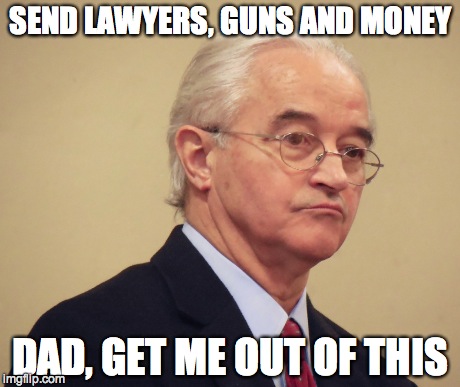
SorrellZevonReally, the end has been all but obvious since Sorrell’s disastrous decision last March to throw the book at Dean Corren for an insignificant-at-best violation of the public financing law. Sorrell had alienated a lot of people over the years with his overzealous prosecution of campaign finance law and his underzealous pursuit of just about everything else in his purview. L’affaire Corren left him friendless in Montpelier and in Democratic and Progressive circles (he long ago lost the Republicans), with the possible exception of Sorrell’s political godfather, Howard Dean.

Today, the end came not with a bang, but an emailed whimper. Paul Heintz:

For a man who has spent much of his adult life in public service, Sorrell made his announcement in a remarkably low-key fashion. Rather than holding a press conference, he delivered the news in a terse, five-sentence statement emailed to reporters Monday afternoon.

Unsurprisingly, he couldn’t see any advantage to be gained from taking questions at his own political funeral.

Continue reading

Everybody in the pool

So the news broke on Labor Day: Phil Scott announces that he will announce he plans to announce a run for governor.

It’s more than a year till Election Day, and we’ve already got extremely competitive races on both the Democratic and Republican sides. Pop quiz for Vermont history buffs: when was the last time that happened? If it ever has?

And I do have a prediction. Not on the winner; aside from Scott wiping the floor with Bruce Lisman in the GOP primary, it’s way too early to pick winners. But I can say, without much trepidation, that this will be the most expensive campaign for a state elected office in Vermont history.

Heck, there may be more money spent in the primaries alone than in any previous full campaign.

Continue reading

The Littlest Boondoggle

A few days ago I heard, second-hand, of a brief encounter between an anonymous Vermonter and one of the state’s town clerks. The gist: the clerk was talking about a three-and-a-half-day workshop coming up this week. The clerk saw it as kind of a waste of time and taxpayer money, especially since it would be held in the tony precincts of the Jay Peak resort.

The session iis being held by the Secretary of State’s office, and is designed to teach clerks about the new integrated software system currently being implemented. Okay, fine, but does it really take three and a half days? And why Jay Peak, of all places? Doesn’t that cost a lot?

Questions worth asking, I thought. So I went to the source, Mr. Secretary Jim Condos himself. What I found out is that the unnamed town clerk was telling the truth, at least technically; but there were reasonable explanations for all of it. A little disappointing for political scandalmongers, but a story worth telling nonetheless.

Continue reading

Seven Shades of Nothing

After a couple of big surprises Wednesday morning, the rest of Campaign Finance Filing Day was rather a damp squib. Nothing much was revealed. Unless, that is, the “nothing” is in itself significant.

And I wouldn’t be a political blogger if I couldn’t make something from nothing.

And so, theVPO presents the top seven nothings and what they might mean.

In the race for Governor, four of the five top prospective candidates did nothing. A marginal hopeful did the same. As for the potential Democratic faceoff for Attorney General, neither incumbent Bill Sorrell not declared challenger TJ Donovan reported any new activity.

None of this is terribly surprising. Among those potential gubernatorial candidates, only Matt Dunne had an existing campaign structure (dormant since 2010) to accept donations. And by Vermont standards, it’s still extremely early for anyone to be beating the bushes.

The two likeliest Democratic candidates for governor not named Dunne, Shap Smith and Sue Minter, didn’t seek funds for a corner-office run. Smith reported a bit of fundraising for his State House campaign kitty, easily transferable should the need arise. This leaves Dunne with a sizeable lead — but there’s a lot of time to catch up. In this regard, Dunne’s dollar total is less significant than his ability to quickly sign up a brace of top-tier liberal donors in Vermont and in Silicon Valley.

On the Republican side, the losing 2012 nominee, Randy Brock, didn’t report anything. The putative front-runner, Lt. Gov. Phil Scott, didn’t do any new fundraising — but he has nearly $100,000 left over from his 2014 campaign, so he’s definitely in no hurry.

And then there’s Dan Feliciano, former Libertarian turned kinda Republican, who’s been pondering a second run for governor.

Continue reading

Matt Dunne lays down a marker

There are still many reports yet to be filed, but it looks like the big news from today’s midyear campaign finance deadline will be Matt Dunne’s hefty, and heavy-hitting, finance report. The former State Senator and onetime gubernatorial candidate reports $115,000 in fundraising — but since the report was prepared, he says, he’s added another 20K to the total, bringing his tally to $135,000.

Which is particularly impressive when you consider that he’s done almost all of that work in the last ten days. “Governor Shumlin made his announcement [of non-candidacy] only four or five weeks ago,” he said. After that, Dunne deferred to his political mentor, Congressman Peter Welch, who announced he would not run for governor on June 26 — the very day that Dunne was going out of town for “a long-planned family vacation.”

And yes, if you scan his list of contributions, the earliest date you’ll see is July 6. And the first names on the list: the heavy Dem donors Jay and Caroline Canning. Jay owns the upscale Hotel Vermont. Dunne kept his virtual rolodex* spinning as he contacted well-heeled Vermonters and his many acquaintances in Silicon Valley; Paul Heintz has many of the details in his “Fair Game” column. Suffice it to say that he’s cut a swath through the roster of deep-pocketed Democrats. (A couple names not mentioned by Heintz: Will Raap of Gardeners Supply, the Growald family of Woodstock, and from across the river, former Democratic Party National Committeeman Peter Burling and members of the Taylor family. Dunne’s wife is the author Sarah Stewart Taylor [hi, Sarah]; it’s always nice when you can marry well.)

*Come on, you don’t think a Google executive has an actual Rolodex, do you?

It’s hard to interpret this as anything but a strong marker — a sign to other potential candidates that Dunne is dead serious and has a lot of support, in spite of his nearly five-year absence from statewide politics. Absence, at least as a visible part of the process; he says he’s been heavily involved in various endeavors in Vermont that have kept him very much in circulation.

Continue reading

Deep-pocketed Lieutenant Governor hopeful stakes his claim

Well, here’s an interesting tidbit from Campaign Finance Reporting Day. (July 15 is a deadline for campaign finance reports.)

Brandon Riker, Brattleboro resident and (as far as I know) the only declared candidate for Lieutenant Governor, has raised over $100,000 for his campaign.

That number almost made me shoot Vermont Coffee Company coffee out my nose.

And then I looked down the list of major donors, and one name dominated the list.

“Riker.”

Young Brandon has given his own campaign $58,500. Other people named Riker (Brent, Craig, Julia, Leslie, Barbara, Dale, and Stephanie) have kicked in $28,000.

Nice to be a member of a family that can spare 86 grand on a newcomer’s first political campaign.

Continue reading

Kremlinology III: the public and the private

Not to beat a dead horse, but something just occurred to me about Bill Sorrell’s presence and/or absence at recent gubernatorial signing events.

To recap, on Monday I noted our Eternal General’s conspicuous absence at two recent events, and the even more conspicuous presence of Sorrell’s once and (perhaps) future challenger, TJ Donovan. Three days later, the Governor’s office released a photo of Shumlin signing a bill in the presence of Sorrell and many of his staffers.

But there’s one huge difference between the latter occurrence and its predecessors.

The two non-Sorrell signings were public events with the media on hand. Thursday’s signing was a closed affair in the Governor’s office. No reporters, no video, no pictures except the official one.

The obvious explanation: there’s no way in Hell that Governor Shumlin wants to stand next to Bill Sorrell in the presence of reporters. We’d ask a few courtesy queries about the issue of the day, and then we’d bombard both men with questions about Sorrell’s ethical troubles. Shumlin would have to stand close by while Sorrell tried to explain himself; and even worse, Shumlin would have to give his take on the whole affair. “Do you stand by the Attorney General?” “Do you think he should continue to serve?” “Is it proper for The People’s Lawyer to accept free travel, accommodations, deluxe meals, and political donations from law firms that do business with the state?”

Etc., etc., etc.

The Governor would decline comment because of the ongoing investigation, but boy, would it be uncomfortable.

It’s a profoundly weird situation when you think about it: the Governor and the Attorney General, both elected officials from the same party, can’t appear in public together for fear of embarrassing questions.