Category Archives: Business

Phil Scott’s Business Buzzword Bingo

For those just joining us, Lt. Gov. Phil Scott is planning a big policy offensive (and fundraiser) on Day One of the new legislative session. To wit, a “pitch session” for business leaders to give their ideas on how to fix Vermont’s economy. I can only take this as a direct challenge to the Democratic majority.

Now, in case you thought this event promises to be a big fat snooze… if you saw this as an utterly predictable gathering of likeminded people for the sole purpose of validating preconceived notions… well, you’re probably right.

But I’ve come up with a way to make it more interesting.

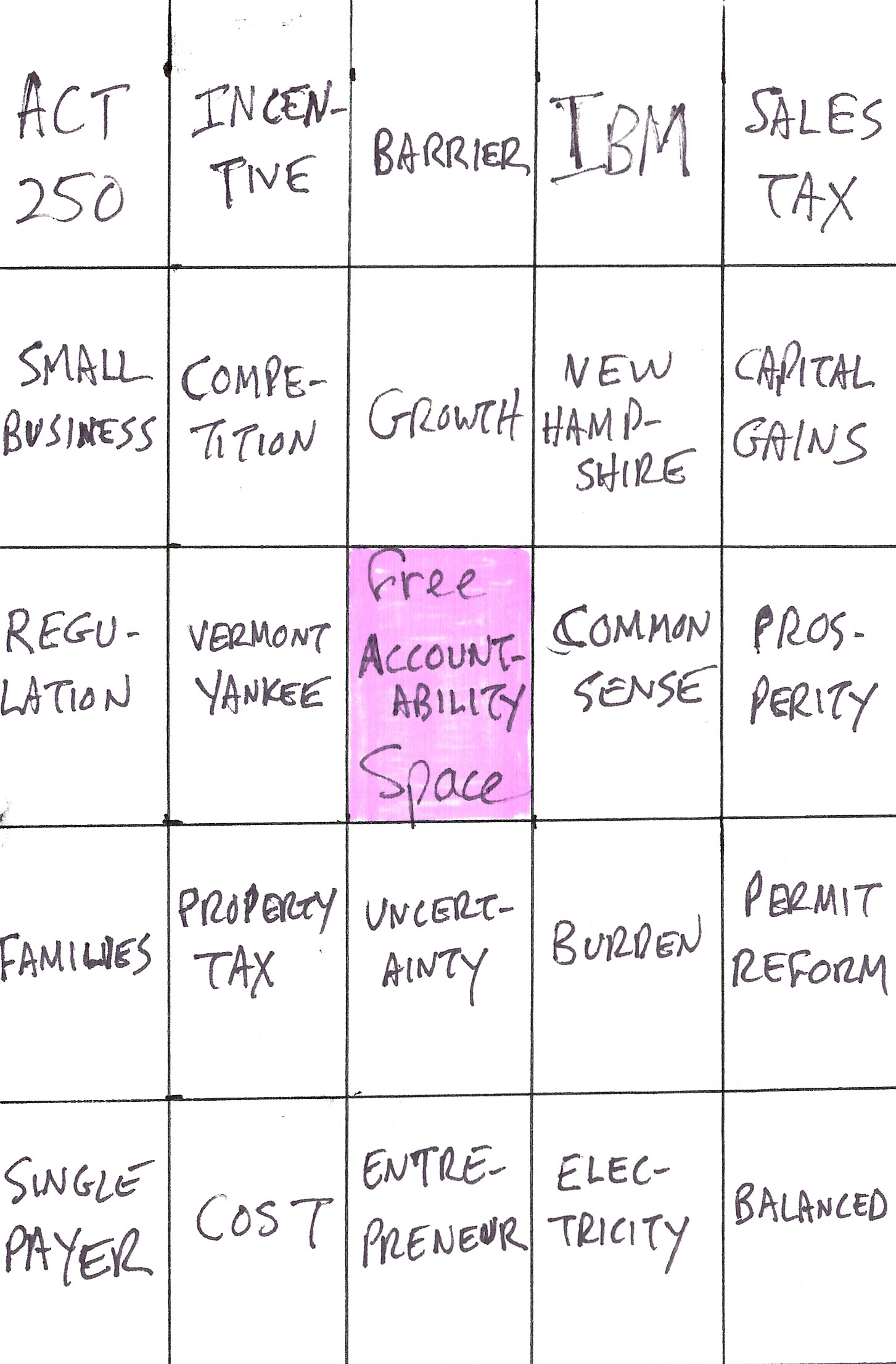
I call it Phil Scott’s Business Buzzword Bingo. Simply print out the image below, take it with you to the “pitch session,” and whenever you hear a buzzword, write an “X” over the corresponding square. When you get five in a row, across, down, or diagonally, shout “BINGO!” You win!

Ground rule: plural or alternative versions of a word are accepted as matches. For instance, “Costs” is a match for “Cost,” and “Entrepreneurial” is a match for “Entrepreneur.”

Come to think of it, you should print out a whole bunch of Business Buzzword Bingo cards, because I have a feeling we’ll get a BINGO every two minutes or so.

Here you go: your very own Phil Scott’s Business Buzzword Bingo playing card. Enjoy!


Phil Scott Bingo card

Bernie bullies the tycoons

Oh noes, the tender hearts of Wall Street have been bruised beyond healing. And the man responsible for this crime against humanity?

Bernie Sanders, of course.

Oil trading data that exposed the extensive positions speculators held in the run-up to record high prices in 2008 were intentionally leaked by a U.S. senator, sparking broader concern about industry confidentiality as Congress moves on Wall Street reform.

Senator Bernie Sanders, a staunch critic of oil speculators, leaked the information to a major newspaper in a move that has unsettled both regulators and Wall Street alike.

For those with short memories, the 2008 oil price spike immediately preceded the mortgage meltdown and near-implosion of the economy. In retrospect, the oil business may have gotten lost in the shuffle. But it was huge at the time; there were predictions that oil prices would shoot through the roof, sending many Vermonters scurrying to pre-buy their heating oil. At what turned out to be the very peak of the market.

The primary cause of that spike was not demand or global instability or exploration failures; it was the severe warping of the market at the hands of speculators. The notable non-Socialist Matt Cota of the Vermont Fuel Dealers Association put it this way in 2008:

The problem is that the trading of oil has been deregulated. And large financial players are dominating the market. A recent Washington Post article showed that 81 percent of future oil contracts are controlled by non-physical players — people who don’t own trucks, people who just trade paper.

…It’s provided volatility to a market that, frankly, is so vulnerable to volatility. We’re talking about a product that people need to get to work and to heat their homes. And for this to be used as a financial tool, so Wall Street traders can make billions, is shameful.

Shameful indeed. And now comes Bernie Sanders, revealing the extent of speculative perfidy:

“The [Commodity Futures Trading Commission] has kept this information hidden from the American public for nearly three years,” he said. “This is an outrage. The American people have a right to know exactly who caused gas prices to skyrocket in 2008.”

… The leaked data contains long and short positions held by oil traders in 2008, the same year that oil prices spiked to $147 a barrel. Critics at the time accused oil speculators of driving up prices, leading lawmakers to later insert a provision into the Dodd-Frank Wall Street overhaul law compelling the CFTC to place stricter limits on how many commodity contracts any one trader can control.

Sanders was perfectly within his rights to release the data. According to Reuters, the CFTC is legally barred from such releases, but it is bound to give information to members of Congress upon request. They are not constrained from releasing the information.

But regulators and Wall Street sharpies are worried that making the data public makes them look really bad might have “a chilling effect on derivatives trading,” according to John Damgard, the head of the Futures Industry Association.

Heavens to Betsy, I certainly hope so. Our economy would be a lot healthier and more stable if there was a lot less dicking around with futures and derivatives, and more focus on productive activity that makes stuff, creates jobs, and generates honest profits.

(Great line from Lewis Black: There should be a law that says if you have a company, and you can’t describe what it does in one simple sentence, it’s illegal.)

Sorry, Mr. Damgard. I ran a thorough self-diagnostic, and I found no trace of sympathy. Take your hurt fee-fees and go swim with the other sharks.

‘Tis the season for hyping politically convenient survey results

This time, it’s a survey from the completely unbiased HAHAHAHA CNBC comparing the business climates of the 50 states. Here’s a shocker: Vermont didn’t do very well, coming in 42nd in the nation.

One clue that there might be something funky with this survey is the fact that all the Northeastern states were clustered at the bottom: New York 40, New Jersey 43, Pennsylvania 44, Maine 45, Connecticut 46, and Rhode Island dead last.

The only Northeastern states to get out of the doldrums were New Hampshire, tied with Arkansas for 30th, and that business-hating socialist hotbed of Massachusetts at 25.

Right off the bat, I’ve got to believe there’s some sort of built-in regional bias. And with Massachusetts the star performer of the region, it’s hard to see how much of an impact Vermont’s liberal tax-spend-and-regulate environment would have; we can’t be that much worse than Massachusetts. Indeed, the rankings are such a mixed bag that it’s hard to identify useful trends: some factors favor robust social investment (infrastructure, education), some have a clear geographic bias (availability of transportation), some favor large states, some small.

Of course, that didn’t stop VTGOP Chair “Super Dave” Sunderland from glomming onto the survey like Paula Deen on a stick of butter.

Well, there’s the VTGOP analysis, in its full 140-character glory. What say we take a closer look at this survey?

Vermont’s rankings tended toward the extremes. There were ten categories in all. We were near the top in Quality of Life and Education. We were in the middle on a few things (including the oft-criticized Business Friendliness, #31), but right near the bottom on Cost of Doing Business, Cost of Living, Infrastructure & Transportation, and Workforce.

All right, so we’ll take credit for Quality of Life and the excellent education system that the Republicans would like to undercut (gubernatorial candidate Scott MIlne calls for as much as a 30% slash in public school funding). But let’s see why we fare so poorly in those four major categories. CNBC lists the criteria in each category, although there’s no explanation of how the criteria are evaluated and weighted, so it’s only of limited utility.

Cost of doing business. Criteria include state and local tax burden (income, property, business, gasoline), utility costs, wage rates, and rental costs for commercial space.
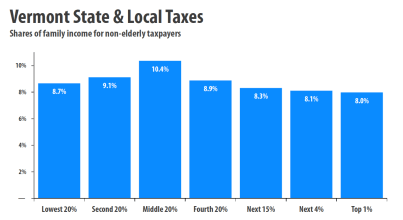
Why I don't feel sorry for the overburdened rich. From the Institute on Taxation and Economic Policy.

Why I don’t feel sorry for the overburdened rich. From the Institute on Taxation and Economic Policy.

Regarding taxes, first of all I’d note the absence of sales tax, which hits middle- and lower-class residents hardest. For included taxes, CNBC used the official tax rates. However, some of our tax rates are artificially high compared to taxes actually paid. This is especially true for top income earners. Vermont’s official top income tax rate is 8.95%, which is on the high side; but because of generous rules on eligible income, top earners pay an effective rate of only 5.2%. And when you combine all taxes, the top 20% pay a smaller share than any other group.

As for utility costs, yes, they’re relatively high. That’s partly because of Vermont’s relatively aggressive adoption of renewables, but also because of our relative lack of home-grown sources. We don’t have any of our own coal, oil, or natural gas.

On wage rates, well, I’d just as soon have better wage rates than some “business-friendly” states like Texas and Utah and Nebraska. Ditto rental costs: I’m glad we put reasonable limits on commercial development. It’s part of the price we pay to keep our “Quality of Life” score high. (If, like Scott Milne, you’d like to see Vermont look more like the West Lebanon, NH commercial strip, then you’re entitled to your opinion. I guess.)

Cost of Living. A fairly straightforward category. Some of the low ranking is due to social choices (energy and development, see above) and some is inherent in being a small, rural, cold place (food, heat).

Infrastructure & Transportation. This category is a little funky. “Quality of roads and bridges” is only a small part of it. CNBC’s top criteria:

We measure the vitality of each state’s transportation system by the value of goods shipped by air, waterways, roads and rail. We look at the availability of air travel in each state, the quality of the roads and bridges, the time it takes to commute to work and the supply of safe drinking water.

Well, hell. Vermont’s never going to score well on most of that. We don’t produce a lot of goods, so we don’t transport much. We don’t have much of a transportation infrastructure because we’re so small: only a couple freeways, a lot of winding two-lane roads, very little rail or air. And our commute time is long because we’re rural.

Workforce. This is another funky one. Along with education level of employees and number of available workers (we struggle on that one), CNBC puts a lot of stock in right-to-work laws and toothless labor unions. Again, if that makes us a bad place to do business, it’s a trade-off I’m more than willing to make.

There’s one more crucial piece you need to understand about the CNBC ranking. Not every category gets equal weight. In fact, the most heavily weighted category, Cost of Doing Business, is worth 450 points, while Education is worth only 150 points and Cost of Living only 50.

CNBC’s weighting system pushes Vermont farther down the rankings because we generally score worse on the heavily-weighted categories than on others.

Some of the weighting is reasonable, and some of it is standard fiscal-conservative dogma. Education, in particular, seems to be very important to a lot of Vermont businesses, and yet it carries little weight in CNBC’s rankings.

But then, it’s depressingly normal for the business world to focus on the immediate and short-term, instead of the long-term. You’d think that businesses would be smart enough to realize that a little short-term pain (enough tax revenue to support infrastructure, education, and social services) is more than justified by the longer-term gain of doing business in a strong, stable environment rich in social capital.

The survey is somewhat useful if you look beyond the mere rankings and use it to evaluate your state’s strengths and weaknesses. And if you make thoughtful decisions on which factors are worth improving, and which things you’d like to keep the way they are. Even if they don’t absolutely maximize the business climate.

 

The new boss can’t be as bad as the old boss, right? …Right?

Memory Lane, kids! On November 12, 2012, I wrote a piece on Green Mountain Daily entitled:

Expect IBM to leave Vermont within three years. No matter what we do.

And today comes the news that IBM is “selling” its semiconductor business, including its plant in Essex Junction, for negative $1.5 billion. Yep, it’s paying GlobalFoundries to take the business off its hands. IBM is, indeed, leaving Vermont.

Allow me a little tiny bit of gloating here. Mmmmm, ahhhh.

Okay, enough. Get on with it.

That GMD post was inspired by the work of technology journalist Robert X. Cringely, who’d reported that IBM was in an all-out blitz to shed domestic workforce and slash itself into profitability. My point was that if IBM left Vermont, it’d be because of global corporate strategy. Not because we didn’t build the Circ Highway or our electric rates were too high or then-Senate leader Peter Shumlin once called an IBM lobbyist a “liar.” (Which, Republicans, just stop. It happened years ago. And if a lobbyist and his employer takes lasting umbrage at an offhand comment during the heat of legislative debate, well, they’re just way too damn sensitive.)

So here we are, less than two years later, and IBM is on its way out.

My prediction was right on the facts — but wrong on the implication, that IBM’s Essex plant was a goner. Fortunately, GlobalFoundries sees potential in the plant and/or its skilled workforce. In the short run this is very good news, because the way things were going at IBM, it’s a relief not to have thousands of good jobs and the Chittenden County economy dependent on Big Blue.

However…

While GlobalFoundries is saying all the right things — it plans “to provide jobs for ‘substantially all’ IBM employees at both Essex Junction and East Fishkill who are part of the transferred business,” it assured Governor Shumlin that it “plans to continue employment, investment, and operations in Vermont,” and it told the Burlington Free Press that it is committed to Essex for the “foreseeable future” — this deal should not significantly reduce the concerns over the Essex plant’s future.

After all, it’s not like GlobalFoundries has a lot invested in Essex. It agreed to accept a boatload of money, plus the IBM chip business. And when you combine the GF and IBM capabilities, you’ve got two manufacturing plants in the Hudson River Valley — one of which is a brand-new $8 billion facility — and one up here in Essex. If there’s any consolidation in GF’s future, I’d have to guess it’ll lean to the south.

Aside from the fact that reassurances like these are routine, and worth approximately the toilet paper they’re written on, there are some obvious caveats in today’s crop.

GlobalFoundries says it “plans” to provide jobs for “substantially all” IBM employees at Essex “who are part of the transferred business.” That’s a lot of weasel words in a single sentence. “Plans” can change. “Substantially all” is a matter of definition. And how many in the Essex workforce are NOT “part of the transferred business”? Will they be cut by IBM? If given the opportunity to remain at IBM, will they have to relocate? After all, IBM won’t have a presence in Vermont anymore.

Governor Shumlin is meeting with GlobalFoundries officials later today. Color me cynical, but I’d expect GF to put the screws to the Governor. The corporation will provide generic promises and make very specific demands. And the Governor is in a weak bargaining position: he knows that the Essex plant means a lot more to Vermont than it does to its new owner.

"I have returned from GlobalFoundries with peace for our time."

“I have returned from GlobalFoundries with jobs for our time.”

He might even come out of the meeting with a piece of paper in hand, proclaiming a new deal that’s good for Vermont and for GlobalFoundries.

Not that I could blame him. We’re over a barrel with the Essex plant. Its closure would be a huge blow to our economy. In the short term, the IBM/GF deal is good for the state — if only because I’d hate to continue depending on the good graces of IBM. But a lot of uncertainty remains, and the moral of the story continues to be “don’t put all your eggs in one basket.”

I grew up in Michigan, a state that grew and prospered with the domestic auto industry. The Big Three had its roots in Detroit. It did a lot of good for Detroit. But when the global winds shifted, the automakers had to shift with the times, and Detroit was left to hang. The takeaway: it’s not healthy to be too dependent on one business or market sector. Sooner or later, it’s gonna bite you in the butt.

IBM’s departure is a stark reminder: Vermont’s economy should be as diversified as possible. Eventually the winds are going to shift again, and we need to be ready.

Art Woolf’s arguments of convenience

Welp, Vermont’s Loudest Economist is at it again. Art Woolf’s latest dispensation of wisdom in the Thursday Burlington Free Press is chock full of half-baked research, lazy reasoning, and politically convenient conclusions.

The main conclusion, as is often the case: Vermont sucks.

The topic of Art’s latest “How We’re Doing” effort was outmigration – the fact that Vermont’s population is roughly stable (or stagnant if you prefer, as Art does) and a lot of people are leaving.

This week’s entry in the digital Freeploid is entitled “Ex-Vermonters Vote With Their Feet.” (The print edition had a different title.)

As if every decision to move is a “vote” against Vermont. Every birth, a “yes” vote; every death, a “no” vote. (The Medical Examiner ruling: Death By Taxes.)

popchgsept25The accompanying chart shows three factors in population change: births/deaths ratio, immigration (from outside the US), and Net Domestic Migration. It shows immigration as a constant: we have a relatively small trickle of foreigners setting here. The births/deaths ratio was healthy until 2008, when the birthrate began to drop. But the biggie is Net Domestic Migration, which has been negative since about 2004.

(The chart is, of course, scaled to dramatize the net-migration plunge.)

Woolf chalks up the declining birthrate to our aging population, which is reasonable (although I wonder how much the Great Recession played into it): we do have more people beyond the usual child-rearing age. Woolf speculates that our birthrate will continue to fall as our population ages.

But later, when he’s expounding on the causes of our negative Net Migration, he completely ignores the aging population. Did it occur to him that a lot of our outmigrants are senior Vermonters heading for the Sun Belt? Not to judge by his column:

When people vote with their feet, they are saying something about the desirability of a state.

Those people are saying that despite its many attractions, Vermont is not a popular place for people to live and work.

For some that’s true, but not for an 80-year old who’s tired of hauling firewood and shoveling snow.

Woolf uses our aging population as a cudgel when it’s convenient; he ignores it when it’s not.

Also, as usual, Woolf doesn’t bother to compare Vermont to similar states. The outmigration of young people is a common problem for small, rural states; is Vermont’s better or worse than, say, Maine’s or Wyoming’s? Or northern New Hampshire’s?

Finally, let’s bring up a sacred cow that Woolf would never touch: the role our employers play in making Vermont undesirable. Generally speaking, Vermont’s pay rates are on the low side. Even if you’re talking about comparable jobs, the pay is often lower in Vermont than elsewhere.

Two examples I have some familiarity with: medicine and academics. Pay scales at UVM (and Dartmouth) are lower than at similar institutions elsewhere — sometimes substantially lower. Like, 50% or more. Our institutions get away with that because (a) Vermont offers such a high quality of life that many professionals will settle for a lower salary, and (b) our cost of living is relatively low compared to, say, Boston or New York or even Albany.

Many Vermont employers, especially in technology fields, complain that they can’t find enough qualified workers. Well, maybe they aren’t paying enough. Maybe they’re not recruiting hard enough.

No, that’s not it. Must be the taxes.

To be fair, Woolf doesn’t come out and blame taxes and regulation for Vermont’s outmigration. But he omits a lot of factors that lead to other conclusions: that we have built-in disadvantages, that our employers skimp on pay and aren’t aggressive enough in attracting new residents. And that our aging population is likely a major factor in growing outmigration.

This week’s entry, like many of his columns, is meant to undergird the business point of view — that we need to fling open the door to growth by cutting taxes, regulations, and those pesky environmental laws. As a thorough, honest look at How We’re Doing, the best grade you can give is Incomplete.

Extreme Makeover, Freeploid Edition

Gannett is taking the inevitable next step in its pursuit of profit: spinning off its newspaper business, formerly the heart and soul (such as it was) of the corporation. The publishing arm will start with a clean slate, unlike some other spinoffs that loaded corporate debt onto the new entity; but it also strips away whatever fiscal protection was offered by Gannett’s moneymaking broadcast properties.

For readers of the Burlington Free Press wondering what its future will look like, I suggest media coverage of its sister paper, the Tennesseean. The Nashville daily is being transformed into a “beta” newsroom, a new-world model for affiliated papers to follow. The topline looks good: The Tennesseean promises a larger reporting staff and more local journalism.

But the attic is full of spiders, and if I were a senior Freeploid employee, I’d be preparing to be “future endeavored” into a lousy job market. The best summary, with plenty of links, comes from the Poynter Institute. And it includes such gems as:

— The newsroom will, indeed, have more reporters — but fewer others, including far fewer editors. The total staff will shrink from the current 89 to 76. That’s a 15% cut.

Every newsroom staffer will have to reapply for new jobs and no one is guaranteed a new gig. Out goes seniority! I bet those redefined jobs will offer lower pay and lousier bennies. Also, senior staff had better be as up-to-date with the digital world as your average twenty-something J-school grad, or they’ll be out on their ears. With, according to Nashville Public Radio, “a small severance package.” Lovely.

— The lack of editors will put the onus on reporters to produce “publication-ready copy” because there won’t be enough editors to give stories a second look. Expect a lot more typos, bad grammar, and stories rushed to publication.

Every reporter I know has seen stories ripped to shreds by unskilled, or agenda-driven editors. But there’s a reason that traditional journalism demands mediation between writing and publication: it’s the quality control. It is, literally, the most significant difference between traditional media and the likes of Yours Truly. I write what I know and feel, based on experience, and I can post anything I want to. The editorial system breeds a certain level of professionalism, which is why the Freeploid can expect to be paid for its content and I cannot. (I’d like to be, hint hint, but I can’t expect it.)

“Audience analytics” will rule the roost. Executive Editor Stefanie Murray, the Tennesseean’s own Jim Fogler, says “We’re going to use research as the guide to make decisions and not the journalist’s gut.” Wonderful; we’ll be setting our journalistic priorities based on pageviews and reader surveys. Er, I mean “audience surveys,” because “reader” is so 20th Century.

I realize that newspapers face a difficult future. Their old sources of advertising are drying up, and digital ads don’t fill the gap. Unless you’ve got something else going for you, like donor support (VPR, VtDigger) or a healthy, ad-rich print operation (Seven Days), you’re dependent on ad revenue. (The traditional paper got at least two-thirds of its revenue from ads, not readers.) The Tennesseean is one more experiment in creating a sustainable future. But the minions of Gannett are furiously lipsticking this pig — presenting the “new” Tennesseean as a model of intensive, community-oriented journalism. It’s not. It’s another effort at slashing costs to maintain profit margins.

The Freeploid has a whole lot of experienced senior staffers who work very hard. Their experience can lend context and depth to their reporting. If the Tennesseean’s “beta” test goes well, in terms of profitability, expect the winds of change to blow strong through the Freeps’ offices in the near future.

Essex Junction’s negative equity

Oh, here’s some good news on IBM’s facility in Essex, courtesy of Bloomberg. 

IBM was willing to pay Globalfoundries Inc. to take on IBM’s money-losing chip-manufacturing operations, according to a person familiar with the process.

IBM was offering about $1 billion to persuade Globalfoundries to take the unit, said the person, who asked not to be identified because the negotiations were private. Globalfoundries wanted to be paid about $2 billion, enough to offset the division’s losses, the person said.

Okay, first we’ll posit that IBM’s chip division includes other plants besides Essex, so we can’t blame that plant alone for IBM’s negative equity. But it is a stark reminder that Essex and IBM’s other chip operations are basically dead weight. And now that Globafoundries has withdrawn from the bidding, IBM is desperate to unload the division:

IBM’s willingness to pay underscores the urgency for Chief Executive Officer Ginni Rometty to get less profitable businesses off the books.

Rometty’s top priority is to reverse recent losses, and hit very ambitious earnings targets by 2015. Er, that’s five months from now.

To stay competitive in manufacturing, IBM may have to invest billions of dollars to keep its plants up to date with newer chip technology. IBM’s East Fishkill location cost $2.5 billion to build.

We’re talkin’ billions of losses and/or risky investments in a market that IBM has basically lost to Intel. When you compare that awful reality to Vermont’s potential offer of a few million bucks in incentives, you see the scope of the problem and the almost complete inability of li’l ol’ Vermont to make a difference. Somehow I don’t think resurrecting the Circumferential Highway or another cut in electricity rates will save this sinking ship. Nor would the more business-friendly “tone” that Scott Milne keeps promising. And it’s hard to see what the Shumlin Administration, or any other administration, could possibly do in the face of such dismal market realities.

The Milne Transcripts, part 6: The supreme importance of tone

Yet another installment in my reports on Scott Milne’s rather disastrous July 25 appearance on WDEV Radio’s Mark Johnson Show. It was his first in-depth interview since formally launching his campaign for Governor. As such, it provides a window on the motivations, priorities, and political skills of the likely Republican nominee. 

Vermont Yankee wasn’t on Mark Johnson’s agenda. After all, it’s a fait accompli; Entergy stopped fighting to keep VY open when low natural-gas prices made it a financial loser, and a closing date has been announced. But Milne brought it up unbidden while trying to deflect attention away from a very unflattering discussion of health care reform, in which he appeared to confuse Vermont Health Connect with single-payer health care. (The former is operational, albeit troubled; the latter is Governor Shumlin’s yet-unattained Holy Grail.)

Milne was critical, not necessarily of the shutdown itself — he remained carefully neutral on that — but on the Shumlin Administration’s “tone.” Which, it seems, is one of the biggest bones Milne has to pick with his prospective opponent.

The tone and the style with which the Shumlin Administration went forward with that… we’re going to end up with a nuclear toxic slum on the banks of the CT River for probably 65 years or whatever the maximum decommissioning time is.

…Iif we had a Governor who was much more, in tone, business-friendly and working cooperatively to fix problems even with people that you disagree with, we could have given them a license extension. In exchange, gotten them to pony up the money for the rapid decommissioning.

Mmm, yeah, a couple problems with that. First, Entergy has never shown any willingness to adequately fund VY’s decommissioning; they’ve always played for the maximum amount of time. Given Entergy’s track record, it’s extremely doubtful that a different “tone” would have induced them to agree to a very costly proposition.

Second, Entergy stopped fighting for VY because it had become a financial drain. Why would they agree to commit hundreds of millions of dollars to the decommissioning find at a time when VY was already hurting their bottom line?

For Scott Milne to believe he could have convinced them otherwise reveals a dangerous combination of naivete and unfamiliarity with the issue.

Speaking of naivete, MIlne apparently believes that a different “tone” is all we need to make Vermont a growing, prosperous economic miracle. He’s harshly critical of Shumlin’s economic record, but when asked how he’d do things differently, this is what he comes up with:

Our primary, um, fix that we’re going to offer to Vermont is, uh, a much better tone and friendly tone towards business, and then some specific plans about how to attract business and keep business in Vermont.

His “primary fix” is a “better tone.” He’s vaguely promising “some specific plans” somewhere down the road, but his #1 solution to our economic troubles is a “better tone.”

I dunno. To me, and to many liberals and progressives, Governor Shumlin is awfully solicitous of the business community. He seeks their input, he listens to them, someties he shapes his policies to accommodate their concerns… and he’s certainly attracted more than a Democrat’s usual share of donations from Vermont businesspeople. Indeed, perhaps the biggest reason for the Republicans’ financial woes is that Shumlin has co-opted many of their usual big-money donors. If Shumlin is such a negative for business, why aren’t businesspeople trying harder to unseat him?

Besides, “tone” by itself is nothing. The “tone” makes a difference only as it affects your policies — say, kneecapping Act 250 or otherwise easing regulatory processes. For Milne to call for a new “tone” as the “primary fix” strikes me as disingenuous. He’s presenting himself as a moderate, so the last thing he wants to do is offer detailed pro-business policies. That’d give away the game. Instead, he talks of “tone,” and sounds a bit like a fool in doing so.

This was predictable, and should not be mistaken for good news

In a classic late-Friday newsdump, “sources” have slipped word to Bloomberg News that an impasse has been reached in IBM’s negotiations to sell its chip manufacturing arm to Globalfoundries Inc. “Globalfoundries… made an offer that was rejected by IBM as too low,” says Bloomberg, which called the failure of the talks “a setback for IBM Chief Executive Officer Ginni Rometty.”

She’s been in a race to meet 2015 earnings goals at all costs — most notably, by cutting the workforce and shedding any units that can’t generate profits. The strategery being, I guess, “if we keep shrinking and shrinking, we’ll grow.”

Like diving into a black hole and coming out the other side, eh?

I can believe Globalfoundries was lowballing IBM, since the word all along was that GF was not interested in IBM’s physical plants (including Essex Junction), just its engineers and intellectual property. If GF didn’t want the big costly plants, of course it would undervalue the package.

And besides, if GF wants the engineers and the brains, it sure doesn’t need to buy ’em from IBM. It can just go ahead and recruit, which is exactly what it’s been doing. Paul “The Huntsman” Heintz:

Globalfoundries… has announced in recent weeks that it has hired several top employees from IBM’s Essex Junction and East Fishkill, N.Y., plants. The company has also placed employment ads in papers serving those regions — including the Burlington Free Press.

Any IBMers who want to continue their careers must realize that GF is a better bet than IBM. It means moving, which isn’t for everyone; but GF should be able to entice quite a few people. After all, IBM has become a spectacularly awful place to work — with the constant threat of layoffs and the ever-tightening pressure to produce, produce, produce.

Now, I’m sure there’s some “intellectual property” under IBM’s control that GF would like to have. But naturally it wouldn’t offer anywhere near the amount of money IBM wants. It doesn’t need to buy the IBM assets; it just needs to pilfer the brainpower. Which it should be able to do easily, since its “competition” is the doom chamber of IBM employment.

And as usual, IBM is leaving state and local officials completely in the dark. Get a load of this convoluted statement from Commerce Secretary Pat Moulton about the Bloomberg report:

“I don’t know what that means — whether that’s good news or bad news, but I have not heard anything officially or unofficially,” she said. “Obviously having a company remain here and remain viable is important, so it was hard to know what a Globalfoundries deal — if there was one on the table — would have meant.”

I call that a cotton-candy statement: a teaspoon of substance whipped into a furious froth of nothing. It’s also a measure of the value IBM places on its relationships in Vermont: zero. IBM’s been keeping us completely in the dark for years.

If Globalfoundries was truly uninterested in IBM’s physical plant, a purchase agreement would have been bad news for Vermont. But the collapse of the deal shouldn’t be taken as a good sign. IBM will be even more desperate to spin off the unit. Or simply wind it down. And would any other potential purchaser be interested in an Essex plant that GF “had placed little or no value on… because [it is] too old”?

Two and a half years ago on Green Mountain Daily, I wrote that we should be prepared for IBM’s exit from Vermont within three years. And that it wouldn’t be Governor Shumlin’s fault, at all; it’s a result of IBM’s short-sighted, profit-chasing binge of outsourcing, downsizing, and stock repurchasing. IBM’s domestic workforce has shrunk dramatically in the past decade, and is continuing to do so. Essex is a rubber ducky in the IBM bathtub, the plug has been pulled, and we’re all spinning the drain.

My three-year prophecy is likely to miss, but my larger point remains: don’t expect IBM to stick around much longer. And don’t blame Governor Shumlin when it leaves.

The price we pay for cheap crap

Two news items on a single theme: Big Mac Mystery Meat, and toxic baubles.

Second one first, ‘cuz there’s a direct Vermont connection. Two-Fisted™ Attorney General Bill Sorrell has filed suit against Dollar Tree, purveyor of cheap crap and nothing but cheap crap, “for selling jewelry that contains toxic substances.”

What’s more, DT is a repeat offender. Sorrell says the bottom-barrel retailer is in violation of an earlier agreement to stop selling jewelry with unacceptably high levels of lead and cadmium. Charming. Sorrell’s office says the chain has sold “over 30,000 individual items… through its stores in Barre, Bennington, Burlington, Derby/Newport, and Rutland.”

The original 2010 settlement arose from what the AG’s office calls “a growing awareness… that many products imported from China and other countries contained toxic substances.” And the release adds, not at all reassuringly, that

“…although Dollar Tree routinely requires the testing of products it purchases for resale to consumers, its testing protocol does not ensure that all items of jewelry sold in its stores are free of toxic substances.”

Uh-huh. They require testing, but their testing program “does not ensure” the safety of their customers. I guess if they had a really thorough testing program, that’d interfere with the free and open flow of cheap crap. Which probably violates Dollar Tree’s constitutional right of free speech. Heck, if money is speech, isn’t a commercial transaction also speech?

On to Mystery Meat. McDonald’s, purveyor of oddly gray “hamburgers,” is portraying itself as “a bit deceived” over an audit of a Chinese meat supplier. The Daily Mail reports that Shanghai Husi Food was shut down after “a TV report showed workers apparently picking up meat from the factory floor, as well as mixing meat beyond its expiration date with fresh produce.” Yum, yum!

Mickey D’s CEO Don Thompson says “We are no longer serving product from the primary facility there that has the challenges and the issues.” I should hope so.

But that’s not the bad news. The bad news is this, from CNBC:

McDonald’s and many other food companies rely on third parties to perform audits to check whether facilities are complying with food safety rules and other regulations. It is not uncommon for suppliers at the center of food safety scandals to have received high marks on their audits.

Apparently, a whole lot of weak links in our food chain is the hidden price we pay for Cheap McCrap. And cheap pizza and “chicken,” since KFC and Pizza Hut have also served meat from Husi’s factory floor and compost heap.

At least they didn’t find elevated levels of lead or cadmium. Then again, how can we be sure they’re testing for that?

Oh, and let’s add Item 2.1 to my list: the opening of Pier 1 in South Burlington, bringing a whole world of cheap crap to one convenient location. Not to mention screwing its workers:

Long-time Williston resident Jeffery Fucci… will manage the new store, leading a team of approximately 35-40 associates. Associate hours fluctuate based on the needs of the business and the season.

That’s right, folks. All the “associates” will see their hours fluctuate “based on the needs of the business.” Yay, more crappy jobs for Vermont!