I haven’t spent a lot of time covering this year’s debates, mainly because there are so damn many of ’em that I could spend all my time doing nothing but that, and there’s too much other stuff to write about.
Debates are considered key moments in a campaign. Candidates spend a lot of time preparing for them. Staffers dissect performances and adjust tactics for future encounters. But how many people pay attention?
Well, we’ve got a pretty good test case before us, and the answer is “hardly anybody.”
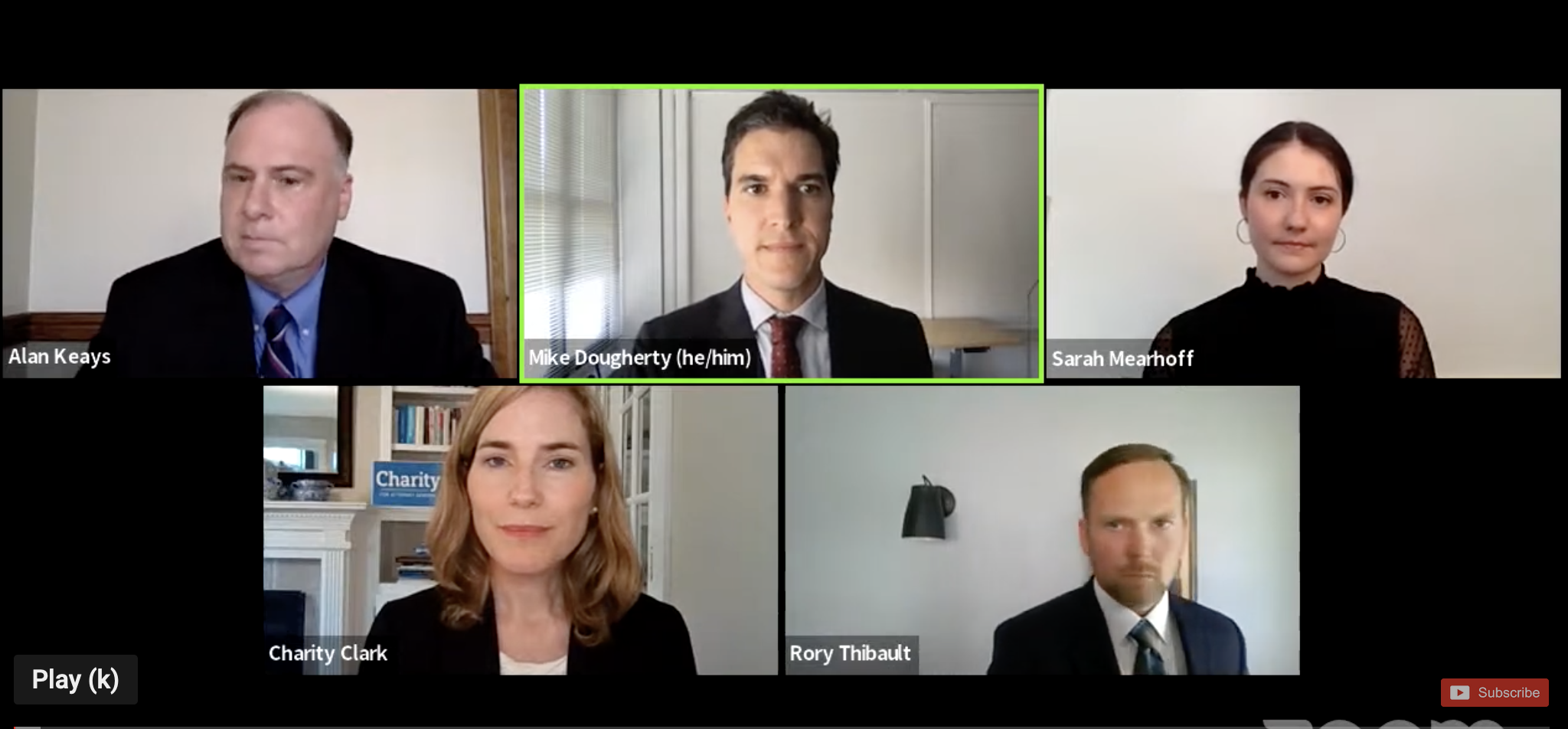
Last night, VTDigger hosted a debate for the two Democrats running for attorney general. By Digger’s own account, the affair highlighted some key disagreements between Washington County State’s Attorney Rory Thibault and Charity Clark, who was ex-attorney general TJ Donovan’s chief of staff.
After it was live-streamed, the debate was posted on YouTube. As of this writing, it has been viewed 645 times.
Six hundred forty-five. For comparison, the last time the Democrats had a competitive AG primary was in 2012 when Donovan challenged Sorrell and nearly won. 41,600 people voted in the primary.
Do high courts do Friday newsdumps? It would seem so. The Vermont Supreme Court issued a ruling on Friday, July 1 — heading into a three-day holiday weekend — with massive implications for independent oversight of OneCare Vermont, our favorite too-big-to-fail institution, and for the state auditor’s office.
The newsdump worked like a charm. VTDigger cranked out a quickie same-day story that hit the Internet at a time when lots of people had stopped paying attention to the news. By Tuesday, July 5, the decision had pretty much vanished from public attention. A strong statement from Auditor Doug Hoffer blasting the decision went largely unnoticed. But I sure hope responsible parties in the Legislature have taken note, because something needs to be done to fix this.
The unanimous decision denied Hoffer access to OneCare’s payroll information. He had sought access after OneCare’s payroll and benefits expenses jumped from $8.7 million in fiscal year 2019 to $11.8 million the following year. He understandably wanted to find out why. It’s an issue that should concern us all because OneCare is (a) kind of a rolling experiment that’s (b) playing with massive amounts of public money for which it is (c) not very accountable at all.
I’ll get back to OneCare, our most mysterious of public sector black boxes, but first I want to discuss the Auditor’s part of this. The court ruled that the Auditor has no authority in statute or in contract to access OneCare’s financial records. It asserted that financial oversight belongs solely to the Green Mountain Care Board, which is essentially OneCare’s captive partner in this grand experiment.
Well then, I ask, what in hell do we have an auditor for?
The VTDigger commentary space is often a repository for the very best in straw-man punching: setting up an easy target and dispatching it with, if you’re talented enough, a rhetorical flourish.
Well, Tom Evslin, entrepreneur, serial Republican donor, self-appointed technology seer and number-one fan* of Elon Musk’s Starlink Internet service**, went one better in the straw man competition. He threw together a whole bunch of miscellaneous straw men under the rubric of “overabundance of caution” and went straight down the line, punching each of them in turn. All in service of a point that apparently made sense to him but is, in fact, utterly incoherent.
*His occasional musings on the glories of Starlink have found a home on True North Reports, because Musk is the closest thing reality offers to an Ayn Rand hero. Except Musk is a phony; his companies have received literally billions in public sector grant funding.
The overarching point is that Our Political Leaders sometimes overreact to a potential danger, thus putting us all in metaphorical shackles. And by “overreact,” I mean doing something that Tom Evslin disagrees with. Ah, if only we were all as wise as he.
Fourth in a series on the July `1 campaign finance reports. Yes, it’s still relevant because the general media coverage of the filings was disgracefully thin. Previously: Lieutenant Governor, Governor, Attorney General. Final installment pending: a look at select legislative races.
The Democratic primary for Secretary of State attracted three very qualified candidates after incumbent Jim Condos decided it was time to retire. One has a clear lead thanks to being the first candidate to declare; the second is catching up in a hurry; the third is lagging far behind.
The first is Deputy Secretary of State Chris Winters. He’s been a candidate the longest, plus he had to know long before Condos’ announcement that the position would be vacant. Condos has been thumbing the scale with gusto even before he stepped out of the race, and recently he flouted tradition by formally endorsing Winters.
That should be a substantial intangible factor in Winters’ favor. He also leads in the tangibles, having raised $39,000 in the reporting period and a total of $61,000 for the campaign to date. He has spent $23K so far, which leaves him with $38K in the bank. $5,500 of his spends went to the Vermont Democratic Party: $1,500 for placement at the party’s Curtis-Hoff fundraiser, and $4,000 for access to the VDP’s extortionately priced and indispensable voter database. He also spent $1,500 on yard signs from the Texas-based firm Super Cheap Signs. Union shop, I trust.
Notable donors on Winters’ list: $4175 from Martha Allen, former head of the VT-NEA; $4,210 from the Vermont Association of Realtors; $4,000 from Ernie Pomerleau, Burlington developer and friend of moderate Democrats everywhere; $500 from outgoing Treasurer Beth Pearce; and $101 from former governor Howard Dean.
Second place in the money race is Rep. Sarah Copeland Hanzas, who didn’t announce until late April. She’s done well since then, receiving $39K in donations in a month and a half. She has spent $22K, so she has $17K in cash on hand.
Topping her donor list are a bunch of people named Copeland, presumably family, who gave a combined $11K. She got $1,000 apiece from renewable energy developer David Blittersdorf and former ANR deputy secretary Peter Walke. There’s a gaggle of current and former lawmakers including Shap Smith, John Gannon, Carol Ode, Leslie Goldman, Becca White, Sarita Austin, Amy Sheldon, Maxine Grad, Don Hooper, Mary Sullivan, Janet Ancel, Tony Klein, and Mike Yantachka.
Other notable names: $1,050 from Lisa Senecal, co-host of “We’re Speaking,” a podcast produced by The Lincoln Project; $500 from Democratic donor Billi Gosh and $300 from progressive donor Crea Lintilhac; $500 from Will Raap, founder of Gardeners’ Supply; $300 from former lobbyist turned bluesman Bob Stannard; $500 from the Leonine lobbying firm and $250 from lobbyist Heidi Tringe; and $150 from attorney general candidate Charity Clark. Her expenditure list is topped by $13,463 for postcards (and presumably mailing) from the Print & Mailing Center of Barre.
Finishing a distant third in fundraising is Montpelier City Clerk John Odum, who entered the race shortly before the March 15 filing deadline. He raised $13K during the latest reporting period and a total of $20K for the campaign to date. He’s spent $14,494, which leaves him with $5K and some change.
But wait, it gets worse. Odum received $8,400 from Elizabeth Shayne, partner of state Rep. Tiff Bluemle. Now, a donor can’t give a candidate more than $4,210 for the primary. I have to assume that half of Shayne’s money is earmarked for the general election campaign and can’t be spent until after the primary. If that’s true, then Odum only has about $1,000 in cash on hand. He’d better have one crackerjack of a grassroots/field operation, is all I can say.
(Update! The $8,400 was a clerical error. Shayne donated a total of $4,200. Odum’s financial report has been corrected. His amended report indicates that his campaign has about $1,900 in cash on hand.)
Overall, Copeland Hanzas has a clear advantage among Democratic officeholders and party mainstays. Winters has outraised the field and has more cash on hand plus Condos’ imprimatur, but his donor list is short on Democratic stalwarts. Odum is far behind in fundraising and cash on hand; unless he’s got hidden advantages, he’s looking like the third place finisher in the primary.
Otherwise, how do I see the race from here to Primary Day, now less than a month away? Hard to tell. Neither Winters nor Copeland Hanzas has a high profile outside of Montpelier. Winters has Condos behind him; Copeland Hanzas has a lot of lawmakers in her corner, and that’s nothing to sneeze at. Members of the House are very plugged in to their districts. Get enough of them in your corner, you’ve got a head start on a statewide network.
So. If anyone claims to know how this is going to turn out, they’re probably blowing smoke.
I’m not the best person to eulogize Rep. Warren Kitzmiller, whose death was announced by the Vermont Democratic Party this evening. But I do have some things to say, because I always had a soft spot in my heart for him.
Which is a bit strange, because he is the epitome of the kind of lawmaker I have little patience for. He’d represented Montpelier in the Legislature for 21 years; he was appointed in 2001 to succeed his late wife Karen. (He’d announced his retirement from the Legislature, but didn’t quite make it to the finish line.) He was elected time after time in contests that were over before they began, such was the power of his name and his place in the community. He was the founder of Onion River Sports, and he served in a plethora of roles in Montpelier city government and civic life.
I didn’t get to experience him in all his glory. By the time I started hanging out at the Statehouse, he was a quiet, genial presence with little to no policy profile. He rarely initiated any legislation, and rarely spoke in committee or on the floor.
In other words, he kind of occupied the seat without much apparent purpose. His very progressive city could have benefited from more energetic representation.
He ticks off all the bad boxes. Never won the seat on his own. Didn’t seem to do much or have any ideas. Stayed in office well beyond his sell-by date.
But hell, I liked the guy.
He was unfailingly friendly. He didn’t take himself too seriously. He was always up for a chat, and usually had smart, insightful things to say. He was a legitimate pillar of his community. He earned his popularity through service. In my limited experience, I never saw him act or speak out of meanness. If everyone were more like Warren Kitzmiller, this world would be a much better place.
Whenever I drive into Montpelier, I pass by his house on North Street. I once visited him there, and had a very nice conversation on his back deck. Maybe that’s why I took note of his house every time I passed by, and hoped he was doing well.
The drive down the hill will be a little sadder from now on. Many people will have much more reason to miss the guy and have much more comprehensive things to say about him. But I didn’t want to let his passing go by without comment. He was one of the good ones.
There’s something about immortality, about escaping the finite bounds of a lifetime. If not in corporeal form, at least in lasting impact. Making a mark, leaving a legacy, your name remembered long after your contemporaries have returned to the dust. Escaping the curse of Adam and Eve. It’s an almost universal human yearning, reflected in the appeal of religious belief and, well, superhero comics.
Well, you didn’t come here for the warmed-over philosophy. Let’s get to Jim Condos.
The outgoing Secretary of State put his thumb on the sca — I should say, smashed his fist on the scale and jumped up and down on it with all his considerable weight* when he endorsed his deputy Chris Winters to succeed him when he leaves office.
*Big-boned.
He wants that legacy, doesn’t he? He wants his impact on the office to last beyond his physical tenure. He wants one final validation from the voters, who have treated him kindly over the years.
Sen. Bernie Sanders has gone and endorsed Senate President Pro Tem Becca Balint in her bid for U.S. Congress. It’s not technically a violation of the unwritten rule against taking sides in a party primary because Bernie’s technically not a Democrat, but still.
It’s not the first time he’s done this, but it is the most impactful. In 2020 he endorsed David Zuckerman over Rebecca Holcombe in the Democratic gubernatorial primary, but he didn’t do so until July 27. The white smoke wafted up the chimney three weeks earlier this time, which is crucial because mail ballots are already in circulation.
I can only speculate on the why. Is this one last shot in the sub rosa contest of ideas between fiercely independent Bernie and loyal Democrats Leahy and Welch? It certainly reads like a power play — a contest to see who really captures the hearts and minds of Vermonters.
The less Machiavellian reading is simply that Sanders sees Balint as an ideological match, and Lt. Gov. Molly Gray as an unacceptably centrist candidate. My guess is that it’s mostly the latter, and the former is the cherry on top.
I don’t think Leahy or Welch will be willing to break the rule for their Chosen One. But I bet they’ll bend it some more by continuing to say nice things about Gray without actually endorsing, and keeping their networks active on her behalf.
That’s a big help, but Bernie’s public support is bigger.
Third in a series. Part 1 covered the race for lieutenant governor; part 2 was about the race for governor.
The big money in the campaign for attorney general belongs to the guy who’s not in office anymore. TJ Donovan, recently departed for a sweet corporate gig that somehow advances his commitment to consumer protection, still has nearly $300,000 in his campaign treasury, most of it surplus from 2020. Unlike Treasurer Beth Pearce, Donovan has yet to disperse his money to other candidates or the Vermont Democratic Party or anyone else. I’m sure he’ll get around to it sometime. Or maybe he’s saving it for……
Regarding the people who want the job — former Donovan chief of staff Charity Clark and Washington County State’s Attorney Rory Thibault — they’re in a competitive money race that leaves neither in a dominant position, although Clark has some advantages.
This race got off to a late start thanks to Donovan’s sudden decision to go corporate. The July 1 campaign finance reports include all of Clark and Thibault’s campaigns. Clark reported raising almost $80,000, while Thibault took in $74,000. But… Thibault donated $12,000 to his own campaign while Clark gave herself $4,000.
On the other hand, Clark raised $12K from people named Clark while Thibault only netted $4K from others sharing his last name, so those two factors are a collective wash.
Sharp-eyed readers will notice I’ve added a third page to this blog. It’s a place where you can give a donation — one-time, weekly or annually — in the amount of your choosing.
No pressure, no paywall, no “premium content.” Purely honor system. If you enjoy what I do here, I’d appreciate a token or three of your appreciation.
Thanks, and now back to your regularly scheduled programming.
Second in a series on the July 1 campaign finance reports. The first installment covered the race for lieutenant governor.
We’re livin’ in an upside-down world, I tell ya.
There are six campaigns for statewide office. Second from the bottom, from a fundraising perspective, is the race for governor.
Yep.
Gov. Phil Scott and Brenda Siegel have raised a combined total of $82K. The only cheaper campaign is Auditor Doug Hoffer’s bid for re-election. He has raised precisely zero dollars in the past year. He carried forward a $1,115 surplus from 2020; he’s spent $862 of that, including a $200 donation to the Vermont Democratic Party. I guess he’s not worried about taking on H. Brooke Paige or whatever patsy the VTGOP digs up to take Paige’s place.
Otherwise? The six candidates for lieutenant governor have raised a combined $324K, including a paltry $16K for the two Republicans. The two Democrats running for attorney general check in at $154K. The three Dems competing for Secretary of State have raised a combined $120K. And good ol’ MIke Pieciak, running all by his lonesome for the Democratic nomination to succeed Beth Pearce, has raised $106K.
Meanwhile, the race for governor tootles along below the radar.







 The Vermont Political Observer.