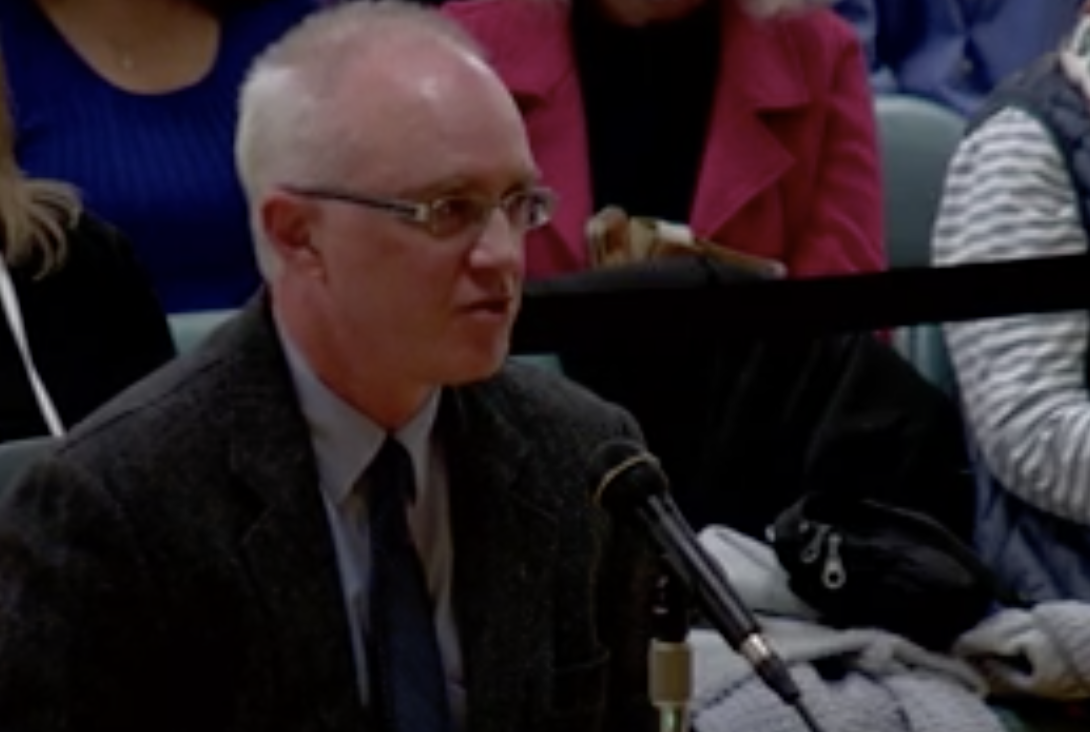
The person pictured above, who bears a striking resemblance to a morality crusader in a TV detective show who’s eventually revealed as the killer, is Michael Shively, PhD.
Shively is a researcher on sex trafficking for the benignly-named National Center on Sexual Exploitation. In the past two weeks, he has appeared before the Montpelier and Burlington City Councils to speak against proposals to decriminalize prostitution. Proposals that, in his words, “would allow any home, any apartment, any nail salon to become a brothel.”
His appearances and affiliation have been duly parroted in media accounts of his “testimony,” which in each case amounted to two minutes during public comment time.
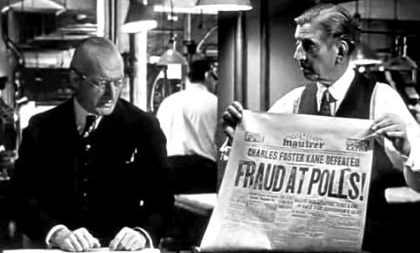
Well, let me fill you in. But first, in case you thought I was unfair in my description of Shively, here’s Levi Beecher, morality crusader slash murderer from an episode of the CBC series “Murdoch Mysteries.”
It was yet another Covid briefing full of same-old, same-old. Carefully chosen statistics, evidence-free optimism, whistling past the graveyard, vigorous straw-man punching, self-pity, and not a lick of policy change despite the fact that new cases and hospitalizations continue to be distressingly high. Rather than trying to find a new theme in today’s performance, here’s a collection of random notes from a dispirited observer.
The question of the day came from the Vermont Business Journal’s Tim McQuiston: “Why should we care about kids getting Covid at all?”
Lest you think I’m unfairly plucking that out of context, here’s the rest of his statement (only slightly abridged):
There’s been a lot of difficulty in child care and finding workers for child care. The parents have to stay at home. Now with cases in schools, kids might have to be quarantined and stay at home. … Why should we care about kids getting Covid at all? It’s creating a lot of disruption for them. It’s obviously disrupting the economy. Cases and their symptoms are very low, but there’s a lot of effort still going on, still a lot of disruption.
Eesh. McQuiston works for a publication that caters to business, but that’s approaching Ebenezer Scrooge territory. Gov. Phil Scott replied that we have to keep cases down among children because they might spread it to more vulnerable people.
And then Health Commissioner Dr. Mark Levine said something that shouldn’t have been remarkable, but it was. He actually mentioned long Covid!
Funny thing. A couple weeks ago Jay Nichols, head of the Vermont Principals Association, didn’t seem terribly concerned about reports of racist language at a Winooski/Enosburg high school soccer game. Nichols said the VPA might investigate if it received information about such an incident, but for now the Enosburg district was handling it. He gave no indication that the VPA would take an active role.
Since then, we’ve heard of at least two other incidents of hate speech at high school games.
And now, he’s announced a list of (bland and unconvincing) actions in response to the incidents. In doing so, he said “We have plenty of racism and sexism and stuff like that happen every single day.”
Huh.
Two things. First, “stuff like that”? Really?
Second, if this “stuff” happens every single day, why in Hell didn’t the VPA have a process before now?
That statement is bad enough. But when you actually read the list of actions, it’s clear that this is nothing more than a beleaguered organization trying to cover its ass while actually doing as little as possible.
Even by the usual dismal standards, this was a doozy of a weekly briefing. Gov. Phil Scott acknowledged that his policies haven’t been effective against the Delta variant, he had no idea why, yet he would keep doing the same things he’s been doing and just hope it starts to work. Definition of insanity, anyone?
His opening remarks were heavy on “personal responsibility,” which sounds like good old Vermont plain talk. But the underlying message is that it’s our fault his policies haven’t worked. If only we’d all take personal responsibility, everything would be just fine and his genius would be revealed for all to see.
Pushing vaccination was the sum-total of his policy. Vaccines and boosters. Boosters and vaccines. No hint of a fallback policy if we never achieve herd immunity because even in Vermont, some people are anti-vaxxers or Covid skeptics and some will never become eligible. Good public policy doesn’t depend on every single person being personally responsible; it tries to make up for and/or rein in our weaknesses and misbehaviors. I mean, if everyone took personal responsibility, we wouldn’t need prisons or police. Or laws.
That’s why vaccination plus a sensible masking policy has worked so much better than vaccination alone. It would work here too, but Scott is too stubborn and/or beholden to business interests to even consider any mask mandates or limits on travel or public gatherings.
His administration proudly trumpets the percentage of eligible Vermonters who’ve gotten at least one vaccine shot. It’s now an impressive 88.9%. Which obscures the fact that the percentage of all Vermonters with at least one jab is more like 70%. You never, ever hear that figure at the Tuesday pressers.
In fact, a recent tweet from Scott’s official account completely obliterated that key difference:
That, children, is what we in the business call “a lie.”
Meanwhile, take a gander at this map from the New York Times.
The Detritus of Gov. Scott’s Emergency Housing Policy, Left Behind In His Retreat
What a stouthearted guy. What a champion of principle.
What a fraud.
All it took was a few days of bad publicity to induce Gov. Phil Scott to execute a complete 180 on the state’s emergency housing program. After days of resolute insistence that the program had to expire as scheduled this Friday, he turned tail and ran — announcing in a written statement (courage!) that he will allow the program to continue until the end of this year. Between now and then, the federal government picks up the entirety of the tab. Which meant that his now-inoperative stubbornness on ending the program was nothing but a bit of fluff, a purely political stance, since ending the program now wouldn’t have saved the state a dime.
And really, the year-end deadline is equally meaningless since, as VTDigger reported, the Legislature has already apportioned $36 million in federal Covid relief money to keep the program running indefinitely into the new year.
It’s not often that Scott gets caught in a purely political act. But that’s exactly what this is. There can be no valor, no respect, in this abject retreat.
And this is the second time he’s pulled this maneuver. He did the same in September: Insisting on an end to the program only to capitulate when things got a little hot.
The real shame is that it would have been simple for him to retake the high ground.
They must be burning the midnight oil these days at the Fifth Floor Excuse Factory, because the news on Covid-19 continues to be stubbornly bad. Any shred of belief that we’ve turned a corner was dashed with the last few days’ case counts — including an all-time one-day record of 342 new cases on Saturday. The seven-day rolling average remains dauntingly high, as do test positivity rates, hospitalizations, and deaths.
Can’t wait to see how they’ll explain all this at the Tuesday Covid briefing.
It’s approaching undeniable that Gov. Phil Scott’s plan of vaccination first, last and always is just not working. We’ve blown through prediction after prediction of Delta’s decline, and it’s still going strong.
One might expect the governor to change course, or at least tack a little against this gale-force wind, but I don’t think he’s quite convinced yet. Scott has stuck to his guns even as his justifications and explications have gotten thinner and thinner. I mean, last week he openly admitted that he didn’t know what was going on with Covid.
At the very least, he ought to come to the briefing with an air of humility and tell the people that his administration is rethinking the entire issue in light of the numbers, and is putting everything on the table. That would actually be a good way to prepare Vermonters for stronger measures if needed.
Now let’s try to answer the musical question, why hasn’t his policy worked? Vermont does have a high vaccination rate, after all. Are our current numbers a blip on the radar, or can we expect the high case counts to continue? Well, a couple things argue for the latter: Vaccination alone is insufficient, and the vaccine’s effectiveness seems to ebb over time.
Is this the worst moment in Gov. Phil Scott’s nearly five years in office? I’d have to say yes. Now, there haven’t been that many bad moments. Maybe the time he vetoed not one but two state budgets and nearly triggered a government shutdown. But that turned out to be a blip on the radar.
This? This could be the first time he suffers real political damage. He’s taking simultaneous hits on three fronts: The continuing Covid surge, his administration’s erratic Covid policy in the schools, and yet another retreat on the emergency housing program. In all three cases, he looks less like a compassionate moderate and more like a stubborn conservative.
I’m not saying he’s vulnerable in 2022. He isn’t yet, but the bloom is coming off the rose.
He’s had to abandon his optimism on the Delta variant and admit he doesn’t know what’s happening. Our seven-day rolling average of new cases is still near record highs, and hospitalizations, deaths, and test positivity rate are all distressingly high. Still, Scott continues to signal no change in policy. The longer he does so, the more embarrassing his inevitable comedown will be. Unless he gets lucky and the Delta variant goes away.
The school situation is not getting better anytime soon. The “test to stay” program is still being rolled out more than six weeks into the school year. The administration has touted the program’s success in Massachusetts, but there’s a big difference. In Massachusetts, the program was implemented in late July. There was time for planning and adjustment before the doors opened to students. Up here, Education Secretary Dan French is like an auto mechanic working on a car while it’s being driven.
Actually, since he hasn’t offered any resources to schools, it’s more like he’s in the passenger seat telling the driver to work on the engine while the car is in motion.
When last we met, I castigated Gov. Phil Scott for his needlessly cruel posture on the emergency housing program, which he insists on shutting down next Friday when it won’t save the state a damn dime.
This time I’d like to widen the frame, and point out that there ain’t nobody making a public stink about this craven retreat from basic humanity. Well, that’s not entirely true; some people, including tireless advocate and two-time statewide candidate Brenda Siegel, have been bangingthedrum. Otherwise…
Media? An occasional story on VTDigger, and that’s about it. No questions on the subject at Scott’s Tuesday presser.
Legislative leadership? I haven’t heard a peep*. Maybe that’s because they agreed to the original plan to kill the program last spring, so they feel an uneasy sense of complicity. Or maybe it’s because the unhoused aren’t a core constituency.
Update: Two legislative commitees are holding hearings on the program next week. House General Etc. is on Monday morning at 9:00, Statehouse Room 11 or streamed online. The Legislative Committee on Administrative Rules will meet next Thursday at 10:00 in Statehouse Room 24 and streamed online. Hopefully these hearings will prompt some kind of action, and produce some media attention to the issue.
Vermont Democratic Party? Not as far as I can tell. Nothing on its website. The VDP has issued a measly three press releases (according to my inbox) in the last month-plus, and emergency housing was not mentioned at all.
Vermont Progressive Party? You’d think so, but (again, as far as I can tell and I’m open to correction*) no. No press releases, no public statements.
*Correction: I’ve learned that the Progressive Party issued a press release in favor of continuing the emergency housing program in July, when it was first scheduled to end. Since then, Prog lawmakers have continued to speak out in support of the program.
Why the silence? Because we treat the unhoused as if they’re a separate and inferior species, living among us but not really of us. They are The Ignorables.
We are, once again, approaching a deadline to kick hundreds of unhoused people out of their temporary lodgings in hopes that they will (a) find permanent housing in a terribly tight rental market or (b) just go away, please. As of next Friday 10/22, more than 500 households are set to lose their housing. The original deadline was in June, and more than half of those housed in motels were kicked out at that time. State officials agreed to extend it for the neediest clients to September. Then, just before it was to expire, Gov. Phil Scott allowed a 30-day “pause” in terminating the program. He didn’t want to label it an extension because that might seem, I don’t know, too capitulative?
Now we’re waiting to see if another extens — sorry, pause — might be in the works. Meanwhile, anxiety levels must be going through the roof for those hundreds of clients.
But hey, don’t worry; pretty soon they won’t have a roof for their anxiety to go through. See, it all works out.
This is bad and heartless enough. (There’s also an element of blackmail, but more on that later.) But what makes it a moral calamity is that there is no goddamn reason to end this program right now. It’s not costing the state a dime because the feds are paying the freight through the end of this year. Plus, Vermont is swimming in federal Covid relief funds so there’s no excuse for kicking people out onto the street. Or campground, since that’s one resource being offered to the dispossessed.
Remind me again how the governor is devoted to protecting the most vulnerable. Or is that nothing but eyewash?
After weeks of staunchly denying that there was a monster in the attic, the tactic is finally becoming untenable. The pounding, stomping and grunting is just too loud to ignore. So now we’ve switched to “Yes, there’s a monster and we don’t know what his intentions are, but we think it will go away on its own. No need to do anything.”
Yeah, the Scott administration’s carefully posed optimism was on short supply in the latest gubernatorial Covid briefing. After several days of case counts between 200 and 300, a rising test positivity rate, dozens of hospitalizations and a high death count, Gov. Phil Scott and his top officials have retreated from their Happy Place.
Still, despite the bad numbers and failed projections, he still insists that there’s no need for any additional action. It’s all about the vaccine, baby. Get your shots and you’ll be fine.
Well, maybe. At least you’ll be less likely to end up in a hospital or a grave.