Wow. Sarah Fair George and Ted Kenney are running what has to be the costliest race for state’s attorney in Vermont history. George, the incumbent, entered the race with $14,444 left over from previous campaigns and she’s raised another $34,623 this year from 182 separate donors. Challenger “Dead Eyes” Kenney has raised $33,331 from 129 donors.
Has this ever happened before? I can’t imagine it has.
(Side note: This may explain the relative absence of money in Chittenden County Senate races. The state’s attorney contest is attracting a lot of cash, presumably drawing funds away from other campaigns.)
Did anyone notice? The campaign finance reports were filed on July 1, and for the life of me I can’t find any reportage on this remarkable development.
Well, maybe not so remarkable. We knew this was going to be a red-hot contest between George’s progressive record and Kenney’s vaguely-defined combo platter of reform and crime reduction, but still. A combined $68,000 raised by July 1?
Kenney has dipped into his war chest (obligatory “war chest” reference, check) much more freely than George. As a result, George heads into the primary home stretch (obligatory “home stretch” reference, check) with a substantial edge in cash on hand.
One thing stands out when you look over the campaign finance filings for the three state Senate districts in Chittenden County: There are lots of candidates, and most of ’em aren’t raising much money anywhere outside of their own pockets. Seems like a potential equity issue; if you can afford a couple thousand bucks or more, or a LOT more, you don’t have to worry so much about fundraising from other people.
Maybe this is a byproduct of splitting up the formerly unified Chittenden district: No longer can candidates raise money from anywhere in the county. Now they have smaller fields to harvest. Likely a bigger factor: There are a lot of contested statewide races consuming a lot of Democratic money, perhaps away from legislative races.)
The king of the self-funders is Erhard Mahnke, affordable housing advocate and longtime Bernie Sanders associate. He dumped a cool $10,000 into his own campaign, and has only raised $666 from anyone else. That gives him a financial lead in the Chittenden Central district, because he hasn’t spent much so far.
Other notable self-funders include Brian Shelden and Irene Wrenner, Democratic candidates in Chittenden North. They’ve given nearly $7,500 to their own campaigns and raised less than that from other people. Meanwhile, the sole Republican, state Rep. Leland Morgan, has barely tried. He’s raised less than $700. Perhaps he’s looked at district demographics and decided he doesn’t really need to try. Or he’s waiting until after the primary.
Back in Chittenden Central, the top three fundraisers have done well from their own pockets and from others, too.
Another round of Congressional campaign finance filings are in, and the headline is that Lt. Gov. Molly Gray leads the money race. And she does, but not by a meaningful margin, not enough to sway the primary… and Senate President Pro Tem Becca Balint is catching up. (I’ll try to come back to the numbers in the near future, but that’s all you need to know for now.)
Plus, she’s got the LGBTQ Victory Fund PAC spending six figures on her behalf. As is her custom, Gray is slamming Balint for, um, I guess, not preventing this independent actor from acting independently on her behalf? Because Balint is legally barred from any kind of interaction or coordination with Super PACs.
Well, it’s all bullshit anyway, and disastrously-timed bulllshit at that. Really? When the LGBTQ+ community is under attack, you want the community to unilaterally disarm? You want Balint to condemn an LGBTQ+ fund from promoting LGBTQ+ representation?
Gray says her beef isn’t with this group; it’s with any outside spending: “Vermonters decide who represents Vermonters, and no one else,” she says. But she’s happily accepting big fat checks from D.C. lobbyists, isn’t she? Yes, she is.
Meet Emerson Lynn, editor emeritus (and editorial writer) for the St. Albans Messenger, respected presence in Vermont journalism, and, according to a letter to the Messenger, court stenographer for Lt. Gov. Molly Gray’s campaign for Congress.
On Thursday July 14, the Messenger published an editorial written by Lynn endorsing Gray in truly fulsome terms and bashing her main opponent, Senate President Pro Tem Becca Balint. The essay sounds like it was written by the Gray campaign.
Which, maybe it was.
The letter is from Natalie Silver, who was an advisor to the 2020 Gray campaign and is now Balint’s campaign manager. (I was told about the letter and inquired with the Balint campaign, which supplied it to me.)
In the letter, Silver accuses Lynn of being a shill for Molly Gray.
In 2020, during Gray campaign meetings, Silver wrote, “It was discussed openly that you were a Molly supporter and that the campaign would coordinate with you on your editorials, even drafting language for you.” Silver claimed the same thing is happening now on Gray’s behalf. Further, Silver asserts that “you have never spoken to me or [Balint], nor asked us a question about any of the various goings on in the campaign,” and, in fact, rejected the offer of a meeting. (Full text below.)
Silver doesn’t come across as selflessly heroic in this. In 2020 this arrangement helped Silver’s candidate and she was fine with it. Now it hurts her candidate and she’s complaining, so this is a case of situational ethics all around. But hey, situational ethics are standard in politics, are they not?
I haven’t spent a lot of time covering this year’s debates, mainly because there are so damn many of ’em that I could spend all my time doing nothing but that, and there’s too much other stuff to write about.
Debates are considered key moments in a campaign. Candidates spend a lot of time preparing for them. Staffers dissect performances and adjust tactics for future encounters. But how many people pay attention?
Well, we’ve got a pretty good test case before us, and the answer is “hardly anybody.”
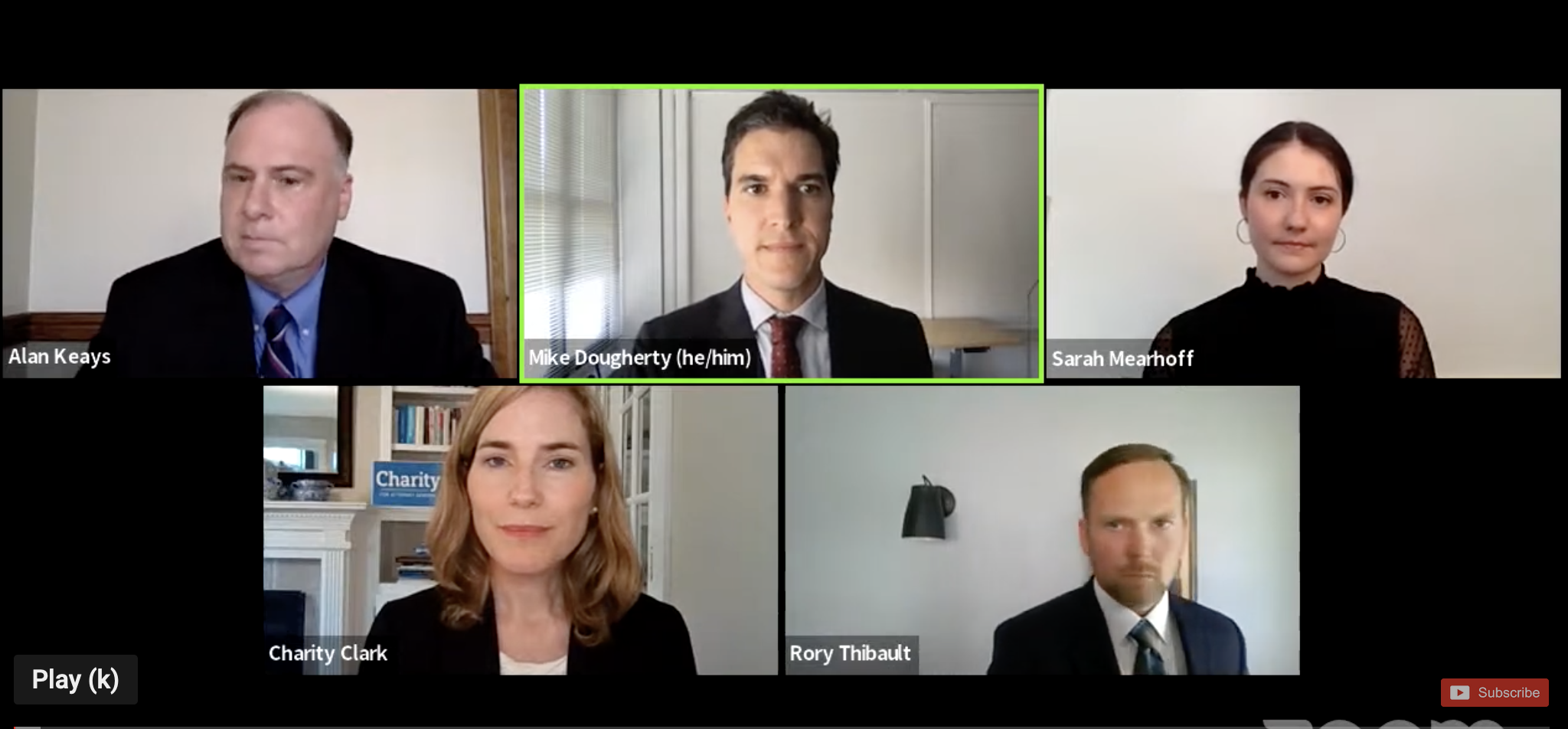
Last night, VTDigger hosted a debate for the two Democrats running for attorney general. By Digger’s own account, the affair highlighted some key disagreements between Washington County State’s Attorney Rory Thibault and Charity Clark, who was ex-attorney general TJ Donovan’s chief of staff.
After it was live-streamed, the debate was posted on YouTube. As of this writing, it has been viewed 645 times.
Six hundred forty-five. For comparison, the last time the Democrats had a competitive AG primary was in 2012 when Donovan challenged Sorrell and nearly won. 41,600 people voted in the primary.
Do high courts do Friday newsdumps? It would seem so. The Vermont Supreme Court issued a ruling on Friday, July 1 — heading into a three-day holiday weekend — with massive implications for independent oversight of OneCare Vermont, our favorite too-big-to-fail institution, and for the state auditor’s office.
The newsdump worked like a charm. VTDigger cranked out a quickie same-day story that hit the Internet at a time when lots of people had stopped paying attention to the news. By Tuesday, July 5, the decision had pretty much vanished from public attention. A strong statement from Auditor Doug Hoffer blasting the decision went largely unnoticed. But I sure hope responsible parties in the Legislature have taken note, because something needs to be done to fix this.
The unanimous decision denied Hoffer access to OneCare’s payroll information. He had sought access after OneCare’s payroll and benefits expenses jumped from $8.7 million in fiscal year 2019 to $11.8 million the following year. He understandably wanted to find out why. It’s an issue that should concern us all because OneCare is (a) kind of a rolling experiment that’s (b) playing with massive amounts of public money for which it is (c) not very accountable at all.
I’ll get back to OneCare, our most mysterious of public sector black boxes, but first I want to discuss the Auditor’s part of this. The court ruled that the Auditor has no authority in statute or in contract to access OneCare’s financial records. It asserted that financial oversight belongs solely to the Green Mountain Care Board, which is essentially OneCare’s captive partner in this grand experiment.
Well then, I ask, what in hell do we have an auditor for?
The VTDigger commentary space is often a repository for the very best in straw-man punching: setting up an easy target and dispatching it with, if you’re talented enough, a rhetorical flourish.
Well, Tom Evslin, entrepreneur, serial Republican donor, self-appointed technology seer and number-one fan* of Elon Musk’s Starlink Internet service**, went one better in the straw man competition. He threw together a whole bunch of miscellaneous straw men under the rubric of “overabundance of caution” and went straight down the line, punching each of them in turn. All in service of a point that apparently made sense to him but is, in fact, utterly incoherent.
*His occasional musings on the glories of Starlink have found a home on True North Reports, because Musk is the closest thing reality offers to an Ayn Rand hero. Except Musk is a phony; his companies have received literally billions in public sector grant funding.
The overarching point is that Our Political Leaders sometimes overreact to a potential danger, thus putting us all in metaphorical shackles. And by “overreact,” I mean doing something that Tom Evslin disagrees with. Ah, if only we were all as wise as he.
Fourth in a series on the July `1 campaign finance reports. Yes, it’s still relevant because the general media coverage of the filings was disgracefully thin. Previously: Lieutenant Governor, Governor, Attorney General. Final installment pending: a look at select legislative races.
The Democratic primary for Secretary of State attracted three very qualified candidates after incumbent Jim Condos decided it was time to retire. One has a clear lead thanks to being the first candidate to declare; the second is catching up in a hurry; the third is lagging far behind.
The first is Deputy Secretary of State Chris Winters. He’s been a candidate the longest, plus he had to know long before Condos’ announcement that the position would be vacant. Condos has been thumbing the scale with gusto even before he stepped out of the race, and recently he flouted tradition by formally endorsing Winters.
That should be a substantial intangible factor in Winters’ favor. He also leads in the tangibles, having raised $39,000 in the reporting period and a total of $61,000 for the campaign to date. He has spent $23K so far, which leaves him with $38K in the bank. $5,500 of his spends went to the Vermont Democratic Party: $1,500 for placement at the party’s Curtis-Hoff fundraiser, and $4,000 for access to the VDP’s extortionately priced and indispensable voter database. He also spent $1,500 on yard signs from the Texas-based firm Super Cheap Signs. Union shop, I trust.
Notable donors on Winters’ list: $4175 from Martha Allen, former head of the VT-NEA; $4,210 from the Vermont Association of Realtors; $4,000 from Ernie Pomerleau, Burlington developer and friend of moderate Democrats everywhere; $500 from outgoing Treasurer Beth Pearce; and $101 from former governor Howard Dean.
Second place in the money race is Rep. Sarah Copeland Hanzas, who didn’t announce until late April. She’s done well since then, receiving $39K in donations in a month and a half. She has spent $22K, so she has $17K in cash on hand.
Topping her donor list are a bunch of people named Copeland, presumably family, who gave a combined $11K. She got $1,000 apiece from renewable energy developer David Blittersdorf and former ANR deputy secretary Peter Walke. There’s a gaggle of current and former lawmakers including Shap Smith, John Gannon, Carol Ode, Leslie Goldman, Becca White, Sarita Austin, Amy Sheldon, Maxine Grad, Don Hooper, Mary Sullivan, Janet Ancel, Tony Klein, and Mike Yantachka.
Other notable names: $1,050 from Lisa Senecal, co-host of “We’re Speaking,” a podcast produced by The Lincoln Project; $500 from Democratic donor Billi Gosh and $300 from progressive donor Crea Lintilhac; $500 from Will Raap, founder of Gardeners’ Supply; $300 from former lobbyist turned bluesman Bob Stannard; $500 from the Leonine lobbying firm and $250 from lobbyist Heidi Tringe; and $150 from attorney general candidate Charity Clark. Her expenditure list is topped by $13,463 for postcards (and presumably mailing) from the Print & Mailing Center of Barre.
Finishing a distant third in fundraising is Montpelier City Clerk John Odum, who entered the race shortly before the March 15 filing deadline. He raised $13K during the latest reporting period and a total of $20K for the campaign to date. He’s spent $14,494, which leaves him with $5K and some change.
But wait, it gets worse. Odum received $8,400 from Elizabeth Shayne, partner of state Rep. Tiff Bluemle. Now, a donor can’t give a candidate more than $4,210 for the primary. I have to assume that half of Shayne’s money is earmarked for the general election campaign and can’t be spent until after the primary. If that’s true, then Odum only has about $1,000 in cash on hand. He’d better have one crackerjack of a grassroots/field operation, is all I can say.
(Update! The $8,400 was a clerical error. Shayne donated a total of $4,200. Odum’s financial report has been corrected. His amended report indicates that his campaign has about $1,900 in cash on hand.)
Overall, Copeland Hanzas has a clear advantage among Democratic officeholders and party mainstays. Winters has outraised the field and has more cash on hand plus Condos’ imprimatur, but his donor list is short on Democratic stalwarts. Odum is far behind in fundraising and cash on hand; unless he’s got hidden advantages, he’s looking like the third place finisher in the primary.
Otherwise, how do I see the race from here to Primary Day, now less than a month away? Hard to tell. Neither Winters nor Copeland Hanzas has a high profile outside of Montpelier. Winters has Condos behind him; Copeland Hanzas has a lot of lawmakers in her corner, and that’s nothing to sneeze at. Members of the House are very plugged in to their districts. Get enough of them in your corner, you’ve got a head start on a statewide network.
So. If anyone claims to know how this is going to turn out, they’re probably blowing smoke.
I’m not the best person to eulogize Rep. Warren Kitzmiller, whose death was announced by the Vermont Democratic Party this evening. But I do have some things to say, because I always had a soft spot in my heart for him.
Which is a bit strange, because he is the epitome of the kind of lawmaker I have little patience for. He’d represented Montpelier in the Legislature for 21 years; he was appointed in 2001 to succeed his late wife Karen. (He’d announced his retirement from the Legislature, but didn’t quite make it to the finish line.) He was elected time after time in contests that were over before they began, such was the power of his name and his place in the community. He was the founder of Onion River Sports, and he served in a plethora of roles in Montpelier city government and civic life.
I didn’t get to experience him in all his glory. By the time I started hanging out at the Statehouse, he was a quiet, genial presence with little to no policy profile. He rarely initiated any legislation, and rarely spoke in committee or on the floor.
In other words, he kind of occupied the seat without much apparent purpose. His very progressive city could have benefited from more energetic representation.
He ticks off all the bad boxes. Never won the seat on his own. Didn’t seem to do much or have any ideas. Stayed in office well beyond his sell-by date.
But hell, I liked the guy.
He was unfailingly friendly. He didn’t take himself too seriously. He was always up for a chat, and usually had smart, insightful things to say. He was a legitimate pillar of his community. He earned his popularity through service. In my limited experience, I never saw him act or speak out of meanness. If everyone were more like Warren Kitzmiller, this world would be a much better place.
Whenever I drive into Montpelier, I pass by his house on North Street. I once visited him there, and had a very nice conversation on his back deck. Maybe that’s why I took note of his house every time I passed by, and hoped he was doing well.
The drive down the hill will be a little sadder from now on. Many people will have much more reason to miss the guy and have much more comprehensive things to say about him. But I didn’t want to let his passing go by without comment. He was one of the good ones.
There’s something about immortality, about escaping the finite bounds of a lifetime. If not in corporeal form, at least in lasting impact. Making a mark, leaving a legacy, your name remembered long after your contemporaries have returned to the dust. Escaping the curse of Adam and Eve. It’s an almost universal human yearning, reflected in the appeal of religious belief and, well, superhero comics.
Well, you didn’t come here for the warmed-over philosophy. Let’s get to Jim Condos.
The outgoing Secretary of State put his thumb on the sca — I should say, smashed his fist on the scale and jumped up and down on it with all his considerable weight* when he endorsed his deputy Chris Winters to succeed him when he leaves office.
*Big-boned.
He wants that legacy, doesn’t he? He wants his impact on the office to last beyond his physical tenure. He wants one final validation from the voters, who have treated him kindly over the years.






 The Vermont Political Observer.