Monthly Archives: December 2020

If Doug Hoffer Issues an Audit in the Forest, Does Anybody Hear?

State Auditor Doug Hoffer, whose work is more honored in the breach than in the observance, has released a report that’s critical of the Vermont Economic Growth Initiative.

(Before he sends me a correction, please note that this report is not a formal “audit,” my whimsical headline notwithstanding.)

The report came out one week ago today. You might well have missed it, because it was pretty much ignored by the Vermont media. As far as I can tell, it wasn’t covered by Seven Days or VTDigger or any of our sadly diminished dailies. (The Vermont Business Journal did post Hoffer’s press release on its website without any actual reportage, but that’s about it.)

Which is kind of sad. Hoffer is the chief watchdog of state government, after all. His reports ought to be newsworthy. But the media ecosystem is so diminished that a lot of stuff falls through the cracks.

I also suspect that Hoffer has gotten a reputation as The Auditor Who Cries Wolf, especially when it comes to economic incentive programs. His skepticism runs counter to the conventional wisdom, which is that these incentives are a valuable tool in the box. And that if the state doesn’t offer incentives, it might lose out to all the other jurisdictions that offer incentives.

That conventional wisdom is treated as gospel by the executive branch and the Legislature. Hoffer always gets a polite hearing before the appropriate House and Senate committees, who then proceed to ignore whatever he has to say. And that’s a shame, because Hoffer is a smart fellow with a real dedication to making government run as efficiently as possible. His work should be taken seriously.

Continue reading

Barre’s Flag Fiasco

Oh no, I’m sorry, that’s way too controversial.

The Barre City Council deliberated for months on a proposal to fly the “Black Lives Matter” flag in City Hall Park, a measure first proposed last spring. They finally resolved the matter in a way that only an all-white group of desperate politicians could devise. They decided the BLM flag would fly through the end of December, and that for January it would be replaced by the “Thin Blue Line” banner, a bastardized version of the American flag that’s favored by the pro-police crowd.

Talk about both-sidesing an issue.

The only thing stupider than the final resolution was its original version, which would have seen 22 different flags displayed for one month apiece. That roster included the flags of England, Italy and France, as well as the Star of David, an Autism Acceptance banner and the flag of the Green Mountain Boys.

Talk about 22-sidesing an issue.

That idea was floated by Councilor John Steinman, a very conservative dentist who once ran unsuccessfully for the House. I couldn’t hazard a guess as to why he chose England, Italy and France (white people white people WHITE PEOPLE WHITE PEOPLE!!!!), or why he cast his net so widely, but somehow that proposal was actually adopted by Council at its November 17 meeting — only to be replaced by the two-flag plan the following week, presumably after an outpouring of laughter and derision.

I shouldn’t have to explain why it’s such an affront to tie those two flags together, but let’s give it a shot, shall we?

Continue reading

Miro’s Opening Salvo

The Mayor, preparing to launch his attack

One has to assume that Miro Weinberger knew exactly what he was doing when he spent a goodly chunk of his Sunday speech attacking the Progressive Party. I mean, he spent most of his time building a case for his party and his re-election, but he had to know that the attack would dominate the news coverage — and would outrage the Progs.

His address was delivered to the city Democratic Party’s online caucus, which unsurprisingly gave him the party nomination in his bid for a fourth term. In the speech, Weinberger custom-crafted a concept of the Democratic Party writ large, a concept I find unconvincing.

Over and over again, he talked of data, science, and expertise as the foundations of his mayoralty. He recalled the ardent baseball fandom of his youth, which was sharpened by the sabermetric revolution launched by Bill James in the 1980s. It convinced him, he said, that “good analysis and the right experts can have a tremendous impact… and generate life-improving results.” Such as four Red Sox championships, presumably.

So, when he became mayor in 2009, he was “determined to make decisions based on evidence, not conventional wisdom.” He outlined a couple examples of evidence-based policymaking, and then tied it to the city’s response to the coronavirus, for which he claimed “one of the best records of any American city.”

Okay, well, he also governs one of America’s smallest cities in a sparsely populated state largely spared in the first wave, but whatever.

And this led directly into Weinberger’s attack on the Progressive Party.

Continue reading

A Failure With Many Fathers

Timing, Mr. President.

Things have pretty much gone to shit at the University of Vermont. The latest installment features the announcement of a plan to take a meataxe to humanities instruction. A total of 24 academic programs are to be cut, totaling roughly one-fifth of the College of Arts and Sciences’ course offerings. The administration thoughtfully unveiled the plan via mass email because that’s the way Ebenezer Scrooge would have done it if he’d had email, right?

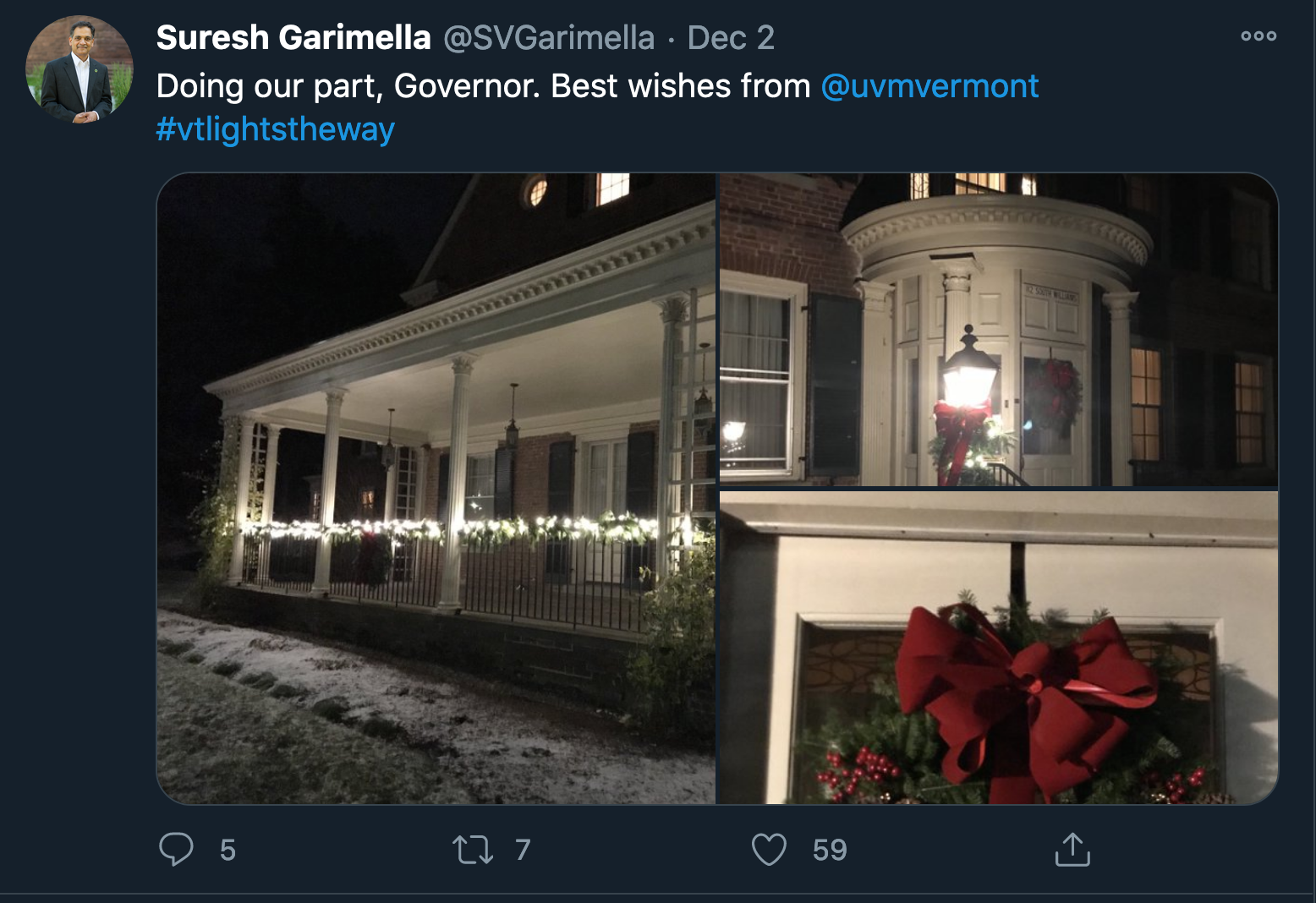
That very same day, after metaphorically turning out the lights in many a campus precinct, UVM President Suresh Garimella posted the cheery tweet reproduced above. Tone-deaf much?

The plan has not been received well, to say the least. The UVM-related Twitterverse has been ablaze with recriminations. Nearly 2,000 people have signed an online petition to reverse the cuts. Campus reaction has been muted because, well, the students have been sent home and teaching is being done online.

Hard to put together a protest under those conditions.

UVM administration has often seemed out of touch and, shall we say, uncollaboriative in management style. Garimella, an engineer by trade, has been in office for less than two years, and his hiring was seen by many as signaling a turn away from the humanities. This year has seen contract talks with the faculty union go nowhere. The administration was forced to rescind planned cuts in lecturers and adjunct faculty after it was met with an uproar.

So, you’re expecting me to slag the top brass and brand Garimella as an enemy of the humanities, right?

You’d be wrong. There’s plenty of blame to go around.

Continue reading

Adventures in Inadequate Governance, part 2

Just tryin’ to keep up…

In part 1, I brought your attention to some appalling facts about Vermont’s lack of oversight for rental housing. Today we turn to three separate articles concerning nursing homes and the coronavirus that reveal further inadequacy in governance. The first is about an apparently toothless settlement with a for-profit senior facility. The second and third detail the toll Covid-19 is taking on some of our most vulnerable Vermonters.

The Intercept, where Glenn Greenwald used to hang his hat before he went batshit, has shone a fresh light on last spring’s worst outbreak in Vermont — at Burlington Health and Rehab, owned and operated by the troubled Genesis HealthCare chain.

Turns out that only weeks before the pandemic struck, Attorney General TJ Donovan had reached a settlement with Genesis over “allegations of neglect” that led to three injuries and one death. That settlement did little or nothing to improve the situation, and within months, 12 BH&R residents had died of Covid-19.

Under terms of the settlement, proudly announced in the customary AGO press release, three Vermont-located Genesis facilities were to pay a fine and hire a Patient Care Coordinator for the three locations plus an independent monitor to oversee quality of care. Was it enough?

“It’s really baffling that the settlement did not include some type of staffing requirements,” said Brian Lee, the executive director of Families for Better Care, a nonprofit advocating for tighter regulation of nursing homes. “Has [Donovan] arrested anybody? Has he prosecuted anybody? Has anybody gone to jail? No. The settlement should have included a requirement for RN staffing. They were short-staffed prior to the incidents and short-staffed after. It’s pretty negligent on the AG’s office to not include that,” said Lee. “The quality of nursing homes is dependent on staffing.”

You can probably guess the next bit. According to federal regulatory records, Genesis failed to increase staffing to recommended levels. Donovan agreed to let Genesis do the hiring, and there was apparently no follow-through by the state to ensure full compliance. This is a problem with Donovan’s negotiating tactics, and also an issue for state regulators. When a facility is enough of a bad actor to trigger enforcement action, shouldn’t the Human Services Agency perhaps provide some extra scrutiny?

I guess not. Well, I can’t say for sure. But what I can say is that whatever Donovan and AHS did, it wasn’t enough. Let’s remember that, the next time Donovan puts out a self-congratulatory press release.

Continue reading

Adventures in Inadequate Governance, part 1

Sumitted for your approval, three news stories on a common theme: What happens when government isn’t up to the task?

Two are about Covid-19 and nursing homes, which I will address in my next post. Under consideration here, courtesy of VTDigger’s Anne Wallace Allen, is a look at Vermont’s wretched rental housing stock. The headline, “About 7,000 Vermont households lack things like kitchens, bathrooms, or heat,” is a bit exaggerated. But the reality isn’t much better.

Nobody knows exactly how many Vermonters are living in substandard housing.

That 7,000 figure is an upper estimate, so the actual number of households without crucial features may be smaller. But the story’s gut-punch is that oversight of rental housing in Vermont is spotty at best, nonexistent at worst.

The state has a rental housing code but no enforcement mechanism. Several of our larger cities have code-enforcement systems. Elsewhere, it’s entirely up to town health officers. They’re usually untrained volunteers with few resources to conduct their business. James Arisman, who formerly served as Marshfield’s health officer, told VTDigger, “Essentially there is no protection for renters in the state of Vermont by an inspection system that is robust and carrying out routine inspections.”

Yeah, that seems a little problematic.

There are plenty of appalling details, but let’s leave it here: How did we get to the year 2020 with such an archaic “system”? It’s yet another example of the Grandfather’s Lightbulb phenomenon. To wit:

Q: How many Vermonters does it take to change a lightbulb?

A: Change it? That was my grandfather’s lightbulb!

Continue reading

This Time, For Sure

By all rights, Miro Weinberger’s bid for re-election as mayor of Burlington ought to be in deep trouble. During his current term, he has overseen the continual failure of the CityPlace redevelopment, embarrassing leadership shuffles in the Police Department, and a summer of protests over cops accused of excessive force.

Not to mention the arrival of ROOOARRR sorry, the arrival of the RRRROOOOARRRR dammit, the F-35’s RRRROOOOOOAAARRRR screaming across the skies RRRRRROOOOOOOAAAARRRRRRR oh c’mon, of the Queen City.

(Yes, that’s a Thomas Pynchon shoutout. Mandatory reading for the mid-70s college intellectual dudebro.)

There’s also the inevitable Incumbent Fatigue that eventually afflicts administrations, both internally and in public perception. (Vermont Governors usually get at least six years in office if they seek it, but rarely more than eight. Miro’s approaching nine right now.)

And did I mention that Miro won re-election with only 48 percent of the vote last time around?

He still won, because two progressive challengers split the remainder.

And wouldn’t you know it, that seems the most likely scenario again this year. It’s certainly Weinberger’s best hope for success.

It’s a dismally familiar scenario for this observer, who’s watched Purity Wars divide progressive parties and movements for something like 50 years. And I’m sorry, but I usually fall on the pragmatic side of this.

After the jump: Storytime!

Continue reading