Monthly Archives: January 2015

The Assassination of Mary Morrissey by the Coward Shap Smith

The Burlington Free Press doesn’t have much time for state government these days, what with the dismissal of its entire Statehouse bureau and its obvious skeleton-crewing in recent weeks.

But boy, they’ve got plenty of time to spare for the potential reassignment of a single Republican back-bencher.

[State Rep. Mary] Morrissey, [R-Bennington]… confirmed Friday she has been told that House Speaker Shap Smith, D-Morristown has plans to reassign her to a yet to be determined committee.

… Morrissey said she sees the move as an effort to silence a legislator who has been forced to ask tough questions that Democrats are not asking themselves.

Or, to put it another way, it’s a routine committee reshuffle, the kind that happens every couple of years. A whole lot of others will be shifted around in the next few days. It is within the purview of the Speaker to make committee assignments.

Morrissey and her allies are depicting this move as an effort to stymie oversight of health care reform. Which, frankly, gives a hell of a lot of credit to Morrissey. In my brief exposure to her work, she seems to be a garden-variety naysayer on health care reform, ideologically opposed to Obamacare and Shummycare under any circumstances, and not offering any special expertise on the subject.

The Speaker himself put it this way:

“I’ve spent a lot of time looking at a group of people that will work well together to come up with policy,” Smith said.

“I want to put together people who will work effectively together and don’t have baggage from past fights,” Smith said.

Since Morrissey is toting a steamer trunk full of conservative dogma, Smith seems to have reason for her removal. It has less to do with the alleged danger she poses to Democrats, and more to do with her kneejerk opposition. She’s not a watchdog, she’s a fallen tree in the roadway.

Her possible removal from the Health Care Committee is standard operating practice. And, frankly, not that big a deal. It’s not like she’s the only one who can ask inconvenient questions, and it’s not like she has special knowledge of the health care system.

Well, if she does, she hasn’t shown it.

Our still-broken inpatient psychiatric system

One of journalism’s highest purposes is to lance the boils of society — to expose unpleasant truths that everybody is doing their best to ignore.

A prime example appears on VTDigger today: a story by Morgan True about the continuing problems in the state’s psychiatric care system, and particularly the brand shiny new state hospital in Berlin.

Among the key points:

— Even after the facility’s opening, some psychiatric patients have found themselves parked in emergency rooms for days or even weeks.

— There have been 59 documented attacks by patients on hospital staff, some resulting in significant injuries.

— The hospital houses a couple dozen of the most severely ill people in Vermont. Many have been convicted of violent felonies. One doctor told True that the hospital is “one of the most dangerous workplaces in Vermont.”

— State law strictly limits the restraint or medication of patients against their will. Even the most violent.

— In part because of this dangerous work environment, the hospital has been consistently understaffed since its opening. As a result, it has yet to operate at full capacity.

Which brings us back to point one: several months after the hospital’s opening, severely mentally ill people are still being warehoused in ERs.

This is a whole lotta bad stuff. It shows a mental health care system that’s still functioning poorly even after the Shumlin Administration’s entire plan has been put in place.

The Department of Mental Health, for its part, seems to be taking a remarkably lax and unforthcoming attitude toward the situation. DMH knows the total number of attacks on staff, but it won’t release any information on staff injuries.

And according to DMH Deputy Commissioner Frank Reed, the department “has not tried to compare the number of violent incidents at VPCH to other psychiatric hospitals.”

Well, why the hell not? I’d think you’d want to know whether our problems are unique, or simply the natural consequence of caring for the most severely mentally ill.

Reed also flunks the transparency test when it comes to waiting times in hospital emergency rooms. He says average wait times have decreased, but…

Reed was unable to provide documentation of average wait times, saying those figures are still being “pulled together.” The numbers will be presented to a legislative oversight committee in January.

Perhaps Mr. True should apologize for inquiring at an inopportune time. But it shouldn’t be that hard to assemble those numbers. Indeed, I’d expect a Department that’s doing its job to compile those figures on an ongoing basis.

In fact, I’d be very surprised if DMH doesn’t have the numbers already. It’s Management 101, isn’t it? Keep track of your most important statistical markers?

True’s report raises all kinds of questions about state law, the Shumlin Administration’s concept of a mental health care system, and how many resources were spent trying to develop a system that was undersized from the start. DMH officials are talking about supplementing the system with a new 14-bed secure residential facility, but acknowledge that it’ll be a tough sell when lawmakers are under the gun to cut the budget. DMH may have already squandered its best opportunity to create a good system.

And please don’t insult me with the “No one could have foreseen” excuse. The people responsible for inpatient care were all saying the same thing after Irene: the Shumlin Administration’s plan was so bare-bones that it was almost doomed to fail. While their advice was ignored, how many millions did the Administration spend on inadequate plans, patchwork facilities, and extra costs? (One example: according to True, the state has paid more than $1 million since 2012 for sheriff’s deputies to monitor psychiatric patients in hospital ERs.)

And it turns out, to the surprise of no one who works in the field, that a 24-bed hospital costs nearly as much to run as the old 50-bed facility, and costs more on a per-bed basis because the foundational staffing needs are so high.

And, given that the new hospital has some of the same kinds of problems as the old one, I have to ask if our laws are out of whack. I mean, look: We’re talking about the two dozen  sickest people in Vermont, many of them violently, dangerously sick. The restrictions on restraint or medication without patient approval may be the best thing for the vast majority of patients; I believe different standards should apply to the very sickest. They are the ones least capable of exercising sound judgment, and most capable of inflicting harm on staff or fellow patients.

One commonality between the old hospital and the new is our strongly patient-centric laws. It seems clear to me that those laws are on point for the vast majority of patients, but that there should be a different standard for patients in the state hospital.
Woman, ever the nurturer

Odd experience today.

A bit of background first. We have an older car that we’ve been taking to the same independent repair shop since we moved here. Never been to the local dealership.

Until today, when I wanted to replace a burnt-out headlight before the weekend. So I called the dealership (which shall go unnamed), and got an incredibly chirpy female who answered the phone with a clearly rehearsed, boss-mandated greeting. I asked for Service, and she sent me to voice mail. I left a message.

An hour later, I called back. Got the same chirpy greeting from a different female. She checked around a bit, and told me I could come in anytime today. And informed me that “Jim” hadn’t had time to return my call because they were short-staffed. Okay.

So I go in. The gents on duty in Service are old-school Grunt ‘n Scratch types. The one who didn’t return my call is clearly just a little bit pissed that I made a second call. But what do I know? The longer I waited, the less chance I had of getting the headlight replaced. On a Friday.

The guys are all either staring at their computer screens or talking on the phone or both. They don’t tell me Jack Squat, so I hang around the desk. Waiting for, oh, maybe a time estimate? An invitation to sit down and have a cuppa joe? I don’t even know whether they’re taking action on my car or just typing stuff into their computers.

About ten minutes later, Randy the Service Guy tells me it’s all set and charges me sixteen bucks.

That’s nice, fast and cheap. But it left me wondering: if the dealer took all that trouble to train his female receptionists to be cheerful and order them to use an overly chirpy rehearsed greeting, then why doesn’t he send his Service Guys to charm school? Whatever good will the female receptionists may have created with their obviously canned greeting was more than undone by the Service Department’s complete lack of communication skills.

And, more broadly, why is it the gals’ job to be the business’ smiley face?

I look forward to returning to my independent garage, where the owner is a woman and the female receptionist actually knows quite a lot about cars. And everybody is equally polite and businesslike.

A Fair Point

A top Vermont pol not known for podium-pounding or rabble-rousing has sent some unusually fiery language in the direction of Vermont’s leading telecom provider.

House Speaker Shap Smith says he has doubts that FairPoint Communications will continue to provide telecommunications services to Vermonters for the long term as its workers continue to strike and service complaints pile up.

Smith, a Democrat, said he believes the company is looking to shed labor costs in order to sell.

You may have missed that little New Year’s Day newsflash, because it was written by the Mitchell Family Organ’s Neal Goswami, and appeared in the paywalled Times Argus and Herald. Nobody else has reported it so far.

FairPoint workers have been on strike since mid-October. Top Democrats have pressured the company to settle, but it has refused to budge. In fact, CEO Paul Sunu recently sent a response to those Dems, portraying his company as the willing negotiator and the unions as the hard-heads.

Smith told Goswami he was “insulted” by the letter, and said FairPoint was putting itself “in a tough place.” And he’s got capitalism’s weapon of choice in his pocket: money.

Smith said the state has provided subsidies to FairPoint in recent years to help it deliver service to rural areas. But the company is not likely to receive a warm reception from lawmakers in the new session, he said.

He accused FairPoint of “trying to basically bust [the] union[s],” and added that “they’ve got a real problem on their hands in the Legislature.”

FairPoint may also have “a real problem” with state regulators. It has proposed a new rate plan that would cap rates for basic phone service (the loss leader) while allowing FairPoint to raise other rates (advanced phone packages, business phones, Internet, satellite TV) without seeking regulatory approval.

Gee, that’d be a big fat giveaway, wouldn’t it now?

At a time when service problems have spiked since the unions walked out, and FairPoint has had one major interruption in its E-9-1-1 system, you’d hope that state regulators would be keeping an eagle eye on these mooks instead of giving them open access to non-basic customers’ wallets.

Beyond the immediate situation, Smith questioned whether FairPoint would still be in Vermont five years down the road — and whether it would be able to find a buyer for its northern New England business. And he’s got a (cough) fair point: the landline business is shrinking everywhere, and rural phone service means high maintenance costs and low profits.

That’s why Verizon dumped our business on FairPoint a few years back.

Smith wants state government to be proactive about the situation, rather than wait for FairPoint to bleed us and its workers dry and then dump the business entirely.

He said the Legislature should begin exploring options with the Public Service Department to ensure the state has quality telecommunications services in the future.

What might that mean? A quasi-public Vermont Telecom? Or a fully public one? Not sure what Shap has in mind, but it’s an important issue we should face before it turns into a crisis.

Phil Scott’s Business Buzzword Bingo

For those just joining us, Lt. Gov. Phil Scott is planning a big policy offensive (and fundraiser) on Day One of the new legislative session. To wit, a “pitch session” for business leaders to give their ideas on how to fix Vermont’s economy. I can only take this as a direct challenge to the Democratic majority.

Now, in case you thought this event promises to be a big fat snooze… if you saw this as an utterly predictable gathering of likeminded people for the sole purpose of validating preconceived notions… well, you’re probably right.

But I’ve come up with a way to make it more interesting.

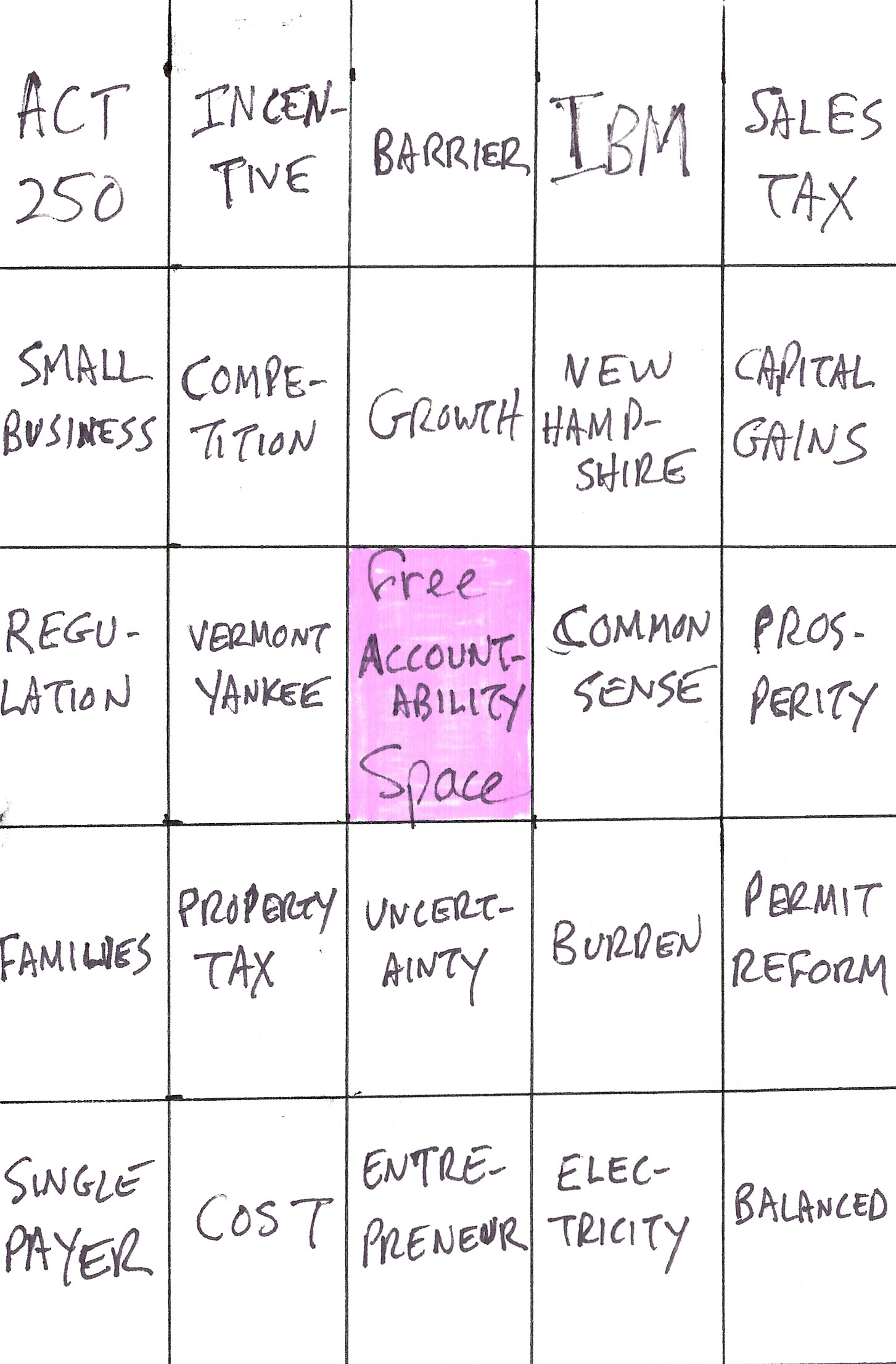
I call it Phil Scott’s Business Buzzword Bingo. Simply print out the image below, take it with you to the “pitch session,” and whenever you hear a buzzword, write an “X” over the corresponding square. When you get five in a row, across, down, or diagonally, shout “BINGO!” You win!

Ground rule: plural or alternative versions of a word are accepted as matches. For instance, “Costs” is a match for “Cost,” and “Entrepreneurial” is a match for “Entrepreneur.”

Come to think of it, you should print out a whole bunch of Business Buzzword Bingo cards, because I have a feeling we’ll get a BINGO every two minutes or so.

Here you go: your very own Phil Scott’s Business Buzzword Bingo playing card. Enjoy!


Phil Scott Bingo card