Monthly Archives: January 2015

How to get those ski leases reopened

Last Tuesday, State Auditor Doug Hoffer issued a report on Vermont’s leases with ski resorts. The leases, he said, were outdated and were not bringing a fair return for the resorts’ highly profitable use of public lands.

At the time, you may recall, the state Parks and Rec Commissioner Michael Snyder basically threw up his hands and said there was nothing the state could do until the leases expire — decades from now.

Well, I’ve been reminded by someone more aware of state finances than I (which probably includes a substantial percentage of my readership) that the state does, indeed, have a hammer it could hold over the resorts’ heads.

It’s a tax exemption, granted in 2002, on ski lifts and snowmaking equipment. This exemption cost taxpayers $1.42 million in foregone revenue in fiscal year 2012.

It’s been suggested that this is basically a giveaway to a lucrative industry. Sen. Tim Ashe, chair of the the Senate Finance Committee, has called for a cleanup of Vermont’s cluttered, nonsensical “tax expenditure” system, and cited the ski equipment exemption as a clear example of the problem. As he put it, “every time they pay less, we all pay more.”

Well, hey. Why not dangle that juicy tax break in front of resort owners, and say something along the lines of “Gee, it looks like you’re getting a sweetheart deal on your leases AND a questionable tax exemption. Tell you what, we’re feeling generous; you can have one or the other, but not both.”

Makes all kinds of sense, at a time when the Governor and lawmakers are scrambling to find revenue and/or cut the budget. Problem is, the underlying reality hasn’t changed since I last wrote about this. Resort owners are politically connected (how many trips has Gov. Shumlin made with Bill Stenger?), and generous with campaign contributions. It would be difficult, if not impossible, to take either of their windfalls away.

Need proof? How about the sound of silence from the Statehouse in the aftermath of Hoffer’s report? Nobody wants to touch this one. It’s a shame. I expect better from my Democratic majority.

Theme from “Jaws” heard in southern Vermont newsrooms

Looks like the Vermont journalism scene is about to take another step into the abyss. Paul Heintz has a story on the Seven Days website, headlined by a bit of consolidation at the Brattleboro Reformer and Bennington Banner: both papers will now share a single managing editor, Michelle Karas. (When asked if she could handle both papers, her less than reassuring response was “I’m hoping so.”)

To me, though, the more important — and more worrying — news was several paragraphs down in Heintz’ piece: DigitalFirst Media, the corporate parent of both papers, wants to get out of the newspaper business. It’s in the process of selling its entire portfolio of more than 100 papers nationwide. It would prefer to unload the whole shebang in a single transaction, although it may wind up selling things piecemeal.

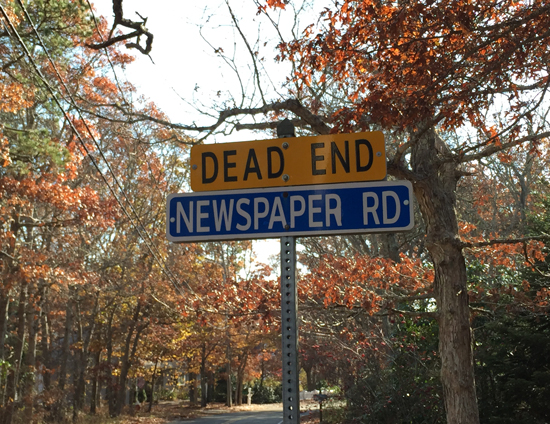
Newspaper Rd. Dead EndDFM’s stash includes such notable properties as the San Jose Mercury News, Salt Lake Tribune, St. Paul Pioneer Press, and Denver Post. Our southern Vermont dailies are afterthoughts by comparison.

And they are about to be thoroughly buffeted by the winds of corporate change.

Possible buyers include a passel of private equity firms, many of which have no experience in newspapers. That’s bad enough, but even worse are the experienced operators said to be in the running. They include Gannett, currently engaged in a slow strangulation of the Burlington Free Press; and GateHouse Media, whose name is poison in Massachusetts.

GateHouse is the creation of another private-equity firm, Fortress Investment Group. Fortress has seen its share of financial trouble in recent years; it nearly went bankrupt in the market crash of 2008. This caused it to default on a huge loan deal to fund construction of the athletes’ village for the 2010 Vancouver Winter Olympics. That forced the City of Vancouver to pony up $450 million (Cdn) to get the village built.

Oh well, you know what they say about eggs and omelets.

Even as it has struggled, Fortress has built a newspaper entity that seems to break all the rules of business. According to the Boston Globe, GateHouse “has never made an annual profit as a public company,” and in 2013 filed for bankruptcy “under the weight of nearly $1.2 billion in debt.”

Even so, Fortress finagled the finances in a way that allowed GateHouse to scoop up 33 more New England newspapers. After which, it immediately imposed draconian staff cuts. Poynter Institute media business analyst Rick Edmonds says GateHouse has a reputation as a “bottom-line, lean operator” that isn’t squeamish about making cuts. “In a case like this, they’ve probably looked at the numbers and said, ‘We can squeeze more [savings] out of this,’” he said.

Through its holding companies, Fortress controls “nearly every newspaper south of Boston,” and also “dominates Boston’s western suburbs.”

Brattleboro and Bennington, just a hop and a skip away. Looking at the two behemoths said to be in the running to buy DigitalFirst, I’d say GateHouse makes a lot more sense than Gannett. And if Gannett winds up buying all of DFM, I wouldn’t be surprised if it spun off the two Vermont dailies, which are teeny-tiny by Gannett standards but right in GateHouse’s comfort zone.

Either way, look for more slashing in southern Vermont’s already sad print-media scene. Which is a real shame; the healthier Vermont media properties, VTDigger, Seven Days, and VPR, all have a clear northern Vermont slash statewide focus. Very seldom does southern Vermont show up on their radar.

There is one thin ray of hope in Heintz’ story. As the Brattleboro Reformer has declined, he notes that an independent weekly, The Commons, has expanded its circulation in recent years.

This may be the next mutation of journalism: a Seven Days approach, including a single weekly print edition and a Web presence with more frequent postings. To be sure, there’s no sign that daily papers will do anything other than continue to diminish in size and quality.

Fear of a non-binding resolution

The anniversary of Roe v. Wade is an opportunity for a bit of political theatrics. Congressional Republicans famously muffed their attempt this year, with an anti-abortion bill so extreme that quite a few female congresscritters objected, leading to the bill’s abandonment.

In Vermont, folks on the other side of the abortion issue brought forward a resolution recognizing the anniversary. This happens every year; but this time, supporters asked for a roll call vote.

Which caused a moment of panic, captured by Seven Days’ Terri Hallenbeck:

Last seen heading for the cloakroom.

Last seen heading for the cloakroom.

The House roll-call vote clearly made some Republicans uncomfortable. In a pre-vote caucus, Rep. Bob Bancroft (R-Westford) asked how members could abstain. Only by not being in the room for the vote, House Minority Leader Don Turner (R-Milton) told him. When Bancroft’s name was called during the vote, he was absent.

Sudden attack of the runs, Bob?

Kudos to Hallenbeck for putting this moment of cowardice on the record. But it made me curious: why was Bancroft especially touchy about this?

Simple answer. He represents Chittenden 8-3, a district represented until this year by Democrat Martha Heath. In 2012 the Republicans didn’t even bother contesting the seat. When Heath announced her retirement, the district was in play. The Democrat, Liz Subin, was expected to win a fairly close race; but Bancroft was swept in on the Republican wave.

It’s likely to be different in 2016, with a Presidential election and Pat Leahy’s Senate seat on the ballot. Democratic turnout will be much higher, and Bancroft may face an uphill battle to win a second term. It’d be very inconvenient for him to be on the record opposing the Roe resolution; but if he supported it, the anti-abortion base would be outraged.

Faced with this dilemma, he chose expediency over exposure.

Well, here’s another good idea we’ll never hear again

Earlier this week, State Auditor Doug Hoffer issued a report suggesting that the state is getting shorted on leases of public lands to ski areas. The long-term leases were negotiated in the Good Old Days, when ski areas were not much more than trails, lifts, and lodges. And they reflect that; lease payments are based on lift ticket sales.

Simpler times.

Simpler times.

Today, ski areas are ski resorts — with myriad amenities and all-season activities. Lift tickets are a small part of the whole. You could argue that that’s because of investments by private-sector operators; you could also say that none of it would exist without the public lands. The AP’s Wilson Ring put it this way:

The [Auditor’s] report says that inflation-adjusted lease payments to the state declined by 14 percent between 2003 and 2013, but property near the ski areas increased in value by about 150 percent, and meals, alcohol and room taxes have increased by between 40 percent and 61 percent.

Parker Riehle of the Vermont Ski Areas Association scrambled to justify his industry’s bargain-basement leases.

“The better that those sales are and the better that the ski rates are on state land the better that the lease payments are to the state,” Riehle said.

Is he really trying to tell us that rock-bottom leases are more lucrative for the state than reasonably-priced ones? Like the supply-side assertion that lowering taxes will increase revenue? How well does that work, Sam Brownback?

Of course, Riehle was reaching deep into the bottom of his rhetorical barrel; he also claims that the leases have led to the preservation of land and wildlife.

Yes, big expensive resports are nirvana for the ecosystem.

Hoffer doesn’t necessarily recommend trying to reopen the leases; he just wanted to provide information and raise the question.

It’s a very good question, with the state’s budget circumstances so tight that Gov. Shumlin has proposed leasing prison space to the feds (which will keep more state inmates in out-of-state for-profit prisons) and placing a three-year moratorium on the Current Use program, among many other things, to generate new revenue. His administration is effectively searching all the sofa cushions for spare change.

Nonetheless, it’s safe to assume that Hoffer’s report will be quietly shelved. Michael Snyder, Vermont’s Parks and Recreation commissioner, says the state’s hands are tied until the leases expire.

That strikes me as an awfully defeatist attitude. The state does hold the ultimate hammer — it’s our land, after all — and could force the ski resorts to reopen the deals if it wanted to.

Of course, ski resort operators (Bill Stenger, come on down!) are very well-connected people with top-shelf representation at the Statehouse and deep pockets for campaign contributions. I can just hear Our Lawmakers issuing heartfelt paeans to One Of Vermont’s Iconic Industries, a Bedrock of Our Vital Tourism Sector, and pooh-poohing any talk of Reneging On Agreements Made In Good Faith.

Too bad, ’cause if Shumlin’s budget is any indicator, we could really use the money. The resort industry has it to spare. And I’d say we deserve a fair return for the use of public property.

But naah, it ain’t happening. Better luck with your next report, Doug.

Don Turner phones it in

House Republicans have apparently decided it’s time to pay some lip service to the idea of health care reform.

Emphasis on “little.”

Under the very generous headline “House Republicans Develop Alternative to Shumlin’s Payroll Tax Proposal,” VPR’s Bob Kinzel outlines a half-assed Republican idea that would, at best, produce a fraction of the benefits of Shumlin’s plan. At worst, it’d be a huge step backward for health care access in Vermont.

The Governor has proposed a payroll tax of 0.7%, with the proceeds going to shore up Vermont’s embarrassingly low Medicaid reimbursement rate. Since Medicaid services are now indirectly subsidized through higher charges to non-Medicaid payers, increasing the state’s reimbursement rate should lead to lower insurance premiums for everybody else. Shumlin says the net drop in premiums would more than make up for the new tax, and he would task the Green Mountain Care Board with making sure the premiums go down.

Also, the reimbursement system would be, y’know, fairer.

House Minority Leader (and king of the kneejerk conservative response) Don Turner isn’t buying it. Funny thing: he doesn’t argue against the tax itself. Instead, he invokes the long-discredited Domino Theory.

“It seems like a little number, but you’ve opened the door,” Turner says.

So he’s not arguing against the tax, just the imaginary consequences of the tax.

His big idea? The state should ditch Vermont Health Connect and opt for the federal exchange. Turner figgers we could save $20 million, which could go toward raising Medicaid reimbursements. Even by his perfunctory standards, this is awfully lame. Transparent, even.

Three problems (at least).

— His $20 million estimate is contested by administration officials. And, as I understand it, a lot of the money spent on VHC is actually federal money. How much of Turner’s reputed $20 million is actually Vermont’s money?

— Shumlin’s tax plan would raise $90 million annually, enough to close the Medicaid reimbursement gap by half. Turner’s $20 million would accomplish slightly more than Jack Diddly Squat.

— Worst of all, the US Supreme Court is considering a case that could end federal health care subsidies for states that use the federal exchange. Turner doesn’t give a rat’s.

“We understand there may be a potential for Vermonters to lose federal subsidies,” Turner says. “However, 35 other states are in the same boat.”

We’ve cut the number of uninsured Vermonters in half, and Turner’s response? “Ehh, easy come, easy go.”

Also, about one-third of the payroll tax revenue would allow the state to expand Medicaid to 20,000 more Vermonters. There’s nothing like that in Turner’s “plan,” and he couldn’t care less. As Kinzel reports, Turner “says he’s not convinced that this expansion is a good idea.”

I guess he’s fine with tens of thousands of Vermonters having no health insurance. Or at least he’d rather have that, than a small payroll tax hike that would be more than compensated for by lower insurance premiums.

Art Woolf To The Rescue!!!

Throughout the history of its big pipeline project, Vermont Gas has been its own worst enemy — alienating landowners, indulging in ham-fisted PR, and repeatedly raising its cost estimates for pipeline construction.

Nonetheless, the odds are still in VG’s favor. Well-meaning protests notwithstanding, if VG can make a plausible economic case, the thing’s gonna get built.

And who’s helping them build a plausible economic case, according to VTDigger?

The construction of the project will create as many as 444 direct and indirect jobs, according to a report by the Vermont consulting firm, Northern Economic Consulting, Inc.

That’s the consulting firm co-owned by our least-favorite economist Art Woolf, he of the reliably awful “How We’re Doing” column in the Burlington Free Press.

Yes, Art’s a professor at UVM, but I suspect he makes a lot more money from NEC than he does for his academic work. His consulting firm has a number of revenue streams:

— Consulting to a variety of high-paying clients, mostly of the corporate persuasion.

— Providing expert witness services for civil suits of all kinds. (“Have you been hurt in a slip and fall accident? Dial 1-800-CALL-ART for expert testimony on your financial losses.”)

— Running an annual Vermont Economic Outlook Conference. The most recent conference was a five-hour affair, with admission priced at a cool $170/person.

— Publishing a monthly Vermont Economy Newsletter, subscription a mere $150/year.

In short, Woolf is more hired gun than objective expert. Which might explain why his weekly columns, more often than not, come across like they were written on behalf of the Associated Industries of Vermont. George W. Bush once told a roomful of wealthy supporters that they were his base; well, the Vermont business sector is Woolf’s base.

So, about his rosy estimate of the pipeline’s economic impact. Without doubt, the vast majority of those 444 “direct and indirect jobs” are temporary, construction-related jobs.

TransCanada has claimed that the Keystone Xl pipeline would create tens of thousands of jobs. But almost all of those are temporary, appearing and disappearing during the projected two-year construction cycle. Operating the pipeline, once it’s built, would take about 50 workers.

As far as I can tell, nobody’s asked Woolf about the quality or duration of those 444 pipeline jobs. But if his math is similar to Keystone’s, then we should expect no more than a handful of permanent positions at Vermont Gas.

Don’t blame Woolf; he’s only doing what bespoke experts do for their money: putting forth the best possible case for his client.

One more thing. The identifier that accompanies Woolf’s column in the Freeploid mentions only that he’s a faculty member at UVM. Nothing about his corporate clients, nothing about the subscriber base for his costly publication. Considering how many business interests are paying Woolf, how often do you suppose there’s been a direct or indirect conflict of interest that’s gone conveniently undisclosed?

Oh, one more one more thing. There’s a typo in the title of last Thursday’s “How We’re Doing.” In the TITLE, for God’s sake. It’s spelled “minuscule,” not “miniscule.” Any copy editors left at the Freeps?


Kill the Task Force

Vermont politicians are addicted to studies. At the drop of a hat, or a tough issue at least, they’ll seek the shelter of the nearest consultant or think tank, or assemble their own commission, committee, task force, or (the Nuclear Option of Political Procrastination) Blue Ribbon Panel.

All of ’em, I say, should be dubbed “Hogans” in honor of Vermont’s Greatest Living Centrist, Con Hogan, who could always be counted on to provide a nice bipartisan sheen to any study effort.

The appointed experts scurry away to do their work, and then return with the fruits of their labors.

Which are immediately shoved in a desk drawer, never to be seen again.

Can you think of a single time when a Hogan actually moved the needle on an issue? In rare cases, a Hogan confirms conventional wisdom and prudent politics; then it can get a little traction. This may turn out to be the case with the RAND study on legalizing marijuana: it promises a rich revenue stream that may prove irresistible to lawmakers.

But if a Hogan’s conclusions are inconvenient or flout conventional wisdom, fugeddaboudit.

The most recent case in point: There were not one, not two, but three separate studies of the Department for Children and Families last year. All three came to very similar conclusions: In order to beef up child protection, DCF needs “better training, more social workers, more transparency and a stronger focus on opiate addiction’s impact on family dynamics.”

The legislature, not content with three studies, appointed its own special committee. Its highest-profile proposals: hang the threat of felony conviction and prison time over the heads of social workers.

That muffled “thud” you hear? Those three studies landing in the nearest recycle bin.

There are many examples; here’s a classic. One of the highest-profile Hogans of recent years was the Blue Ribbon Tax Structure Commission, whose recommendations would have created a fairer tax system, mainly by changing the rules on taxable income in a way that would have raised the effective tax rate for top earners. Who, I remind you, pay far less than their fair share.

But its findings would have ruffled innumerable feathers. So, as VTDigger’s Anne Galloway reported in early 2011:

…state leaders have relegated the Commission’s report to the back burner. The commission’s 18 months of research, efforts to gather a full range of testimony and public debates on policy options didn’t warrant a footnote in the governor’s budget address.

That would be newly-elected Governor Peter Shumlin, who placed a higher priority on not raising [certain] taxes than on creating a fairer system.

Not that I place all the blame on him; it seemed like everyone in the legislature treated the Commission’s report like a snake in the underwear drawer.

Oh well, it wasn’t their 18 months of hard work being flushed down the drain.

Sadly, this outcome is the rule, not the exception. Most of the time, a Hogan is nothing more than a way to kick the can down the road while looking sober and responsible: “We need more information before we can decide this contentious issue.”

Trouble is, the more contentious the issue, the less likely it is that a Hogan Report will actually change anyone’s mind. People like their preconceived notions, and are loath to abandon them just because of some ivory tower “evidence.”

But perhaps my thoughts are themselves too contentious to address head-on. Perhaps what we need is a Hogan Commission — a Blue Ribbon Task Force on Blue Ribbon Task Forces, to determine the efficacy of Hogans once and for all. Only then can we make an informed decision on whether to abandon or constrain the creation of future Hogans.

Shumlin Administration Dumps Ballast

Frontrunner for Least Surprising Personnel Move of the Year:

Department of Vermont Health Access Commissioner Mark Larson is stepping down from his post in March and will be replaced by Deputy Commissioner Lori Collins on an interim basis, the Shumlin administration announced Tuesday.

First of all, I don’t know how much blame Larson deserves for the disastrous rollout of Vermont Health Connect, or in the fundamentally flawed oversight of its development. What I do know is that last September, when the VHC website was finally taken offline so it could be patched together, Larson was the only administration official to pay a price. He was benched from any involvement in VHC, but allowed to keep his job and perform other, undefined duties.

And as you may recall, when Gov. Shumlin announced his abandonment of single-payer in December, Larson was relegated to a seat across the room from the phalanx of officials backstopping the governor. Didn’t want him appearing in any press photos, I guess.

Either he was a scapegoat, or he failed. In any case, he got to keep his job and his salary, even though one of DVHA’s chief operations was no longer in his control. Nice work if you can get it.

Shumlin issued a statement on Larson’s departure, praising the soon-to-be-former Coffee Boy.

“Mark has worked as hard as anyone on my team over the last four years,” Shumlin said. “Mark led the Department through some challenging times, but no one cared more or tried harder to overcome those challenges so Vermonters could access affordable health care than Mark.”

I don’t doubt that he cared deeply or tried hard. The question isn’t how dedicated he was — it’s how effective he was. From all outside appearances, the answer is “not very.”

And yet, by the time he leaves, he will have occupied his position and drawn paychecks for a full six months after one of his primary responsibilities was removed.

One of Governor Shumlin’s best qualities is his loyalty. He builds a team, relies on them, and rewards them for their service. It’s also one of his worst qualities: he sticks by his people whether they objectively deserve it or not. Failure rarely results in punishment or removal; at most, there’s a mutually agreed upon parting of the ways. Shumlin’s been in office for four years now, and I believe the only high-profile person he’s ever fired is Doug Racine — his longtime #1 political rival, and definitely not a Shumlin insider.

In announcing Larson’s departure, both he and the governor noted that, during his tenure, the number of uninsured Vermonters has dropped by half. Which is true; but is that a matter of causation or correlation?

Available evidence suggests the latter.

The microfruits of capitalism

The decrying of “burdensome regulation” is often heard in our land. It discourages entrepreneurship; it’s leaving us behind in the global economy; it raises prices on everything we buy.

All true, to some extent.

But regulations don’t just happen. They are responses to excesses in the marketplace. They are necessarily imperfect responses; bureaucracy is not a precision instrument. Dodd-Frank, whatever its flaws, would not exist if the Wizards of Wall Street had a smidgen of foresight or conscience, if they’d been able to resist the temptation to make a quick billion off toxic derivatives and Collateralized Debt Obligations.

And now we have a new exhibit in our Gallery of Free Market Excess. It’s completely unnecessary, it’s hazardous to the environment, and even industry leaders acknowledge they don’t need it.

Mmmm, fish food!

Mmmm, fish food!

I’m talking about nonbiodegradable microbeads, “barely visible plastic scrubbing grains used in personal care products.” There’s a bill before the state legislature to outlaw them. John Herrick at VTDigger:

Environmentalists and water quality advocates want them outlawed because the non-biodegradable plastic waste is washed down the drain and slips through nearly all of the state’s wastewater treatment plants.

… No studies measure quantities of microbeads in Vermont’s waterways. But scientists who study Lake Champlain say the beads can be spotted along the shores.

Marine animals consume the microbeads, which can cause internal blockages. Scientists also say that toxic pollutants “attach themselves to the plastic beads like a sticker,” and then head up the food chain.

Who the hell thought it was a good idea to put teeny-tiny nonbiodegradable plastic bits into consumer products? Why do Vermont lawmakers have to spend their time debating a bill to ban them?

Well, now you know where regulations come from.

What’s worse, the microbeads are completely superfluous, according to Martin Wolf of Seventh Generation, a Vermont company that uses natural alternatives.

“Microbeads are nonessential. Substances exist that are mineral or biodegradable, perform the same function, and have no meaningful impact on the economics of the products in which they are used,” he told the Fish and Wildlife Committee.

Mike Thompson, who put his soul in escrow to take a job representing the Personal Care Products Council, says “the industry is committed to phasing out microbeads on a timely basis.”

Of course, his definition of “timely basis” may not be yours. The Vermont bill would ban microbeads on January 1, 2017. That’s too fast for Thompson; he wants December 31, 2017, to match a law already on the books in Illinois. And Jim Harrison, the ever-vigilant head of the Vermont Retail and Grocers Association, “prefers a bill that gives retailers time to sell existing inventories.” What, two years isn’t enough?

How many bazillions of microbeads would be flushed into our rivers and lakes during the year 2017? Can’t the industry manage to make the change in two years, instead of three?

Government regulation is, at times, wasteful, inefficient, and counterproductive. The only thing worse than regulation, thanks to the madly-spinning engines of commerce, is no regulation.

No good deed goes unpunished

(Note: those visiting this page for the first time may also want to read two follow-up posts: one exploring the historical roots of the proposed motto, and one about a state Senate committee’s consideration of the motto.)

_________________________________________

You try to do something nice…

Last spring, Senate Minority Leader Joe Benning got a letter from an eighth-grader at The Riverside School in Lyndonville. She was studying Latin, and wanted Senator Joe to introduce a bill to give Vermont a Latin motto. We’ve got “Freedom and Unity,” but no Latin.

As the idea developed, those involved came up with a motto: Stella quarta decima fulgeat. The translation: “May the Fourteenth Star Shine Bright,” is a nod to Vermont’s status as the fourteenth state to join the union. Nice. Poetic in both languages. Benning brought the student to Montpelier and introduced her to the Government Operations Committee, which would consider her proposal.

*Also possible endorsement deal with the new 14th Star Brewery in St. Albans?

It was too late in last year’s session to launch the idea, but Benning introduced it this month. Senate Bill 2 would not affect “Freedom and Unity” at all; it would simply establish the Latin motto as a separate thing.

A nice harmless moment, no? A reward for a hardworking, creative student, yes?

Funny thing. Last week, WCAX did a story about Benning’s bill. And the reaction, as Benning told me in an email?

I anticipated suffering the backroom internal joking from my colleagues in the legislature.  What I did not anticipate was the vitriolic verbal assault from those who don’t know the difference between the Classics and illegal immigrants from South America.

Sen. Joe Benning, perhaps on his way back to Mexico. (Photo from his Facebook page.)

Sen. Joe Benning, perhaps on his way back to Mexico. (Photo from his Facebook page.)

That’s right, the WCAX Facebook page was inundated with angry posts from ignorant Vermonters spewing their hatred in barely readable fractured English. (Spelling and punctuation as-is) Warning: Teh stoopid, it burns!

Dorothy Lynn Lepisto: “I thought Vermont was American not Latin? Does any Latin places have American mottos?”

Norman Flanders: “What next Arab motto??”

Kevin P. Hahn: “How about ‘go back south of the boarder'”

Richard Mason: “We are AMERICANS, not latins, why not come up with a Vermont motto that is actually from us”

Judy Lamoureux: “Throw him out of the country tell him to take obama with him!”

Phil Salzano: “My question is, are we Latin, or are we Vermonters? Alright then, English it is…..”

Lori Olds: “I thought this was USA why are they trying to make Americans aliens”

Chris Ferro: “That’s a BIG NO, if you live in the United State YOU need to learn ENGLISH!!”

Julie Kellner: “No, you a USA citizen!.. Learn & understand the language!!!.”

Kurtis Jones: “No cause vt ain’t no Latino area. Leave the motto alone”

Zeb Swierczynski: “ABSOLUTLY NOT!!!! sick and tired of that crap, they have their own countries”

Ken Curtis: “Just when I felt our represenatives could not possibly get any dumber , they come up with this…get real… this is the USA, not some Moslim or Mexican country…stop given in to these people…PRESS 1 for English and forget the rest… worry about the problems you were elected to do”

Ronald Prouty Jr. “No way this is America not Mexico or Latin America. And they nee to learn our language, just like if we go there they want us to speak theirs”

Kristen Wright: “thats un called for this is the usa”

Kelley Dawley: “How do you say idiotic senator in spanish? I’d settle for deport illegals in spanish as a back up motto”

Heather Chase: “Seriously?? Last time I checked..real vermonters were speakin ENGLISH.. NOT LATIN..good god…”

I could go on, but that’s more than enough.

And really, it’s only the tip of the iceberg. For every commenter who didn’t know the difference between Mexico and Rome, there were ten who were apoplectic over the notion that Our Representatives Are Wasting Their Time (as if this bill will take more than a few minutes anywhere), and that Joe Benning is a moron who should be voted out of office and/or evicted from Vermont.

The good Senator is reacting to this with admirable equanimity:

I figure this is a good opportunity for my now ninth grader to learn how to respond to such attacks with fortitude and grace.  I hope to be meeting with her and her parents this weekend to continue the educational experience.

Good on ya, Senator. Illegitimi non carborundum.