Tag Archives: Vermont

Woolf Outpaces Ag Sector as Manure Producer

Once a week, UVM economist Art Woolf “graces” the pages of the Burlington Free Press with a column called “How We’re Doing,” a platform for his Not-So-Deep Thoughts about the state of Vermont’s economy. Generally, Woolf’s columns present a distasteful combination of lazy analysis, careless oversimplification, conventional thinking, and free-market dogmatism.

In this week’s emission, “Few Vermont Farms Generate Substantial Income,” Woolf takes a big hearty dump on Vermont’s agriculture sector. He misses quite a few points on the way to a simplistic debunking of agriculture as anything other than a picturesque hobby — not unlike conservatives’ frequent pooh-poohing of “trust fund babies” who seek the meaning of life by idly churning the soil.

Woolf’s two main points are: (1) the financially dominant part of the ag sector is dairy production rather than the oft-touted locavore and specialty-producer movements, and (2) the entire ag sector is pretty much insignificant to Vermont’s overall economy. He highlights statistics that show relatively low employment in agriculture, and low earnings for the vast majority of farmers. And he ends on a downright insulting note:

Most farmers who keep the land cleared and grow the fresh food that we enjoy eating do it as much for their own enjoyment as for the monetary benefits it brings them.

Yeah, thanks a lot, Art. Next time you go to a farmers market, may a producer spit on your strawberries.

Now, I’m not an expert on the agricultural economy. But even I can see that Woolf’s argument is overly simplistic and drastically understates farming’s contributions to our economy — tangible and otherwise. In no particular order:

— Woolf notes that agriculture’s share of Vermont’s eocnomic output, 1.1% in 2013, “has been pretty constant for the past two decades.” I say that’s a remarkable achievement. Our dairy sector has been contracting rapidly; if the ag economy has remained steady, that means other parts are growing. But I guess that didn’t fit into Woolf’s chosen narrative that Farming Is For Suckers.

— Agriculture may be a small part of the entire state’s economy, but I’ll bet it’s the lifeblood of many rural communities. If we had no farming — or if we allowed agriculture to die off instead of trying to keep it vibrant — Vermont’s rural economy would be much worse off than it is already.

— By focusing on direct employment and income, Woolf ignores agriculture’s multiplier effect. How many small businesses cater to farmers, both professional and amateur? How many food producers (Cabot Cheese. Ben & Jerry’s) and restaurants profit from the bounty of Vermont farms and their image of high quality? For many eateries, “local” is a core aspect of their appeal, heavily promoted on their signage and menus.

For just one other example, check out any farmers market, and you’ll see ancillary benefits all around. Non-market vendors surround the market proper. Nonprofit groups raise money and awareness for their causes. Downtowns benefit from greatly increased foot traffic on market days.

— The presence of agriculture is a key aspect of Vermont’s tourism industry. Many visitors come to Vermont specifically for the food, the specialty products, farm tourism, and the scenic vistas only visible because farmers are keeping their land clear. Not to mention the scenic appeal of farms themselves. Woolf gives agriculture no credit for that contribution.

— Woolf bemoans the lack of large-scale farming: “Fewer than one in six farms sold more than $100,000 worth of goods… [and] only 850 farmers reported earning income of more than $50,000.” Well, Vermont agriculture is never going to be a large-scale commodity operation because of our topography. There isn’t enough flat, arable land. Vermont farming is always going to include a large quantity of smaller operations.

— Two of Woolf’s key measures are farm employment and income from sales. He points out that most farmers also earn money in other jobs, and that many farms don’t generate enough sales to support a farmer, much less a family. This understates the economic impact of farming in some crucial ways.

Most importantly, a farm may be productive far beyond actual sales. Farm families benefit from living off the produce of their land even if they don’t sell all of it. This doesn’t show up in traditional statistics (or on tax returns), but it helps keep many Vermonters and their communities afloat if not vibrant.

I also suspect there’s a hefty “informal economy” in the ag sector, through bartering or cash transactions. Many farm employees’ incomes are supplemented by a share of the farm’s crops. These things don’t show up in Woolf’s charts and tables.

— Woolf’s dismissive close — “most farmers… do it as much for their own enjoyment as for the monetary benefits it brings them.” Darn tootin’, Art. Indeed, most people in any walk of life “do it as much for their own enjoyment as for the monetary benefits.” Don’t we all seek employment that nourishes the mind and the soul as well as the checkbook? Don’t we all, at some time or other, choose a less remunerative path because we think it’ll be more satisfying? Heck, even the gimlet-eyed likes of John McClaughry and Rob Roper have chosen to work in the nonprofit field instead of, oh, investment banking or sales. And Woolf himself could probably make more money if he moved to a larger university or became a corporate consultant.

There’s a reason our Founding Fathers called for “Life, Liberty, and the Pursuit of Happiness” instead of “Life, Liberty, and Profit Maximization.”

— Finally, Woolf ignores the hard work that’s gone toward growing the ag economy. It’s already paid substantial dividends, measurable and otherwise. Organizations like the Vermont Sustainable Jobs Fund, Rural Vermont, and the Northeast Organic Farmers Association of Vermont, are helping support and foster an agricultural sector that combines the old and the new in ways that will bolster our economy and help preserve the best of Vermont. And, Woolf notwithstanding, provide a living for a goodly number of Vermonters.

If agriculture wasn’t economically important, I doubt that so many nonprofits and governmental operations would be doing so much to strengthen it. Plowing under the farm fields and building subdivisions would be a much easier, shorter path to economic growth; but what kind of Vermont would be the result?
 

The oddsmakers have spoken; bet the under

Leaders of the Vermont Republican Party have done their best to set expectations for this year’s elections at an achievably low level: a gain of perhaps three Senate seats plus something close to ten pickups in the House. Well, now comes VTDigger’s Anne Galloway with an outlook on the legislative races; she quotes Vermont Pundit Laureate Eric Davis as projecting two or fewer gains in the Senate and two to four in the House.

And I say, “Bet the under.”

For those unfamiliar with sports gambling, the bookmakers set a “point spread,” which is basically the expected margin of victory. (Technically, it’s the bookmakers’ estimate of where bettors will lay their money; the bookies’ goal is to get half the money on each side of the proposition.) Say, the Patriots are favored by 8 points over the Jets. In order for you to win a bet on the Pats, they have to win by more than 8. If you bet on the Jets and they lose by 7 or fewer points, you win.

That’s called “betting the under.” Davis has basically made the Republicans a two-point favorite in the Senate and two-to-four in the House.

And if I were a (ramblin’) gamblin’ man, I’d bet the under. The Republicans will not even manage to meet Davis’ projection.

The Dems have a huge disadvantage, in that they are defending a large quantity of seats, including (presumably) a number of marginal constituencies that could easily swing Republican. On the other hand, the Dems have many advantages:

Davis says the Vermont GOP’s inability to recruit statewide candidates for state treasurer, secretary of state, auditor and attorney general indicates the party has organizational and financial difficulties that weaken its chances for regaining seats in the state Legislature. The Republicans have one full-time staffer and $36,430 in cash on hand as of the end of May.

The Vermont Democrats have candidates for all but 16 districts, and most are incumbents, which gives the party a huge boost out of the gate. The party also has strong infrastructure, $119,429 in cash as of May 31 and four full-time staffers.

Jinkies, whatever happened to that Republican windfall from last December’s Chris Christie fundraiser? You know, the one projected by party officials to take in perhaps a quarter million dollars? Methinks the take was a hell of a lot smaller than that, based on (1) their current bottom line, (2) the fact that, as far as I can tell, the VTGOP never released a dollar figure after the event, and (3) a cursory look at VTGOP financial reports doesn’t reveal any influx of cash in the six figures, let alone $250K.

Anyway, that’s a daunting list of challenges for Vermont Republicans.

But it doesn’t even include the Democrats’ biggest advantage: the in-depth, state of the art operation they can generate with their financial and organizational edge. You might recall a post-election report by Andrew Stein, then of VTDigger, entitled “Got Ground Game? How Data Drive Vermont’s 2012 Elections.” It detailed how the Democrats exceeded expectations through the use of newfangled voter identification, tracking, and persuasion techniques based on a firm foundation of “robust voter data.” These techniques are actually much more effective than the traditional methods of mass mailings and advertising.

Stein reported that the Dems were much more attuned to these methods than Republicans, who were still reliant on the stuff of traditional campaigns. And while the Republicans came out of 2012 well aware of their deficiencies, they are still drastically under-resourced, while the Dems maintained a sizable full-time staff between 2012 and now. Including John Faas, then a newcomer to Vermont who ‘creatd a database that shows Vermonters’ voting hsitory, contact information, any previous contact with the party, the districts voters live in and party-specific modeling information.”

Well, Faas has remained on the job ever since. You think the Dems’ data has gotten even better in the last two years?

If you are in inveterate politics nerd, I recommend a lengthy article from late April in the New Republic, “How the Democrats Can Avoid Going Down This November.” Reporter Sasha Issenberg goes through the history of campaign strategy and tactics, leading to the data-heavy 21st Century iteration which has fueled Barack Obama’s two successful campaigns and benefited Democrats across the country.

There’s a whole lot of information in the story, but I’ll pull out a couple of key points.

There are two kinds of voters in America, and I don’t mean conservatives and liberals. I mean “reflex voters,” who vote in just about every election, and “unreliable voters,” who tend to vote only in Presidential years. Lately, the Republicans have had an edge in Reflex voters while the Dems have a lot of Unreliables.

The Reflex voters will show up no matter what. The traditional stuff of campaigns — advertising, mailings, phone banks, etc. — doesn’t make any difference for them. The key to successful Democxratic electioneering is getting Unreliables to the polls. And the traditional stuff of campaigns won’t do the trick. Of political ads on TV, Issenberg starkly observes that there’s no proof that they work. Which perhaps explains the faceplant of Vermonters First, the ad-heavy conservative SuperPAC that seemed to have no effect at all on the 2012 race.

What does work is personal contact. Which is extremely time-consuming. But modern campaign research has identified ways to get the benefit of personal contact through printed or emailed material, and to professionalize formerly volunteer-driven field operations. But for all this to work, you have to know which voters to target. And the Dems have built a vast database of their Unreliable voters, which has allowed them to invest their resources in closely targeted, proven effective techniques. In 2012, this resulted in larger-than-expected Unreliable turnouts both nationally and in Vermont. And larger-than-expected Democratic success.

By itself, these methods don’t win elections. But they make a measurable difference, and can mean the difference between defeat and victory in close campaigns.

Vermont Democrats sail into the 2014 campaign season with these advantages fully on their side. And that’s why I’m betting the under: the Dems will limit their losses and might even pull off a gain or two.

In Galloway’s article, Davis identifies several legislative races that could result in Republican pickups. It’s safe to assume the Democrats are well aware of that list, and will concentrate their organizational efforts on the closest of races. That’s a lot of firepower focused on a relative handful of contests, and is almost certain to result in Democratic surprises come November 4. In fact, I wouldn’t be surprised if the Dems actually manage to extend their majorities.

It’s almost enough to make you feel sorry for Jeff Bartley, the VTGOP’s “Victory Director.” He’s fighting a steeply uphill battle against far superior forces, and he’ll be lucky to claim even a few victories on Election Night.


The strange case of the missing memoir

May 29, 2012: a night that will live in blandness.

Then-WCAX anchor Kristin Carlson sits down with former Governor Jim Douglas for a friendly  interview about the ex-Guv’s autobiography, which was said to be on its way to the printer. Release date: fall 2012. And, as Carlson said in her intro,

During his four terms as Governor, Jim Douglas was seen as a leader who carefully guarded what he said publicly. But now, he’s opening up about his time as Governor and his nearly four decades in elective office.

“Opening up,” heh? This oughta be good.

What follows, of course, is anything BUT good. In fact, it was a textbook display of that signature Jim Douglas combination of blandness and insufferability.

The classic dead-eyed Jim Douglas "smile"

The classic dead-eyed Jim Douglas “smile”

The ex-Guv hints that “there will definitely be some surprises.” And then absolutely refuses to even hint at a single solitary surprise. Sample colloquy:

Douglas: “… the stories I haven’t had a chance to tell.”

Carlson: “Such as?”

Douglas: “Well, you’ll have to wait, Kristin. but I’ll, I’ll have some stories.”

When pressed, Douglas offered a vague list of subjects, “even the press.” He hinted that his book would chronicle the failings of the Vermont media.

What failings?

“Well, I think you’ll have to wait and see what I write.”

Carlson made one more try, asking about one of the book’s alleged themes: “How a Republican can win in Vermont.” Any hints?

“Well, I’ll get into more detail, obviously, in my memoirs…”

Well, thank you, Governor Douglas, for saying absolutely nothing about the topic of this interview. And thank you for wasting our viewers’ time.

Carlson was too much of a pro to vent her annoyance. But Christ on a cracker, that was a thoroughly painful six minutes. The word that came to mind unbidden was “jackhole.” Jim Douglas deigned to grace Channel 3’s airwaves with his presence, and damn it, his presence is all they’re gonna get.

This trip down Memory Lane was prompted by an inquiry from fellow Green Mountain Daily stalwart “BP,” who emailed the group asking whatever became of the Douglas memoir.

The answer? Nothing, apparently. There’s no hint of any publicity after that brief May 2012 outburst. There’s no hint of a Douglas autobiography appearing anytime since, nor any inklings of a pending publication.

There was a book published in 2011, before the WCAX interview, entitled “The Douglas Years: Dedicated to the People of Vermont.” It’s currently ranked #2,523,904 on Amazon.com’s sales chart. But I seriously doubt this is the purported memoir. For one thing, there’s the date discrepancy.

But mainly, “The Douglas Years” is mighty thin gruel, even by Douglas’ standards. It’s a little over 200 pages long. More than half of that is taken up with photographs and transcriptions of Douglas speeches. As for the content, it’s a painfully dry (even by Douglas’ standards) recitation of issues that faced Vermont during his Administration and how they were dealt with. It reads as though it was written by committee.

(No, I haven’t bought the book; I’ve just thumbed through it using Amazon’s “Look Inside” feature. The Table of Contents alone nearly put me into a coma.)

So I have to conclude that the Great Jim Douglas Autobiography is, after more than two years, missing in action. Did Douglas balk, like a spooked showhorse, when he came face-to-face with putting those closely-guarded stories in print? Did his publisher take one look at the manuscript and judge it unreadably stiff and boring?

I’ve put out a few inquiries via email and to my tens of Twitter followers; so far, no responses. I’ll update if I hear anything.

All right, who asked Tommy One-Note for an encore?

It’s been awhile since Tom Pelham, self-proclaimed prophet of fiscal restraint, graced us with one of his interchangeable opinion pieces. But here he comes again, with yet another screed on Vermont’s impending financial doom.

Hey, you keep repeating it, it’s gotta be right sometime, no?

The latest installment, entitled “Inevitable Consequences,” is all about the same stuff as every other Tom Pelham wheeze: the state is on the edge of the abyss because we (by which he means profligate Democrats) are spending beyond our means.

Republicans have, of course, been singing this identical tune for several years now. We are still waiting for the cataclysm to arrive. But hey, they keep repeating it, they’ve gotta be right sometime, no?

Tommy One-Note begins with his one and only guiding principle of governance: “sustainable spending requires that growth in government spending reasonably equate to growth in the underlying economy.” Which is an absurdly dogmatic approach to government, or anything else. But more on that later.

He cites an array of statistics in support of his case that Vermont’s population is stagnant, while public sector spending continues to grow. He sees the gap growing wider and wider until it becomes an unbridgeable chasm.

And you’ll never guess what his solution is.

That’s right, Challenges for Change, the discredited Douglas Administration initiative for which Tom Pelham is the sole remaining cheerleader. There’s good reason for that: Challenges for Change was a bust. 

Before he became Governor, Peter Shumlin was a notable proponent of CFC, touting it as “a great success.” But when he was actually running the joint, he discovered that CFC was a hollow shell, whose projected savings “may not likely be realized.” CFC had fallen far short of its goal in FY 2011, and there was no evidence it would suddenly kick into gear.

“It was a big disappointment and a failure,” Sen. Vince Illuzzi, the Republican chairman of the Senate Committee on Economic Development said last week. “We would have saved time and money if we had simply trimmed all departments’ budgets by 2 to 3 percent.”

And a top House Republican, Patti Komline, called CFC “smoke and mirrors” and “a dismal failure.”

In short, the abandonment of CFC was not, as Pelham claims, due to a lack of fiscal restraint by governing liberals; it was a bipartisan dismissal of a failed experiment. And yet, Pelham still clings to those savings estimates that had lost credibility among virtually everyone not named Tom Pelham.

That’s not the end of Pelham’s myopic approach to budgeting. He says that state spending has risen in spite of a shrinking workforce and a sluggish economic recovery. His reasoning includes the  unstated assumption that, if the state had spent less money, the Vermont economy would have performed exactly the same.

Which is nonsense. Many states fell into the trap of cutting spending in mid-recession, and were rewarded with even slower growth in jobs, production, and tax revenue. Pelham appears to believe that the “extra” money spent by Shumlin & Co. might as well have been tossed into a bonfire — when, in fact, public-sector spending has a beneficial impact on the economy. Just about every state program — transportation, human services, education, corrections, etc., etc. — puts money into the economy. The Keynesian approach mandates accelerated spending in bad economic times, in order to get the engine going at full speed again.

Also, many areas of public sector spending make our economy stronger, and our people safer, healthier, and better educated. That equals progress. And most of those investments would never be made by the private sector. If government doesn’t act, shit don’t get done. Within his own definition of fiscal restraint, Governor Shumlin is making wise investments in clean energy, education, and other areas that will strengthen Vermont in the future.

I’m certainly not saying we should waste money. Indeed, as a liberal, I feel strongly that the public sector should operate as efficiently as possible. And in fact, far from completely abandoning Challenges for Change, the Shumlin Administration has used some of its principles and process in writing budgets and managing the government. Which is another Pelhamian fallacy: some of the relatively meager savings promised in CFC have, in fact, been realized.

It’s just that the Governor has chosen not to bank the savings, but rather to invest them in Vermont’s people and economy. That’s why the financial doomsday predicted by Pelham and others has stubbornly refused to materialize: if Shumlin’s policies work, the economy will improve and revenues will increase. It’s worked very well so far, to the tune of a historically low unemployment rate and an economy that weathered the Great Recession far better than most.

In short, what I’m saying is, Tom Pelham can shut up now. He is wrong, and no amount of repetition will make him less wrong.

When cold comfort is the only comfort you’ve got

Ah, the sweet stench of desperation is emanating from the Vermont conservative camp.

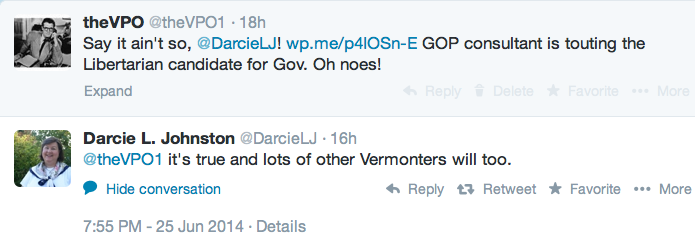
First, the political consultant who hasn’t won anything since unhitching her wagon from Jim Jeffords more than a decade ago, Darcie “Hack” Johnston has responded to my previous post about her Tweets supporting Dan Feliciano, the Libertarian candidate for Governor. He of the typo-riddled website.

Well, I Tweeted about the post, and the Hack replied:

Screen Shot 2014-06-26 at 3.31.05 PM

First of all, let me say I am humbled and honored that the Hackster has taken notice of my existence on this earth. Second, yuh-huh, sure, tons of Vermonters will be joining the Feliciano parade. About the time there’s a snowball fight in Hell. And third, if Feliciano’s campaign had the tiniest hint of hope about it, Johnston has officially given him the kiss of death.

Now let us turn to “Super Dave” Sunderland, occupier of the most thankless job in Vermont, chair of the Vermont Republican Party. With virtually no reason to think his party can unseat Governor Shumlin, he’s resorted to touting the results of a new “poll” indicating widespread dissatisfaction with the Guv:

Screen Shot 2014-06-26 at 3.30.19 PM

Mmmm, about that “poll.” First, it was an online survey, and we all know how useless those things are. And second, it was posted on the Vermont Business Journal website, and we all know which way the VBJ’s readership leans politically. Also, while the “poll” was in progress, Sunderland was touting it on Twitter, which further skewed the results. Actually, it’s surprising how many “A” grades the Governor got.

But hey, Vermont conservatives find themselves with nothing but a big basket of sow’s ears, so I can’t really blame them for trying to make a silk purse.

What Scott Milne should do

The New Candidate For A New Millennium, Scott “Mr. Bunny” Milne, is off to an inauspicious start. He doesn’t have a campaign website yet, so there’s no established way for supporters to, like, give him a campaign contribution. He has yet to hire a single staffer. And he acknowledges that he has yet to formulate positions on some key issues.

Plus, at last Saturday’s VTGOP confab, he was a tad underwhelming. The Freeploid’s Terri Hallenbeck:

He then launched into a story about raising rabbits as a kid and how his out-of-state relatives enjoyed watching them breed, prompted by the premise that he got his rabbit cages in Wolcott, the town where Berry lives. In the parking lot afterward, Milne wondered how well the rabbit story had gone over with his audience. He has three months before the primary to weed the rabbits out of his political speeches.

Aww, bunnies.

So the novice candidate is off to a bumpy start. Understandable, but time is a commodity in short supply chez Milne. So what should he do? How can this longshot candidate elevate his slim-to-none chance of upsetting Governor Shumlin, or at least help to promote a new, more inclusive type of Vermont Republican Party? I’ve got ideas, and as usual, I doubt he’ll take ’em.

First thing: attach himself at the hip to popular Lt. Gov. Phil Scott. Do joint campaign appearances as often as possible. Announce common initiatives and policy ideas. Scott usually likes to hoe his own row, but he should be amenable to a little partisanship this year, since Governor Shumlin done left him at the altar and endorsed Progressive Dean Corren.

He should spend a lot of time talking with key business leaders. But not the Usual Suspects, no sirree. I’m talking about Vermont Businesses for Social Responsibility. I’m talking about some of the relative centrist business types who’ve abandoned the VTGOP in favor of Shumlin. I’m talking about Bruce Lisman; for all his faults, he does have a solid good-government orientation. Heck, he even has a few good ideas. Milne ought to make an overt play for the Campaign for Vermont crowd, and point out where the Shumlin Administration has fallen short on their key issues.

In terms of policy, he’s done a good thing by proclaiming himself a single-payer skeptic instead of an outright opponent. He would do well to refine his message by taking a stand in favor of universal coverage as a goal in some form or other. He should talk more about that, and less about cost concerns.

There’s lots of room for criticism of Governor Shumlin on health care. But it should be put in terms of managerial competence, not the usual tax-and-spend bumpf. Milne can legitimately question Shumlin’s ability to deliver, based on past and current track record. He can position himself as a champion of responsible governance in the tradition of George Aiken. That’s the true heart of moderate Republicanism, and it’s a message that could appeal to centrists and independents.

On many issues, I’d argue that Milne doesn’t have to develop specific proposals. As a general principle, he can position himself as a competent manager willing to work with the almost certain Democratic majority to find solid, responsible solutions. This is different than the VTGOP’s constant call for “balance in Montpelier.” This is a call for a new, inclusive approach to government.

Milne could even slip to Shumlin’s left on taxation. The Governor is a resolute foe of raising taxes on the wealthy. Milne could outline a thorough tax-reform plan including the school funding mess and a rebalancing of the entire system. Some new revenues could be drawn by cutting loopholes and deductions for top earners. If those revenues are balanced by lower taxes elsewhere (a plan promoted by the Democratic legislature in 2013 but blocked by the Governor), Milne would probably offend some of the dead-enders, but he’d gain respect across the board.

And yes, as I’ve written before, the wealthy get off relatively cheaply in Vermont’s current tax structure. If you include all taxes on working-age Vermonters, the wealthy pay a smaller percentage of their incomes in taxes than any other group — including the bottom 20%.

On some issues, Milne can articulate a more traditionally conservative view if he establishes himself as an independent thinker in other areas. For instance, he could posit a more balanced cost/environmental approach to renewable energy — but only if he acknowledges the truth of climate change and our responsibility to address it in tangible, concrete ways.

He can continue the good-management theme on a variety of smaller trouble spots, such as the current DCF mess (but please don’t talk about Challenges for Change) and the whistleblower brouhaha: part of being a good, sharp-eyed manager is to welcome the input of employees with valuable perspective.

Any of these suggestions can be modified or swapped out for better-fitting parts. But I think I’ve outlined a way for Scott Milne to establish himself as a credible alternative to Governor Shumlin, and as the harbinger of a new and more appealing VTGOP.


Oh Cioffi, don’t take your love to town

Welp, the Burlington area business community has, in the immortal words of Kenny Rogers, painted up its lips and rolled and curled its hair, and is clearly contemplating going out somewhere.

The occasion: the long-rumored, virtually inevitable, closure of IBM’s plant in Essex Junction. The response: Frank Cioffi, well-connected head of the Greater Burlington Industrial Corporation, has outlined a plan to entice IBM or its successor to please, please, please not leave Vermont. </a>

And while the Cioffi Plan doesn’t quite go so far as to offer free hookers ‘n blow, he does seem willing to put on a miniskirt and, ahem, bend over backwards to make our corporate overlords feel right at home. This, in spite of the obvious fact that nothing Vermont can do will change the course of events in Essex Junction. Decision-making at IBM and the rumored purchaser of its chip-making business, Globalfoundries, is taking place on a much broader stage than ours.

And sure, any corporate overlord would be happy to accept a handout (or a blowjob, metaphorically speaking), but it won’t extend the life of the plant by a single iota. It’ll just bleed the state’s treasury by a little but significant bit.

Now look, I’m not saying we shouldn’t try to keep the plant open and its roughly* 4000 jobs intact. But it’s not worth selling ourselves and creating a bad precedent for future corporate overlords if it won’t help.

*”Roughly” because IBM refuses to release employment numbers or layoff totals. It’s almost certainly a lot less than 4000 and dwindling, but who the hell knows. Nice corporate neighbor is IBM. 

The Cioffi Plan includes the usual bumpf. Using that prospective $4.5 million slush fund, approved by the Legislature but contingent on found money, to bribe induce IBM to stick around. Boosting workforce training programs, which is nice but the problem at Essex isn’t the workforce, which is excellent; it’s IBM’s infernal profit-seeking.  Establishing state and regional “action teams” (with Cioffi getting a big seat at the table) to, I guess, take action. Or at least talk about it.

Oh, and one curious item:

• Identify a “public entity buyer” for the IBM campus wastewater treatment facility and other campus infrastructure, using state and federal resources to acquire and subsidize operating costs, as the IBM infrastructure is “the most significant in our state.”

Hmm. Sounds like Cioffi wants to free IBM or its successor of infrastructure and waste-management responsibility for the plant — which is one goddamn huge item — and transfer it lock, stock, and leaky barrels to the public sector. I’d really like to see a price tag on that one. Do we, the people, also assume liability?

One thing Cioffi left off his laundry list was the cost of electricity. Perhaps that’s because Governor Shumlin already negotiated a price break for the plant. Still, it’s unlike our Business Whores to leave any favor unoffered.

Aside from the transfer of the “wastewater treatment facility and other campus infrastructure,” none of these ideas are particularly troubling. Or creative. Or anywhere near enough to influence a decision-making process that’s happening far away for reasons having nothing to do with Vermont’s  business-friendliness.

Indeed, Cioffi himself acknowledges that his big plan won’t help retain IBM.

Cioffi said that “regardless of what name is on the door of the IBM Vermont enterprise, we all must act immediately and convincingly to demonstrate our state’s commitment and our region’s commitment to the well-being of the IBM enterprise.”

In the words of another songwriter: Hey, Vermont, put on your red light, and get ready to sell your body to the night.


Ironic postscript. Why is it that the champions of free-market capitalism are always eager to give a publicly-funded advantage to selected enterprises? Shouldn’t the government stay out of the way and, as Mitt Romney put it, stop trying to pick winners and losers?