So the Legislature, in all its not-quote-infinite wisdom, has approved H.454, the sweeping “education reform” bill. In doing so, it pressed a gun firmly to its own neck. This bill threatens to backfire big-time if they don’t fix it next year, so in passing this bill they set themselves up for an even more contentious education debate — this time during an election year.
Yeah, no pressure.
As I’ve noted previously, the bill’s best feature is its raw unpalatability. To me, it’s virtually certain that H.454, in its current form, will never take effect. It’s political poison in so many ways that lawmakers will have no choice but to reopen this Costco-supersized can of worms next January.
Monday’s the big day, or so they tell us. The full House and Senate are scheduled to vote on the education reform Grand Bargain, which will never take effect in its current form even if it survives the big votes.
Still, major drama. The vote is not a sure thing by any means, despite the unified support of Gov. Phil Scott and Democratic and Republican legislative leadership. Many members of both parties realize the bill would negatively impact their local schools — districts in Democratic areas could see significant spending cuts, while rural Republican districts could see a wave of school closures and higher property taxes. The Democrats are also hearing it bigly from school officials and labor union constituencies.
Maybe legislative leadership can crack the whip firmly enough to scratch out a win, if only with the threat of a midsummer return to the Statehouse at the behest of Gov. Phil Scott. But as I wrote previously, leadership’s best argument is that they can all come back next year and overhaul the overhaul. In other words, hold your nose and vote for it, just so we can declare victory and get the hell out of here. Inspiring.
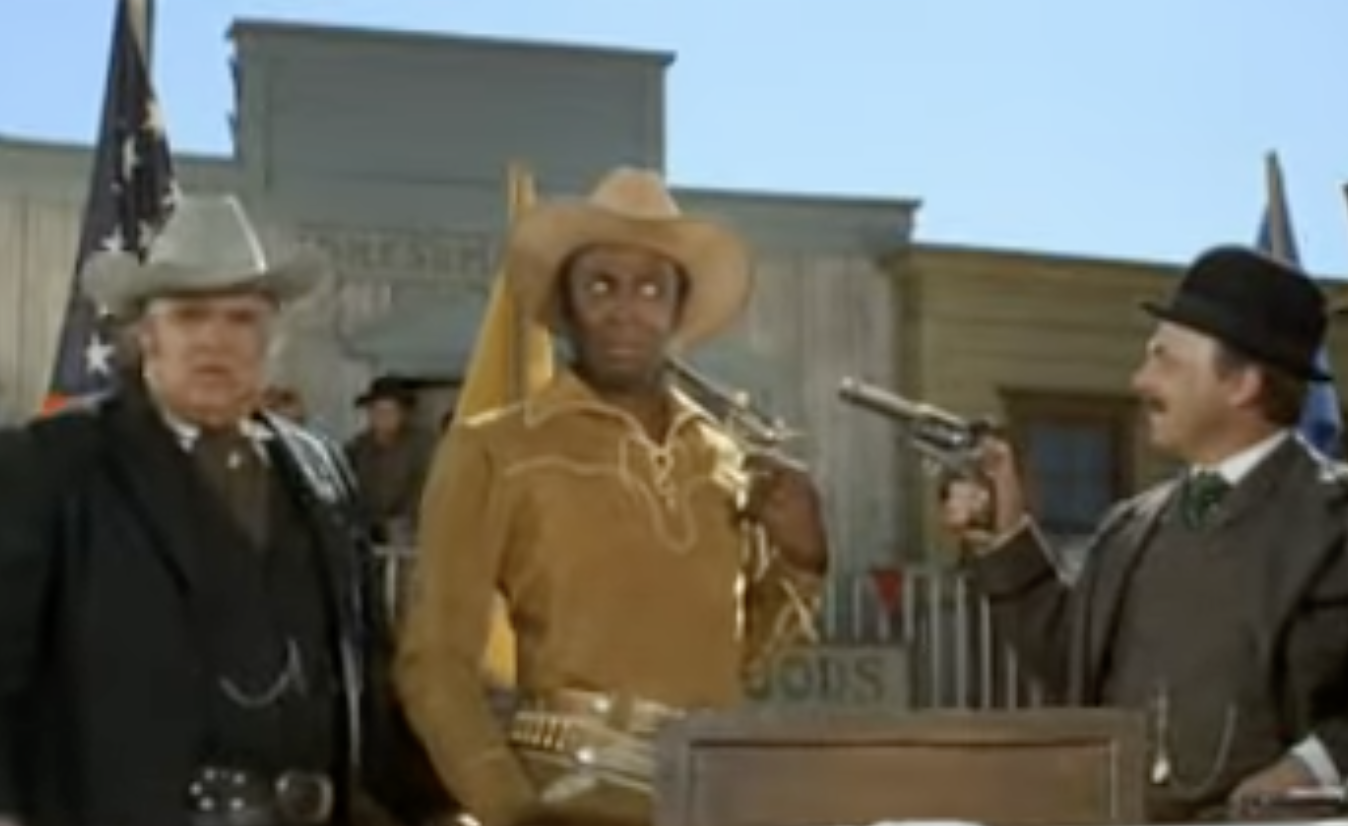
First of all, “Declare victory and go home” is apparently one of many “famous quotes” that were never said at all, or never said by the person credited with saying them. (Usually Winston Churchill. Or Albert Einstein. Or Yogi Berra. Peas in a pod.) Details below, if you want to stick around.
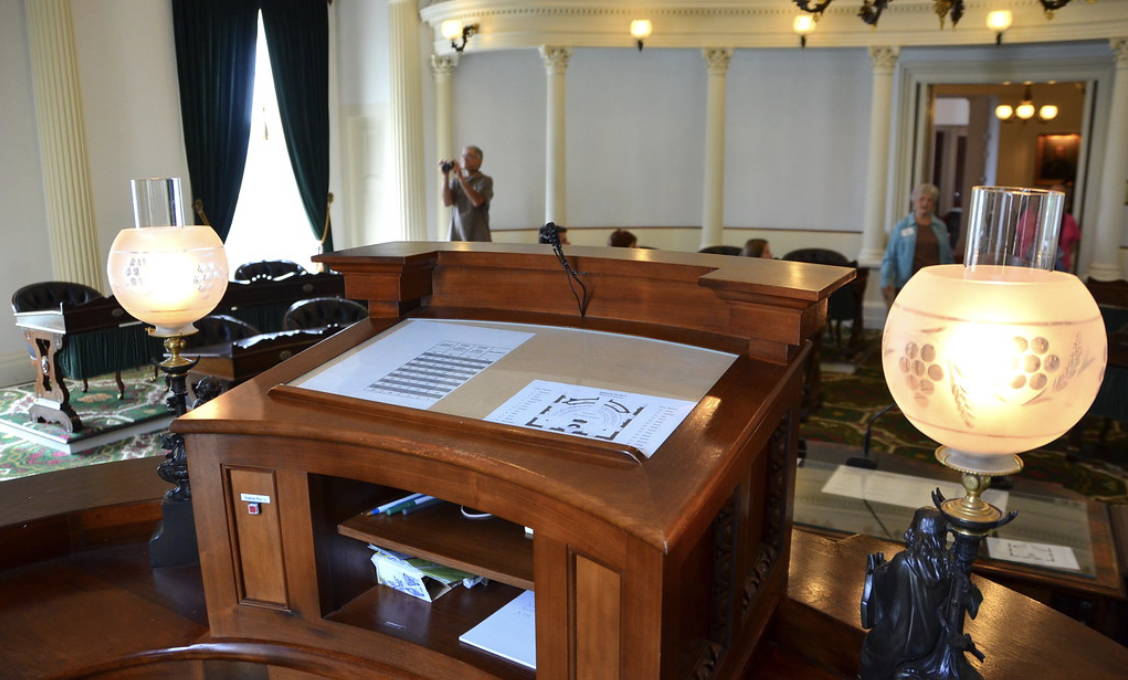
Second of all, the “handshakes across the table” picture is not nearly as dramatic or satisfying when it’s taken from the viewpoint of the center-table cameras used to transmit legislative hearings. But I wasn’t there for the Big Moment, so I had to make do.
Now to the business at hand. After weeks of wrangling and repeated brushes with failure, legislative leaders and the governor reached a grand bargain of sorts on reforming public education finance and governance. Sounds impressive, right? But maaaan, the articles about this achievement are chock full of caveats and red flags. The more you read, the less monumental it seems. Really, it looks like a way for all concerned to engage in the Statehouse’s favorite participatory sport, kicking the can down the road.
If you think that’s overly cynical, I give you the words of none other than Gov. Phil Scott, who endorsed the bill and promised to twist Republican arms to try to get it past the entire House and Senate, an outcome that’s far from assured. Here’s how the governor described what this bill would do:
I believe it will put us on a path to stabilize property tax pressure for working Vermonters, while also putting us on a path to much needed governance reform that will unlock more opportunities for our kids.
The Phrase That Pays is “on a path.” This isn’t the actual transformation of our education system. This puts us “on a path” to transformation.
In other words, this bill is never going to take effect in its present form — even if it does pass the Legislature on Monday. Scott also predicted a return to the education reform issue next year, and he doesn’t think it will be any easier than this year.
Need more evidence that Our Betters just wrote themselves a “Get Out of Jail Free” card? Start with the fact that the bill wouldn’t take effect until 2028, a full year later than the governor had wanted. That’s plenty of time for second thoughts and rewrites.
Besides that, the bill is loaded with escape hatches, “off ramps” (Vermont Public’s Lola Duffort), and “is replete with unknowns and contingencies, and requires years of phase-ins and -outs before it takes full effect” (VTDigger’s Ethan Weinstein).
Now, that’s lawmaking.
But to even get to the point where those off ramps and contingencies can be deployed, this bill has to survive a vote of the full House and Senate. The governor himself predicted that some Republicans and some Democrats would vote “no.” (Almost certainly some Progressives will as well, but I think Scott sees the Progs as a rounding error or something.) Senate Minority Leader Scott Beck, who played a crucial role on the Committee of Conference that produced this bill, plans to spend the weekend urging his fellow Republicans to vote “yes,” and predicted plenty of uncomfortable and difficult conversations. “The conversation will definitely start with a lot of ‘no’s,” he said.
Which makes all the sense in the world. This bill would impose significant tax increases on some districts, mainly Republican ones, and force significant spending cuts in other districts, mainly Democratic ones. It would also lead to widespread school closures, almost entirely in rural areas. Honestly, if I were a Republican lawmaker, I’d have a hard time voting “Yes” because it would clearly NOT be beneficial to my constituents. And if I were a Democratic lawmaker, I’d have a hard time voting “Yes” because the bill would almost certainly force cuts in the public education system.
You and I won’t be privy to those arm-twistings, but I’ll bet you a shiny new dime that one of the key arguments will be “Don’t worry, this bill will never take effect. We’ll fix it next year.”
Speaking of which, you know what would come in real handy? A fully-empowered Commission on the Future of Public Education, the august body created by the Legislature last year and tasked with presenting a reform plan by the end of 2025. Given the obvious fact that this bill is deeply flawed and probably designed to never take effect, it sure would be nice to have a robust report from the Commission on how to fix this mess.
But wait, the governor and Legislature sidelined the Commission in their rush to Get Something Done This Year, even if it’s not the Right Thing. It still exists, but it’s in a limbo state, with no clear vision of what it’s supposed to accomplish and no institutional backing. Or as VTDigger’s Corey McDonald put it this week:
Now, as education reform proceeds, with only minor input from the body, the future of the commission tasked with studying the future of public education in Vermont is, itself, uncertain.
Well, that’s unfortunate.
For all the wrangling and the weeks of overtime, for all the struggles that split the House and Senate and will certainly divide the Democratic and Republican caucuses on Monday, we are nowhere near consensus on education reform. The governor himself predicted that next year’s debate on education reform will be “just as challenging, if not more” than this year’s. Great.
But hey, the Committee of Conference got its magical handshake moment, and that’s the best they could have hoped for.
Postscript. “Declare victory and go home,” or some variation on that theme, is universally credited to Vermont U.S. Sen. George Aiken. The phrase was a half-serious attempt to bring an end to the Vietnam War.
Except that, well, apparently he never said it. That’s according to Vermont historical journalist Mark Bushnell, who found that Aiken’s actual words were far more circuitous than the punchy, pithy version that now adorns many a QuoteFancy image. Here’s Busnell’s quotation of Aiken from the Congressional Record:
“(T)he United States could well declare unilaterally that this stage of the Vietnam war is over — that we have ‘won’ in the sense that our Armed Forces are in control of most of the field and no potential enemy is in a position to establish its authority over South Vietnam.”
That thing about “in control of most of the field” was a damn lie, and I suspect Aiken knew it. At best, we controlled the big cities and our military outposts.
But that’s not all. Aiken didn’t actually want us to “go home.” He wanted us to take a step back from aggressive military engagement in favor of “intensive reconnaissance,” whatever the hell that means. One of the causes of our defeat in Vietnam was a lack of reliable intelligence: We were incapable of doing effective reconnaissance because of language and cultural barriers, and South Vietnam was a corrupt basket case incapable of much of anything. According to Bushnell, Aiken did not believe the U.S. could or should leave Vietnam.
So much for our favorite wise man. But hey, you know, he’d probably feel right at home in our current education reform debate.
You know what’s a really great indicator of success? When a legislative body takes on a vital issue, and comes up with a “solution” that everybody seems to hate.
Well, that’s exactly what we’ve got with the state Senate’s education reform plan, which was approved last week by the Senate Finance Committee. Better still: the people who hate it the most are in the Democratic majority. Seriously, the only Senators who have anything good to say about this thing are Republicans.
And their words constitute the very definition of “damning with faint praise.”
Take, for instance, Sen. Randy Brock: “everybody… is coming away somewhat or entirely disappointed,” but “doing nothing is even a worse option.” Senate Majority Leader Scott Beck favors the bill, but warns that it could bring substantial tax increases to economically disadvantaged communities. Great!
Democrats, meanwhile, could barely conceal their contempt. “This bill will be devastating to our education system,” said Sen. Ruth Hardy. “I’m extremely uncomfortable with all of this,” said Sen. Martine Laroque Gulick, about whom more later. Senate Finance Committee chair Sen. Anne Cummings, who held her nose and voted yes, “can’t remember ever feeling as bad about a vote as I do on this one,” and she’s been in office since 1997, so she’s taken a few votes. Sen. Thomas Chittenden, who voted for the bill in committee, said he might well vote “No” on the Senate floor.
To judge by the published comments, it’s quite possible that when this bill gets to the full Senate, it will get more votes among minority Republicans than majority Democrats. Which is a remarkable development for one of the most significant bills of the entire session.
Hooray, Phil Scott is going to get what he wants. Again.
Every time there’s an inflection point in the General Assistance Emergency Housing program (d/b/a the motel voucher program), it’s always the same thing. Scott takes a hard line against spending a dime more on vouchers… we get close to a mass unsheltering… and then he does a last-minute walk-back, offering a compromise to keep at least some people in the program.
But he simply cannot include everyone. Some folks just HAVE to be unsheltered. It’s like his one and only bedrock principle when it comes to vouchers. Some folks have gotta lose.
And here we are again. Scott rejected the Legislature’s move to extend winter eligibility rules through June, and later — as he always does — he offered a partial extension, which belies his supposedly principled argument against spending any more money on vouchers.
This is nothing new. So for the rest of this post, my attention turns to the Republican Senate caucus’ role in backstopping the governor, and the deeply misleading press release put out after the vote by caucus leader Sen. Scott Beck.
As I have noted previously, 2024 has been a barn-burner of a time for state Senate fundraising. Thanks largely to the Barons of Burlington writing bushels of four-figure checks and Democratic donors striving to keep pace, a lot of money has gone into some potentially close Senate races.
Some candidates were clearly taken by surprise at the amounts raised, because they’ve got a lot left with precious little time to spend it. The result: Senate hopefuls have made a blizzard of mass media buys in the second half of October, even as statewide campaigns have seemingly ended major expenditures. (Since Phil Scott and John Rodgers made their big radio splurge on October 28, there have only been two mass media filings by statewide candidates, and they add up to less than $2,000.)
But the Senate, that’s a different story. The mass media reports continue to come flying in. Mostly. There have been no late spends in Franklin or Windham, where the incumbents are safe as houses. (Lamoille’s Richard Westman just rolled in on October 31 with $7,303 spent on postcards and online ads.)
At the other end of the scale we find two districts not known for high rollers: Caledonia and Orleans, where longtime Democrats Jane Kitchel and Bobby Starr are retiring and every major-party candidate has spent tens of thousands of dollars. The number-one late spender on our list: Rep. Katherine Sims of Orleans, with $16,417 spent on mass media since October 15. Her Republican counterpart, Samuel Douglass, has spent $4,705, so late spending in Orleans totals more than $21,000. In Caledonia, Democrat Amanda Cochrane has spent $11,242 while Republican Rep. Scott Beck has laid out $6,603, for a district total of nearly $18,000.
I guess there’s at least one economic sector booming in the Kingdom.
The campaign for Vermont Senate is the main battleground in our rather underwhelming 2024 election season, thanks to a number of open and potentially competitive seats. Plus there’s little on the statewide ballot to divert attention, and the Dem/Prog supermajority in the House appears to be safe. That leaves the Senate, where key vacancies have attracted strong candidates and very generous donor support.
I’ve written previously about the highly unusual, possibly unprecedented, amount of turnover in the Senate between the 2022 cycle and this year’s: 2022 saw the departures of ten sitting Senators, fully one-third of the entire chamber. Six more incumbents will be absent next January through retirement (Brian Campion, Jane Kitchel, Dick McCormack, Bobby Starr) or death (Dick Mazza, Dick Sears).
Furthermore, five of the six vacancies are in districts that haven’t been seriously contested in years because of long-established, nigh-unbeatable incumbents. That’s especially impactful because sitting senators are virtually bulletproof. The last time an incumbent senator lost a bid for re-election was in 2016, when Bill Doyle and Norm McAllister were defeated. Doyle was 90 years old and had developed a widely-known habit of falling asleep during hearings; McAllister faced a bunch of criminal charges.
That’s about what it takes for an incumbent senator to lose. Which means this year’s winners are likely to be in office for a long time to come. Those are high stakes.
Pictured above is a curious sort of politician: He presents himself as a simple farmer, a rural populist who gives voice to the voiceless — meaning people who live outside the Burlington area. But John Rodgers, former Democratic state lawmaker turned Republican nominee for lieutenant governor, has seen his campaign picked up off the mat by major backing from Chittenden County elites. The Barons of Burlington, you might say.
These same people are writing batches of four-figure checks to a handful of Republican candidates for state Senate who have some chance of winning. The goal, clearly, is to kill the Democratic/Progressive supermajority in the Senate and end the truly historic string of veto overrides in the current biennium. It’s a longshot; the Republicans would need a net gain of four seats to end the supermajority. But if Rodgers wins, they’d only need three because the potential tie-breaking vote would be in their back pocket.*
*Correction: THe tie-breaking vote might be useful but not for veto overrides. If there’s a tie on an override, it’s already lost.
A few months ago, this Barons of Burlington thing was kind of cute. Like, can you really expect to swing an election with a sprinkling of large donations? Now, it’s looking like a serious, coordinated effort beyond anything I’ve seen in my 12+ years of walking this beat. I mean, all these people writing identical checks to the same handful of candidates? It’s beyond anyone’s notion of coincidence.
Scene setting: During the current biennium, the D/P contingent totaled 23 while the R’s had only seven. Twenty votes constitute the narrowest of supermajorities, so the Dems have had a nice little margin for error.
The Republicans need to post a net gain of at least four seats in November to end the supermajority, but every seat they pick up makes it harder to override.
Quick assessment: If absolutely everything broke their way, the Republicans could pick up a maximum of five more seats — which would leave the D/P majority with 18, two short of a supermajority. But the chances of that are slim at best. The Republicans are more likely to win a seat or two, which would preserve the supermajority but make overrides harder to achieve. If you spin the scenario the other way, the Dems could hold serve and pick off one Republican seat.
August 1 was another campaign finance deadline, the last before our August 13 state primary. As usual, there was plenty of interesting stuff to be found. And as usual, there was a dearth of coverage in our sadly diminished media ecosystem. VTDigger waited a few days to put together a solid campaign finance database helmed by its longtime (by Digger standards) data reporter Erin Petenko. But any effort, by anyone, to identify trends or develop insights? Haven’t seen any.
Meanwhile, those who follow me on Elon’s Hellscape know why I’m late to the party. After doing a fair bit of spadework around the deadline, I came down with Covid. It was a pretty severe case for a few days and I’m still on the mend, but I feel able to put words on the screen for the first time since last Thursday.
Anyway, got some things to say. Let’s do the toplines first and then get to the details.
While the vast majority of candidates have trouble scratching a few bucks together, there are a few who have more money than they know what to do with. The primary’s one week away, early voting as been going on for roughly a month, and they’re sitting on large quantities of unspent cash.
Many of these hopefuls have been generously funded by a cadre of Burlington-area business types, who may look at their investments post-primary and despair at the improvidence of their strategery.
Two candidates got a rocket strapped to their backs by those business leaders in July. John Rodgers, running for lieutenant governor, and Rep. Pat Brennan, running for state Senate. They went from near zero on July 1 to huge, nigh unspendable hauls on August 1. Congrats, I guess?
Gov. Phil Scott’s campaign has far outstripped Democrat Esther Charlestin. Why his people are bothering to beat the bushes, I don’t know. I remain convinced that he’d be better advised to mothball his campaign and start a PAC — or a Super PAC — and spread his influence around.
The oddities around Thomas Renner’s campaign for lieutenant governor continue to proliferate. His fundraising slowed to a trickle in July, but he spent very little and has a sizeable unspent reserve. I still don’t know what his campaign is about. Or who’s running it, for that matter.







 The Vermont Political Observer.