Every spring there comes a moment when you suddenly realize, “Wow, the legislative session is just about over.” For me, that moment came last week, with a bunch of stories about progress on major bills. A look at the calendar made me realize that in many other years,adjournment would have already adjourned. We’re well into overtime already.
We’re also getting a pretty clear idea of what history will make of the 2025 session, and it’s exactly what we all could have predicted last November 6, when Republicans decimated the Democrats’ veto-proof legislative majorities. No longer was the majority secure in its ability to override vetoes.
And they have legislated accordingly, trying to pass major bills that would be acceptable to the all-time record holder for vetoes by a Vermont governor. Scott, meanwhile, has pursued his customary course: Sitting in the balcony, tossing Jujubes at the stage, and emitting a squid-ink cloud of uncertainty around what he’d be willing to accept.
The result is a disappointment to anyone hoping for progressive lawmaking, but an entirely predictable one. What else could the Legislature do, really?
You know it’s a weird day when THIS pops up in your email inbox.
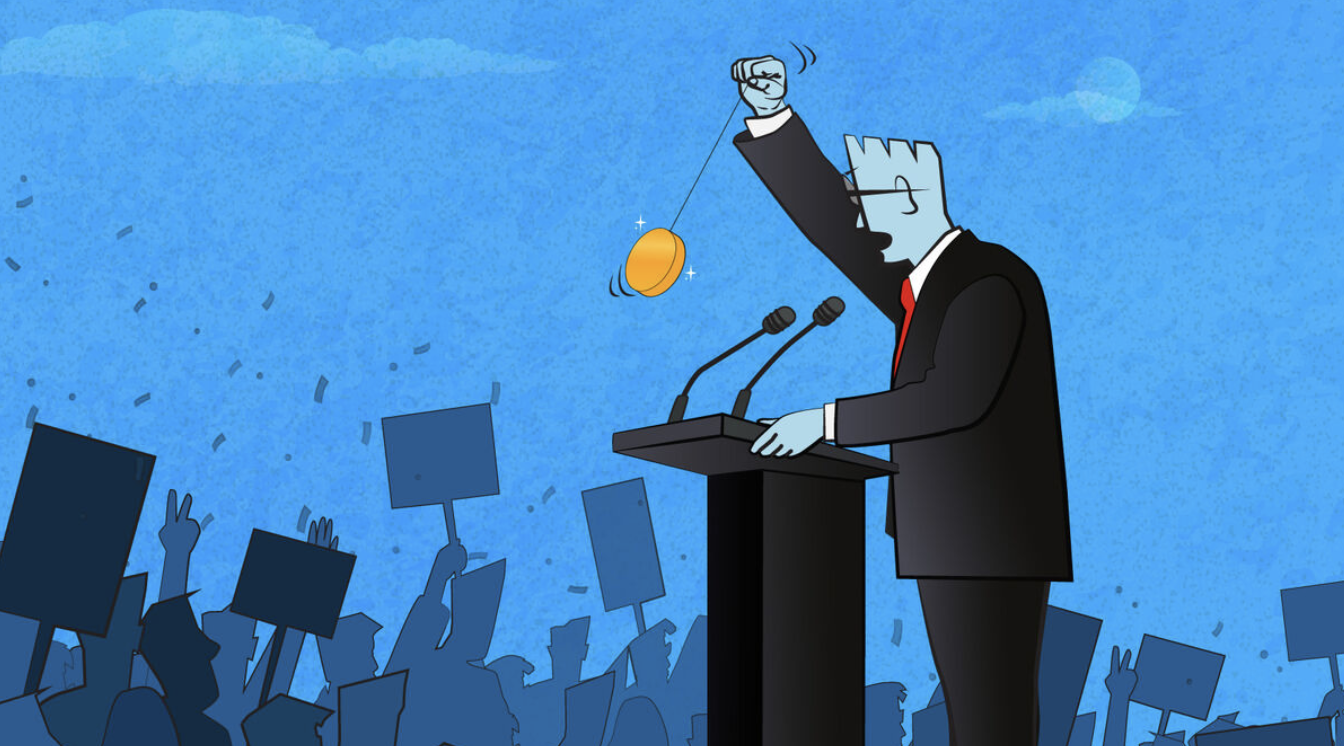
The guy on the left is, of course, Lt. Gov. John Rodgers, who spent 2024 cosplaying as a Republican in order to win Vermont’s bucket of warm piss, and has lately been pivoting madly to the left with his openly anti-Trump public statements, almost as if he plans to run for governor on the Phil Scott plan whenever an opening next presents itself. On the right is Jason Lorber, former Democratic state representative, standup comedian, and all-purpose consultant for hire. Two peas in a bipartisan pod, right?
So why did this too-large-for-comfort image appear in my inbox? It was sent by a reader who is, I suppose, on Lorber’s email list. The accompanying text announces a standup gig featuring Lorber on May 15 at the Savoy Theater in Montpelier. And guess who his opening act is?
Why, John Rodgers, widely known for his, uhh, comedic stylings?
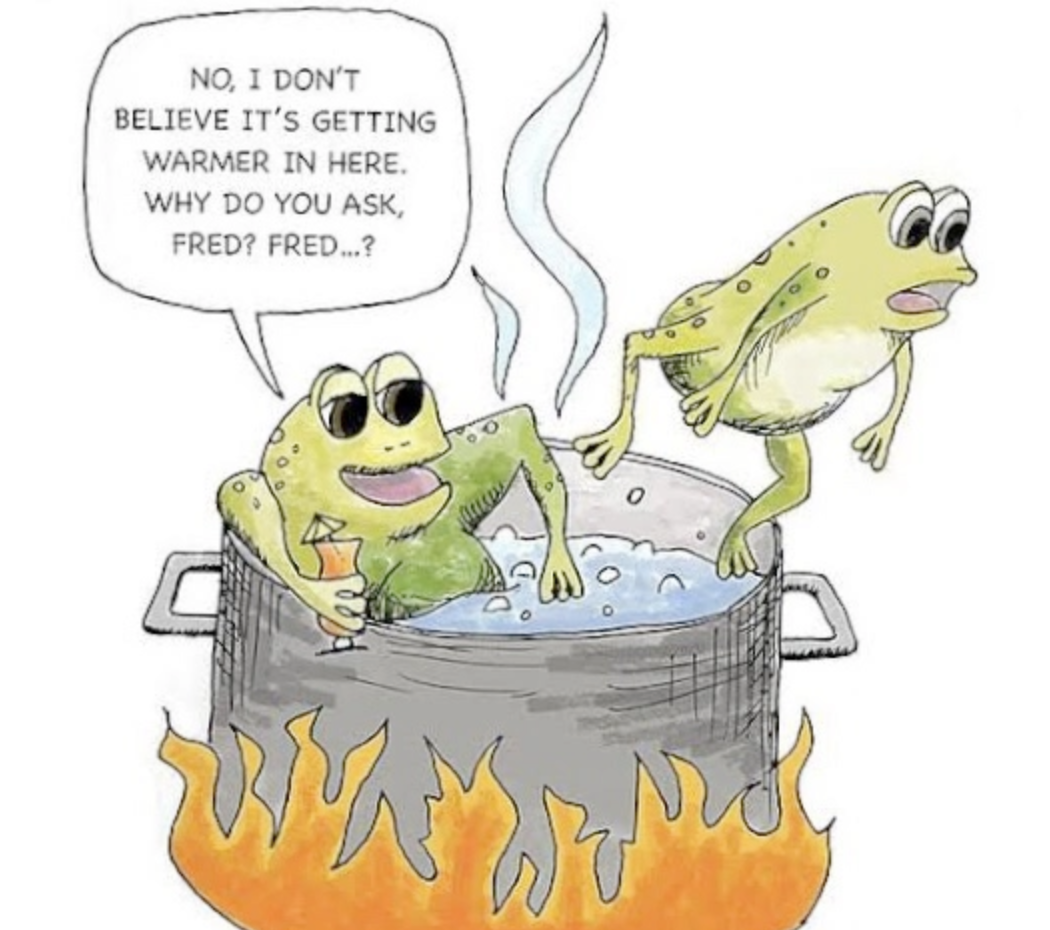
Gov. Phil Scott continues to urge Vermonters to take a chill pill and ignore the bull rampaging through the china shop. He tells us to stop focusing on “the rhetoric in D.C.” — without identifying the source of the rhetoric. He did so once again last week in an interview with Vermont Public’s Michaela Lefrak which was faithfully, painfully, completely transcribed on VP’s website. Feast your eyes on this cornucopia of good talkin’.
Well, what— again, we have to wait for whatever the action is he takes against us here in the state, and react to that. And I, I think we have been doing that, but, but for all of us to fall into that trap, I think, is, would be unfortunate and it takes away from all the problems that exist here in Vermont today, that we’re not doing because we’re focusing on the rhetoric that he, he wants to stir up, and I don’t believe we can live in chaos for the next three and a half years. They just have too much to do, too much to accomplish right here in Vermont.
Winston Churchill would be proud.
Anyway, the governor couldn’t be wronger about this. First of all, we’re going to be living “in chaos for the next three and a half years” no matter what. Donald Trump is going to keep waving all the red flags and eroding our democracy and our federal government even if we take Scott’s advice and whistle resolutely past the graveyard.
Trump is a bully. He backtracks when confronted, and then seeks the soft spots in our defenses. It’s exhausting and yes, it takes a lot of time, but we don’t have the luxury of sitting back and waiting for rhetoric to turn into reality. Just ask immigrants, refugees, and transgender folk if they’re feeling secure these days.
Even when it’s nothing more than “rhetoric,” it creates tremendous uncertainty across the board. As Public Service Commissioner Kerrick Johnson told a legislative committee in February, “It changes daily in terms of the program. It changes daily in terms of the program and the people we’re required to work with. It changes daily in terms of the interpretation of the language and what’s being sent.” How the hell can the state do its job in that environment?
But c’mon, it’s gone far beyond mere rhetoric in more ways than I can count. Still, I’ll give it a try. What follows is a list of specific actions taken by the Trump administration that have already had a measurable impact on Vermont and Vermonters. I dare the governor look over this list and gabble placidly about “rhetoric.”
A crowd big enough to attract the ire of any passing fire marshal jammed into the Statehouse’s normally placid Cedar Creek Room for an event that was inspiring, worrying, and kind of all over the place. (More on the curious backstory of this event later. Stick around if you can.)
Technically it was a press conference led by state Senate leadership, but about 300 people packed into the room to cheer on the speakers as they called for due process under law, freedom for Mohsen Mahdawi, unlawfully detained by U.S. Immigration and Customs Enforcement, and a fight by any nonviolent means necessary against Donald Trump’s assault on democracy and justice.
There were statements and there were questions from the press, like any normal press conference. But there was also an awful lot of enthusiastic response from the crowd. And for maybe the first time at such an event, the featured lawmakers acknowledged that working through the legislative process would be far from enough. “What it’s going to take is slowing ICE down and coming close to illegal interference,” said Senate Majority Leader Kesha Ram Hinsdale.
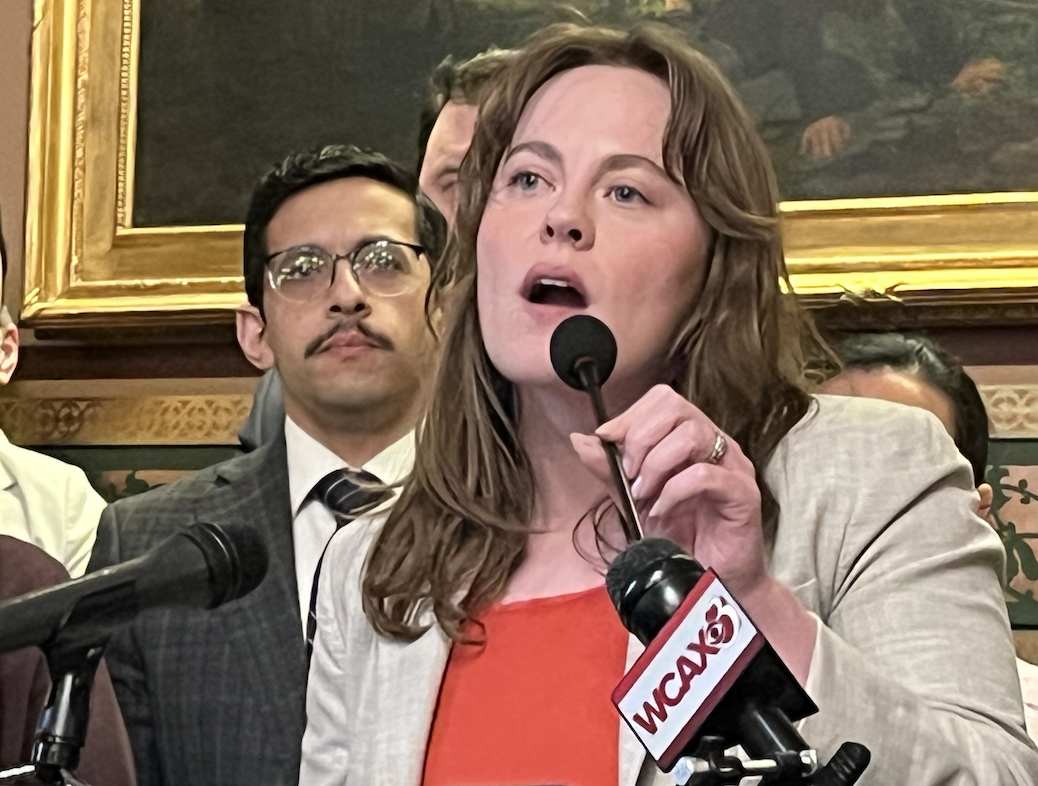
State Sen. Becca White, pictured above, led the crowd in “an oath of nonviolence and peaceful protest.” The voices filled the room as she led a brief call-and-response:
At his Wednesday press conference, Gov. Phil Scott was studiously noncommittal on the use of state prisons to house federal detainees. He unironically expressed the belief that it might be better for detainees like Mohsen Mahdavi to be kept in Vermont instead of being dragged off to Mississippi (where Vermont routinely sends its own inmates) or some other hellhole. But he left the door open to working with lawmakers on that issue and others, as the Legislature considers ways to manage state cooperation with federal immigration authorities.
Behind the scenes, something very different is happening. The Scott administration appears to be stonewalling a legislative panel with jurisdiction over the prison contract.
This comes from Independent Rep. Troy Headrick, a member of the House Corrections & Institutions Committee, with additional input from fellow committee member, Democratic Rep. Conor Casey.
Headrick wrote a blogpost on April 16 detailing “executive obstruction” frustrating the committee’s work on the issue. “In committee, we have developed a tri-partisan consensus,” Headrick writes, “that Vermont has no business being complicit with [Immigration and Customs Enforcement]’s repeated violations of due process, the First Amendment, and basic human rights.”
Unfortunately, he continues, this effort to end the feds’ use of state prisons to hold detainees has been “stalled… by direct interference from the Governor’s office.”
At his weekly press conference, Gov. Phil Scott refused a call from Senate Democratic leadership to terminate Vermont’s agreement with the federal government that allows immigration detainees to be held in state prisons. “I’m not sure it helps the people being detained by moving them out of Vermont,” Scott said, citing a report that one detainee expressed relief that he was being held in our B.L.S.
And you know, he’s not wrong. At least not in one important way. Immigration attorney Brett Stokes of the Vermont Law and Graduate School and Falko Schilling of the Vermont ACLU told VTDigger that they’d prefer their clients to be close at hand, not sent to unknown facilities in other states — or even overseas. I understand that, and I think we should take their viewpoint seriously.
That said. There is a moral dimension to this question that Scott did not address. Do we as Vermonters want to be complicit in the Trump administration’s crackdown on alleged thought crimes? Are we comfortable being part of this authoritarian project? Phil Scott apparently is, as long as we can help shave the rough edges off.
I must also point out a bitter irony that went unnoticed by our news media.
“I get the frustration that people are feeling. People want to do something about what they see happening,” Scott said. ““But is that in the best interest of those who are being detained to just ship them off to somewhere else, Mississippi, Texas, wherever?”
The Vermont House of Representatives did something kind of impressive a couple weeks ago. Not that the media paid much attention, due in part to all Trump all the time — and I let it pass by for that same reason, but I can play catchup when events call for it. So here I am, belatedly.
Way back on April 2, the House approved H.91, the “Vermont Homeless Emergency Assistance and Responsive Transition to Housing Program.” Quite a mouthful, but the acronym is VHEARTH, which is catchy indeed.
But that’s not the impressive part. What the bill’s writers managed to do is create a new state program from scratch. VHEARTH is meant to replace the much-lamented and chronically underfunded General Assistance Emergency Housing Program, d/b/a/ the motel voucher program. Yep, legislative leaders had been begging Gov. Phil Scott to propose an alternative to vouchers for years. Seems they finally got tired of waiting for the chief executive to do his damn job.
I first learned of this five days later, when the Barre Montpelier Times Arguspublished a front-page story (paywalled, sorry) about H.91 gaining House approval. I was so surprised to learn of a major Statehouse development in my sadly reduced local paper that I had to check and double-check to make sure I hadn’t missed a story in the more customary outlets like VTDigger, Seven Days, or Vermont Public.
But I hadn’t. Those usually dependable organizations either missed a major piece of legislation achieving a milestone, or they deemed it unworthy of their attention. If it was the latter, well, they were sorely mistaken.
This is a social media post from VTDigger spotlighting the top story in Friday’s “Final Reading,” about Vermont politicians taking a stand against a U.S. House-passed voter ID bill that would make it harder, especially for women, to register to vote. Great, fine, a nice little space-filler on Friday afternoon.
The photo features Democratic Secretary of State Sarah Copeland Hanzas and Republican Gov. Phil Scott. (The photo also sits just below the headline of “Final Reading” itself.) Here’s the problem: Copeland Hanzas is quoted in the article, but Scott does not appear. At all. No quote, not even a passing mention. In fact, not a single Republican is quoted or mentioned, while Democratic U.S. Rep. Becca Balint is quoted and Democratic Attorney General Charity Clark is mentioned.
But you combine the photo with the headline’s reference to “Vermont Leaders” panning the bill, and you come away with the distinct impression that Phil Scott is on board with this effort.
He is not. At least not publicly. But you wouldn’t realize that unless you read the article carefully and kept track of who is actually quoted.
Most people don’t even click the link, they only see the social media post. Of those who do click the link, relatively few pay close enough attention to notice the presence or absence of one “Vermont Leader.”
By using this photo, VTDigger did Phil Scott a big fat favor in terms of bolstering his “moderate” bona fides, a favor he did nothing to earn.
Gov. Phil Scott’s message that we should all take a chill pill regarding Donald Trump’s continuing rampage through the china shop of democracy and good government is starting to look remarkably poorly timed. This week’s Vermont news is loaded with headlines about Trump, and none of them are good. So I have to ask. Is it time to worry at least a little bit? Could our chief executive muster a discreet furrowing of brow on behalf of all the Vermonters having their lives tossed around by Trump?
The worst of all the stories is about the arrival of the feds’ jackbooted immigration regime, which threatens to imminently deport two Nicaraguan high schoolers who are here legally and have done nothing wrong. Adam Bunting, interim superintendent of the Champlain Valley School District, announced the federal action in a letter to the CVSD community. “These students, who have done nothing wrong, are suddenly being told they don’t belong,” Bunting wrote. “To deport these students is not only heartbreaking for those of us who know them personally — it also contradicts the very values Vermonters work to instill in our young people,”
A story by Seven Days’ Alison Novak notes that “Elected officials, including state representatives, U.S. Sen. Bernie Sanders’ (I-Vt.) office and state Treasurer Mike Pieciak, have also reached out offering support” to CVSD.
Hmm. Notice any absences there?
Governor Scott, where the hell are you? Do you agree with Bunting that the federal action “contradicts the very values Vermonters work to instill in our young people”? If not, please explain. If so, then SAY SOMETHING.
These deportation orders, as inhumane as they are and as shocking to our consciences, are only the beginning of this week’s parade of bad news.
Our Beloved GovernorTM seems intent on torpedoing his own reputation as a “Nice Guy,” or maybe he’s giving it a thorough stress test to prove that it’s completely unsinkable. He has issued a statement in response to Education Secretary Zoie Saunders’ latest misadventure that simply oozes smugness and the kind of bland reassurance that could only come from a man in an unassailable position of privilege.
In a few short paragraphs, Scott casts himself as The Wisest Man in Vermont, remaining calm when all about him are unreasonably aflutter over Donald Trump’s assault on democracy and the federal government. And he paints Saunders as the victim of “some activists” who fomented “fear and anxiety throughout our education system.”
Yeah, that’s right, it’s not Saunders, who caused this whole ruckus by ordering all superintendents to attest that their policies and curricula were compliant with Trump administration orders — on Friday night, the worst possible time to distribute guidance on a touchy issue — and then barfed all over her shoes trying to walk it back. No, it wasn’t her fault, it was those damn activists. Whose number includes, among others, the associations representing Vermont school boards, principals, and superintendents, plus the teacher’s union.
Well, either the entire professional educational community is included in Scott’s shitlist of “activists,” or they are all easily duped flibbertigibbets who can be whipped into a lather for no reason by unnamed “activists.”





 The Vermont Political Observer.