Tag Archives: Phil Scott

The Luckiest Man in Vermont

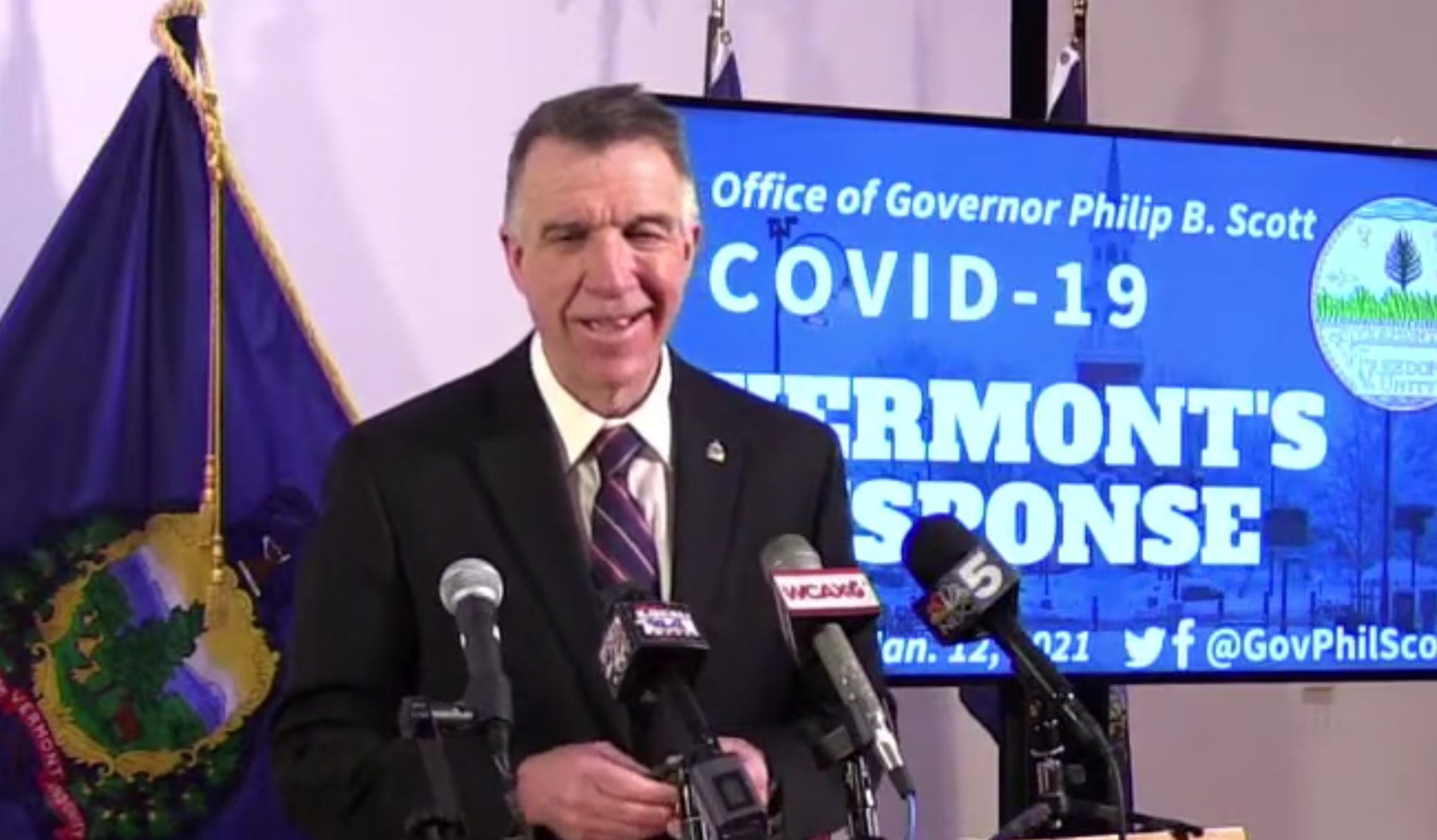
Gov. Phil Scott issued his budget address today (YouTube video here). It was an astoundingly pain-free occasion, considering that we’re in the throes of a pandemic that’s been holding our economy hostage for almost a year now. In fact, rather than proposing painful cuts, Scott offered a generous scattering of funds for a wide variety of programs that, he said, will put Vermont on a sounder footing going forward.

How? Simple. The tsunami of federal Covid relief money. Scott’s budget includes $210 million in one-time money from the feds. As we heard from state economists Tom Kavet and Jeffrey Carr last week, federal money has prevented an economic collapse and even contributed to a boom in some sectors.

Throughout his political career, Phil Scott has benefited from little-known and/or underfunded Democratic opposition in races for state senate, lieutenant governor and governor. In his six races for statewide office, the closest result was the 2010 contest for lieutenant governor — seven percentage points over Steve Howard. He gets credit for being an appealing political figure, but he sure hasn’t had to fight very hard.

And now, once again, he’s the luckiest man in Vermont. You’d think a shattering pandemic would lead to massive cutbacks, but no. Scott could once again boast of a budget that wouldn’t increase taxes or “existing fees.” And according to Kavet and Carr, the state economy will continue to be buoyed by federal infusions for the next two fiscal years. Which will make it a lot easier to craft a pain-free state budget again next year and, if he runs for a fourth term, he may well be unbeatable once again.

Continue reading
VTGOP Chair Fires a Shot Across the Bow of Moderate Republicans

I don’t think Deb Billado is planning to resign anytime soon.

The Vermont Republican Party chair made that clear when she devoted her most recent weekly newsletter to a very fringey speech made by the very fringey South Dakota Gov. Kristi Noem. It was a shot across the bow of Republican lawmakers who recently called for her resignation — and a slap in the face to Gov. Phil Scott.

You see, Scott and Noem are polar opposites on Covid-19 policy. Scott has proceeded with great caution, erring (mainly) on the side of public safety. Noem has kept her state wide open — including the granddaddy of all superspreaders, the Sturgis motorcycle rally.

The result: Vermont has a death rate of 27 per 100,000 residents, the second lowest among the states. South Dakota has lost 189 out of every 100,000, the seventh worst death rate in the nation. In total Covid-19 cases, Vermont is the best in the nation at 1,654 per 100K, while South Dakota is second-worst at 11,958 per 100K. How about testing? Vermont has conducted 133,174 tests per 100K — more than one test per resident. South Dakota? Way near the bottom, at 44,827 tests per 100K.

So, Vermont is doing far better at tracking the virus, keeping people healthy, and keeping them alive. I can’t say that Billado endorses South Dakota’s Covid “strategy,” but she went out of her way to highlight Noem’s views in a message to all Vermont Republicans. Now, maybe Billado didn’t intend it as direct criticism of Vermont’s govenror, but I bet you dollars to donuts that Team Scott sees it that way.

Beyond that, there’s the issue of Billado calling a collection of QAnon-adjacent nutbaggery a “thoughtful speech.” We’ll run it down after the jump.

Continue reading

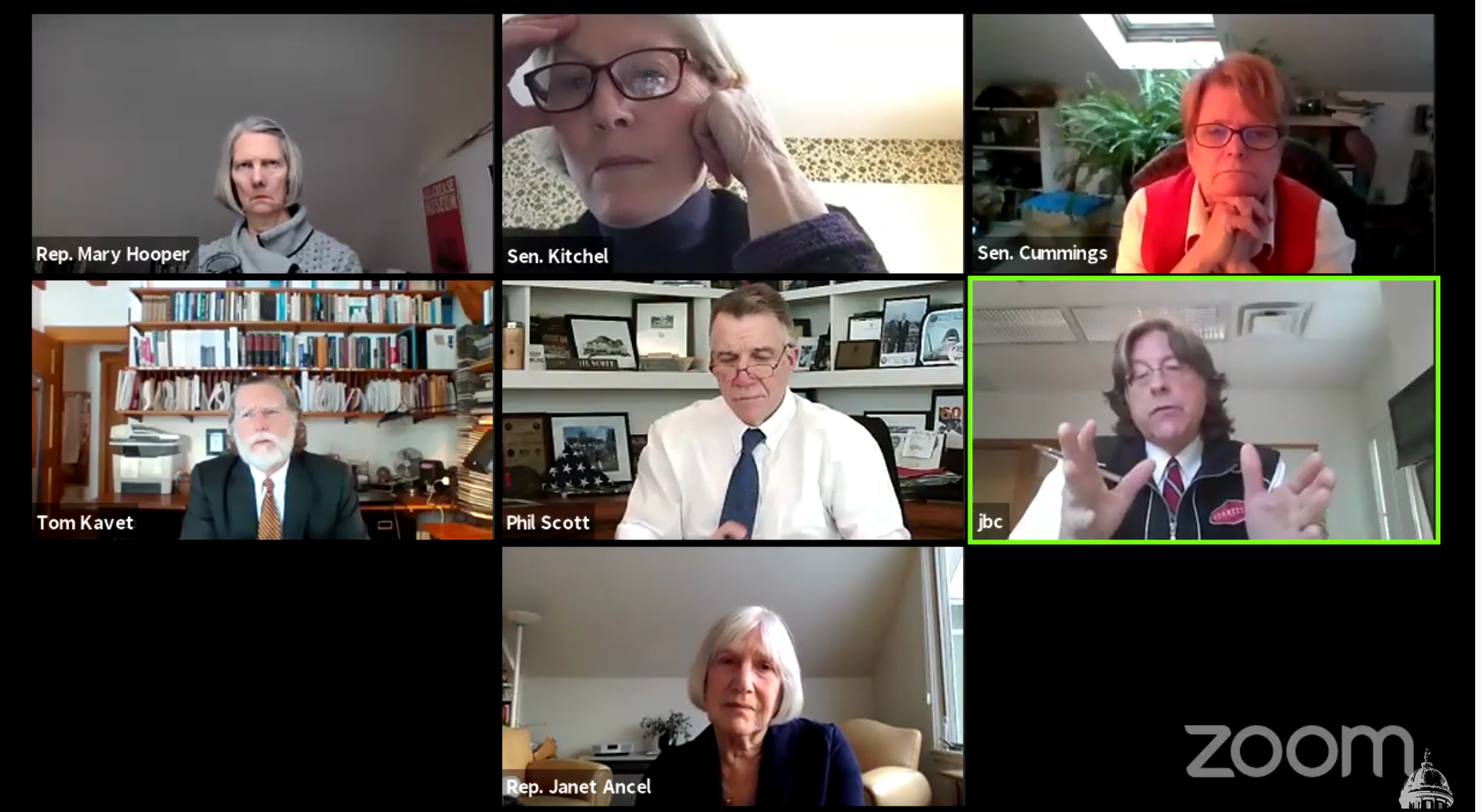
“The Tom and Jeff Show”

Best: Gov. Scott, great lighting, busy but effective background. Worst: Pretty much everybody else.Extra demerits for “Redshift” Cummings and “Tiny” Hooper.

Vermont’s Emergency Board, an obscure but highly influential entity, held its twice-yearly meeting Tuesday afternoon to receive an updated revenue forecast from state economists Tom Kavet and Jeffrey Carr. Or, as the governor dubbed it, “The Tom and Jeff Show.” (The E-Board includes Gov. Phil Scott and the chairs of the Legislature’s four “money commitees” — House and Senate Appropriations, House Ways & Means, and Senate Finance. All of whom are women, it should be noted.)

Their report is posted as a downloadable file on the Legislative Joint Fiscal Office website. It’s recommended reading; it’s full of economic information beyond the basic tax projections. Video of the E-Board meeting available here.

Considering the pandemic and all, the news is astonishingly good. The new outlook for FY2021 predicts a very slight dropoff in total revenue, about $20M in all. That’s peanuts compared to earlier dire predictions. For FY2022, which begins in July, the new forecast predicts $77M in additional revenue. Carr and Kavet also predict a big increase in revenues for FY2023.

(Now, if you’re concerned about the federal deficit, it’s not all good news. Since 2018, deficit spending has gone from 105 percent of GDP to 135 percent. Covid relief is one driver of the increase; the other is the Trump tax cuts of 2017.)

How can this be? One simple explanation: A tsunami of federal recovery funds. And with Democratic control of the presidency and Congress, Carr and Kavet expect at least one more big infusion. (President-elect Biden has proposed a $1.9 trillion relief package.) So far, federal relief funds to Vermont account for a stunning 20 percent of the state’s gross domestic product.

“Without the federal money, I’d be declaring a five-alarm fire on Vermont’s economy,” said Carr. “We’re all Keynesians now. If we throw enough money at a problem, we can mitigate the damage in the aggregate.”

Continue reading

Act Like Nothing’s Wrong

@VTGOP, Exactly As Illustrated

You have to feel a little bit sorry for Deb Billado, chair of the Vermont Republican Party. She’s been working hard for three years now, trying to build a functioning machine out of spare parts and duct tape. But her Trumpian worldview makes her an ineffective advocate for the kind of fiscally conservative, socially moderate organization the VTGOP needs to be.

Now it’s all coming apart, thanks to the January 6 insurrection triggered by President Trump. While Republican Gov. Phil Scott came right out with a call for Trump’s removal from office, Billado issued a statement condemning the violence without mentioning the President at all.

On Tuesday, Billado issued another statement, this one urging people not to take part in a January 17 Statehouse rally in support of Trump. She began, oddly, with this:

It has come to my attention through various vague media reports that there is a rumor of some kind of protest planned at the capitol building in Montpelier this weekend.

Exsqueeze me?

Continue reading

Is the VTGOP About to Break Apart?

He’s definitely up to something.

The Vermont Republican Party is a dysfunctional mess. For pretty much as long as I’ve been writing about #vtpoli — 10th anniversary coming up this year — the party has struggled in fundraising, organizing, candidate recruitment, and choosing an ideological lane. There’s been tension between its elected officials, who recognize that they have to appeal to the center in order to win, and the party faithful, who are profoundly conservative.

During the Trump years, that split has gotten wider. Gov. Phil Scott has essentially divorced himself from the party since November 2017, when he backed Mike “Not The Reporter” Donohue for party chair, only to see incumbent Deb Billado narrowly re-elected by the state committee. (Donohue is pretty conservative but he’s a realist, not a fanatic.) The party hierarchy is now full of Trump true believers, including Billado, vice chair Deb Bucknam (last seen filing a nutty lawsuit over Gov. Scott’s Covid-19 policies), and the two national committee members, Jay Shepard and Suzanne Butterfield.

Well, now the VTGOP’s split is going public. Rep. Scott Beck of St. Johnsbury is calling for the resignation of party officials who refuse to advocate for Trump’s removal from office, and he’s gathering support among Republican electeds.

“I have had some pointed comments at VTGOP leadership, and I have said to them, ‘If you cannot cross these bridges, I think it’s time for you to move on,’” Beck told Seven Days on Tuesday.

Sen. Corey Parent and Rep. Anne Donahue have joined the call for Billado to resign, after she issued a mealy-mouthed condemnation of the January 6 Capitol riot that didn’t mention Trump at all.

Beck et al. are clearly right about this; the current VTGOP is doomed to permanent minority status. But if they’re serious, it’s going to be a long, hard struggle. Things would get a lot worse before they start getting better, and “getting better” is not a sure bet. Because if they succeed in dislodging the hard-core Trumpers, there will hardly be anything left.

Continue reading

Gov Tells Steve From the Kingdom, “Talk to the Hand”

The governor reacts to Guy Page as if he’d just bitten into a lemon.

One of the features/bugs of Gov. Phil Scott’s twice-weekly Covid-19 briefings is that a lot of reporters beyond The Usual Suspects get to participate. Sometimes this is a good thing; scribes from Vermont’s many local weeklies often ask solid questions.

And then there’s Steve Merrill aka “Steve from the Kingdom” and Guy Page, two hard-core right-wingers known for asking irrelevant questions that go nowhere.

Well, today they outdid themselves. Page brought a QAnon-inspired question to the party, and Merrill tried to provoke an argument with Scott. (Page and Merrill appeared back-to-back near the end of the briefing; Page begins around the 1 hour, 46 minute mark of the video, viewable at the above link.)

For those unfamiliar with the weedier patches of the Vermont media ecosystem, Page is a longtime fixture around the Statehouse and a genuinely nice guy. He used to lobby for nuclear power; now he’s kind of a one-man band of right-wing partisan journalism. He operates a couple of websites and, during legislative sessions, he produces an occasional newsletter.

Merrill is the volunteer host of a little-known and seldom-viewed talk show on NEK-TV, the Kingdom’s community access service. Which is enough to get them on the briefing list.

What follows is their “contribution” to today’s briefing.

Continue reading

Today, Every Republican Has a Choice to Make

Treason on the hoof.

Finally, after five years, we have identified the point where Republicans (well, some of them at least) start feeling a sense of shame.

It took an invasion of the U.S. Capitol by a mob of agitated conspiracy theorists, egged on by our president, to make some Republicans realize that maybe things have gone too far. Notable among their number is a healthy serving of GOP elected officials, from Gov. Phil Scott to House Minority Leader Pattie McCoy to Sen. Corey Parent to former VTGOP executive director Jeffrey Bartley, and I apologize for anyone else I left out. You did the right thing.

It wasn’t anything new for Scott or many other Vermont Republicans, who have never approved of what the president was doing to the party they loved. But for most Republicans, the remorse was extremely belated. They didn’t draw the line at “rapists and murderers,” or “grab them by the pussy,” or his habit of hurling base insults at his political opponents, or the consistent groveling at the feet of Vladimir Putin, or a foreign policy that favored dictators and punished our longstanding allies, or hush money payments to a porn star, or Trump’s refusal to release his financials, or tearing refugee families apart at the border, or otherwise punitive immigration policies, or “good people on both sides,” or the Trump Foundation self-dealing, or the rank nepotism of his administration, or the shameless profiteering at taxpayer expense, or the disastrous response to Hurricane Maria, or his persistent efforts to bend the justice system to his will, or the efforts to get dirt on Joe Biden, or the commission of clearly impeachable offenses, or the revolving door of imcompetent sycophants and ideologues who populated his administration, or the catastophically bad response to Covid-19.

Nope, it took a direct invasion of the Capitol at the instigation of Donald Trump. So it turns out that Republicans aren’t quite completely shame-free after all. Good to know.

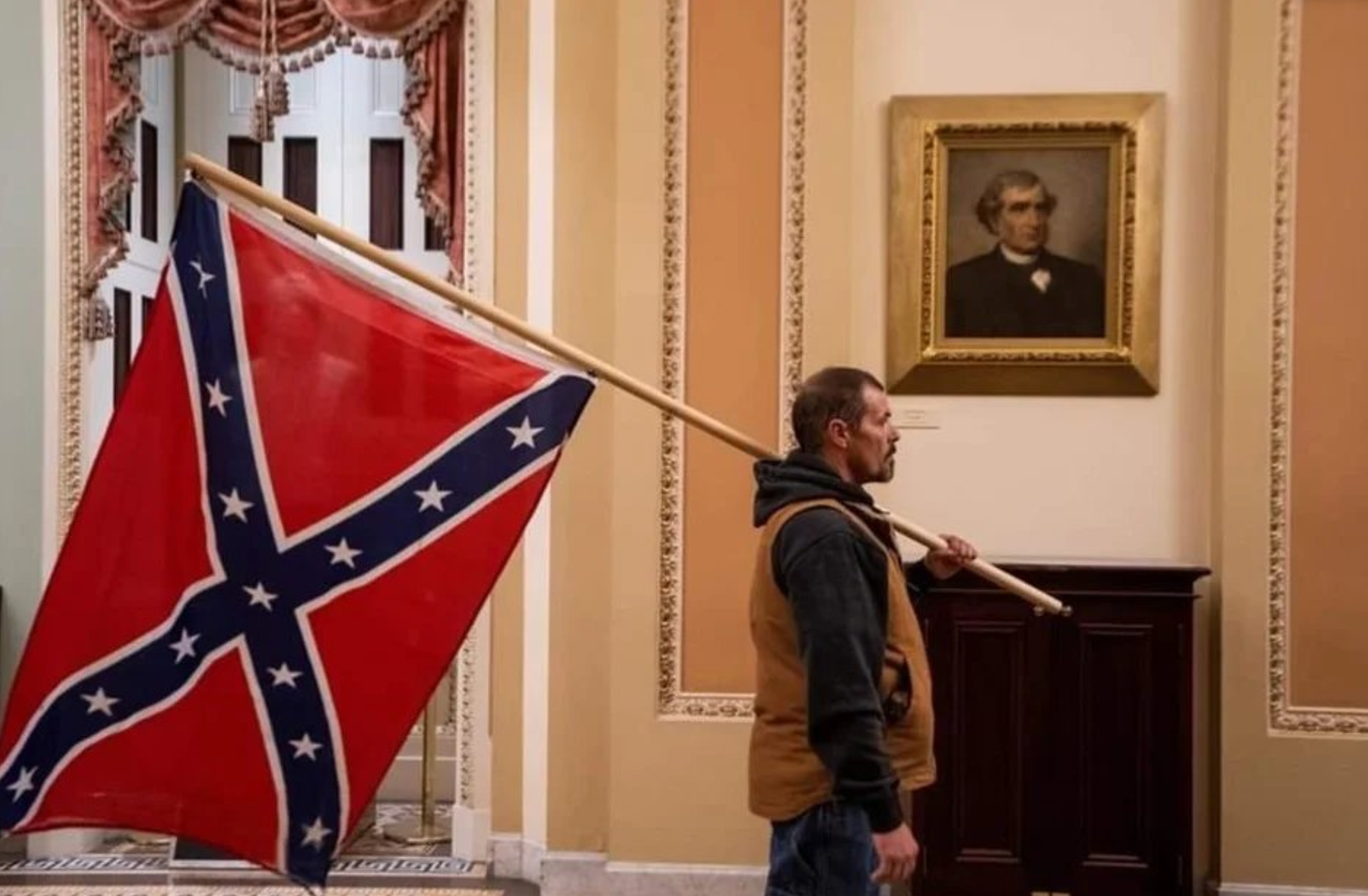
The image above says everything that needs to be said about the events of January 6. As former state representative and chief American History fanboy Dylan Giambatista pointed out on Twitter, the guy is carrying a Confederate battle flag past a portrait of Vermont’s own Justin Morrill, stalwart Republican member of Congress from Civil War days. It was an inadvertent middle finger aimed at anyone who has fought to preserve the union.

After the jump: The CovidCruiser returns.

Continue reading

Prepping for Disappointment

Well, the incoming leaders of the House and Senate are pouring buckets of cold water on any hopes of a progressive agenda in the next two years.

In some ways, this makes perfect sense. In others, it’s a continuation of the squishy-soft stylings of the outgoing leadership. And that’s disappointing for anyone who was looking forward to the possibility of change.

My former colleagues Xander Landen and Kit Norton have posted a legislative preview, and it’s chock full of Business As Usual — the kind of Democratic strategerizing that’s helped Phil Scott remain governor. Or, shall we say, done little to nothing to draw a clear contrast between Scott and the Dems.

Now, these are extraordinary times. And I have no quarrel with the idea that coronavirus will be first and foremost on the agenda until we’ve vaccinated our way back to normality. The budget alone could occupy the available time between now and adjournment.

So yeah, when Speaker-In-Waiting Jill Krowinski says her top priority is “to bring people together and create a plan of action to beat the virus and it needs to be a recovery plan that leaves no one behind,” I completely agree. Save for the grammatical tic.

But 2022 ought to be a completely different story.

Continue reading

Another Brick in the Climate Change Wall

Late Monday, the Scott administration initiated the process for filling a pending vacancy on the Public Utility Commission. The PUC is a three-member body with broad authority over electricity, natural gas, cable TV and telecommunications in Vermont. During the Phil Scott years, it has consistently applied the brakes on development of renewable energy.

This, despite the fact that it has had two Democratic appointees, one of them being Margaret Cheney, wife of U.S. Rep. Peter Welch. I don’t know why the two Dems have played along with the renewables slowdown, which has included strict noise rules for large-scale wind installations and a steady ratcheting down of the net-metering rate (the amount utilities are required to pay for power generated by solar installations).

And recently, VTDigger reported that the PUC had rejected a study that showed major savings from solar power in the Northeast. Yeah, they’re not exactly green-friendly.

And now, one of the two Democrats is exiting the commission. Sarah Hoffman Hofmann was appointed to a six-year term by then-governor Peter Shumlin in 2015, and her term expires this year. On Monday, the administration issued a press release seeking applicants for the position. It did not explain the circumstances of the vacancy, so we don’t know whether (a) Hoffman Hofmann is stepping down or (b) Scott wants to replace her.

The upshot is that Scott appointees will soon hold a 2-1 majority on the PUC, including chair Tony Roisman. Cheney and Hoffman Hofmann haven’t exactly been friendly to green power, but a Scott appointee will inevitably support the governor’s anti-renewable agenda.

And no matter how long Scott is governor, his appointees will dominate the commission for at least four more years. It’s one of the small costs of Scott’s re-election, and another reason why Democrats who voted for Scott can’t really claim to support climate action. Because as I wrote in October, the governor gives plenty of lip service to the issue, but opposes any meaningful policy changes. His choice for Hofmann’s replacement will be expected to toe the administration’s line.

Note: Updated 12/29 to correct misspelling of Commissioner Hofmann’s name.

Tell Me Again Why a Wealth Tax Is a Terrible Idea

From the Public Assets Institute’s “State of Working Vermoint 2020”

An income tax surcharge — permanent or temporary — is a political nonstarter in Vermont. It was one of Lt. Gov. David Zuckerman’s major proposals in his bid for governor, and look what it got him. I am fully confident that a wealth tax would fail to draw anywhere near a majority in either the House or Senate Dem/Prog caucuses, let alone escape Gov. Phil Scott’s ever-ready veto pen.

But it’s a really good idea, and it’s a real shame we’re not taking it seriously.

First of all, Vermont needs new revenue. We’re threatened with huge budget cuts unless the federal government comes to our rescue. And even if it does, we need major public-sector investment on climate issues, broadband, housing, and higher education. Among many others. Even Scott acknowledges the need for these investments, but then he shrugs his shoulders and says we just can’t do it.

Second, the wealthiest Vermonters, just like the wealthiest Americans, have benefited tremendously from federal and state tax policies that cater to their interests. Zuckerman based his call for a temporary wealth tax on the fact that top earners really cashed in on Trump’s 2017 tax cuts. The lite-guv simply asked them to pay a share of that bounty for the greater good of the state.

But even before Trump, the system was rigged on behalf of the wealthiest. Ronald Reagan started this ball rolling, and it’s just gotten worse and worse since then. The above chart, taken from the Public Assets Institute’s “State of Working Vermont 2020” report, shows the result of these decades of an unbalanced economy and tax system. From the report:

Over the last four decades, there has been a dramatic upward redistribution of income in Vermont and across the country. In 2019, the top 20 percent of Vermont households received almost half (48.4 percenty) of the income earned in the state. The top 5 percent of households got 20.7 percent. Average income for the top 20 percent of households had increased more than 8 percent since 2007, after adjusting for inflation. For the bottom 20 percent, average income was down more than 7 percent.

And that’s just the income part of this equation. It doesn’t address taxation, which is generally very regressive at the federal level and in the vast majority of states.

After the jump: More mythbusting.

Continue reading