This week, Vermont’s Public Broadcasting ConglomerateTM has been releasing Part 2 of its (obligatory full name here) VPR – Vermont PBS 2022 Poll. And today’s story about one result is a study in journalistic imbalance.
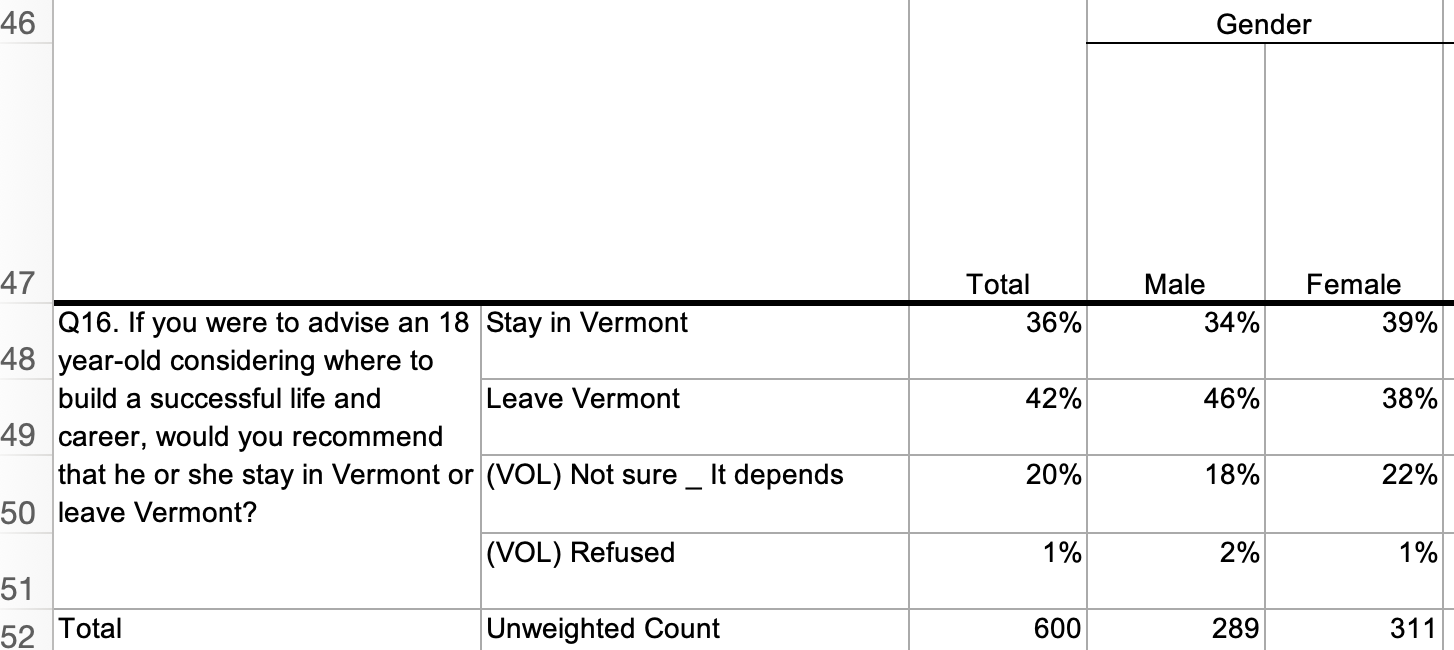
The article is about the above question: Would you recommend that a young person stay in Vermont or leave?
The total result goes right down the middle: A bit more “leave” than “stay” with a sizable tranche “not sure.” Within that, however, Republicans were far less sanguine on Vermont as land of opportunity. A full 63% of Republicans said “leave.” Among independents, that number was 32%, and for Democrats it was 43%.
That’s perfectly fine fodder for a think piece. But the story that came out of the VPBCTM sausage factory was basically PR for a tired Republican talking point. A talking point that’s been repeated so often, for so long, that it’s become a self-fulfilling prophecy.
Doug Racine, the former lieutenant governor, state senator and Human Services secretary, is considering a third run for the state’s top job. Racine had been considering a candidacy for lieutenant governor, but that field has gotten crowded. He told methat as he was gauging potential support for an LG run, he was encouraged to set his sights higher.
His willingness to run, he said, depends on assurances that he’d have the necessary support from state and federal Democratic donors and organizations. “The question is, is it a viable race or not?” Racine said. “The answer depends on the level of support.” He said he’s getting “a lot of enthusiasm” for his potential candidacy, but “that doesn’t pay the bills.” Especially since, he pointed out, the Republican Governors Association has spent millions on behalf of Gov. Phil Scott in 2016 and 2018.
Although, he said, there’s bit of uncertainty on that front. “I don’t know if Trump would let them” spend on Scott’s behalf, Racine said. “Phil is not the most popular guy in Republican circles.”
“Others who have explored a run for governor have something to lose,” he noted. “I’m retired. It’s not like I’d have to leave my job.” That’s a very real consideration for many — especially since a race against Scott is a risky endeavor.
The 69-year-old Racine was the Democratic candidate for governor in 2002; he lost narrowly in a three-way race with Republican Jim Douglas and independent Con Hogan. He sought the party’s nomination again in 2010, but lost a squeaker of a five-way primary to eventual governor Peter Shumlin, whose margin of victory was a mere 197 votes. He was Shumlin’s human services secretary from 2011 to 2014.
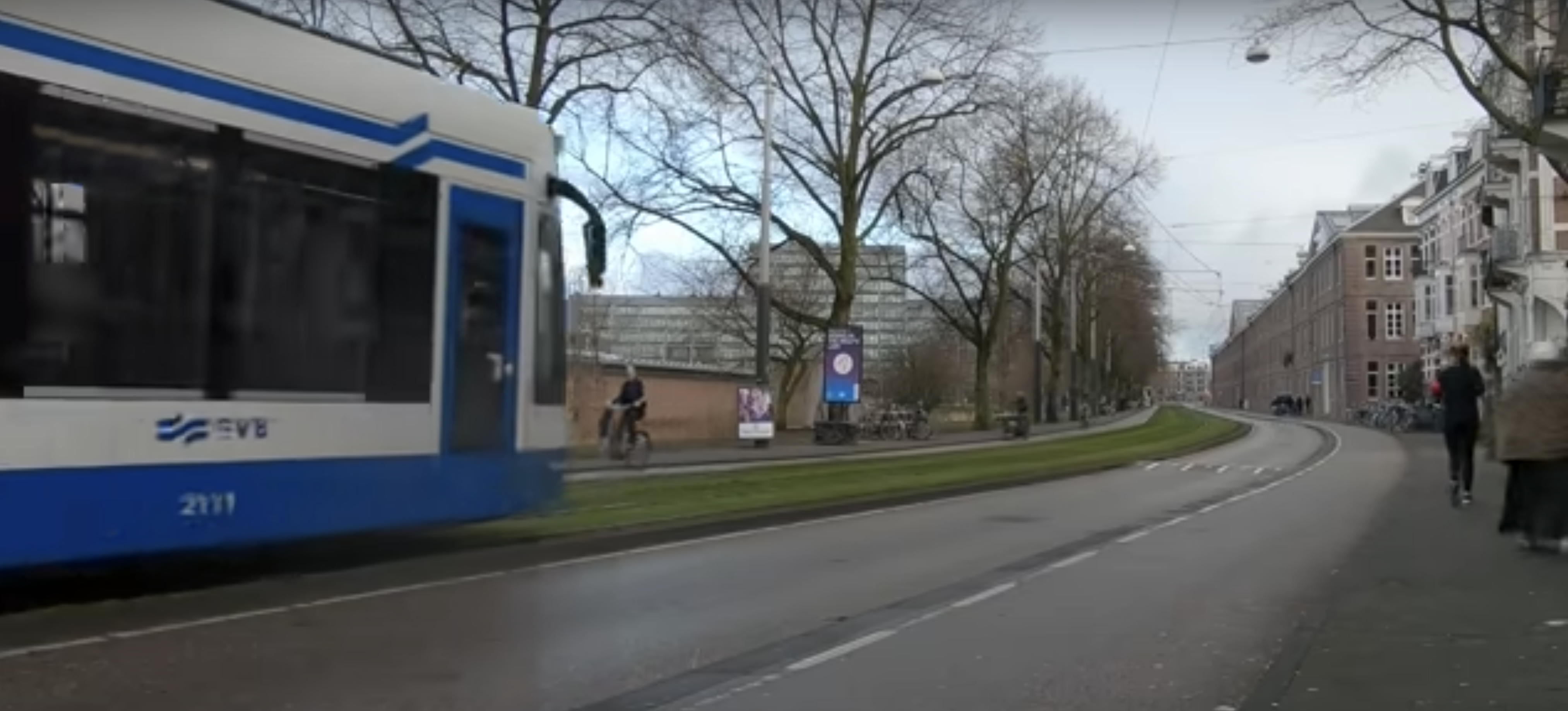
This, friends and neighbors, is a typical streetscape in Amsterdam. Note the balanced, complete integration of auto, pedestrian, bicycle and public transit.
Meanwhile, here in America, the best we can do is staple bikeways and walkways onto existing streets and roads in ways that put non-motorists in danger and force our buses to fight their way through traffic. And I fear that our coming investments in infrastructure and greenhouse gas reduction will do little to change this dysfunctional reality.
Funny thing. The Netherlands is a far better place to drive than any American city. In fact, it’s been rated the best country in the world to drive in. It’s faster for motorists in spite of the relatively narrow roadways, and it’s a damn sight safer.
And before you can say “Oh, well, the Dutch have always been weird,” their towns and cities used to be car-centric until fairly recently. And they were loud and crowded and difficult to get around in, just like their American counterparts. But the Dutch made a concerted effort to define “transportation” as it should be defined: “getting the most people from one place to another as quickly as possible.” And that doesn’t mean more and wider roads, because more and wider roads actually slow things down.
Vermont’s Climate Action Plan includes a lot of pretty noises about equity, creativity, and alternative modes of transportation. Sounds nice, but Gov. Phil Scott’s plan focuses almost entirely on electric vehicle subsidies and infrastructure. That would mitigate our climate footprint, but it would do nothing to make our transportation system better, safer or more equitable. Right now we have a flood of federal Covid cash to invest; if we adopt Scott’s plan, we will squander this once-in-a-lifetime opportunity.
Acting Human Services Secretary and Effusive Wireless Advocate Jenney Samuelson
As our political leaders, state and national, try to reassure us that the post-pandemic future is now, one of their favorite rhetorical devices is mental health. The danger to our physical health is nothing compared to the toll of isolation, fear, absence of normal activity, and apparently how facemasks cut off blood flow to the brain. Our leaders aren’t simply pushing us back to the assembly line of work and consumerism; they are the good guys, protecting us from Covid’s frightful toll on mental health.
Take, for example, Edjamacation Secretary Dan French implying that those of us still worried about the pandemic are pushing our kids into the abyss. At this week’s Gubernatorial Agenda Promotion Event, he talked of reducing the anxiety level in schools by getting everything back to normal. In other words, if you’re still concerned about prevention, if you’re constantly badgering kids to wash up or stay home if they’re sick or — horrors — force them to wear a mask or do so yourself, you’re complicit in fostering a pandemic of mental illness.
Nowhere in any of this do we hear about the mental and emotional toll of living with the pandemic, of the continuing vigilance that many of us feel compelled to maintain even as French and Gov. Phil Scott pretend that those stresses don’t exist.
Masking is a two-way street. I wear a mask in public spaces, but it’s much less effective if other people are unmasked. Meanwhile, our leaders are practically tearing the masks off our faces. Oh well, the concerns of marginal Vermonters like the old, the immunocompromised, the disabled, and anyone at elevated risk are absent from the administration’s equation.
These things used to be weekly updates on the Covid-19 pandemic but, as of today, that’s no longer the case.
For the second week in a row, Gov. Phil Scott opened the event by declaring he had nothing to say about the pandemic. Instead, he used his platform to tout an administration policy priority. And the first administration official who followed Scott the lectern wasn’t Health Commissioner Dr. Mark Levine or Virus Vaticinator Michael Pieciak or Education Secretary Dan French.
No, it was the person pictured above: Public Service Commissioner June Tierney.
Needless to say, she didn’t talk about Covid. She talked about Scott’s plan to enhance mobile phone service by spending $51 million on new cell towers.
Right off the bat, we get two big tells that the state of the pandemic is no longer the chief subject.
Then came Strike Three. WCAX’s Calvin Cutler wanted to ask about the medical monitoring bill making its way through the Legislature, so he opened by noting that his question was “off topic.”
Scott’s response? “It’s not off topic for our weekly press briefings.”
That’s a new, and I’d say deliberate, change on the governor’s part.
So, per Scott himself, we no longer have weekly Covid briefings. We have weekly administration Happy Hours broadcast live across the state. In an election year, it begins to look less like public information and more like free publicity.
Another day, another Democratic candidate for lieutenant governor. Ex-LG David Zuckerman makes four, and ex-LG Doug Racine may make it five.
Meanwhile, the Democratic field for governor is seen in the Artist’s Rendering above.
Nobody. No one. Not a soul. Zero, zilch, nada.
Dip into the Democratic rumor mill?
Crickets. No sign that anyone in Democratic circles is even considering a run.
It’s already too late for a relative unknown to mount a competitive statewide campaign. By “relative unknown,” I mean anybody who’s never held or won a major-party nomination for a statewide office. See: Christine Hallquist, 2018. After getting a late start, she didn’t have enough time to both (1) introduce herself to the electorate and (2) do the necessary fundraising.
Yup, the fix is in. Phil Scott, presumptive governor-elect. Two More Years!
This week’s Covid briefing was devoted to moving the conversation toward that long-sought-after pivot from pandemic to endemic. There were the usual rote reports of vaccination, school policy, forecasting, mask and test distribution &c., but the administration’s heart wasn’t in it.
The big tell came right at the beginning, when Gov. Phil Scott announced he had nothing to say about Covid-19. Instead, he pivoted to a brief repetition of his favorite policy points — workforce, technical training, how to spend federal Covid relief money and the surplus in the Education Fund (TL;DR: “not on public schools”).
I realize the numbers are coming down, as they inevitably had to. But isn’t it just a little bit early to start the George Aiken process of declaring victory and going home? After all, ICU admissions have yet to decline and deaths are still on the increase. Perhaps the briefest of pauses would be wise.
Of course, it’s almost certain that hospitalizations and deaths will decline within a few weeks. But let’s not get carried away. We’re returning to a decidedly unhealthy baseline. The positive view of our numbers is that we are getting back to, ahem, the bad old days of the Delta variant. That’s no cause for celebration.
The Legislature is once again trying to move forward with a bill to mandate lifetime medical monitoring coverage to Vermonters who may have been exposed to toxic chemicals such as the PFAS family of hazardous greeblies. Lawmakers passed such a bill in 2018 and 2019, only to see it vetoed by Gov. Phil Scott both times for his usual weak-ass reasons.
Well, now we know exactly how closely the administration was coordinating its stance with big corporate interests. Short version: Hand in glove. Or footsie under the table, if you prefer.
This revelation doesn’t come from Vermont’s sadly diminished political press, but from The Hill in faraway Washington, D.C. On January 26, The Hill posted the second in a four-part series on efforts to defeat such legislation in multiple states. The opening paragraph lays out the thesis:
State-level efforts to help victims of “forever chemical” exposure get compensation have met resistance from both governments and industry — and this pushback has been particularly effective in Republican-led states.
Like for instance, Vermont, which is the focus of the 1/26 story. It draws on public records requests that uncovered how “an official in the governor’s office coordinated with a lobbyist in ‘watering down'” the bill.
The official was Ethan Latour, then assistant spokesflack for Scott and now Deputy Finance Commissioner (because flackery is such good preparation for a high-level fiscal management post). The most telling moment: Latour sent an email to Warren Coleman of MMR, the top black-hat lobby shop in Montpelier, in which he shared a draft of a policy memo to the governor. Yep, Latour was making sure his memo danced to Coleman’s tune.
But that’s not the most telling part! In the email, Latour made reference to “his/our proposal,” meaning a weakened version of the bill which was a joint effort between the administration and Coleman’s corporate paymasters.
One more snuggly little detail: Before Latour joined the Scott administration, he worked for…. wait for it… MMR.
Update. Latour doesn’t work for the state anymore. He’s on the Secretary of State’s Lobbyist registry as a lobbyist employed by… wait for it… MMR. Isn’t that special!
These are the two Republicans running for lieutenant governor. It ought to be an easy choice. Prominent lawmaker, articulate, thoughtful conservative versus fringey zealot. And maybe it will be; I make Benning the clear favorite.
But it might not be, and therein lies the problem with today’s VTGOP. There are a lot of Gregory Thayers in the party ranks. Party chair Paul Dame is likely to take a cautiously neutral position because he can’t afford to inflame the far right, even though Benning is clearly the better choice. He’s the only one who’d bring credibility to the ticket, and he’s earned his party’s support through his years of service.
But we’re talking about a VTGOP that’s turned its back on Gov. Phil Scott, the only Republican who’s won a statewide election since 2008. And a VTGOP whose base probably sees Benning as a turncoat.
This, friends and acquaintances, is Jamie Vardy, ace striker for Leicester City FC and world-class shithouse. His specialty is the extravagant goal celebration in front of opposition fans. I do believe he’d rather score on the road than at home, just so he can put on displays like this. A former teammate says that Vardy would ask fellow players how to deliver insults in their language so he’d know how to say “Your sister is a whore” to a Portuguese defender.
Shithousery, broadly defined, is behavior designed to get under your opponent’s skin and hopefully disrupt their play. Kicking, grabbing, taunting, egregious overacting in an attempt to draw a foul, that sort of thing. It’s a quality you hate in opposing players but love when they’re on your side.
Which brings us to Vermont politics, especially Democratic politics, which is woefully short on shithousery. You might think we’re better off that way. To be sure, shithousery can be overdone; there are figures on the national scene who are capable of nothing but. (Ted Cruz, Jim Jordan, Paul Gosar, etc.) Vardy, on the other hand, is a topnotch player who once carried his squad to an improbable Premier League championship.
We need us a Jamie Vardy. By “we,” I mean Vermont’s Democrats and Progressives. The closest thing we’ve got is Bernie Sanders, but he’s not active on the home front. We need someone in state politics happy to throw a sharp elbow in the opposition’s ribs, even if they have to suffer the tut-tuts of the chattering class.
Phil Scott, for all his “nice guy” reputation, is an exceptional shithouse. He knows how to fire a sucker-punch when the ref isn’t looking. Say, when he accuses his critics of playing politics or slams the media for creating controversy. Or when he tiptoes around veto threats while refusing to engage with lawmakers.
It’s how he keeps the Dems off balance. They’re always trying to guess how far they can go without triggering a veto, which makes them water down their own legislation. Which results in Democrats looking like fools when they try to convince their voters that really, if you vote for us this time, we’ll deliver on the stuff we’ve been promising for years. Scott also keeps a stable of shithouses in his executive office, just as fellow “nice guy” Jim Douglas did when he was governor. (Names? Jason Gibbs, Dustin Degree, Tayt Brooks. All three have Two have been at Scott’s right hand since day one; Degree joined them eleven months into Scott’s first term.)






 The Vermont Political Observer.