Tag Archives: Katherine Sims

Sen. Sam Douglass, Campaign Finance Scofflaw

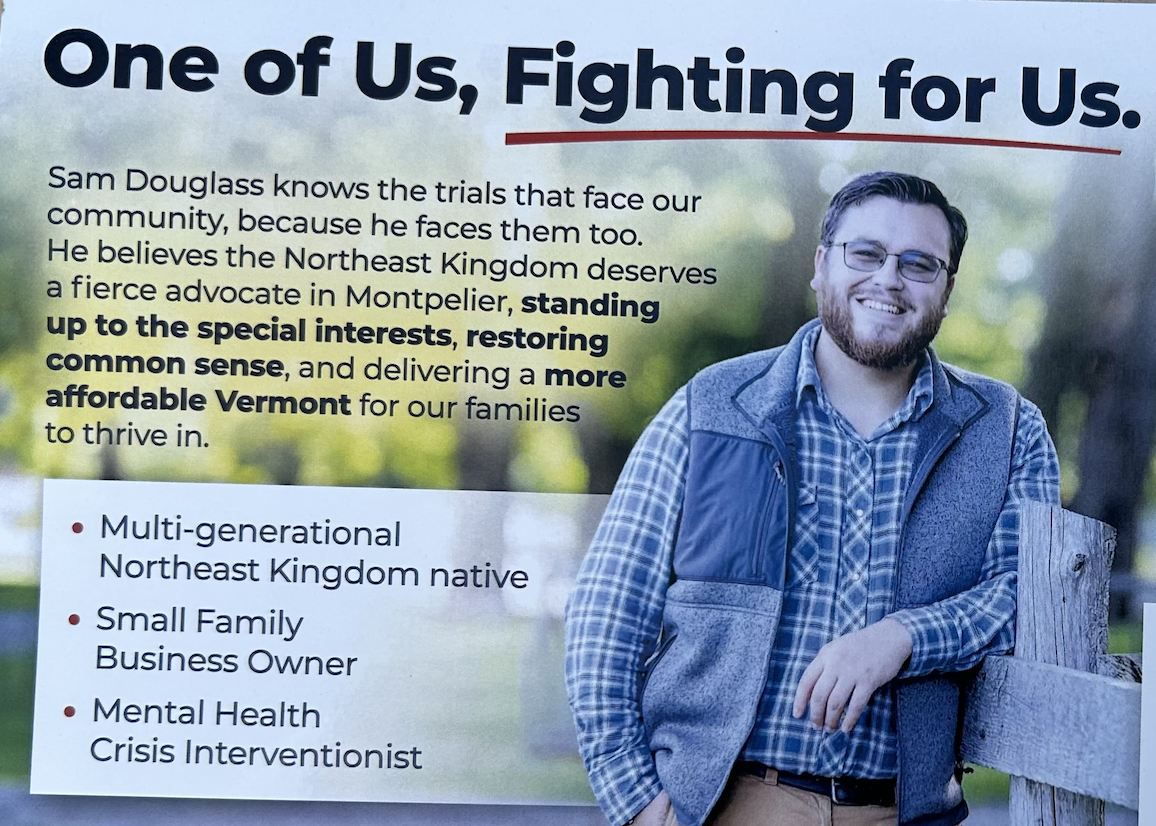
The folksy Son of the Soil pictured above is Sam Douglass, senator-elect from the Orleans district. Or, as I find myself thinking of him, Senator Scofflaw. Because while he claims to be a “fierce advocate,” he was shockingly blasé about his legal obligations to report campaign finances accurately and promptly. Makes you wonder about his fierceness, not to mention his devotion to fiscal responsibility.

Because his campaign finance filings are the opposite of “responsibility,” and include numerous violations of state law. Fortunately for him, the penalties are laughably small and rarely enforced. Otherwise he’d be in a heap of trouble. As it is, maybe some Concerned Citizen will see fit to file a complaint with the Attorney General’s Office, for all the good that will do.

Let’s start with the fact that Douglass has yet to file his Final Report, which was due on December 15. And there’s a real need for a final accounting, because his most recent report leaves many questions unanswered.

His post-election filing, submitted on November 19, shows a serious imbalance between income and outgo — and not in the way you’d expect. The Douglass campaign has reported raising nearly $41,000 and spending only $27,460. Did he really leave one-third of his bankroll on the table in a race against Democratic Rep. Katherine Sims, who raised more than $76,000? Or has he failed to fully report his expenditures?

Vermont’s campaign finance law and the Secretary of State’s reporting system can be a challenge, but when you run for public office you are obliged to follow the rules. Besides, Senator Douglass is going to be responsible for writing the laws. Shouldn’t he be capable of obeying them?

Continue reading


Here’s a New One: Republicans Wanting to Limit Money in Politics

Will wonders never cease. Two Republican lawmakers have introduced a bill that would set limits on fundraising for legislative offices. It’s scheduled to get a quick committee hearing Tuesday afternoon, and is likely to be ignored after that. But if the Democratic majority was interested in some world-class trolling, they’d let the bill go forward and watch Republican leadership work frantically to pull the plug on the thing.

Two House members from the Kingdom, Woody Page and Larry Labor, are the lead sponsors of H.116, which would prohibit House and Senate candidates from raising more than $1,000 from any single source — including candidates’ contributions to their own campaigns — and set a $29,000 ceiling for total fundraising by any legislative candidate. (The bill would also do a bunch of other things, but the legislative limits are by far the most impactful.)

Page and Labor found a very friendly ear in The Newport Daily Express, which published a totally one-sided article about the bill that extensively quoted the co-sponsors and just about nobody else. This, despite the fact that the story quoted Page and Labor’s vociferous criticism of former Democratic state representative Katherine Sims, who lost a bid for state Senate in November. There’s no sign that the Express sought comment from Sims, which is gross journalistic malpractice.

What the two Kingdoms’men don’t seem to realize is that their bill would hurt their own party’s cause much more than anything else. Well, there’s also the rank hypocrisy of Republicans, the party of plutocrats, bitching about excess money in politics, but hey, who’s counting?

Continue reading

Wise Investments, and Other Notes from the State Senate Home Stretch

As I have noted previously, 2024 has been a barn-burner of a time for state Senate fundraising. Thanks largely to the Barons of Burlington writing bushels of four-figure checks and Democratic donors striving to keep pace, a lot of money has gone into some potentially close Senate races.

Some candidates were clearly taken by surprise at the amounts raised, because they’ve got a lot left with precious little time to spend it. The result: Senate hopefuls have made a blizzard of mass media buys in the second half of October, even as statewide campaigns have seemingly ended major expenditures. (Since Phil Scott and John Rodgers made their big radio splurge on October 28, there have only been two mass media filings by statewide candidates, and they add up to less than $2,000.)

But the Senate, that’s a different story. The mass media reports continue to come flying in. Mostly. There have been no late spends in Franklin or Windham, where the incumbents are safe as houses. (Lamoille’s Richard Westman just rolled in on October 31 with $7,303 spent on postcards and online ads.)

At the other end of the scale we find two districts not known for high rollers: Caledonia and Orleans, where longtime Democrats Jane Kitchel and Bobby Starr are retiring and every major-party candidate has spent tens of thousands of dollars. The number-one late spender on our list: Rep. Katherine Sims of Orleans, with $16,417 spent on mass media since October 15. Her Republican counterpart, Samuel Douglass, has spent $4,705, so late spending in Orleans totals more than $21,000. In Caledonia, Democrat Amanda Cochrane has spent $11,242 while Republican Rep. Scott Beck has laid out $6,603, for a district total of nearly $18,000.

I guess there’s at least one economic sector booming in the Kingdom.

Continue reading

The Barons of Burlington Are Trying to Buy the State Senate

Pictured above is a curious sort of politician: He presents himself as a simple farmer, a rural populist who gives voice to the voiceless — meaning people who live outside the Burlington area. But John Rodgers, former Democratic state lawmaker turned Republican nominee for lieutenant governor, has seen his campaign picked up off the mat by major backing from Chittenden County elites. The Barons of Burlington, you might say.

These same people are writing batches of four-figure checks to a handful of Republican candidates for state Senate who have some chance of winning. The goal, clearly, is to kill the Democratic/Progressive supermajority in the Senate and end the truly historic string of veto overrides in the current biennium. It’s a longshot; the Republicans would need a net gain of four seats to end the supermajority. But if Rodgers wins, they’d only need three because the potential tie-breaking vote would be in their back pocket.*

*Correction: THe tie-breaking vote might be useful but not for veto overrides. If there’s a tie on an override, it’s already lost.

A few months ago, this Barons of Burlington thing was kind of cute. Like, can you really expect to swing an election with a sprinkling of large donations? Now, it’s looking like a serious, coordinated effort beyond anything I’ve seen in my 12+ years of walking this beat. I mean, all these people writing identical checks to the same handful of candidates? It’s beyond anyone’s notion of coincidence.

Continue reading

So You’re Saying There’s a Chance

I’ve previously discussed the Republicans’ chances of ending the Dem/Prog supermajority in the House, which are essentially zero. Now it’s time for the Senate, where the Republicans do have an actual chance at ending the supermajority — but the odds are stacked against them.

Scene setting: During the current biennium, the D/P contingent totaled 23 while the R’s had only seven. Twenty votes constitute the narrowest of supermajorities, so the Dems have had a nice little margin for error.

The Republicans need to post a net gain of at least four seats in November to end the supermajority, but every seat they pick up makes it harder to override.

Quick assessment: If absolutely everything broke their way, the Republicans could pick up a maximum of five more seats — which would leave the D/P majority with 18, two short of a supermajority. But the chances of that are slim at best. The Republicans are more likely to win a seat or two, which would preserve the supermajority but make overrides harder to achieve. If you spin the scenario the other way, the Dems could hold serve and pick off one Republican seat.

Continue reading

So the VTGOP’s Big Plan Is… Try to Take Jane Kitchel’s Senate Seat? Is That It?

Previously we looked at the dire financial straits of Esther Charlestin’s candidacy for governor, where she barely cleared $12,000 in a race that calls for, by Howard Dean’s reckoning, at least 164 times that much money. Now it’s time to look at the Republican side of the ledger, where pretty much everybody can rightly cry poverty.

With one notable exception.

That would be state Rep. Scott Beck, running for the Northeast Kingdom Senate seat currently occupied by retiring Democrat Jane Kitchel. Beck has raised a rather stunning $35,565. (His likely Democratic opponent, Amanda Cochrane, has raised a respectable $7,165 and enjoys Kitchel’s active support.) Beck appears to be the only Republican candidate who has raised more than enough money to run a respectable race. Besides, of course, Gov. Phil Scott, The Exception To Every Republican Rule,

More to the point, Beck and the governor are about the only two Republicans who aren’t complete embarrassments when it comes to fundraising. Which shows you just how desperate the party’s situation is.

The VTGOP ought to be in a position for a nice little comeback in the Legislature, threatening to end the Dem/Prog supermajorities that imperil every single one of Scott’s many, many, many vetoes. And they’re not.

Instead, the wistful eyes of the donor class have largely turned to putative Democrat Stewart Ledbetter’s bid to wrest away a Senate seat from liberal Democrat Martine Gulick or Progressive firebrand Tanya Vyhovsky. Ledbetter has amassed the largest campaign kitty of any Statehouse candidate thanks primarily to Burlington-area business leaders. You know, the very people who would historically be bankrolling Republicans.

Continue reading

Yeah, I’ve Seen This Movie Before

VTDigger’s Sarah Mearhoff authored an article Thursday that prompted flashbacks in this tired old brain. The story was copiously entitled “As the ‘right to repair’ debate comes to Montpelier, lawmakers face a ‘flood’ of opposition from national interest groups.”

Yep, a look back in the Google Machine reveals that I wrote the same damn story back in 2018.

“Right to repair” is a concept that ought to be enshrined in our law, except that it causes conniptions in Our Corporate Overlords. They’ve created perpetual revenue streams for consumer products by making it difficult to downright impossible for an owner to repair stuff outside of the corporation’s closed circle of bespoke parts, tools, software, and authorized repair shops.

This is fine in some ways, bu in excess it costs consumers bucketloads of extra money. You can’t, for instance, take your iPhone to an unauthorized shop to get a cracked screen replaced or a new battery installed. You’ve got to go to an official Apple shop and pay full Apple prices. And a repair shop has to pay through the nose for the privilege to be an official Apple joint. (Small Dog is no longer authorized to do Apple repairs because they didn’t want to pay the requisite freight.)

At issue in 2018 was a bill to establish a right to repair for all consumer items. It ended up as yet another study bill after hungry packs of top-dollar lobbyists descended on the Statehouse. This year, the bill in question would create a right to repair only for farm equipment. And once again, the custom-tailored lobbyists have swarmed the Statehouse. It’s the same playbook, and I fear it will once again end with the bloody carcass of pro-consumer legislation being ripped to shreds in their oh-so-sharp teeth.

Continue reading

Big donors, big money in targeted House districts

Two years ago, the Republican State Leadership Committee funneled $370,000 into Vermont, backing candidates in close races for the Vermont House. The VTGOP won several of those seats and took away the Democrats’ supermajority status.

So far this year, the RSLC has spent a lot less. But a handful of closer-to-home moneybags have taken matters into their own hands. They’ve donated more than $100,000 to individual Republican House candidates and House Minority Leader Don Turner’s political action committee.

In the small-dollar world of State House campaigns, that’s a huge amount of money.

First, a hat tip to Green Mountain Daily’s Sue Prent, who reported on the Franklin County iteration of this phenomenon a couple weeks ago. Turns out, it’s only part of a bigger pattern. But because the money is broadly dispersed, the pattern has attracted little attention.

Two of the donors are familiar names to anyone who follows Vermont politics. The other two might be new to you.

Continue reading