Tag Archives: Julie Moore

Julie Moore, Off the Top Rope

I don’t know whose idea it was to make Natural Resources Secretary Julie Moore the lead signatory on an opinion essay aimed squarely at Vermont’s environmental community, but… it’s… a choice, that’s for sure.

The Moore op-ed, co-signed by Public Service Commissioner Kerrick Johnson, is entitled “Vermont’s Housing Needs Require Decisive Action – Step Up or Step Away.” The unfortunate echo of Donald Trump’s infamous “Stand Back and Stand By” remark aside, the essay is a direct attack on the environmental groups that Moore frequently interacts with — and hopefully cooperates with. I guess not, eh?

The essay posits environmental advocates as The Enemy in Gov. Phil Scott’s effort to ease Vermont’s housing crisis. I mean, “Step Up or Step Away” comes across as a very thinly veiled threat.

Before I go on, I must point out an inadvertent admission in Moore and Johnson’s essay. It’s right there in the second sentence: “The cost of housing has skyrocketed with median home prices in Vermont more than doubling in the last 10 years, putting both homeownership (sic) and rentals out of reach for many.”

To which I immediately thought, well, who’s been governor of Vermont for almost the entire last decade? Oh yeah, Phil Scott, that’s who.

Continue reading

Kicking the Can All the Way to 2050

We already knew Gov. Phil Scott has called for a full-scale retreat from fighting climate change. But in his January 30 press conference, he made it clear he not only wants to eliminate any mandatory emissions reduction targets this side of 2050, avoid any potential legal challenge over the state’s failure to meet 2025 or 2030 targets, extract all the teeth from the Climate Action Council, implement a much more permissive measuring stick for emissions, and weaken the Renewable Energy Standard, but he overtly stated he wants no further action at all for another two years.

Yep. He had already tasked his officials with devising a plan to meet the 2050 emissions targets. But in his presser, he specified the delivery date for that plan.

December of 2026.

Sure, let’s put a freeze on climate policy while his administration takes its sweet damn time coming up with a 25-year plan — and finalizes it after the next election. When Scott might well be on his way out of the corner office. If this term is his last, this marvelous two-year effort is bound for the dustbin of history.

But really, the point is not to create an actionable blueprint. It’s to take himself off the hook for climate action anytime soon.

Continue reading

Scott to Burlington: Eh

Gov. Phil Scott’s Thursday press conference was meant to deflect attention from his administration’s painfully slow approach to emissions reductions. The governor opted for his favorite diversionary tactic: Finding a straw man to punch. But the bigger takeaway from the event is his steadfast refusal to consider new policies — or even a drive up I-89 — in response to Vermont’s opioids crisis.

Let’s tackle climate first. Scott and Natural Resources Secretary Julie Moore (she of the excessively deliberate “progress” toward meeting our legally mandated 2025 emissions targets) asserted that an emissions-focused policy was wrongheaded. Instead, they said, there needs to be a balance between cutting greenhouse gases and making Vermont more resilient in the face of future climate disasters.

Scott backhanded “those who didn’t want us to focus on resiliency work” in the Legislature and claimed that “there’s been some pushback” on resiliency in the Vermont Climate Council.

I’d like some names, please.

There might be different opinions on the balance, but there is no one in the Legislature “who didn’t want us to focus on resiliency work.” As for the Climate Council, it was created by the Global Warming Solutions Act to further its statutory emissions targets. Resiliency isn’t the Council’s job. It’s like accusing FEMA of failing to enact permitting reform.

Enough of that. Now back to Burlington.

Continue reading

Shocker: The Scott Administration Is In No Hurry on Climate Action

There was a brief exchange during the September 25 meeting of the Vermont Climate Council that went unnoticed at the time. But it seemed a clear signal that the Scott administration isn’t all that concerned about meeting the emission reduction targets for the year 2025 as established in state law by the Global Warming Solutions Act.

“Established in state law” as in “legally mandated.” But hey, what’s the rush?

The upshot, since it’ll take me a while to get there: The administration is, at best, slow-waking the process even though time is running painfully short to achieve our 2025 targets. If you check your calendar, I think you’ll find that 2025 is coming our way right quick.

Of course, Gov. Phil Scott and Natural Resources Secretary Julie Moore have previously opined that the 2025 and 2030 targets are no big deal, so maybe this shouldn’t be a surprise. But still, we’re talking about an eyes-wide-open flouting of state law. And that’s kind of a big deal.

Continue reading

Time for the Governor to Get Serious About Climate Change

The Vermont Climate Council is meeting on Monday. That’s the entity tasked under the Global Warming Solutions Act to make a plan to meet the Act’s mandatory emissions reduction targets. And from what I hear, Council members who represent environmental interests will be arriving with pointed questions for the Scott administration.

The issue: Is the administration ready to lead the rulemaking process necessary for attaining our target for the year 2025, which [checks calendar] is only about 15 months away? By law, the rules are supposed to be in place by next July 1. That might seem like a lot of time, but rulemaking is by nature a deliberate process, so we’d best be getting on with it.

You’d think our Year of Climate Disruption would inject a dose of urgency to the process. A mild winter, smoky skies from Canadian wildfires, the floods of July 10, and a very wet summer have brought the reality of climate change to our doorstep. One could imagine a Vermont governor seizing the moment to pivot from flood relief to a focus on aggressive climate policies.

But Phil Scott has shown no signs of being that kind of governor.

Continue reading

Vermont’s Renewable Energy Sector Has Taken a Dive Since 2016. Gee, What Happened at the End of That Year?

The good folks at Renewable Energy Vermont have issued a new report called “No Good Reason” which chronicles the extreme slowdown in solar energy projects since 2016. As seen in the above graph, Vermont’s rollout has slowed at the same time that solar is on the rise across America.

Two words missing from the report: “Phil Scott.”

Yep. the report shows that since 2016, state regulators have done their level best to delay and defeat solar energy development in Vermont. But while it assigns blame to the Public Utility Commission, the Department of Public Service and the Agency of Natural Resources, it skirts around naming the man responsible for appointing those officials and setting the policy course they all follow. Also unmentioned: political appointees like DPS Commissioner June Tierney, ANR Secretary Julie Moore, PUC Chair Anthony Roisman, and PUC Commissioner Margaret Cheney, a.k.a. the wife of U.S. Sen. Peter Welch.

Maybe REV is trying to be diplomatic. Myself, I think they’re cowards.

Still, it’s a great report that quantifies what’s been obvious for years: the Scott administration is happy to obstruct solar in Vermont and meet our renewable energy needs with power from Hydro Quebec.

The result: Vermont ranks 48th in the nation in meeting its electricity needs within its borders. Only Massachusetts and Delaware, small states that consume a lot more energy than Vermont, rank lower.

Continue reading

Phil Scott Wants to Have His Cake and Veto It Too

Gov. Phil Scott’s veto of the Affordable Heat Act followed a familiar pattern for the most veto-happy governor in Vermont history. Rather than taking a conservative stance on policy, he focused on a flimsy process-oriented argument. It’s a tactic that allows him to claim the mantle of moderation even as he makes himself an obstacle to progressive ideas.

Just ask him, he’ll tell you he’s all for fighting climate change — but not this way.

The problem is, if we restricted ourselves to climate policies with the Phil Scott Seal of Approval, we’d miss our legally mandated targets for emissions reduc —

— oh wait, we are missing our legally mandated targets for emissions reductions!

Less than a week ago, Scott’s own Agency of Natural Resources issued its latest report and forecast on greenhouse gas emissions, which “predicts that Vermont will get halfway to its 2025 requirements and slightly less than halfway to its 2030 requirements.”

But that’s no big deal for an administration that thinks it’d be just fine to miss the 2025 and 2030 requirements as long as we hit the big one in 2050. ANR Secretary Julie Moore has said so herself. And the governor has expressed the same sentiment.

Continue reading

Duval Picks Up Moore’s Envelope, Rips It To Shreds, Flings Pieces Into the Air

The storm clouds are gathering. The forces are assembling. I don’t think it’s an exaggeration to say that the Scott administration is going to war against the Vermont Climate Council and any progressive climate legislation that the Statehouse majority might send to the governor’s desk.

Last week, we saw Natural Resources Secretary Julie Moore give a “back-of-the-envelope” guesstimate of the short-term costs of S.5, the Affordable Heat Act, which she herself acknowledged was probably inaccurate. Then, on Tuesday, there was an unusually aggressive riposte by Jared Duval, a member of the Climate Council. Duval pretty much ripped Moore’s testimony to little tiny bits. (Video of the hearing is here starting at the 1:40 mark; his written testimony can be downloaded here.)

Duval submitted a lengthy, detailed written statement that destroyed Moore’s testimony line by line and concluded that it was “inappropriately selective, improperly done, and deeply misleading.”

No punches pulled, then.

Continue reading

Top Administration Official Invites Senators to Disbelieve Her Testimony

Some people in the Scott administration strike me as experts in their field who don’t necessary buy official policy, but stick it out in hopes of influencing said policy. Natural Resources Secretary Julie Moore is at the top of that list, as is Health Commissioner Dr. Mark Levine. Sometimes when Moore is shilling the company line she seems less than 100% behind what she’s saying.

But inviting lawmakers to discount her testimony? That’s a new one.

Moore appeared on January 26 before the Senate Natural Resources Committee. The topic was S.5, the Affordable Heat Act, previously d/b/a the Clean Heat Standard. Moore was there to deliver dire news about the short-term costs of the Act and the lack of in-depth research on its consequences.

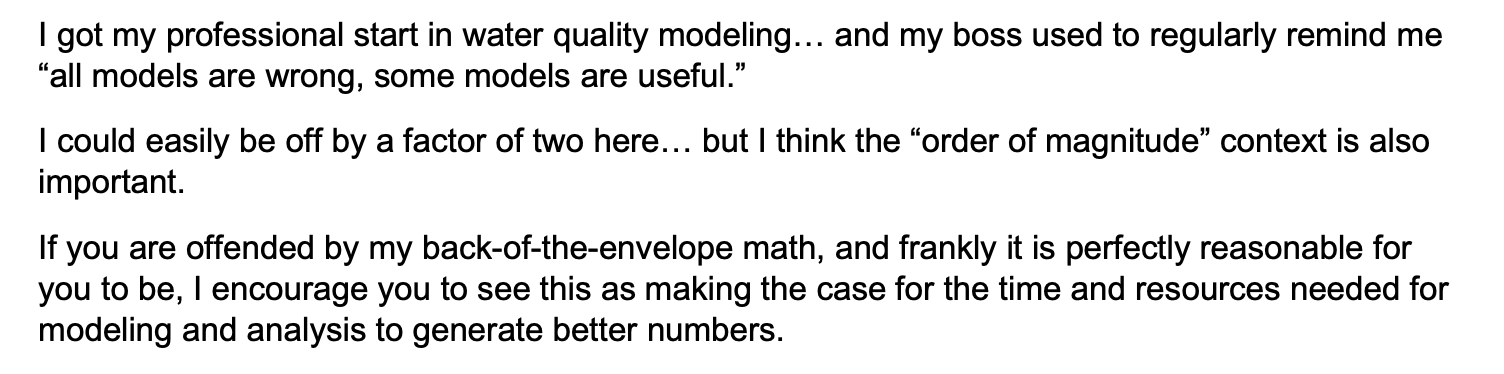
She acknowledged that her “back-of-the-envelope math” could “easily be off by a factor of two here.” She even said it would be “pefectly reasonable” for committee members to be “offended” by her guesstimates. VTDigger reported these remarks but failed to express how unusual, if not downright weird, it is for a state official to cast such doubt on their own testimony.

Mind you, these caveats weren’t off-the-cuff. They were part of her written testimony. Here’s the passage in full.

The administration is openly opposed to S.5 and, indeed, to any strong steps against climate change. In that context, one would suspect that administration officials would, if anything, exaggerate the negative impacts of S.5. And Moore openly courted that kind of suspicion.

Continue reading

“Uncharted Territory of Destruction” Seems a Bit… I Don’t Know… Suboptimal?

Cheery little piece in The Guardian carries an informed warning that we are rapidly running out of time to avoid truly disruptive impacts of climate change:

The consequences are already being seen in increasingly extreme weather around the world, and we are in danger of provoking “tipping points” in the climate system that will mean more rapid and in some cases irreversible shifts.

This latest canary to gasp for air in the mine shaft is a report from “United in Science,” a multi-agency international effort that issues a new climate change report each year. The new entry warns that the Earth is heading into an “uncharted territory of destruction.”

The signs are already clear. We seem to get a new catastrophe every day. Wildfires from Chile to Mongolia, the destruction of Antarctica’s Doomsday Glacier, water shortages in the American Southwest, one-third of Pakistan underwater, and widespread heat waves that pose an immediate threat to human health and the web of life itself.

Meanwhile, here in Vermont, the Scott administration’s top environmental official says it doesn’t really matter if we miss our 2030 emissions reduction target as long as we get where we need to go by 2050.

Thirty-eight years from now.

Continue reading