Tag Archives: Jim Harrison

I’m Not Predicting a Legislative Exodus, But It Wouldn’t Surprise Me

State Rep. Jim Harrison, one of the most respected members of the House Republican caucus, will leave the Legislature shortly after the new year. Harrison has represented his district in rural Rutland County since 2017; before that, he’d been a Statehouse fixture for decades as head of the Vermont Retail and Grocers Association. He told The Rutland Herald that a move to Wilmot, New Hampshire is in the works simply because he and his wife have decided “it’s time to move on.”

Well, this is sudden, definitive, and puzzling. A Statehouse lifer and loyal Republican is bugging out for no particularly compelling reason. And I have a feeling that Harrison is an early canary in the coal mine. The conditions are right for a wave of resignations and retirements among Democrats and Republicans alike.

For starters, the Statehouse is a grind. The hours are long and often tedious, the demands are great and the financial rewards laughable. Honestly, it’s a wonder that anyone sticks around for very long. And then you get to the fact that this year’s session was tougher than usual, and next year’s is likely to be worse.

Continue reading

Vermont Republicans Seem to be Just Fine with a Mass Unsheltering

The House Human Services Committee tried its best to devise a solution for our looming, self-induced homelessness crisis. The committee consulted with Scott administration officials to put together a plan that would extend the motel voucher program through June 30 with some major changes. Eligibility would be expanded to include those in the General Assistance program plus the “adverse weather” program that kicks in when temperatures get low, but it would set a questionably realistic $75 per night cap on motel reimbursements. (Motels are currently getting an average of $132 per night.) I don’t think much of the plan, but it was an honest effort to reach consensus and keep people sheltered at least through June 30.

But now the Republicans are saying “No, thanks. We prefer the mass unsheltering.”

Human Services’ plan went to the House Appropriations Committee on Friday. At the end of the day, the committee took a straw poll in its revised version of the FY2024 Budget Adjustment Act, which included the Human Services plan. The informal, nonbinding vote was 12-0.

Fast forward to Monday afternoon, when Approps took its actual vote on the Act. And whaddyaknow, the committee’s four Republicans changed their votes. The BAA still passed by an 8-4 margin, but the Republican switcheroo meant the Act passed on a party line vote with no GOP support. And according to a report by Vermont Public, administration officials are throwing cold water on the Human Services plan.

Continue reading

A Thoroughly Grim Outlook on Vermont’s Housing Crisis

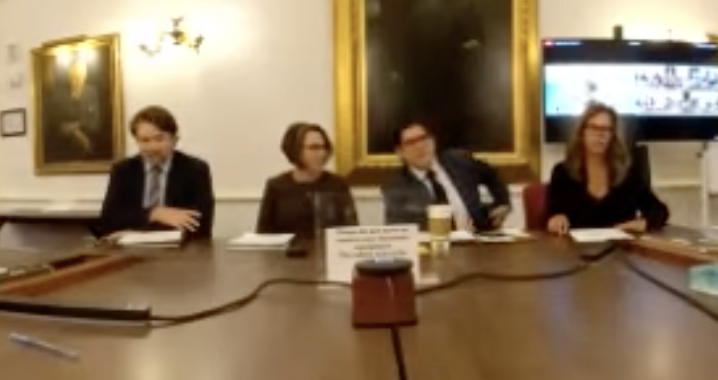
If the above image looks a little fuzzy, thank the limitations of the Legislature’s system for recording and livestreaming its hearings. But it reflects the situation we face on housing: Our public leaders seem small and indistinct when discussing the enormity of Vermont’s housing shortage, and their explication of the crisis was long on broad pronouncements and short on specifics.

The Scott administration’s A-team, pictured above, appeared before the Legislature’s Joint Fiscal Committee and delivered a gloomy overview that has to rank as one of the most depressing events I’ve experienced in my 12-ish years following #vtpoli. Doesn’t quite top Peter Shumlin’s surrender on health care reform or his near defeat at the hands of Scott Milne, but it’s not far behind.

The big takeaway: The housing crisis is even worse than we thought. From top to bottom, end to end, from the most basic of living spaces to the most extravagant, we don’t have nearly enough. Oh, and the epidemic of unsheltered homelessness that Our Leaders assured us was all taken care of last winter? That’s going to get even worse before it has a hope of getting better. And the “getting better” is going to take years.

And the interim solution, if they can manage to pull it off, is a massive increase in emergency shelters, most likely of the congregate variety. That, for a population ill-suited for such arrangements.

Other than that, Mrs. Lincoln, how was the play?

Continue reading

Ain’t No Cure For the Dumbertime Blues: The Veepies, Hot Weather Edition

Here at theVPO Institute for the Study of Political Inadequacy, we have yet to establish a causal link between the weather and incidences of stupidity, but it stands to reason that our current heat wave would fry a few synapses. Anyway, here’s a rundown of what’s new in the land of busted neural connections.

First, and we’ll have to put the Award Factory on double shifts to crank out enough Veepies for these honorees, is the No One Was Driving, Officer, We Were All In the Back Singing Award to the Scott administration, the Legislature, and members of a special “working group” for cutting way back on the “motel rooms for those experiencing homelessness” program without actually, uhh, creating an alternative. Members of the working group have my sympathy; they were given an impossible task and did their best. As VTDigger’s Katie Jickling reported back in March, the working group was established because no one could think of a halfway decent solution. It was a convenient receptacle for a very hot potato.

And the group, faced with the same set of dismaying facts (federal funding going away, not enough state dollars to carry forward, and an overheated real estate market), came up with this little cluster: Eligibility has been significantly tightened, which means that several hundred Vermonters could be tossed out of motel accommodations on July 1 without anywhere else to go. Eligibility will be further tightened on September 22, leaving hundreds more on the streets.

In many areas, rental housing just doesn’t exist. Elsewhere, it’s way too pricey. Homeless service organizations are trying to prepare, which includes arranging supplies of camping equipment. Because hey, nothing says “summer fun” like homelessness! Maybe we can give ’em discount rates at some of the less popular state parks.

There are no easy answers here. But given the fact that we’re currently awash in federal Covid relief funds, is there really an excuse for this massive policy failure? Veepies all around!

After the jump: Burlington Dems need a calendar, a plea to not use a veto session for its intended purpose, a once-respected journalist enters the Conspiracy Zone, and a new low in far-right commentary.

Continue reading

The Ghost of Jeb Spaulding Returns

Somewhere, Jeb Spaulding is saying “I told you so.”

The former chancellor of the Vermont State College System fell on his professional sword last spring by unveiling a plan to decimate VSCS in order to save it. In the ensuing uproar, he resigned.

Well, the new leadership has totted up the cost of saving the system — and it’s one hell of a price tag. On Tuesday, Spaulding’s successor Sophie Zdatny (pronounced just like it’s spelled) told the House Appropriations Committee that the state needs to pour another $203 million into the system over the next six fiscal years.

That’s on top of VSCS’ base appropriation of $30.5 million a year.

And that’s in addition to round after round of projected cost-cutting that would mean significant reductions at all VSCS campuses.

None of which would begin to address the system’s $150 million in deferred maintenance. Well, if VSCS sells or demolishes buildings in the downsizing process, that cost would go down somewhat.

All of this is necessary, Zdatny said, to return the system to fiscal sustainability. (Her presentation can be downloaded from the committee’s website.)

There’s one significant difference between Zdatny’s plan and Spaulding’s. The latter called for the closure of both Northern Vermont University campuses plus the Randolph campus of Vermont Technical College. Zdatny would keep all the system’s campuses open — but with a substantially reduced footprint at each location.

In order to follow through on the plan, the system would need $51 million on top of the $30.5 million base for fiscal year 2022. The additional need would decrease over time, from $51M in FY22 to $18M in FY27. After that, VSCS could maintain operations on the $30.5 million base.

How? By slashing $5 million a year off expenses in each of the next six years.

Seems as though Jeb had a point after all.

Continue reading

Small business should beware of joining the corporate army

A while back, I proposed that Vermont’s small retailers ought to open their own interest group. I suggested the Vermont Association of Independent Retailers, or VAIR for short.

The idea came to me while reading about their putative Montpelier representation, the Vermont Retail and Grocers Association, helmed by the very effective Jim Harrison. One of his favorite techniques is to bring some mom-and-pop types to the Statehouse whenever there’s legislation that might touch on retail interests, such as the proposed sugary-beverage tax.

Truth is, Harrison gives a lot of lip service to the little guy, but his real clients are in Big Retail — the WalMarts, Hannafords, and Dollar Generals of the world. And quite often, the interests of Big Retail are at odds with what’s best for small business. Guys like Harrison draw a stark divide between the private sector and government; in fact, the real divide is frequently found between big retail and small. I would ask this of real independent retailers: which is the biggest threat to your existience? A change in state regulations, or the big boxes and dollar stores springing up all over the place?

This is also true in the broader business world. And in that field, there’s a thousand-pound lobbying gorilla called the National Federation of Independent Businesses, or NFIB. Which has a Vermont branch, helmed by veteran corporate lobbyist Shawn Shouldice. (Who also, I can’t help but note, does PR for Bruce Lisman.)

The NFIB sounds like a joint effort of all the mom-and-pops. It bills itself as “the voice of small business.”

Well, it’s not.

Continue reading

The recycling market and Act 148

This is the second of two posts about the Bottle Bill, unclaimed nickels, and universal recycling. Part 1 can be read here.

On July 1, the state of Vermont will ban all recyclable materials from landfills. Under a law called Act 148, everything recyclable is supposed to be kept out of the waste stream.

Hooray, right?

Well yes, but there are issues. (Aren’t there always?) Foremost among them, unsurprisingly, is money. Handling trash will become more expensive post-July 1, especially for trash haulers in smaller, more rural service areas. Haulers can’t impose a charge on recycling, so they’ll have to recoup their costs by raising their tipping fees.

That could induce sticker shock in some places. Tom Moreau of the Chittenden Solid Waste District estimates that some disposal fees could triple under Act 148.

Continue reading

A modest proposal for Mom and Pop

A Republican lawmaker said something dumb this week.

I know, I know. Stop the presses, right?

Rep. Ronald Hubert, R-Milton, who owns a retail business, said between 10 and 12 “mom and pop stores” are closing every year because of state mandates.

Mmmm. And you know this how, exactly? Did the 10 to 12 mom and pops check the “Burdensome State Regulations” box on their mandatory “Reasons for Closure of Small Business” forms?

Now, I have no trouble believing that a dozen “mom and pop stores” are closing every year in Vermont. There’s a natural attrition among small businesses. But aside from that, our hardy moms and pops are under siege — not from state regulations, but from big chain retail. I’ll be you dollars to Maple Glazed Koffee Kup Donuts that the single biggest threat to mom-and-pop retail is the rapid proliferation of Dollar General stores that offer a full range of groceries as well as aisles and aisles of cheap plastic crap.

Which brings me to my modest proposal. Continue reading

The New Hampshire Chimera

See also previous post, “The Bag Man carries a heavy load.” 

The Monster of Jim Harrison's nightmares.

The Monster of Jim Harrison’s nightmares.

Previously in this space, I examined the various arguments against a proposed tax on sugar-sweetened beverages unleashed, helter-skelter, by Jim Harrison of the Vermont Retail and Grocers Association. But I saved the best for last: his frequent invocation of the great mythical devourer of Vermont businesses, the New Hampshire Chimera.

Yes, every time someone proposes a new tax or tax increase, its opponents summon the spectre of businesses shuttering en masse and countless jobs fleeing to the tax haven on our eastern border. There’s some truth in this dire outlook — just enough to keep the fear alive — but far less than its proponents would have you believe.

Let’s start with population. Fewer than 170,000 Vermonters live in the counties that border New Hampshire. Most of those people live close enough for major shopping excursions, which is why you see relatively few large malls or superstores on the Vermont side. That’s a tangible loss to our economy, but its true value is questionable: most of the jobs are low-quality, and we avoid the environmental costs of large-scale retail development. (Just look at the West Lebanon strip. Bleurgh.)

For more casual shopping, such as picking up a few groceries, filling your gas tank or getting a snack, a much smaller fraction live close enough to the border — say, five miles or so. Any more than that, you’re not going out of your way for a quick stop.

Now there’s the matter of crossing the border. There are long stretches where you’d have to travel five miles or more to access the nearest bridge.

Then you come to shopping availability on the other side. The scaremongers see a New Hampshire border bristling with retailers from Canada to the Massachusetts line. In fact, there are three major retail zones in western New Hampshire: Littleton, West Lebanon, and Keene. Otherwise, there are long stretches of Not Much.

Once again, the greatest impact of higher Vermont taxes is not on the mom-and-pop stores so dear to the rhetorical heart of Jim Harrison; it’s on the supermarkets, megamarts and strip malls that you can find in those three retail hubs. And nowhere else.

In sum, New Hampshire is a major draw for mega-shopping, but it’s a relatively minor threat to other economic activity. And border communities with some creativity, like White River Junction and Brattleboro, find ways to juice their economies even in the shadow of the New Hampshire Chimera.

(Harrison likes to throw in Massachsetts and New York as well, but they are no threat. Their taxes are also pretty darn high; relatively few Vermonters live near those borders; and there’s virtually no destination shopping within easy driving distance in either state.)

Given all of these factors, New Hampshire looks like a much smaller threat than it is in the mind of Jim Harrison. There is no reason for us to be a captive of our neighbor’s policies. We should set our tax policies on their own merits, not out of fear of New Hampshire.

Let’s take an example right out of the Jim Harrison playbook. Here’s one of his vague-on-details anecdotes:

Two years ago, the legislature needed some more money for roads and bridges. They increased Vermont’s gas tax. At that time, the gas tax was 13 cents more per gallon than it was in neighboring NH. Within months, four gas stations on the Vermont side of the Connecticut River Valley closed.

Wow. That’s an oddly specific and limited horror story. It raises a host of questions.

— Where, exactly, were these gas stations?

— Can a direct line be drawn between their closures and the gas tax hike?

— If they closed “within months,” were they marginal businesses before the gas tax took effect? It sure sounds like it.

— Had any of them been planning to close anyway? Small businesses do tend to come and go at a rather alarming rate under any circumstances.

— How many gas stations are there in that zone? I’m guessing several hundred. And while the closure of any business is a sad thing, four is a pretty small number by comparison.

— If the gas tax increase had that great an impact, I’d think the closures would have continued beyond “within months.” Did they, or was the damage limited to four?

And finally…

— Is Harrison saying we shouldn’t have raised the gas tax? If not, then what exactly is he arguing for?

He would probably reply that border convenience stores have already taken a hit, so we shouldn’t hit them again. That’s an arguable point, but how much of a gas station’s business consists of customers buying sugary drinks and nothing else? If the gas tax didn’t chase them across the border, why would a tax on sugary drinks, which represent a smaller slice of their business?

The more likely outcome, it seems to me, is that customers will pay the extra freight or switch to unsweetened beverages — diet sodas, iced tea, flavored waters. There’s quite a variety of drinks with no added sugar. Dairy drinks, even with added sugar, wouldn’t be covered by the tax. Coffee wouldn’t be, no matter how sweet you like it. (Smart retailers will load up on the non-sugary options and feature them in shelving and advertising.)

This is especially true for the typical convenience store stop: filling the tank, using the restroom, buying a drink for the road.  The drink is one small part of the equation. And again, if you’re not going to New Hampshire for the cheaper gas, you’re not going there because your Coke costs an extra quarter.

The bigger burden of a beverage tax would fall on — say it with me, children — Big Retail. Places you go when you want a 12-pack or a case or some two-liters at the lowest price. You wouldn’t drive an extra ten miles to save a quarter on a Mountain Dew, but you would to save a few bucks on a case as part of a big trip to the supermarket.

Which is the point I made in my previous post: the tax poses the biggest threat to Big Retail and Big Beverage, and they’re the ones providing the big money behind the opposition to the beverage tax. The mom and pops are the poster children, but their actual victimhood is significantly limited.

And if you’re worried about the loss of Big Retail in Vermont’s economy, bear in mind that the border regions are largely empty of Big Retail. They’ve already departed for the low-cost option.

In sum, there is a cost to the beverage tax. It should be considered as part of the equation. But the effect is nowhere near the monster that inhabits Jim Harrison’s dreams. And it should not be a decisive consideration in the coming legislative debate.

The Bag Man carries a heavy load

Listening to Jim Harrison on VPR’s Vermont Edition last Friday led me to one inescapable conclusion: as a public debater, he makes a mighty fine bagman.

Harrison, for those with a bliss-inducing level of ignorance about Statehouse matters, is one of the most effective lobbyists in Montpelier. Harrison heads the Vermont Retail & Grocers Association, and his current bête noire is the proposed two-cents-per-ounce tax on sugar-sweetened beverages.

The recommended daily allotment of sugar is 8 teaspoons for a male adult, 6 for a female adult, and 2-3 for a child.

The recommended daily allotment of sugar is 8 teaspoons for a male adult, 6 for a female adult, and 2-3 for a child. So go ahead, kids: Enjoy your daily two ounces of Coke!

Harrison appeared on VPR with the chief pro-tax lobbyist, Anthony Iarrapino of the Alliance for a Healthier Vermont. Harrison’s presentation was pretty much all over the place: he’d shift from one prehashed talking point to another with not even an attempt at segue, he pulled trusty (and rusty) anecdotes out of his back pocket; he’d throw multiple talking points into a single answer, making it impossible to examine them closely. His overall approach could be summarized as, “Throw everything at the wall and hope something sticks.”

If you summed up all his various statements, it’d go something like this:

— The tax will do nothing to change behavior.

— The tax would be the death knell for countless independent businesses.

— Soda consumption is already trending downward, so we don’t need a tax.

— The tax won’t work because people will just shop where the beverages are cheaper (i.e. New Hampshire).

— There is “no comparison” between tobacco and sugary drinks. So the success of the tobacco tax at reducing smoking says nothing about the potential impact of a beverage tax.

Is your head swimming from all the contradictions? It should be. But I feel for Harrison, because he’s basically defending the indefensible: the right to sell grossly unhealthy drinks at the lowest possible price. When, in reality, sugary beverages are artificially low in price because the corn and sugar industries benefit vastly from federal handouts and favorable tax policy.

Harrison’s favorite argument boils down to “We’ve got to compete with New Hampshire.” There’s so much to say about that old canard, I’m going to tackle it in a separate post. For now, let’s focus on Harrison’s other recurring theme: It Won’t Work.

“This is a social experiment. No other state has done anything like this.” True enough, but we do happen to have a wonderful example of a sugary-beverage tax at work. On January 1, 2014, Mexico imposed a one-peso-per-liter tax (about 7 cents) on sugary drinks. The move came in response to rapidly climbing rates of obesity and diabetes. The results? A University of North Carolina researcher is working with Mexican officials on that question, and here’s what they found:

… preliminary results show that during the first three months of 2014, purchases of sodas and other taxed beverages declined by 10 percent compared to the same time period last year.

Meanwhile purchases of untaxed drinks, like 100 percent fruit juice and milk, went up 7 percent, and purchases of bottled water went up 13 percent.

If that’s not enough, the Wall Street Journal reports that a survey of Mexicans found that they are drinking fewer soft drinks, and are more aware of the link between sugary beverages and health problems since the tax was imposed. Another survey indicated that more than half of all Mexicans had cut back on sugary drinks.

Also, Coca-Cola’s biggest Mexican bottler reported a 6.4% sales drop in the first half of 2014 compared to the same period in 2013.

Those are impressive results for the early days of a relatively small tax. Vermont’s would be eight times as large. Imagine the impact it would have on sales of sugary drinks. (Again, I’ll deal with the cross-border argument in a later post.)

As for the comparison with the tobacco tax, Harrison really didn’t have an answer. The tobacco tax has, indeed, helped to drive down smoking rates. He didn’t try to argue that point; he simply bristled at the notion that tobacco and sugary drinks are in the same category.

Well, obviously, they’re not. They’re closer than Harrison would like to admit, but tobacco is clearly a bigger health threat. However, the real comparison isn’t “how bad is it for you?” It’s “Will a tax reduce demand?” On that question, the success of the tobacco tax is strong evidence that a beverage tax will work. Just in case Mexico isn’t enough for you.

Whenever Harrison is fighting a fee, tax, or regulation, he brings out the mom-and-pop types who are, as he puts it, constantly teetering on the brink of oblivion. “Most of our members are smaller, independent stores,” he says. That’s true if you count every store as one. But if you count total sales, the supermarket and megamart chains far outweigh the small independents.

And it’s not the moms and pops who put up the $600,000-plus spent on defeating a sugary-beverage tax in 2013, and are spending hundreds of thousands more this year. No, that money comes from Big Retail and Big Beverage. The moms and pops are politically convenient props.

Harrison also cited some statistics showing that soda sales have trended downward in recent years, and used that fact to question the link between sugary drinks and rising rates of obesity and diabetes. The problem there is, not all sodas are sugary (DIet Coke, et al.) and not all sugary drinks are sodas. And while it’s true that soda sales are dropping, sales of non-carbonated sugary drinks are through the roof: energy drinks, sports drinks, “juice” drinks containing very little juice, sweetened iced tea, etc.  It’s not just soda that represents a public-health threat; it’s the vast cornucopia of sugar-laden beverages on the market.

There were many more points in Harrison’s presentation. Each of them sound plausible when presented in a rapid blur of talking points, but all are full of holes when inspected more closely.

Coming soon to this space: “The New Hampshire Chimera.”