Tag Archives: Ginny Lyons

A Modest Suggestion for Our Newsgatherers — Oh, Never Mind, They’ll Just Ignore Me Anyway

Really good piece of work by the cross-media combo of Carly Berlin and Lola Duffort on the humanitarian toll about to occur thanks to cuts in the state’s emergency housing program. They went out and did the work, speaking with numerous recipients of state-paid motel vouchers who are about to lose their places. The stories are heartbreaking, and dismaying for those of us who’d like to believe we’re capable of better than the planned unsheltering of up to 900 households, all of which fall into one or more category of “vulnerable.”

By the customary multiplier, that’s somewhere in the neighborhood of 1,500 individuals, including people with disabilities, children, and those fleeing domestic abuse. And where will they go? That’s “unclear,” per Duffort and Berlin.

Area shelters were full, affordable housing waitlists were a mile long, and towns and cities across the state have grown more aggressive about evicting campers from public land.

Full credit for a job well done. And now I have a suggestion for a great follow-up.

Continue reading

The Humanitarian Crisis Is Almost Upon Us, and Official Vermont Is Doing Nothing About It

Nothing has changed since my August 18 post about pending reductions in the state’s emergency housing program. Well, that’s not exactly true. Nothing has changed in terms of the official response, but there are all kinds of ways in which the situation is looking even worse than previously thought. That light you see at the end of the tunnel? That’s the headlight of the train headed right for us. Today is September 6; hundreds of people in state-paid motel rooms will see their eligibility expire beginning in mid-September, at the same time a cap on the number of motel rooms will take effect.

That cap is 1,100. At last count, there were more than 1,400 households in the program — and a waiting list of hundreds more. Om case you’d forgotten, eligibility had already been restricted to the truly vulnerable: People with young children or disabilities, people who had suffered a natural disaster or are fleeing domestic abuse.

Remember when Senate Appropriations Committee Chair Jane Kitchel sought reassurance that no one in a wheelchair would be put out on the street if the voucher program were cut back, and Department of Children and Families Commissioner Chris Winters replied “Hopefully not”? Well, turns out we definitely will be kicking out people in wheelchairs, and others with severe disabilities, and generally, people with nowhere else to turn.

In Friday’s mail was the latest edition of The Montpelier Bridge and its two front-page articles: “City Moves to Clear Country Club Road Encampment” and “Motel Program Restrictions Mean 100 Local People To Be Ousted.” Yeah, welcome to the greatest nation on Earth.

Continue reading

With Plenty of Misrepresentation and Condescension, Plus Some Astonishingly Retrograde Comments, the Vermont Senate Again Refused to Extend the Motel Voucher Program

In the above photo, Sen. Bobby Starr is expounding on the moral failings of the “able-bodied” poor lazing around in taxpayer-funded motel rooms while his colleagues try to conceal their discomfort. It was just one of many dispiriting passages in Friday afternoon’s meeting of the Senate Appropriations Committee, in which the panel briefly took up and immediately dismissed one last effort to extend the motel voucher program (the one that currently provides shelter to 80% of Vermont’s homeless) beyond the end of June.

Well. Now that I’ve dropped you directly in the middle of the story, let’s go back and set the stage. After the full Senate on Thursday gave preliminary approval to an FY2024 budget that would end the voucher program on schedule, two first-term solons — Nader Hashim and Tanya Vyhovsky — did something very unusual for a pair of rookies in the seniority-heavy upper chamber: They tested the patience of their superiors by submitting a last-minute amendment that would have dedicated another $20 million to the voucher program. (It would have also defunded the detestable remote worker grant program, but that was just a bonus.)

The figure was based on conversations with housing advocates, who believe it’s the minimum amount required to prevent a large-scale unsheltering of voucher recipients. But multiple members of the committee, including chair Jane Kitchel, dismissed the number as inadequate. Kitchel said the $20 million would run out by year’s end, meaning the program would require a midyear injection of funds. She refused to engage in what she called “deficit” budgeting.

Hashim, who presented the amendment to the committee, didn’t have the information needed to counter Kitchel’s assertion, and no one else was given a chance to testify. Committee members also claimed that spending more on vouchers would mean fewer dollars for permanent housing, as if it was impossible to shift money from elsewhere in the budget or even — horrors! — raise revenue to cover the cost. So you see, they said with a metaphorical shrug of the shoulders, they had no choice but to end the voucher program.

I could go on, and I will, but let’s get back to Bobby Starr. You won’t want to miss this.

Continue reading

Thoughts and Prayers and Jazz Hands

The fix was in from the start. There was never any serious consideration given by any legislative committee or political party, for that matter, to addressing the tsunami of homelessness that’s headed our way this summer. At hearing after hearing, in committee after committee, housing advocates were given brief windows to testify, and their testimony was dismissed as quickly as it was delivered.

The most blatant example happened Friday afternoon in the Senate Appropriations Committee, which was finishing its work on the FY2024 budget. In presenting the housing section of the budget, committee chair Jane Kitchel brought up the advocates’ “desire” to continue the motel voucher program beyond July 1.

Yep, “desire.” She used that word not once, not twice, but three times. “Desire” as in a deep-seated inexplicable craving, not a reasoned policy choice.

Look. Nobody “desires” to continue the voucher program. It’s a flawed and inefficient piece of patchwork. But it’s the only available way to prevent the sudden unhousing of thousands of Vermonters this summer.

Kitchel also omitted the rest of the advocates’ proposal. They put forward a solid, proven plan to use the voucher program as a temporary bridge to more permanent solutions. Pssh, details. Kitchel closed her colloquy by explaining, “I want to raise that because I don’t want anyone to think that I did not bring this up for discussion.”

Gee, thanks. Bring it up by mischaracterizing it and making it clear that any actual discussion would be unwelcome. Not that members of the committee were interested in exploring the subject. They didn’t want to spend any more time on the issue than they had to. There was a lot of looking downward, staring into the distance, shuffling of papers, studious checking of electronic devices, and hardly any discussion.

Continue reading

How Not to Hold a Legislative Hearing

Hey, remember when I wondered where all the other witnesses were? The ones who should be testifying on behalf of all the groups and institutions sure to be affected by the scheduled end of the emergency motel voucher program?

Turns out it’s just as well they didn’t show up, because the hearing was way too short even for the witnesses who did appear. The whole thing was kind of embarrassing, in fact. (It doesn’t help when lawmakers like Sen. Ann Cummings seem to be ostentatiously not paying attention, but it’s hard to resist the siren song of personal electronics.)

Wednesday morning, two Senate committees — Economic Development and Health & Welfare — held a joint hearing on emergency housing and, just as a bonus, the lack of housing and support services specifically for people with disabilities.

Either issue warranted a good bit of time. Instead, both were crammed into a single hour. Seven witnesses were on the schedule which [whips out abacus] means each of them were allotted less than ten minutes to make their case and answer questions.

Before I go on, lI should say that in the long run, this hearing will be a footnote. What matters are the discussions and negotiations around the FY2024 budget, and whether provision will be made for adequate housing and shelter for the 1,800 households who face eviction when the motel program is allowed to expire.

Continue reading

Chittenden Senate: Brother, Can I Spare a Dime?

One thing stands out when you look over the campaign finance filings for the three state Senate districts in Chittenden County: There are lots of candidates, and most of ’em aren’t raising much money anywhere outside of their own pockets. Seems like a potential equity issue; if you can afford a couple thousand bucks or more, or a LOT more, you don’t have to worry so much about fundraising from other people.

Maybe this is a byproduct of splitting up the formerly unified Chittenden district: No longer can candidates raise money from anywhere in the county. Now they have smaller fields to harvest. Likely a bigger factor: There are a lot of contested statewide races consuming a lot of Democratic money, perhaps away from legislative races.)

The king of the self-funders is Erhard Mahnke, affordable housing advocate and longtime Bernie Sanders associate. He dumped a cool $10,000 into his own campaign, and has only raised $666 from anyone else. That gives him a financial lead in the Chittenden Central district, because he hasn’t spent much so far.

Other notable self-funders include Brian Shelden and Irene Wrenner, Democratic candidates in Chittenden North. They’ve given nearly $7,500 to their own campaigns and raised less than that from other people. Meanwhile, the sole Republican, state Rep. Leland Morgan, has barely tried. He’s raised less than $700. Perhaps he’s looked at district demographics and decided he doesn’t really need to try. Or he’s waiting until after the primary.

Back in Chittenden Central, the top three fundraisers have done well from their own pockets and from others, too.

Continue reading

Wet Arse, No Fish

It’s not exactly a surprise that legislative leaders have given up on passing a mask mandate bill, but the timing is curious indeed. Last Friday, we appeared to be one single grumpy senator away from committee approval. Now, less than a week later, the white flag is waving.

On Friday (per VTDigger’s excellent Final Reading), Ginny Lyons, chair of the Senate Welfare Committee, asked her members if they were ready to vote on the bill. Sen. Ann Cummings replied that she wasn’t. Which is pretty odd, considering that a mask mandate has been a hot issue in #vtpoli for months now. Had she given it no thought until that moment?

Lyons asked if the committee could vote on Monday, usually an off day. The not-terribly-energetic Cummings responded, “What’s the matter with Tuesday?”

The bill was on the committee’s agenda first thing Tuesday morning. But at that point, Lyons announced an indefinite delay. “Leadership continues to discuss the path forward for that bill,” she said. “It was scheduled for this morning, but we’re going to postpone our work and hopefully it’ll only be until tomorrow morning.”

“Hopefully.”

But the state Senate is where hope goes to die.

Continue reading

Wanted: A Few New State Senators. Or a Lot.

Well, I guess there’s at least one group with a worse seniority problem.

The Vermont Senate, as has been noted in this space, is a temple of tenure. It’s almost impossible to defeat a sitting senator; the only time we get a new one is when someone voluntarily retires. That rarely happens and, as a result, the Senate just keeps getting older and older.

How old? Average age of the 30 senators is 63.4 years. There are only five senators under age 50; there are 14 over 70, and 11 who are 75 and older. There are two others in their late 60s, which means we have a Senate majority past retirement age.

And the oldest wield the most power. The average age of the 11 policy committee chairs is 72.1. Brian Campion is the only policy chair under 64. Yep, that chamber loves it some seniority.

This has some unfortunate effects. First, there’s often an airless quality to the Senate’s work. It is an entity apart from the real world — or even those rambunctious young’uns in the House. (Senators often treat the House with open contempt.) Second, senators are often out of touch when discussing issues of concern to young people like digital technology, child care, substance use, rental housing, and workforce development. Third, well, it’s really hard to get the Senate to take a fresh look at anything or contemplate a change in How We’ve Always Done It.

Sure, tenure has its benefits. They know their way around the building, and that’s nothing to sneeze at. Some, including Dick Sears, Bobby Starr, and Jane Kitchel, bring decades of experience and deep knowledge of their policy beats.

But in any organization, you want a mix of young and old, new and tenured. The Senate is terribly skewed toward age and seniority. It’s long past time for some serious turnover. Will 2022 be the year we get it? I sure hope so.

After the jump: Naming some names.

Continue reading

For a minute, I thought this was a thing (and other senatorial thoughts)

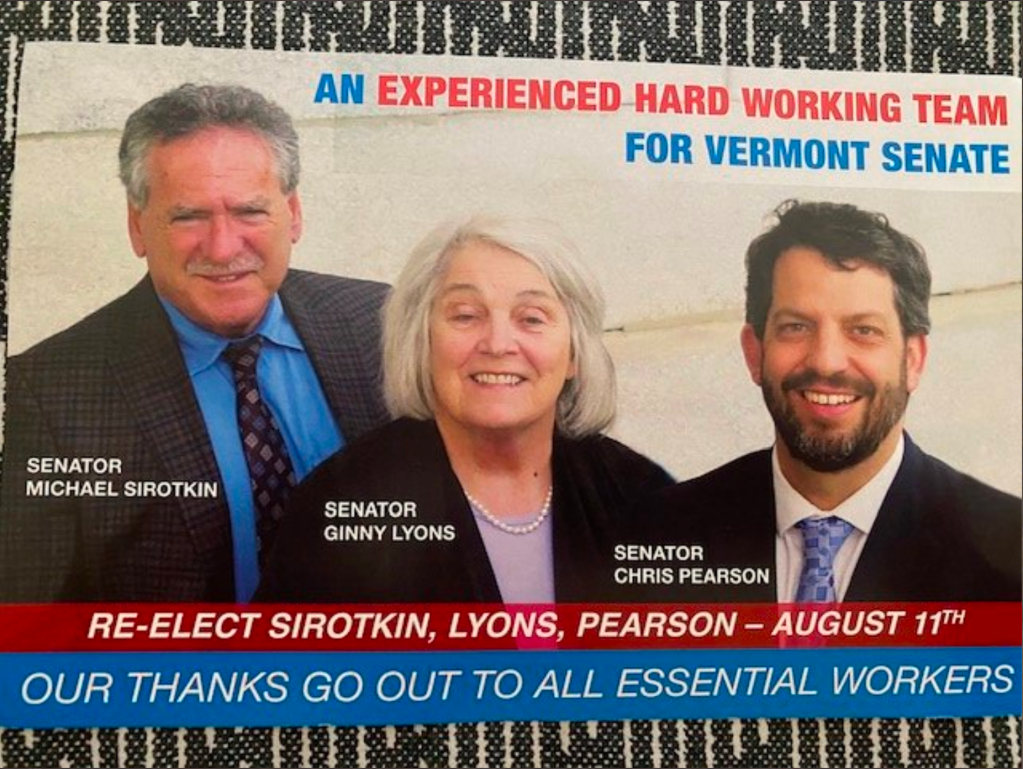
This is a mailer sent to voters in the Chittenden County Senate district. It features three of the four incumbents who are seeking re-election, running as a ticket.

The fourth? Sen. Phil Baruth.

Hmm. Was he excised, like Trump from that Jeffrey Epstein photo on Fox News? Is he persona non grata?

Nope. No conspiracy, no coup, nothing juicy. In this pandemic season, he explained, “I made a pledge not to raise or spend any money. I couldn’t bring myself to ask for money when everybody’s finances have taken a massive hit.” And since taking part in the joint mailer would have cost a couple thousand dollars or so, he withdrew from the enterprise. In fact, just today he posted a message on Facebook about his decision.

It’s not entirely a selfless decision; two of the six seats are open, which increases the odds that the four incumbents will sail through a crowded Democratic field. Baruth feels confident he will survive the August vote. “If, after five cycles, I haven’t accrued enough goodwill [to win], maybe that’s for the best.”

He’s almost certainly right. I expect the four incumbents to be the top four finishers in the primary. As for the rest of the Chittenden County Senate field, handicapping the primary is a fool’s game. Normal campaigning is off the table, so how do people get their names out there? Judging by the mid-July finance reports, only one candidate has enough money to make a major media push.

Besides, this primary is a mystery. These affairs are usually low-key and low-turnout, but a massive number of Vermonters have requested absentee ballots. We could easily see a record turnout, which makes for an unpredictable election.

Even the campaign finance filings are harder than usual to interpret. Some candidates, like Baruth and Rep. Dylan Giambatista, who’s running for Senate, have eschewed fundraising. Many others have shifted to passive mode, accepting donations that come in but doing little or nothing to solicit funds.

But hey, the reports are there, so let’s give ’em a look.

Continue reading

Plus c’est la même chose, plus c’est la même chose

If you’d been harboring any faint hopes for change in the State Senate leadership, you were quite reliably disappointed by Saturday’s Democratic caucus.

With only the tiniest hint of dissent, the status quo was maintained in Our Most Stagnant Deliberative Body. John Campbell? Yep, President Pro Tem again, along with Phil Baruth as majority leader, Claire Ayer as whip, and… the earth would tremble and the skies would be rent asunder if they failed to re-elect Dick Mazza as “third member” on the organizationally influential Committee on Committees, where he will rejoin the Phil Scott Fan Club with Campbell and Scott himself.

Maybe someday there’ll be a real Democrat on that panel.

Seven Days’ Paul Heintz, ever the pot-stirrer, introduced me to Mazza before the caucus convened. And the Eternal Member gave me a hearty greeting, making it clear that he knew what I’ve written about him and that it didn’t make a damn bit of difference. Baseball players used to refer to beat reporters as “flies,” and that’s how Mazza sees me: a fly buzzing around his shit. Didn’t even bother to flick me away.

So the fix was in. There were no competing nominees for any of the four posts, and there was only the slightest bit of dissent: Anthony Pollina voted “no” for Campbell and Mazza without explanation. Afterward, he spoke to Heintz:

“I would like to see the ability for more people to be involved in leadership, quite frankly, and I think that it would be more healthy for the caucus to have some conversation about who’s going to be the leader, and we don’t seem to have that conversation.”

Yeah, we certainly don’t. The organizational meeting was a hearty session of hands-around-the-campfire, we’re-all-friends-here. Any ill feelings were kept resolutely in check. In fact, there was one moment of unintentional gallows humor, when a senator who I didn’t recognize* nominated Mazza for “third member” by praising the past work of the Committee on Committees; he said that everyone had been happy with the committee assignments made by the CoC.

*Subsequently ID’d as Tim Ashe, putative Prog/Dem and studious ass-kisser to the Senate power structure. Gah. 

Somehow, Ginny Lyons and Ann Cummings didn’t scoff loudly. Both veteran lawmakers were screwed out of committee chairmanships by the CoC last time around. Lyons was replaced on Natural Resources by climate change skeptic Bob Hartwell, and Cummings was removed from Finance, presumably because she had the temerity to stage a brief challenge to Campbell’s leadership in 2012.

The CoC’s smackdown had its intended effect, as no one rose to challenge the same-old, same-old. The Three Kings will soon return to their secret undisclosed location to dole out the committee goodies. We’ll see if they behave themselves this time — but only after the fact, since Campbell has declared that the CoC is not subject to open meetings law. Paul Heintz, last February:

When Seven Days happened upon its three members — Lt. Gov Phil Scott, Senate President Pro Tem John Campbell (D-Windsor) and Sen. Dick Mazza (D-Grand Isle) — convening to discuss the matter last Thursday in Scott’s Statehouse office, Campbell declared, “It’s not a public meeting.”

“My understanding,” he elaborated, “is it’s a private, deliberative meeting of one of the committees of the Senate and therefore, you know, not open to the public.”

“So committees can just close the doors when they’re deliberating?” Seven Days asked.

“I believe this one, yeah,” Campbell said. “My opinion is that.”

Following that dismal exchange, the CoC held a closed-door confab with Senate Secretary John Bloomer and chief legislative counsel Luke Martland, who then produced a convenient bit of legal mumbo-jumbo to cover Campbell’s backside. When asked why Senate rules, which strictly limit closed committee meetings, don’t apply to the CoC, this laughable exchange took place:

Said Bloomer, “This, in my opinion, doesn’t apply because these are standing committees. The Committee on Committees has no function to take evidence.”

Added Campbell, “The Committee on Committees is totally different. It’s kind of a misnomer using that name, ‘committee.’”

The Committee on Committees isn’t a committee, eh?

Pardon me if I feel completely justified in my cynicism about the CoC.

Let me somewhat belatedly make clear that I have no beef with Ayer or Baruth, aside from their willingness to be part of a leadership team with an inconsistent record for upholding the principles (and candidates) of the Democratic Party. Baruth offered a tepid explanation for the lack of change, telling me that it was going to be a difficult session, so continuity of leadership would be a positive.

“We can’t change captains now,” said the First Mate. “The Exxon Valdez is in trouble.”

Campbell introduced his new aide, former Shumlin Administration functionary Erica Wolffing, fresh off her gig at the Democratic Governors Association.  And he made brief reference to his poor performance as Pro Tem in 2011, which led to Cummings’ challenge and the hiring of Rebecca Ramos as his top aide/nanny. Wolffing will now fill that role, helping him lift that big heavy gavel, and she’ll probably be very good. She’s likely to keep communication lines open between Campbell and the administration, and help keep things running smoothly in the Senate chamber.

After his re-election, Campbell gave a short speech laying out the top four priorities for the coming session, which he said would be “one of the most difficult bienniums in decades.” Which, he added, means “there’s a chance the work we do will be historic.”

Mm. The Hindenburg was historic.

Three of Campbell’s Big Four priorities were predictable:

— Health care. Trying to overcome his past public skepticism about single payer, he promised a full and open consideration of Shumlin’s plan. “We have an obligation to the administration to hear what they have to say, and to the public to deal with the rising cost of health care.”

There’s also that social-justice part of it, but Campbell didn’t mention that.

— The budget. He said the likely $100 million deficit was “not pie in the sky,” and lawmakers will have to look closely at revenues and state functions, prioritize services, and look for efficiencies and duplications. By funding too many “good ideas,” he said, “we’ve spread ourselves very thin.” He called for a tight focus on “what is our obligation to business and to citizens,” as opposed to what we’d like to do. (Yes, he said “business” first.)

In short, No New Taxes. And don’t expect any new money for anything.

— Education funding and governance. “We will have to look at what we need to educate our kids, and what we don’t.”

The fourth priority was a bit surprising:

— Lake Champlain, which he first called an “economic driver” and then called it “iconic.” Priorities.  “It’s not just because the EPA has said we must act; we have an obligation.” What that means remains to be seen, with all the talk of cutting government and focusing on the essentials and no new spending. It was nice to hear Campbell put Champlain at the top of the list, but I suspect we’re not going to get much more than lip service or possibly tokenism.

It’s looking like a dispiriting biennium for liberals. The Senate remains safely in the death grip of The Usual Suspects, now armed with what they see as an electoral mandate to cut and cut and cut. Shumlin himself, in remarks to the House and Senate caucuses, made it clear that his response to his near-defeat will be a predictable tack to the center. (More on that in an upcoming post.)

And so we beat on, boats against the current and all that.