Tag Archives: Gannett

Soylent Green is old journalists

Uh-oh. The soft, rustling footfalls of Death can once again be heard in the open-plan offices of Gannett newspapers, including the Burlington Free Press. Gannett CEO Bob Dickey issued this memo earlier today:

I wanted to let you know that today we are offering eligible, long-term Gannett employees within certain business segments and departments of our company the opportunity to take advantage of an early retirement program.

The employees who are receiving the offer all satisfy the criteria of being 55 years of age or older with at least 15 years of service as of October 12, 2015.

That’s right, boys and girls: it may be less than one year since Gannett launched the (Mostly Empty) Newsroom Of The Future, but it’s already time for another round of cost-cutting!

Er, pardon me: “providing the company flexibility to reinvest” and “better align our structure to become a next generation media company.”

Continue reading

Gannett chief preps golden parachute

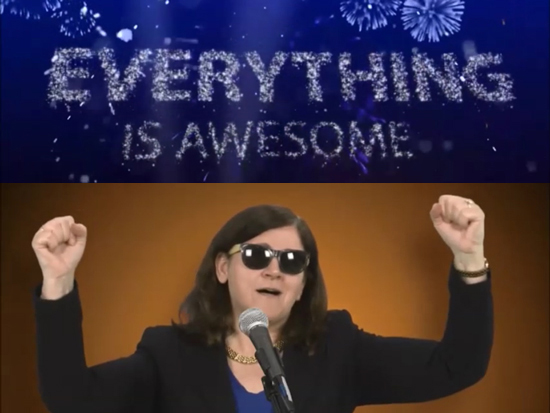
Everything is awesome… when you've just made four million smackeroos.

Everything is awesome… when you’ve just made four million smackeroos.

Gracia Martore, CEO of Gannett, last seen disgracing herself in an unbelievably wrong-headed music video, must really believe in the future of her company.

Because she just unloaded more than 80% of her stock holdings in Gannett. American Banking & Market News reports that Martore sold 123,560 shares of stock in the Burlington Free Press’ parent company, leaving a mere 30,034 shares in her portfolio.

Her take? $4,312,244.

How many reporters would that buy?

Her stock dump comes just before the planned split of Gannett’s newspaper and TV/digital divisions. Gannett will retain the troubled publishing businesses, while new entity TEGNA will get all the broadcasting and digital stuff.

The spinoff is expected to take effect by the middle of this year, which is… hmm… checking my calendar… a mere six weeks away.

And where do you think the price of Gannett stock is going to go, after all its goodies are under a new corporate umbrella? I think we know how Gracia Martore would answer that question.

All Bernie all the time

A good newspaper covers the waterfront. It provides an overview of what’s gone on in the world, the things you need to know, things you might not otherwise know.

Those of us who still read newspapers appreciate the chockablock presentation of stories from the community, nation, and world. It’s a tangible StumbleUpon that gives you more information about the things you’re aware of and brings other items to your attention, making you a better-informed and more well-rounded citizen.

Well, the Burlington Free Press is here to say “Screw that mess.”

Today’s Freeploid, from the top:

Page 1: Bernie Sanders
Page 2: Bernie Sanders
Page 3: Full-page advertisement
Page 4: Bernie Sanders
Page 5: Bernie Sanders
Page 6: Bernie Sanders
Page 7: Bernie Sanders
Page 8: Bernie Sanders
Page 9: Bernie Sanders
Page 10: Bernie Sanders
Page 11: Bernie Sanders

Page 12: Editorial and op-ed about Bernie Sanders.

Finally, on page 13, the first non-Bernie content: a pair of opinion pieces about other subjects.

After that? Sorry, no room. The next ten pages are devoted to Sports, with the variety of content you expect from a good newspaper.

Continue reading

The Beatings Will Continue Until Everything Is Awesome

This came out a few days ago, but I can’t resist. It’s so great in such a terrible way.

Last week, the Gannett corporation (owner and strangulator of the Burlington Free Press) held a big event to announce the new name for its digital spinoff. The winner: TEGNA, said to be taken from letters in the word “Gannett.” The name was immediately and widely panned, but those initial reactions tend to come and go. The name is dumb, but it won’t hurt the company.

gannettNo, the bad part was the cringeworthy lip-sync performance of “Everything is Awesome” (from The Lego Movie) by top Gannett executives. If you haven’t seen it, please take two minutes out of your day. It’s just incredibly wonderful in its stupefying awfulness. And thank journalism watchdog Jim Romenesko for digging up the video and posting it online.

Okay, seen it? We’ll continue.

Everything about that is UN-awesome, from the tone-deaf messaging to the terrible performances. Oh, and misspelling “commission.”

But the topper?

https://twitter.com/HeyHeyESJ/status/591698231865778176

Yup.

Pet Shop Owner: Free Press Makes Best Cage Liner

The Burlington Free Press is a struggling newspaper through no fault of its own. It’s in a declining business, and it’s owned by a profit-driven bloodsucking corporation. Still, it puts out many a good story.

Why, then, do I persist in mocking the Freeploid at every opportunity? And why does almost everyone else in Vermont print media despise the paper? Because it’s way too full of itself. The Burlington Free Press used to be the crown jewel of Vermont journalism; it isn’t anymore, but it still thinks it is.

Two prime examples from a single day — today. First story:

Police: Juror read Free Press during trial

A man who served on the jury in a sexual assault case against ex-jail guard Richard Gallow has been accused of contempt of court for allegedly reading the news during trial.

The jury in the case was ordered to avoid media coverage of the Gallow trial. Juror Robert Blow is accused of flouting that order — by reading the Burlington Free Press.

Which the Free Press is happy to tell you over and over again. Continue reading

Gannett honors cashiered Free Press writer

Ohh, this is sad, even by Burlington Free Press standards.

Last Friday, the Gannett newspaper chain announced its “Best of Gannett” awards for the company’s best journalism in 2014. Among the big winners were the Arizona Republic, the Des Moines Register, the Palm Beach (CA) Desert Sun, and the Staunton (VA) News Leader.

This being a media awards thing, there were dozens upon dozens of winners. (Journalism awards are kinda like participation ribbons. I speak as a past winner of dozens myself.)

So where, oh where, can the Freeploid be?

Scroll down. Keep scrolling. More. More. Keep going. Further. Go on.

Okay, there. The Free Press’ one and only prize is a Third Place award in the category of “Narrative Writing/Voice,” which aims to honor “powerful and tightly written news and feature stories… and any examples of evocative writing regardless of platform.”

And your winner? Oh, this is embarrassing.

Tim Johnson. 

Yes, the Tim Johnson who was abruptly fired last fall after 16 years on the job.

Gee, somehow the Free Press never bothered to report this great victory. And it’s usually so quick to brag about any honor it wins, no matter how trumped-up.

Here’s a final indignity: The awards come with cash prizes. Unfortunately for Tim, the money goes not to the writers, but to their employers. Or, in Tim’s case, ex-employer.

That’s Gannett for ya, giving the prizes to itself and screwing the talent. *Correction; see second Postscript below.

Postscript. I’ve heard through the grapevine that Johnson learned of his award through this blog. Nobody at the Free Press or Gannett bothered to inform him. That’s not just sad; it’s shameful. Even if the Free Press was going to keep the check, they could have at least given him a certificate or something. 

Post-postscriptA commenter notes that I made a mistake in reading the Gannett press release. The newspapers do pocket the cash for the Public Service awards, but the writing and reporting prizes are supposed to go to the individual staff. Presumably the Free Press will be scheduling a nice presentation ceremony for Johnson. Hahahaha.

Will the last one off the seventh floor please turn out the lights?

The institutional memory at the Burlington Free Press, Vermont’s Shrinkingest Newspaper, has taken another big hit. 28-year veteran reporter Molly Walsh is leaving the Freeploid for the friendlier confines of Seven Days.

It’s a body blow to the Free Press’ diminishing ability to cover the news. And the timing couldn’t be worse, since Walsh has been reporting the Burlington mayoral race. Not quite as bad as Terri Hallenbeck and Nancy Remsen leaving on Election Day, but not helpful. It’s also one more indication of Seven Days’ growing dominance in the Chittenden County news market, and its seriousness about positioning itself as a vital news source.

Better days…

Better days…

Walsh was diplomatic about the lifeboat she’s swimming away from:

There’s been a lot of change. I think some of the changes are for the better and some are questionable.

But her actions speak louder than her words. Can you imagine, at any earlier point in history, an established reporter voluntarily leaving an established daily newspaper for an alt-weekly?

Strange but true: Seven Days is a better place to work than the Freeploid, with its reporters expected to write clickbait-friendly articles, produce endlessly, create and market their “brand,” provide video and photography as well as copy, work with the sales department and key advertisers, and live on the high-wire of editing their own stories.

About the last point. One of the Freeploid’s sister Gannett papers, the Cincinnati Enquirer, was inundated by reader complaints about the quantity of mistakes in the Sunday paper. Most of the errors were minor, but every one undercuts a newspaper’s credibility. The Enquirer, like the Freeploid, is an example of Gannett’s Newsroom of the Future, which includes little or no copyediting.

The Sunday foofaraw was so bad, it prompted chief editor Carolyn Washburn to write a memo to news staff emphasizing the need for them to “take full ownership of your own clean copy.” Meaning, “don’t expect the editors — pardon me, Producers and Coaches — to be your backstop.”

Now, you’d think an average reporter would be capable of producing literate copy, but it’s not nearly as simple as you’d think. This former copyeditor can tell you that mistakes are like cockroaches in a New York City apartment: no matter how hard you try, it’s almost impossible to stamp ’em out. And it gets harder with every re-reading of a story: after two or three scans, your eyes inevitably start to glaze over. That’s why media outlets have traditionally had copyeditors: the more eyes you have on a story, the more likely you are to weed out the errors.

In sum, the Free Press has got to be a really hard place to work these days, and it’s only going to get worse. Walsh’s departure is one more signpost on the Free Press’ road to irrelevance.

Well, at least the Free Press dumped its political reporters BEFORE the list came out

A big oopsie from the Montana province of the great Gannett Empire.

On Jan. 28, the Washington Post’s Chris Cillizza released a (deeply flawed and incomplete) list of the “best political reporters” in each of the 50 states. One of the four Big Sky nominees was John Adams of Gannett’s Great Falls Tribune.

Unfortunately for the Trib, only two days after the list came out, Adams declined to go through the mandatory re-interviewing process for all Gannett journalists. He balked because his position — capital bureau chief — was being eliminated, and he didn’t want any of the jobs on offer.

After serious thought and consideration I opted not to apply for any of the positions. I have been very happy in my role as the capital bureau chief for the Great Falls Tribune and would have liked to have continued in that role, but I did not feel any of the available openings in the Tribune’s new “newsroom of the future” were a good fit for me.

Bad timing, Tribbies. By contrast, our local Gannett House O’ News ‘N’ Stuff, the Burlington Free Press, had the sense to jettison its two best political reporters (Terri Hallenbeck and Nancy Remsen) a couple months before Cillizza posted his list. The Freeploid still suffered the lesser embarrassment of having Cillizza name Mike Donoghue and April Burbank as two of Vermont’s top four state political reporters, when Donoghue’s beat is only partly political and Burbank had been on the beat for less than two months.

Well, it ought to be an embarrassment, but the Freeploid is actually proud of its reporters’ “achievement.” But then, it long ago established its reputation as Vermont’s Most Shameless Newspaper Media Organization. Indeed, I wouldn’t be surprised if Cillizza’s source wasn’t someone inside the Free Press and/or Gannett; he depended heavily on reader nominations for states he wasn’t familiar with, and he clearly hasn’t a clue about Vermont. It’s hard to imagine an objective reader nominating Burbank (Donoghue maybe, just on seniority) for the honor. Nothing wrong with Burbank, she hasn’t been covering state politics long enough.


Tomorrow’s Burlington Free Press might be a bit thinner than usual

Today’s a Big Day for Gannett’s Newsroom of the Future initiative. See, Gannett has signed a big-ass contract with the Poynter Institute to provide virtual re-education camps for its rapidly dwindling cadre of newsies.

Shiny happy journalists.

Shiny happy journalists.

The Gannett-Poynter Training Partnership has its official kickoff today at 1:00 with an Employee Town Hall Webcast featuring Gannett President/CEO Gracia Martore “highlighting recent company news and a discussion about what’s ahead.” Expect a load of happy talk about how recent transitions (read: layoffs) have repositioned the corporation for a bright future.

Attendance, I suspect, is mandatory. I hope there’s no big news this afternoon.

After the launch party, staffers will undergo “four to seven modules that address a specific training need,” all with a goal of enhancing Gannett’s digital footprint and engaging the audience (they used to call us “readers”).

Poynter’s “training opportunities” include a bunch of courses in audience analytics, “building your brand,” “developing your social media voice,” promoting content online, and effective Tweeting. (I strongly suggest Michael Townsend sign up for that one.) Other notable “content modules” (they used to call them courses) include…

“Business Models and Strategies” — “innovative ideas that can bring new streams of revenue to your operations.” Which means partnering with sales staff and working with advertisers.

“Best practices for working with citizen journalists” and “How to Tell Great Investigative Stories with Dwindling Resources.” Meaning, we can’t afford reporters anymore.

“Cleaning Your Copy: Grammar, Style and More.”  Meaning, we can’t afford editors anymore.

“The Camera With You: How, and When, to Shoot with a Smartphone.” Meaning, we can’t afford photographers anymore.

Modules for the newly minted position of Content Coach include Managing Creative People (those damn crazy reporters), Dealing With Difficult Conversations (I’d think Gannett managers would already be experienced at this), and Language of Coaching (please stop yelling at the reporters).

Some of this is cringeworthy, and reflects a desperate industry making a last-gasp effort to maintain some sort of relevance. Or at least keep the profit streams flowing as long as possible. But to be fair to Gannett, a lot of this will help journalists and editors adjust to new realities being forced upon them. And when, sooner or later, they find themselves jettisoned by their corporate masters, they’ll be better equipped to bushwhack their way through our brave new media landscape where Content is King, but Content Providers are peons. And where salesmanship is at least as important as quality.

Theme from “Jaws” heard in southern Vermont newsrooms

Looks like the Vermont journalism scene is about to take another step into the abyss. Paul Heintz has a story on the Seven Days website, headlined by a bit of consolidation at the Brattleboro Reformer and Bennington Banner: both papers will now share a single managing editor, Michelle Karas. (When asked if she could handle both papers, her less than reassuring response was “I’m hoping so.”)

To me, though, the more important — and more worrying — news was several paragraphs down in Heintz’ piece: DigitalFirst Media, the corporate parent of both papers, wants to get out of the newspaper business. It’s in the process of selling its entire portfolio of more than 100 papers nationwide. It would prefer to unload the whole shebang in a single transaction, although it may wind up selling things piecemeal.
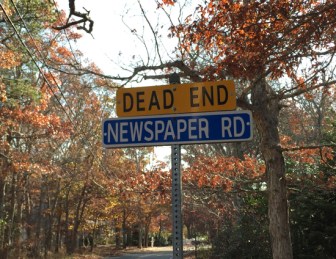
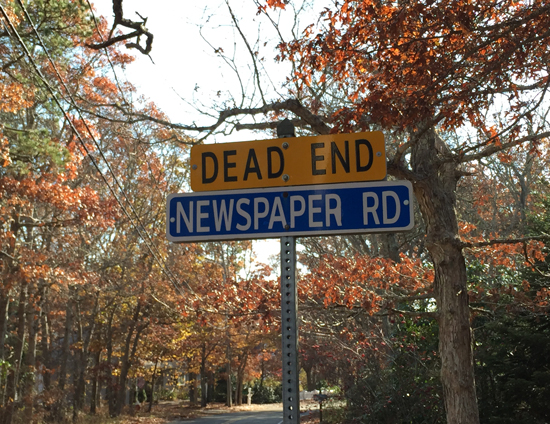
Newspaper Rd. Dead EndDFM’s stash includes such notable properties as the San Jose Mercury News, Salt Lake Tribune, St. Paul Pioneer Press, and Denver Post. Our southern Vermont dailies are afterthoughts by comparison.

And they are about to be thoroughly buffeted by the winds of corporate change.

Possible buyers include a passel of private equity firms, many of which have no experience in newspapers. That’s bad enough, but even worse are the experienced operators said to be in the running. They include Gannett, currently engaged in a slow strangulation of the Burlington Free Press; and GateHouse Media, whose name is poison in Massachusetts.

GateHouse is the creation of another private-equity firm, Fortress Investment Group. Fortress has seen its share of financial trouble in recent years; it nearly went bankrupt in the market crash of 2008. This caused it to default on a huge loan deal to fund construction of the athletes’ village for the 2010 Vancouver Winter Olympics. That forced the City of Vancouver to pony up $450 million (Cdn) to get the village built.

Oh well, you know what they say about eggs and omelets.

Even as it has struggled, Fortress has built a newspaper entity that seems to break all the rules of business. According to the Boston Globe, GateHouse “has never made an annual profit as a public company,” and in 2013 filed for bankruptcy “under the weight of nearly $1.2 billion in debt.”

Even so, Fortress finagled the finances in a way that allowed GateHouse to scoop up 33 more New England newspapers. After which, it immediately imposed draconian staff cuts. Poynter Institute media business analyst Rick Edmonds says GateHouse has a reputation as a “bottom-line, lean operator” that isn’t squeamish about making cuts. “In a case like this, they’ve probably looked at the numbers and said, ‘We can squeeze more [savings] out of this,’” he said.

Through its holding companies, Fortress controls “nearly every newspaper south of Boston,” and also “dominates Boston’s western suburbs.”

Brattleboro and Bennington, just a hop and a skip away. Looking at the two behemoths said to be in the running to buy DigitalFirst, I’d say GateHouse makes a lot more sense than Gannett. And if Gannett winds up buying all of DFM, I wouldn’t be surprised if it spun off the two Vermont dailies, which are teeny-tiny by Gannett standards but right in GateHouse’s comfort zone.

Either way, look for more slashing in southern Vermont’s already sad print-media scene. Which is a real shame; the healthier Vermont media properties, VTDigger, Seven Days, and VPR, all have a clear northern Vermont slash statewide focus. Very seldom does southern Vermont show up on their radar.

There is one thin ray of hope in Heintz’ story. As the Brattleboro Reformer has declined, he notes that an independent weekly, The Commons, has expanded its circulation in recent years.

This may be the next mutation of journalism: a Seven Days approach, including a single weekly print edition and a Web presence with more frequent postings. To be sure, there’s no sign that daily papers will do anything other than continue to diminish in size and quality.