Tag Archives: Barons of Burlington

I’m Not Ready to Say Scott Beck is the Smartest Person in the Legislature, But He’s in the Conversation (Updated)

Score another one for Senate Minority Leader Scott Beck. After his star turn manipulating the education reform process, he managed to wangle his way onto the School District Redistricting Task Force* established by H.454 (now Act 73). He’s one of five Senate appointees, and the sole Republican. Throughout the education reform debate, he was the most prominent Republican voice — and arguably the single most influential senator of any party.

*A name only a legislative body could concoct.

On Monday, the Senate’s Committee on Committees announced its five appointees to the panel tasked with redrawing school district lines. Beck will be joined by Democratic Sens. Martine Larocque Gulick and Wendy Harrison, retired Kingdom East Supervisory Union superintendent Jennifer Botzojourns, and Chris Locarno, retired director of finance and facilities for the Central Vermont Supervisory Union. (The House announced its five appointees on Tuesday morning; details below.)

Beck’s appointment capped off a remarkable rookie campaign as Minority Leader — in his first year as a senator. And in the “Way Too Early” parlor game of gubernatorial speculation, Beck has to be taken seriously as a potential Republican candidate whenever Phil Scott decides to step aside. More so, I believe, than everybody’s favorite maverick, Lt. Gov. John Rodgers.

You may think this a rash judgment, but let’s step back for a moment and describe the trajectory of Beck’s political fortunes.

I should make clear that this post considers Beck as a political actor without regard for whether I agree with him or, more often, not. He has shown himself to be a savvy operator, a respected member of the House who ran as kind of a centrist in his bid for the Senate, but has been a reliable spokesperson for Republican orthodoxy as Minority Leader.

Continue reading
The Burlington Democrats Are Taking an Awful Lot of Republican Money (and Leaving Quite a Bit of It Unspent)

The second and final round of pre-Town Meeting Day financial disclosures is in, not that anyone in the media paid the slightest attention. The deadline was February 22, so I’m in the “belated” category. Apologies. Had other stuff to get to. Plus, honestly, I felt fairly confident that I could leave it for a few days because campaign finance reportage has practically disappeared from our Incredible Shrinking Media Landscape.

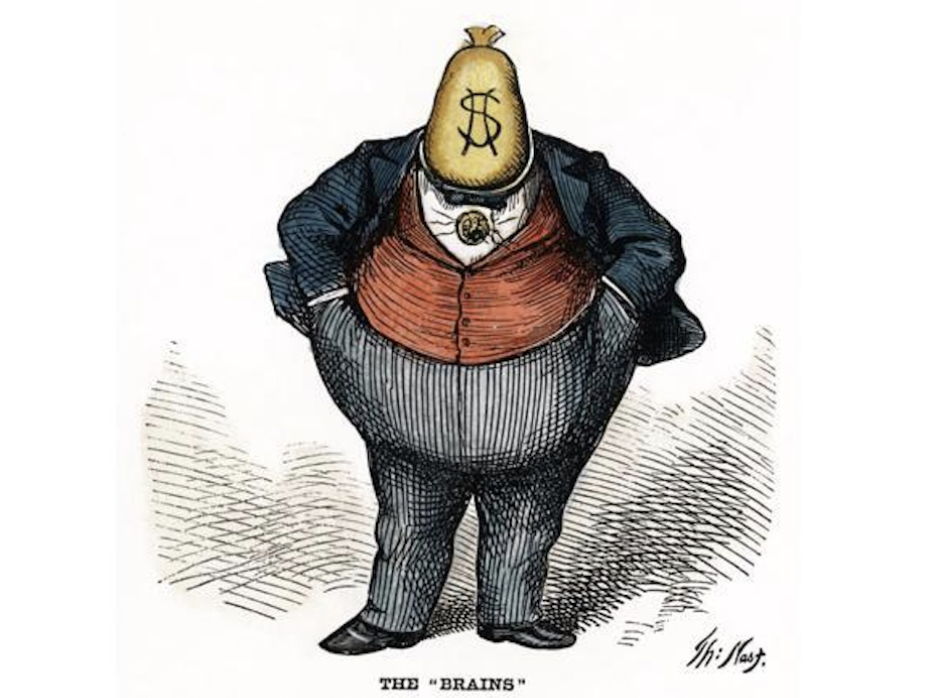
Headline: The two Democratic candidates in competitive races for City Council are raking in the cash, as is the Burlington Democratic Committee. (Reminder: If the Dems win both, they retain a working Council majority. If not, the Progressives would assume the majority.) The Dems’ fundraising far outpaces their Progressive counterparts and any other Council candidate in recent history. And a lot of it is from the upper classes of the greater Burlington area, people who’d be donating to Republicans if the Burlington Republican Committee wasn’t such a disaster. (These donors include many of the Barons of Burlington and others who did, in fact, donate to Republicans in the 2024 general election.)

Subhead: The Dems had left a lot of money unspent as of February 22, which probably means they didn’t expect to raise this much cash. The Town Meeting season is so tightly compressed that there’s no time to redo your strategy because you can suddenly afford more mailers or yard signs or advertisements or balloon clowns or whatever. The upshot: The Barons aren’t getting nearly the full bang for their bucks.

Continue reading

Sen. Sam Douglass, Campaign Finance Scofflaw

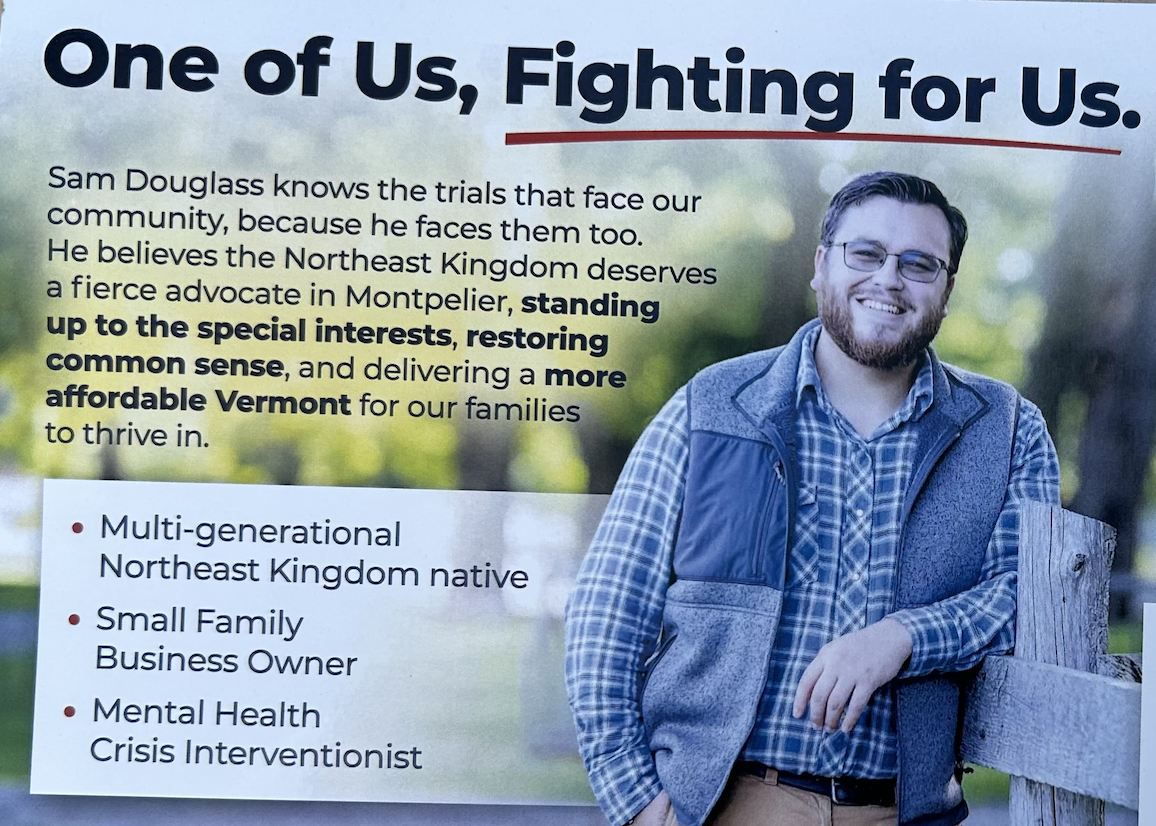
The folksy Son of the Soil pictured above is Sam Douglass, senator-elect from the Orleans district. Or, as I find myself thinking of him, Senator Scofflaw. Because while he claims to be a “fierce advocate,” he was shockingly blasé about his legal obligations to report campaign finances accurately and promptly. Makes you wonder about his fierceness, not to mention his devotion to fiscal responsibility.

Because his campaign finance filings are the opposite of “responsibility,” and include numerous violations of state law. Fortunately for him, the penalties are laughably small and rarely enforced. Otherwise he’d be in a heap of trouble. As it is, maybe some Concerned Citizen will see fit to file a complaint with the Attorney General’s Office, for all the good that will do.

Let’s start with the fact that Douglass has yet to file his Final Report, which was due on December 15. And there’s a real need for a final accounting, because his most recent report leaves many questions unanswered.

His post-election filing, submitted on November 19, shows a serious imbalance between income and outgo — and not in the way you’d expect. The Douglass campaign has reported raising nearly $41,000 and spending only $27,460. Did he really leave one-third of his bankroll on the table in a race against Democratic Rep. Katherine Sims, who raised more than $76,000? Or has he failed to fully report his expenditures?

Vermont’s campaign finance law and the Secretary of State’s reporting system can be a challenge, but when you run for public office you are obliged to follow the rules. Besides, Senator Douglass is going to be responsible for writing the laws. Shouldn’t he be capable of obeying them?

Continue reading

The Barons of Burlington Discover That #vtpoli Is a Cheap Date

Secretary of State Sarah Copeland Hanzas’ brand spanking new campaign finance portal is up and running, and boy howdy, is it an improvement on the old system. Much more information readily available, searchable, downloadable. Too bad nobody in the media, with the occasional exception of VTDigger, pays any attention to campaign finance anymore because (a) the entire idea behind campaign finance law is that sunshine disinfects, but that doesn’t work if the cleanup crews are off the clock, and (b) the new system makes the task much easier.

One huge improvement is the ability to track individual donors. Previously, donor records were extremely difficult to work with. Frequent benefactors would have numerous records, each one bearing a slightly different spelling or punctuation of their name or contact information. If I wanted to track, say, ultraconservative megadonor Lenore Broughton, I’d have to open and review literally dozens of files.

Now all I have to do is click on the “Contributions” button and type Broughton’s name into the “Contributor Name” field, and I can see all her donations to Vermont candidates and organizations in one list. So I can report that so far in 2024, Broughton has shoveled a total of $28,420 into Vermont’s political ecosystem. (This doesn’t include her federal activity; she’s given a whopping $82,700 to federal candidates and organizations in 2024. Including such worthies as Speaker Mike Johnson, Sen. Josh Hawley, unsuccessful Senate hopefuls Eric Hovde of Wisconsin and Kari Lake of Arizona, and an org called Black Americans Political Action Committee, which bears a strong smell of astroturf. She also gave $2,000 to Scary Eagle Man Gerald Malloy. Because he was a federal candidate, that donation was reported to the Federal Elections Commission, not the Vermont Secretary of State.)

The system isn’t perfect. I came across one instance where a donor I think of as an adjutant Baron, Robert Lair, had his name misspelled as “Liar,” so one of his donations didn’t appear with the others. Oh well.

But hey, let’s get to the point, shall we? This being the fifth paragraph already.

Continue reading

John Rodgers Has Even More Work to Do

When last we looked at Lieutenant-Governor-Elect John Rodgers’ campaign finances, we saw that he was nearly $53,000 in the red as of the November 19 filing deadline.

Well, now the final numbers are in — and Rodgers’ deficit has grown even larger.

His December 15 filing, which is the last one for the campaign cycle and is officially attested to as his FINAL REPORT all caps, shows total fundraising of $216,468 and total expenditures of $284,588.01.

That’s a shortfall of $68,120.01.

In percentage terms, Rodgers overspent his income by 31.5%.

It’s a curious situation for a common-sense fiscal conservative “balancin’ the books around the kitchen table” kind of guy.

Continue reading

The Barons Didn’t Buy the Senate, But They Dramatically Increased the Price of Admission

Throughout the campaign season I wrote about the Barons of Burlington, a bunch of well-heeled men — well, almost entirely men — and their obviously coordinated effort to buy a bunch of state Senate seats. They wrote fistfuls of four-figure checks to six Republican candidates for Senate plus their choice for lieutenant governor, Democrat-turned-Republican John Rodgers.

So, now that the dust has settled and the campaign finance reports are nearly complete*, it’s time to answer the musical question: Did the Barons buy the election?

*Final reports are due December 19, but the bulk of the money has been accounted for by now.

The obvious straight-line answer is yes. Their seven chosen candidates swept the field, reducing the Democratic/Progressive majority from 23 seats to 17 with the tie-breaking LG vote going to the Republicans.

The less obvious answer is, well, not really. There is abundant evidence that their money didn’t swing the election — that the Republican gains would have happened anyway.

Continue reading

John Rodgers Has Some Work to Do

John Rodgers still looks to be our next lieutenant governor, absent some history-defying hijinx in the Statehouse. But he can’t close the books on his successful campaign — not without some serious post-election fundraising.

Because according to his latest campaign finance filing, Rodgers is nearly $53,000 in the red.

He raised a total of $214,218, very respectable considering that as of July 4 he hadn’t raised a damn dime. He attracted a veritable tsunami of four-figure donations from the Barons of Burlington and their friends.

But he also spent like a drunken sailor — $266,942 in a four-month period, a breathtaking pace for any office this side of the governorship. That leaves him with a campaign deficit of $52,724, meaning he overshot his revenue by about 25%.

Hell of a thing for a guy who ran on affordability and common sense.

Continue reading

After the Long, Dark Night, a Journey Through the Desert

In my Election Night post, I pointed out the parallels between Vermont’s elections in 2014 and 2024. Both were rebukes of Democratic officeholders; the former, Peter Shumlin; the latter, a couple dozen or so members of the Legislature.

There are parallels, to be sure but they end here: 2014 was largely aimed at Shumlin, while the entire Democratic establishment found itself in the crosshairs this year. And each and every one of them had better be prepared to do some real soul-searching. Because they didn’t see this coming, not at all. They believed the Democratic base was solidly in their corner. Some slippage was expected, but nothing like this.

Behind their misperception of the electorate is a more serious disconnect: Over the last two years, they completely lost touch with the people. They pursued an ambitious legislative agenda and, thanks to House and Senate supermajorities, they enacted an unprecedented number of bills despite gubernatorial objection.

They believed in their agenda. They believed they had a mandate to deliver on the promises of 2022. They believed they were moving Vermont toward a more prosperous and equitable future. One of two things is true: They got the agenda badly wrong, or they completely failed to connect it with the hopes, fears and concerns of the voters, especially outside the cities and suburbs.

Well, there’s a third factor: They made mistakes in crafting legislation. The most impactful was whatever they did to school funding that led to the unintended consequence of substantial property tax hikes for many Vermonters. It’s not easy to make sweeping changes in complex systems. The Legislature has precious few resources of its own, and was operating without any help from Phil Scott’s executive branch.

Continue reading

The Barons Try to Drag John Rodgers Across the Finish Line

The last pre-election round of campaign finance reports is in, not that anyone in the media noticed. To me, the single biggest note is that the Barons of Burlington and their allies are continuing to throw big money at John Rodgers, Republican candidate for lieutenant governor and alleged rural populist. In the first half of October, Rodgers raised $20,250; in the second half, he took in an extraordinary $69,259, almost erasing the cash advantage held by incumbent Prog/Dem David Zuckerman throughout the campaign. Not quite, but almost.

Of that $69,259, a full $58,199 was in increments of $1,000 or more.

That’s more than 83% of Rodgers’ total takings between October 16 and 31.

Son of the soil, my Aunt Fanny.

Here’s another way to slice the bologna. During the period, Rodgers took in a scant $2,560 in gifts of $100 or less. That’s a mere 3.7% of his total.

Which is S.O.P. for Rodgers’ campaign as a whole. He’s raised $212,443 so far, but only $8,809 in gifts of $100 or less. That’s only 4.1% of his total.

Continue reading

Wise Investments, and Other Notes from the State Senate Home Stretch

As I have noted previously, 2024 has been a barn-burner of a time for state Senate fundraising. Thanks largely to the Barons of Burlington writing bushels of four-figure checks and Democratic donors striving to keep pace, a lot of money has gone into some potentially close Senate races.

Some candidates were clearly taken by surprise at the amounts raised, because they’ve got a lot left with precious little time to spend it. The result: Senate hopefuls have made a blizzard of mass media buys in the second half of October, even as statewide campaigns have seemingly ended major expenditures. (Since Phil Scott and John Rodgers made their big radio splurge on October 28, there have only been two mass media filings by statewide candidates, and they add up to less than $2,000.)

But the Senate, that’s a different story. The mass media reports continue to come flying in. Mostly. There have been no late spends in Franklin or Windham, where the incumbents are safe as houses. (Lamoille’s Richard Westman just rolled in on October 31 with $7,303 spent on postcards and online ads.)

At the other end of the scale we find two districts not known for high rollers: Caledonia and Orleans, where longtime Democrats Jane Kitchel and Bobby Starr are retiring and every major-party candidate has spent tens of thousands of dollars. The number-one late spender on our list: Rep. Katherine Sims of Orleans, with $16,417 spent on mass media since October 15. Her Republican counterpart, Samuel Douglass, has spent $4,705, so late spending in Orleans totals more than $21,000. In Caledonia, Democrat Amanda Cochrane has spent $11,242 while Republican Rep. Scott Beck has laid out $6,603, for a district total of nearly $18,000.

I guess there’s at least one economic sector booming in the Kingdom.

Continue reading