
Tag Archives: Andy Julow

News You Should View: Support Your Local Newsroom Edition

Before we get to the best of Vermont media, a reminder that many organizations have begun their end-of-year fundraising campaigns. In these uncertain times there are numerous causes clamoring for a share of your generosity. But please make room in your list for the news outlets you depend on, by subscribing or making a donation. They keep you informed about critical issues. They provide information you couldn’t get anywhere else. They connect us to our communities and to each other. Vermont is blessed to have a lot of local and statewide news operations, and all of them could use your help. Thank you for attending my Ted talk.

Two sides of the immigrant story. From The News & Citizen, two very different pieces, both by Aaron Calvin. First, he covers a “chaotic and violent” action by Customs and Border Parol — this time at a Jeffersonville gas station, where seven people were detained. And as usual, federal officials provided virtually no information about who the detainees were, what they had allegedly done, or where they were taken. Your tax dollars at work.

Second, Calvin writes about Tony and Joie Lehouillier, owners of Foote Brook Farm in Johnson, who have depended on Jamaican migrant workers for years. Those workers helped the farm recover from the July 2023 floods; the Lehouilliers paid it back this month after Hurricane Melissa wreaked havoc on the workers’ communities in Jamaica. They raised enough money to send each of their four employees home with $1,600, and will continue to send food and relief supplies as they are able. Gee, maybe migrant workers aren’t a nameless, faceless threat after all.

Continue reading

News You Should View: Education Reform With Bulldozers and Blasting Caps

This week’s media roundup focuses on a single subject, which was almost inescapable as I made may weekly tour of Vermont news outlets. That subject is education reform, specifically the process outlined in Act 73, the wide-ranging measure railroaded through the Legislature by Gov. Phil Scott with the active connivance of Senate Democratic leadership. It’s now in the early stages of implementation, and wouldn’t you know, everybody seems to hate the thing.

But first. I took a brief trip to Cornwall, Ontario last week. It’s a smallish (by any standard other than Vermont’s; its population is bigger than Burlington’s) city known to Americans, if it’s known at all, as the Canadian side of an international bridge over the St. Lawrence River. While I was there, I did a little reading about Cornwall and came across the story of the Lost Villages.

I’d been through Cornwall many times while driving to and from my home state of Michigan, but I’d never heard of the Lost Villages. They were ten communities in the Cornwall area that were evacuated and deliberately submerged in the construction of the St. Lawrence Seaway in 1958. Roughly 6,500 people were displaced.

When I was back home and scanning Vermont media for this column, I found a common theme: stories across the state about local reaction to the rollout of Act 73. Reactions that include confusion, budding outrage, school officials trying to forestall the worst effects of the process, and universal dismay from those who work in public education. The closest thing to a positive view was, “Oh well, I guess we have to learn to live with this.”

Which made me realize, this is very much a large-scale, top-down, St. Lawrence Seaway approach to education reform. You know, the kind of thing Phil Scott spent his nonpolitical life doing — big, mechanized projects that might do a great deal of good in the aggregate while doing damage at the granular level. But it’s one thing when you conduct such a project for a large-scale benefit like improving long-haul travel. It’s a whole different thing when you deploy the heavy equipment to try to improve the educational experience of public school students.

Which is the goal of Act 73, right? Right?????

Well, I’m seven paragraphs deep into this piece, so I’d better get to the actual subject, don’t you think?

Continue reading

Scott (and Burlington Democrats) to City: Drop Dead

It’s no surprise that Gov. Phil Scott is turning a deaf ear and a jaundiced eye toward the Queen City, rejecting any idea that his do-nothing administration has contributed to downtown Burlington’s troubles. It’s somewhat more surprising that Democrats on City Council are effectively taking the governor’s side in the argument. Well, perhaps more ill-timed than actually surprising. Because talking like Republicans is what Council Democrats do best.

Let’s take this from the beginning. On August 13, VTDigger published an opinion piece by Burlington’s Progressive Mayor Emma Mulvaney-Stanak, in which she slammed the Scott administration for dramatically increasing the number of unsheltered people and failing to offer Vermont’s cities any help in dealing with the ensuing humanitarian crisis.

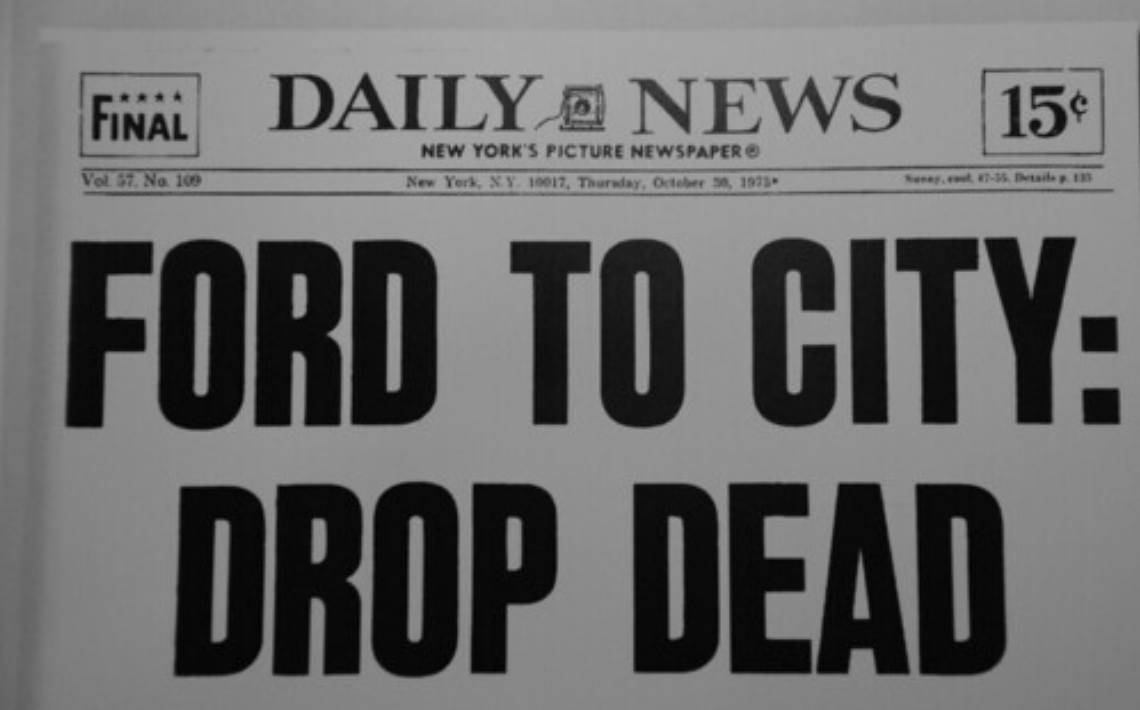
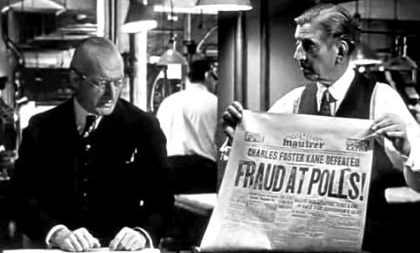
The governor’s response, delivered at a press conference last week, was akin to then-president Gerald Ford’s response to the financial troubles of New York City in the mid-1970s, as reflected in the greatest tabloid headline ever written. LIke Ford, Scott didn’t actually say that Burlington should Drop Dead, but he did argue that the city needed to step up and address its own problems before it could expect any outside help.

Even worse were comments made by Jennifer Morrison, Scott’s commissioner of public safety and former interim police chief of Burlington. According to VTDigger’s Shawn Robinson, Morrison described the city as “terrifying” without explaining what she meant by that, and sounded like someone carrying a grudge from her brief tenure as chief:

Continue reading

“This Broke the Democratic Caucuses”

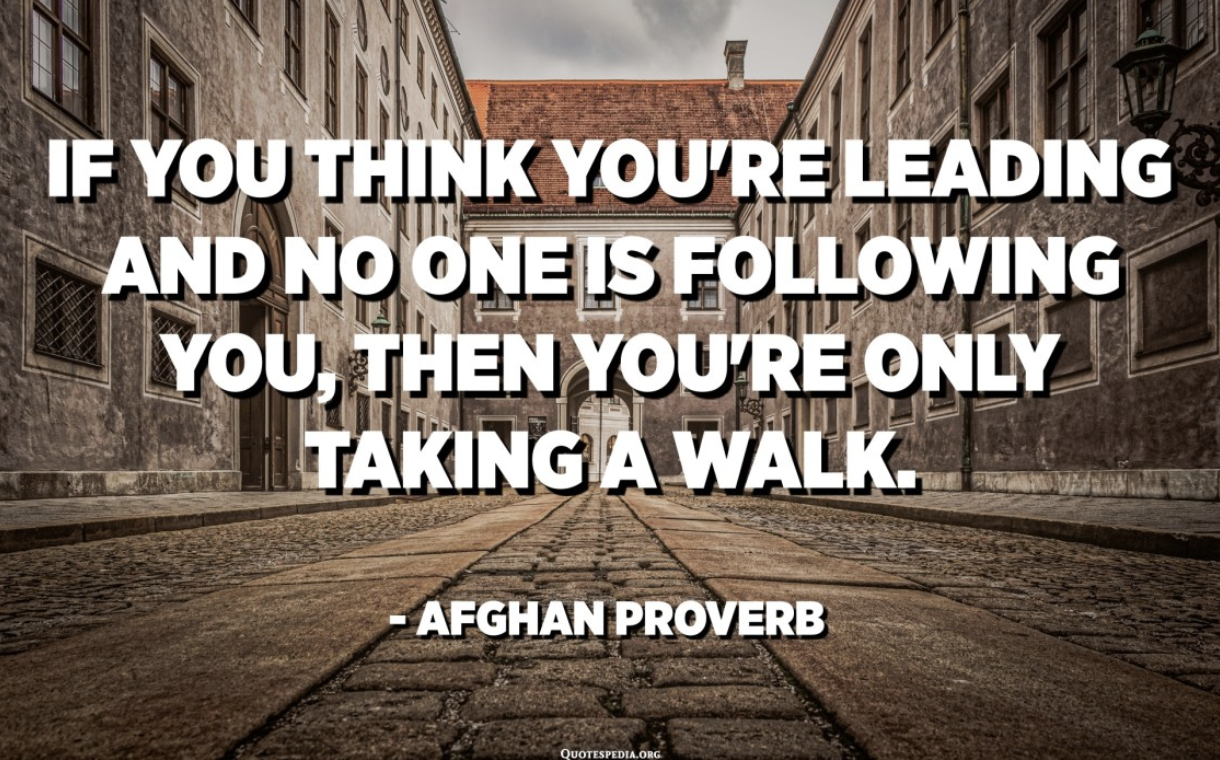
First, the obligatory note about Famous Quotes. They’re all a lie, apparently.

This one is either an “Afghan Proverb” or it was said by Benjamin Hooks or John C. Maxwell or James M. Kouzas, take your choice. I’m just surprised it hasn’t been attributed to the Grand Champions of “I Didn’t Actually Say That”: Abraham Lincoln, Albert Einstein, and Yogi Berra.

Whoever said it, it applies here. The Democratic leadership of the House and Senate played a very dangerous game when they jammed through H.454, the “education reform” bill that’s all about squeezing the public education system and protecting the interests of Vermont’s big private schools. Yeah, they won. They got their grand bargain with Gov. Phil Scott. But at what cost?

It’s almost unheard of for a major bill to pass a legislative body with most of the majority lawmakers voting “No,” and that’s exactly what happened here. Virtually all the Republicans voted in lockstep with the governor, while most Democrats in the House and Senate spurned their leadership and rvoted against H.454.

There’s a reason such a maneuver is almost unheard of, and it’s expressed in my headline. “This broke the Democratic caucuses” is what one majority lawmaker told me, and added that House and Senate leaders “are isolated and insulated from their caucuses.”

Need I say that this is an unhealthy situation, and that it bodes ill for the 2026 session and the November elections? Need I add that leadership needs to put in some serious time mending fences? They should, but based on past performance I have little confidence that they will.

Continue reading

News You Should View: Pre-Summer Slump

Not gonna lie, it’s a bit of a thin crop from our ever-diminishing media fields. Maybe it was the runup to the first big holiday weekend of the season? Maybe it was the amount of MSM attention lavished — rightly — on the education reform debate in Montpelier? Whatever the reason, I had less than usual to choose from. Still, there’s definitely stuff worth consuming. Also, apologies for posting this a bit late; I was out of town for nine days, and I’m still in catch-up mode.

Just like the good old days. We’ll start with the comprehensive coverage given to the education reform issue. It was front and center in the Statehouse, and our major outlets delivered solid, blow-by-blow reporting. If you followed my personal Big Three (VTDigger, Vermont Public, Seven Days), you got a very good sense of what was going on. It was like we were suddenly transported back to the year 2010, when multiple outlets competed for the big stories.

My only complaint: As a whole, the coverage didn’t much question the fundamental assumption of the debate: that the rising cost of public education is the result of shrinking student population and Balkanized governance. Not addressed, or not enough anyway: the fact that Our Betters are failing to address the real cost drivers in the system: (1) the skyrocketing cost of health insurance, (2) the slow-motion crisis sparked by the state withdrawing its traditional support for school infrastructure almost 20 years ago, and (3) social services for schoolchildren being paid for by schools instead of the Agency of Human Services. Our Betters aren’t trying to solve the problems with the cost of public education; they’re just shifting the burden onto the schools.

A new podcast from the Democratic mainstream. Former state senator Andy Julow and Chittenden County Democratic Committee chair Joanna Grossman have teamed up on a podcast whose title they may come to regret: “There’s No ‘A’ in Creemee.” Cutesy, kind of an inside joke, doesn’t roll off the tongue. But hey, whoever thought “Amazon” was a good name for an online bookstore? Well, Jeff Bezos did.

Continue reading

“Let’s Go to Work and Let’s Win”

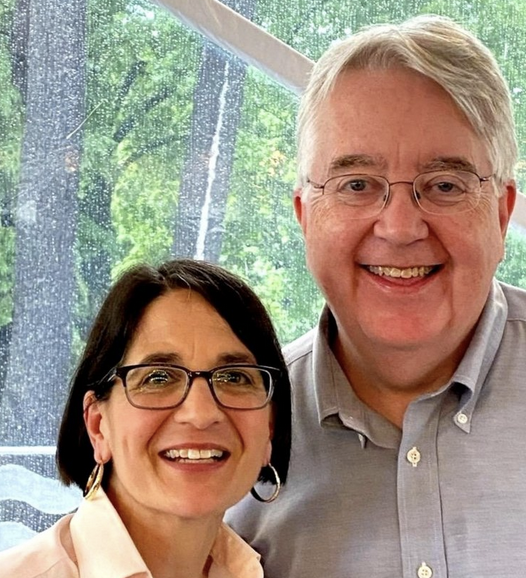
You’d probably have to be pretty deep in the weeds of Vermont politics, or perhaps a resident of Manchester, to recognize the name “Jim Ramsey.” (Pictured above with a slightly better known figure.) He’s only been involved in #vtpoli for a few years, but he’s been on a sharp upward trajectory that culminated on Saturday with his election as the new chair of the Vermont Democratic Party, replacing the prematurely departed David Glidden.

Well, technically Ramsey is the interim chair, filling out the remaining months of Glidden’s two-year term between now and November, when Ramsey will doubtless be elected permanent chair.

Members of the party’s state committee held a special meeting via Zoom on Saturday morning to choose Glidden’s replacement. Two people were nominated: Ramsey and former state senator Andy Julow, who was a late entry in the race.

If you needed any evidence that Ramsey had the inside track, you got it from VDP state committee member Susan Borden. In formally nominating Ramsey, she noted that he’d been endorsed by Treasurer Mike Pieciak, Attorney General Charity Clark, and Secretary of State Sarah Copeland Hanzas. The vote wasn’t close; Ramsey took 38 of the 45 votes cast. Julow received the other seven. In pre-vote remarks to the committee, Julow more or less acknowledged his longshot status. But even so, it’s telling that a former officeholder from the most populous region of Vermont finished a poor second to a guy from Bennington County who’d only been active in state party politics for about five years. It seemed clear that Ramsey was the choice all along.

And having heard his pitch to party leaders and learned a bit more about him, I can understand why.

Continue reading

The Barons of Burlington Are Trying to Buy the State Senate

Pictured above is a curious sort of politician: He presents himself as a simple farmer, a rural populist who gives voice to the voiceless — meaning people who live outside the Burlington area. But John Rodgers, former Democratic state lawmaker turned Republican nominee for lieutenant governor, has seen his campaign picked up off the mat by major backing from Chittenden County elites. The Barons of Burlington, you might say.

These same people are writing batches of four-figure checks to a handful of Republican candidates for state Senate who have some chance of winning. The goal, clearly, is to kill the Democratic/Progressive supermajority in the Senate and end the truly historic string of veto overrides in the current biennium. It’s a longshot; the Republicans would need a net gain of four seats to end the supermajority. But if Rodgers wins, they’d only need three because the potential tie-breaking vote would be in their back pocket.*

*Correction: THe tie-breaking vote might be useful but not for veto overrides. If there’s a tie on an override, it’s already lost.

A few months ago, this Barons of Burlington thing was kind of cute. Like, can you really expect to swing an election with a sprinkling of large donations? Now, it’s looking like a serious, coordinated effort beyond anything I’ve seen in my 12+ years of walking this beat. I mean, all these people writing identical checks to the same handful of candidates? It’s beyond anyone’s notion of coincidence.

Continue reading

So You’re Saying There’s a Chance

I’ve previously discussed the Republicans’ chances of ending the Dem/Prog supermajority in the House, which are essentially zero. Now it’s time for the Senate, where the Republicans do have an actual chance at ending the supermajority — but the odds are stacked against them.

Scene setting: During the current biennium, the D/P contingent totaled 23 while the R’s had only seven. Twenty votes constitute the narrowest of supermajorities, so the Dems have had a nice little margin for error.

The Republicans need to post a net gain of at least four seats in November to end the supermajority, but every seat they pick up makes it harder to override.

Quick assessment: If absolutely everything broke their way, the Republicans could pick up a maximum of five more seats — which would leave the D/P majority with 18, two short of a supermajority. But the chances of that are slim at best. The Republicans are more likely to win a seat or two, which would preserve the supermajority but make overrides harder to achieve. If you spin the scenario the other way, the Dems could hold serve and pick off one Republican seat.

Continue reading