
Vermont Right to Life Practices the Art of Not Being Seen

The folks at Vermont Right to Life know they’re up against it. Vermont voters will have their say in November on Proposition 5, a constitutional amendment protecting reproductive rights, and they will almost certainly pass it by a wide margin. Right to Life knows this. So they are setting out to campaign in stealth mode. Like the many conservative school board candidates I’ve written about, VRTL has abandoned its real agenda in favor of a whitewashed, seemingly inoffensive suite of arguments.

They’ve even launched a new organization, Vermonters for Good Government. Now, doesn’t that sound like something we can all get behind?

But a brief perusal of VfGG’s website shows that their vision of “good government” consists of one thing: Defeating Proposition 5. But they aren’t doing it by shouting about how fetuses are human beings, no sir. They simply want to expose “the implications of swift changes to the Vermont Constitution.”

Swift, ha. The amendment process takes a full two four* years. Ain’t nothing “swift” about Prop 5.

*The amendment must be approved in two successive bienniums, not two successive years.

But wait, there’s more! These people are the real feminists, don’t ya know? VfGG warns of “the unseen, harmful impact of Prop 5 on the health and well-being of young girls, women, our communities, our healthcare system…” And they close by saying they are nothing more than guardians of the Vermont Constitution.

How do I know VfGG and VRTL are one and the same? First, according to the Secretary of State’s nonprofit registry, the principals of VfGG include two prominent figures in the right to life movement, Sharon Toborg and Norman Smith. And second, the VRTL Twitter account is promoting an event sponsored by VfGG.

That event, by the way, is a campaign strategy session led by a notorious figure in far-right politics.

Continue reading

VTGOP Chair Blows the Gender Panic Dog Whistle As Loudly As He Can

Paul Dame has struck again. The VTGOP chair knows that he can’t follow the national Republican playbook verbatim because it’d be a losing proposition in Vermont, so he tries to roll out shaded, nuanced, softened versions of the hard-right talking points.

This time, in his weekly email blast, he turned his attention to the big conservative bugaboo of the news cycle: GENDER PANIC!!!!!!!

The missive is entitled “Progressive Democrats Try To Strip Parental Consent.” In it, Dame waves the bloody shirt over H.659, a bill that would allow nonsurgical, gender-affirming care for minors without parental consent. The bill’s lead sponsors are Reps. Taylor Small and Tanya Vyhovsky, which Dame spells “Vyyhovsky.” Oops.

See, in the Vermont political environment, Dame can’t come right out and advocate a ban on gender-affirming treatment or discussion of gender in the schools because he’d risk alienating too many voters. So he has to aim lower. He sees “parental consent” as a hittable target. It’s also the VTGOP version of fighting abortion rights; they can’t possibly win on banning abortions, so they circle the wagons around parental consent.

But even though Dame has smoothed off the extreme edges of the argument, his piece is built on a lie and gets worse from there.

Continue reading

Not Quite So Many Scofflaws in High Places As It Seemed

As expected, I’ve gotten some blowback from my post naming all the state lawmakers who didn’t file campaign finance reports by the March 15 deadline, and still hadn’t as of a couple weeks later.

I’ve heard from five lawmakers in all. One, Sen. Brian Campion, said I’d mistakenly put him on the list, and he was right. Four others (Sen. Phil Baruth, Reps. Seth Chase, Martin LaLonde and Emily Long) said they’d been advised by the Secretary of State’s office that they didn’t need to file.

And yes, they were right.

Here’s the deal. If you ended the 2020 campaign cycle with nothing in the bank and reported that fact at the time, and you have yet to raise or spend $500 or more in this cycle, you don’t have to report until you reach that threshold.

That was, indeed, the case for the four lawmakers named above. It may be true for others as well (and I’ll add their names to the list if they let me know). But I believe their number is fairly small.

Continue reading

The Empire Strikes Back?

Well, that [seemingly] came out of nowhere.

Ted Kenney, an attorney from Williston, told VTDigger he’s thinking about a primary challenge to incumbent Chittenden County State’s Attorney Sarah Fair George.

Under normal circumstances, this could be labeled “quixotic” but without the raffish charm of the original Quixote. Primarying an incumbent in a race that few people pay any attention to?

Why bother?

Well, I think I know why.

I think he thinks there’s a substantial constituency who prefer a more traditional approach to the office instead of George’s pioneering progressivism. And he may well be right, at least in terms of the power brokers and royal families and business-class donors in the county party.

Kenney’s run, if he makes one, is of a piece with Burlington Mayor Miro Weinberger’s consistent pro-police stance — and whatever touched off the departure of Tyeastia Green, the first director of the Burlington Racial Equity Inclusion and Belonging Department (REIB) and the resignation of three of the REIB’s four managers.

If you’d like details about Weinberger’s law-n-order policies, click on the first link. Mark Hughes of the Vermont Racial Justice Alliance runs down the ways that Weinberger — once he was safely re-elected with a plurality of the votes in a race against two progressive challengers — laid down the velvet glove in favor of an iron fist.

And he keeps waving the bloody flag, depicting the Queen City as a lawless wasteland whose handful of police officers dare not walk the streets. If Miro thinks that’s smart politics, is it any wonder that Kenney believes he could beat George by running to her right?

Continue reading

Guy’s Gotcha Games

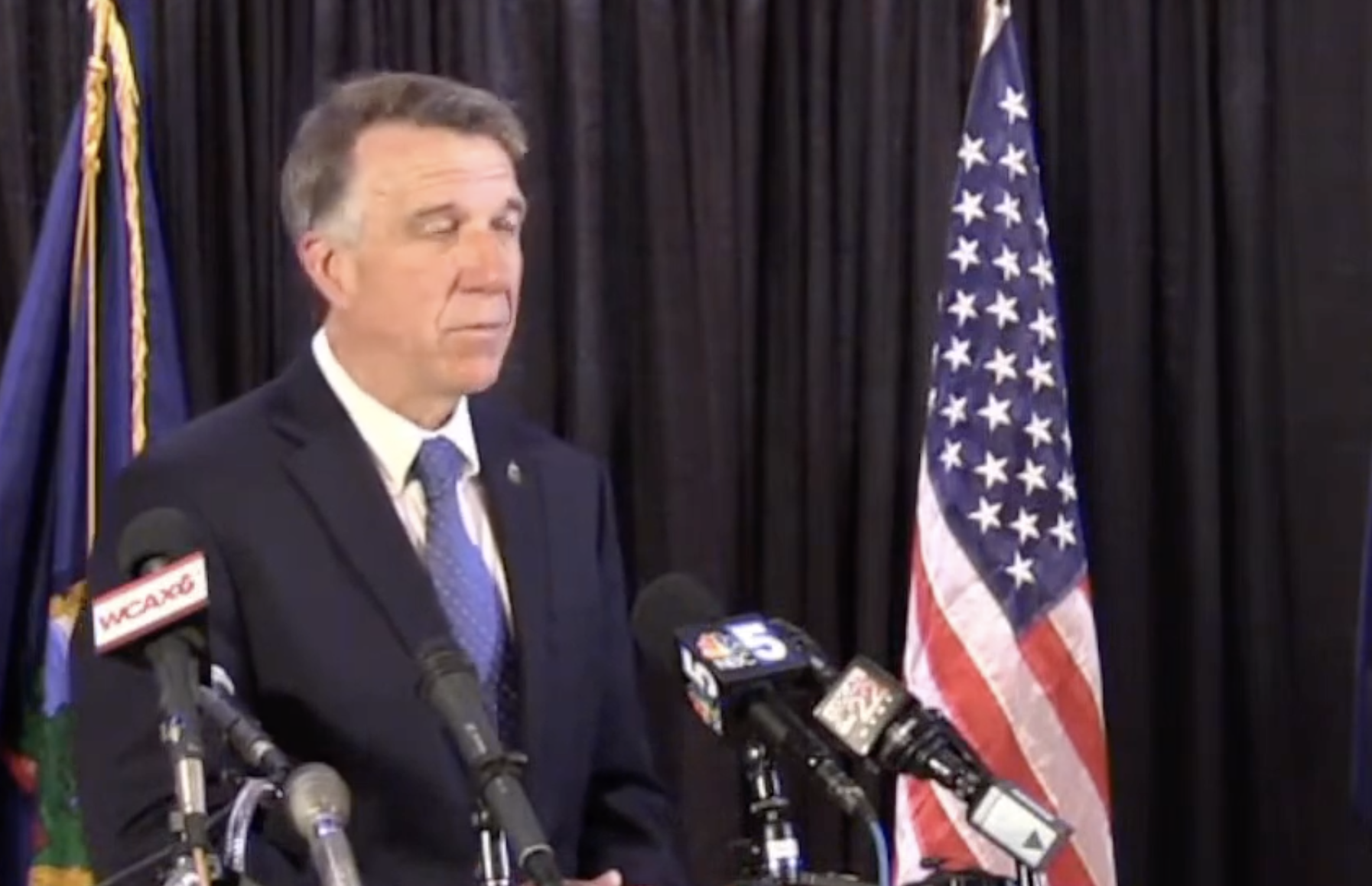
The face Phil Scott makes while listening to Guy Page

One of the minor intrigues around Gov. Phil Scott’s weekly press conferences is “What will Guy Page come up with next?” Page, the sole proprietor of the Vermont Daily Corpuscle (I think I got that right), usually comes out of right field with something straight out of the conservamedia talking point factory. Scott then answers it with his customary studied earnestness.

We got a priceless example yesterday. After asking a bloody-shirt question about an alleged crime wave of drug cartels robbing legal cannabis dispensaries, Page pivoted to the existential:

Governor, you’re the chief executive of an enterprise that includes the Vermont Commission on Women and other groups designed to benefit women. How would you answer the question, “What is a woman?”

The question came straight from Republicans in the U.S. Senate playing “gotcha” with Supreme Court nominee Ketanji Brown Jackson.

Scott smirked, and then proceeded to fumble his answer. I’d run the full transcript here, but it’d be hazardous to your eyesight like staring directly into the sun. The “high points” of Scott’s meander were “I haven’t contemplated an answer to that,” “I just assume that [Commissioners] refer to them as, uh, as ‘her,’ ‘she,’ or ‘her,'” and “I haven’t heard any outcry from the Commission or a Commissioner or that, um, that, uh, entity.” Sheesh.

Oh, for the moral clarity of a straightforward “Gender is a complicated thing. You can’t boil it down to a single factor.”

Scott could have also turned the table on Page. Probably would have been effective, because it turns out that conservatives can’t answer the question either.

Continue reading

A Whole Lotta Scofflaws in High Places

Running update: Sen. Brian Campion, named below as having failed to file, did actually file. Four other lawmakers — Sen. Phil Baruth and Reps. Martin Lalonde, Emily Long and Seth Chase — say they zeroed out their accounts after the 2020 election and have neither raised nor spent more than $500 since, so they don’t have to file.

Updated update. I haven’t heard from any more lawmakers (so far), but I’ve written a second post explaining this exemption in more detail.

Well, if Jim Condos won’t do it, and Sarah Mearhoff won’t do it, I guess I have to.

Allow me to explain.

Last Friday, VTDigger’s always informative Final Reading kicked off with an item about lawmakers failing to abide by the law. Specifically, dozens of them have yet to file campaign finance reports that were due on March 15. Secretary of State Condos sent an email to lawmakers asking that they comply but refused to identify the scofflaws, saying “I can’t be their babysitter,” which kind of implies that they need one. Reporter Mearhoff also demurred from naming names, but teasingly said “I know who you are.”

Gee, and here I thought it was a reporter’s job to tell us what they know. Maybe space reasons? After all, the list of noncompliers is 69 names long. That’s almost 40% of the 180 “public servants” in the Legislature. Forty percent.

Mearhoff also reminded us that when the Legislature wrote the law, it refused to include any penalties for failing to file. That’s pretty standard fare for laws touching on their own interests; lawmakers jealously guard their privileges when it comes to campaign finance and ethics and reapportionment and such. Which leaves us with the plastic épée of public shaming, which rarely manages to penetrate a lawmaker’s skin.

Before I get to naming names, I should say that any mistakes are my responsibility and I will gladly make corrections if any of those listed below can show that they did, in fact, file as required by law. Also, this list was made on the morning of April 5; any reports filed after that are not reflected below.

Continue reading

The VTGOP’s Problems in a Nutshell

Not that they handle it well, but leaders of the VTGOP are in a tough spot. On one hand they’ve got backers of plausible moderate Gov. Phil Scott, the only Republican who’s shown he can win a statewide election; on the other, the die-hard Trumpists and QAnon believers who, sadly, make up much of the party’s base. The latter’s irrepressible dogmatism makes it very tough for old-fashioned Republican types to stay involved.

Because they have to put up with stuff like a recent email exchange among Lamoille County Republicans, shared with me by a very annoyed Lamoille County Republican. It begins with an email sent to a Republican group list from one Shannara Johnson, a dyed-in-the-wool Q type and, ahem, Republican candidate for the House in 2020.

Johnson shared a link to an essay alleging that the United States was operating multiple bioweapons labs in Ukraine, a claim that’s been thoroughly debunked.

Other Republicans on the thread reacted strongly to the post. One called it “Russian propaganda.” Another termed it “a typical and obvious conspiracy theory.” Five people asked for their names to be removed from the email list because of Johnson’s post.

And that’s the dilemma faced by traditional Republicans. In order to stay in the party, they have to put up with the Shannara Johnsons of the world. All the time. I have seen similar conspiracy theories expressed at Vermont Republican state committee meetings, for Pete’s sake.

Continue reading

#MeToo Made Barely a Dent in the Statehouse

I hate to say it, but as far as the Vermont Statehouse is concerned, #MeToo kind of was a fad. At the time, there was talk of serious changes; but in the end, the dynamic is essentially unchanged. From the viewpoint of those enduring harassment, the process is entirely in the hands of lawmakers, there is far more opacity than transparency, and as a result, the process is gathering dust and cobwebs ’cause ain’t nobody using it.

That means one of two things: Sexual harassment is a thing of the past, or the process inspires so little faith that nobody dares to use it. From informal conversations, I can tell you it’s the latter.

This issue hit the front burner thanks to a November 2017 article written by the great Alicia Freese, published about six weeks after the Harvey Weinstein case went nuclear. Freese got female Statehouse staffers and lobbyists to talk about their bad experiences — without names attached due to fear of reprisals. The conclusion: Sexual harassment was simply part of the atmosphere, something they had to be prepared for every day. The incidents ranged from inappropriate comments to propositions to actual assaults.

Afterward, legislative leaders asked the Office of Legislative Counsel (then spelled “Council”) to review Statehouse sexual harassment policy. A month later, Leg Counsel “flagged a dozen significant concerns,” according to a follow-up story by Freese. Chief among the concerns: The panels were made up entirely of lawmakers who might be seen as unfair judges of their own colleagues; complainants were told to confront their (alleged) abuser before filing a formal complaint, which is all kinds of awful; the accused lawmaker had more say in how the case was adjudicated than the complainant; and there was absolutely no transparency to the process.

In the wake of the Leg Counsel memo, then-House speaker Mitzi Johnson promised to institute a “gold standard” policy that would serve as a national example of how to prevent sexual harassment.

Indeed, the Legislature did adopt a reformed process — but the result was a real mixed bag. The bullshit about confronting your abuser was deep-sixed and complainants were given somewhat more say in the process, but the panels are still made up entirely of lawmakers and the process is almost entirely shielded from public view.

I wouldn’t call it a gold standard. Pewter, maybe. The proof: The new policy has gone almost entirely unused, while the work environment remains unfriendly to female staff and lobbyists.

Continue reading

The Study Committee That Never Was

In the past, I have referred to legislative study committees as “the last refuge of legislative delay,” the fallback option when a bill that would actually do something gives lawmakers a raging case of the fantods. The Legislature has an insatiable appetite for creating study committees or task forces or, when they want to look as serious as possible, Blue Ribbon Commissions.

The appointed group then goes out and dutifully performs its task, and reports back to the Legislature — where the findings rarely, if ever, change anybody’s mind. More often than not, the report gets a warm reception followed by a quick trip to a dusty shelf.

There are exceptions; the panel on public sector pension reform did much to move a difficult process forward. But those cases are rare. Usually, formation of a study committee is just another way to kick the can down the road.

But I’ve come across a truly egregious example of a toothless study committee. I found one that seemingly never met, heard testimony, or gathered information, and never filed a report.

I’m talking about the Study Committee on Lobbying Activities of Organizations Receiving State Funds, organized by the state Senate in 2013 after some solons raised concerns with such organizations effectively using taxpayer funds on Statehouse lobbying.

I wrote about this in yesterday’s post exploring two continents on Lobby World. But there’s more to say about what happens when a study committee fails to achieve its purpose.

Which is, apparently, nothing at all.

Continue reading

A Couple More Continents on the Wide World of Lobbying

When I set out to describe the contours of the Lobby World under the Golden Dome, I knew I’d forget some pieces. Well, here are a couple of biggies — underwritten by you and me, the taxpayers of Vermont: State officials, and agencies that receive state funding, are frequently in the Statehouse lobbying on behalf of their entity.

First and foremost, officials of the Executive Branch. Cabinet secretaries and departmental commissioners spend a lot of time in the Statehouse when the Legislature is in session. This is legitimate when they’re testifying before a committee, but most of their Statehouse activity consists of roaming the halls and the cafeteria, shaking hands and maybe twisting the odd arm. When hospitality professional Al Gobeille was Human Services Secretary, he seemed to be in the Statehouse every day.

And that’s nothing more than taxpayer-subsidized lobbying.

Administration lobbying is, in fact, the most pernicious and effective lobbying of all. Because the Legislature has few resources — if any — for independent information, they are largely dependent on the Executive Branch (and lobbyists) for input. Administration officials cultivate good relationships with lawmakers because it’s beneficial for them and their governor.

This is all a big feedback loop with the infamous “revolving door” between* elective office, officialdom and lobbying proper. Many of the key players have been on one side or the other, sometimes all three, and the relationships carry forward. (And, of course, they habituate the same watering holes and eateries in the evenings.) A long friendship won’t win you the day, but you’re assured of getting a friendly ear if nothing else.

*I know, I know, you can’t say “between” three things. But “among” doesn’t sound right either. What this is is a three-way revolving door, which would best be illustrated by M.C. Escher.

It’d be interesting but impossible — but interesting — to tally up all the hours that top administration officials spend in the Statehouse, assign a very generous executive-level hourly rate to the activity, and find out exactly how much lobbying we are directly paying for.

After the jump… lobbying by agencies that receive state funds… and a Senate study of the issue that maybe possibly never happened.

Continue reading