Guy’s Gotcha Games

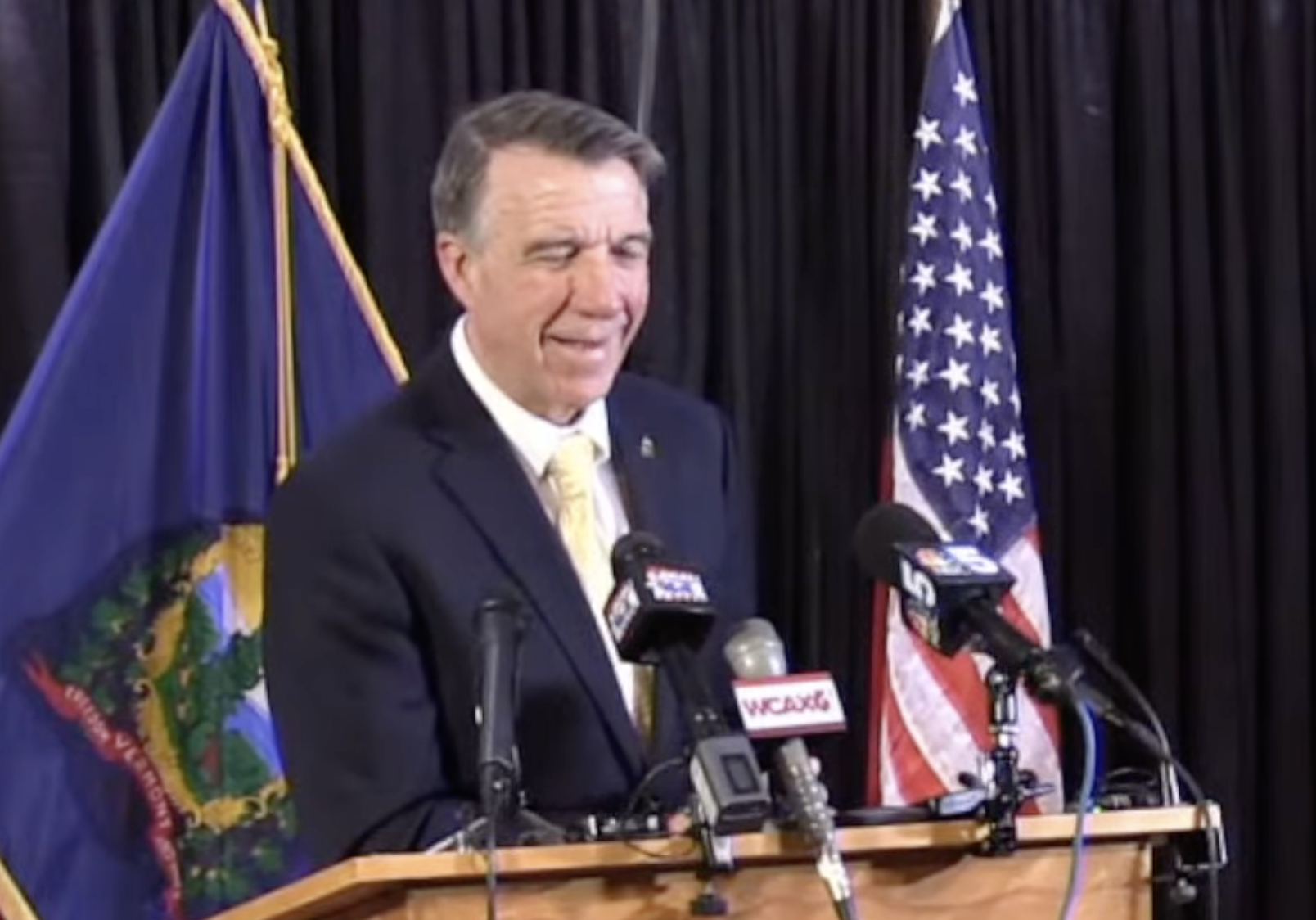
The face Phil Scott makes while listening to Guy Page

One of the minor intrigues around Gov. Phil Scott’s weekly press conferences is “What will Guy Page come up with next?” Page, the sole proprietor of the Vermont Daily Corpuscle (I think I got that right), usually comes out of right field with something straight out of the conservamedia talking point factory. Scott then answers it with his customary studied earnestness.

We got a priceless example yesterday. After asking a bloody-shirt question about an alleged crime wave of drug cartels robbing legal cannabis dispensaries, Page pivoted to the existential:

Governor, you’re the chief executive of an enterprise that includes the Vermont Commission on Women and other groups designed to benefit women. How would you answer the question, “What is a woman?”

The question came straight from Republicans in the U.S. Senate playing “gotcha” with Supreme Court nominee Ketanji Brown Jackson.

Scott smirked, and then proceeded to fumble his answer. I’d run the full transcript here, but it’d be hazardous to your eyesight like staring directly into the sun. The “high points” of Scott’s meander were “I haven’t contemplated an answer to that,” “I just assume that [Commissioners] refer to them as, uh, as ‘her,’ ‘she,’ or ‘her,'” and “I haven’t heard any outcry from the Commission or a Commissioner or that, um, that, uh, entity.” Sheesh.

Oh, for the moral clarity of a straightforward “Gender is a complicated thing. You can’t boil it down to a single factor.”

Scott could have also turned the table on Page. Probably would have been effective, because it turns out that conservatives can’t answer the question either.

Continue reading

A Whole Lotta Scofflaws in High Places

Running update: Sen. Brian Campion, named below as having failed to file, did actually file. Four other lawmakers — Sen. Phil Baruth and Reps. Martin Lalonde, Emily Long and Seth Chase — say they zeroed out their accounts after the 2020 election and have neither raised nor spent more than $500 since, so they don’t have to file.

Updated update. I haven’t heard from any more lawmakers (so far), but I’ve written a second post explaining this exemption in more detail.

Well, if Jim Condos won’t do it, and Sarah Mearhoff won’t do it, I guess I have to.

Allow me to explain.

Last Friday, VTDigger’s always informative Final Reading kicked off with an item about lawmakers failing to abide by the law. Specifically, dozens of them have yet to file campaign finance reports that were due on March 15. Secretary of State Condos sent an email to lawmakers asking that they comply but refused to identify the scofflaws, saying “I can’t be their babysitter,” which kind of implies that they need one. Reporter Mearhoff also demurred from naming names, but teasingly said “I know who you are.”

Gee, and here I thought it was a reporter’s job to tell us what they know. Maybe space reasons? After all, the list of noncompliers is 69 names long. That’s almost 40% of the 180 “public servants” in the Legislature. Forty percent.

Mearhoff also reminded us that when the Legislature wrote the law, it refused to include any penalties for failing to file. That’s pretty standard fare for laws touching on their own interests; lawmakers jealously guard their privileges when it comes to campaign finance and ethics and reapportionment and such. Which leaves us with the plastic épée of public shaming, which rarely manages to penetrate a lawmaker’s skin.

Before I get to naming names, I should say that any mistakes are my responsibility and I will gladly make corrections if any of those listed below can show that they did, in fact, file as required by law. Also, this list was made on the morning of April 5; any reports filed after that are not reflected below.

Continue reading

The VTGOP’s Problems in a Nutshell

Not that they handle it well, but leaders of the VTGOP are in a tough spot. On one hand they’ve got backers of plausible moderate Gov. Phil Scott, the only Republican who’s shown he can win a statewide election; on the other, the die-hard Trumpists and QAnon believers who, sadly, make up much of the party’s base. The latter’s irrepressible dogmatism makes it very tough for old-fashioned Republican types to stay involved.

Because they have to put up with stuff like a recent email exchange among Lamoille County Republicans, shared with me by a very annoyed Lamoille County Republican. It begins with an email sent to a Republican group list from one Shannara Johnson, a dyed-in-the-wool Q type and, ahem, Republican candidate for the House in 2020.

Johnson shared a link to an essay alleging that the United States was operating multiple bioweapons labs in Ukraine, a claim that’s been thoroughly debunked.

Other Republicans on the thread reacted strongly to the post. One called it “Russian propaganda.” Another termed it “a typical and obvious conspiracy theory.” Five people asked for their names to be removed from the email list because of Johnson’s post.

And that’s the dilemma faced by traditional Republicans. In order to stay in the party, they have to put up with the Shannara Johnsons of the world. All the time. I have seen similar conspiracy theories expressed at Vermont Republican state committee meetings, for Pete’s sake.

Continue reading

#MeToo Made Barely a Dent in the Statehouse

I hate to say it, but as far as the Vermont Statehouse is concerned, #MeToo kind of was a fad. At the time, there was talk of serious changes; but in the end, the dynamic is essentially unchanged. From the viewpoint of those enduring harassment, the process is entirely in the hands of lawmakers, there is far more opacity than transparency, and as a result, the process is gathering dust and cobwebs ’cause ain’t nobody using it.

That means one of two things: Sexual harassment is a thing of the past, or the process inspires so little faith that nobody dares to use it. From informal conversations, I can tell you it’s the latter.

This issue hit the front burner thanks to a November 2017 article written by the great Alicia Freese, published about six weeks after the Harvey Weinstein case went nuclear. Freese got female Statehouse staffers and lobbyists to talk about their bad experiences — without names attached due to fear of reprisals. The conclusion: Sexual harassment was simply part of the atmosphere, something they had to be prepared for every day. The incidents ranged from inappropriate comments to propositions to actual assaults.

Afterward, legislative leaders asked the Office of Legislative Counsel (then spelled “Council”) to review Statehouse sexual harassment policy. A month later, Leg Counsel “flagged a dozen significant concerns,” according to a follow-up story by Freese. Chief among the concerns: The panels were made up entirely of lawmakers who might be seen as unfair judges of their own colleagues; complainants were told to confront their (alleged) abuser before filing a formal complaint, which is all kinds of awful; the accused lawmaker had more say in how the case was adjudicated than the complainant; and there was absolutely no transparency to the process.

In the wake of the Leg Counsel memo, then-House speaker Mitzi Johnson promised to institute a “gold standard” policy that would serve as a national example of how to prevent sexual harassment.

Indeed, the Legislature did adopt a reformed process — but the result was a real mixed bag. The bullshit about confronting your abuser was deep-sixed and complainants were given somewhat more say in the process, but the panels are still made up entirely of lawmakers and the process is almost entirely shielded from public view.

I wouldn’t call it a gold standard. Pewter, maybe. The proof: The new policy has gone almost entirely unused, while the work environment remains unfriendly to female staff and lobbyists.

Continue reading

The Study Committee That Never Was

In the past, I have referred to legislative study committees as “the last refuge of legislative delay,” the fallback option when a bill that would actually do something gives lawmakers a raging case of the fantods. The Legislature has an insatiable appetite for creating study committees or task forces or, when they want to look as serious as possible, Blue Ribbon Commissions.

The appointed group then goes out and dutifully performs its task, and reports back to the Legislature — where the findings rarely, if ever, change anybody’s mind. More often than not, the report gets a warm reception followed by a quick trip to a dusty shelf.

There are exceptions; the panel on public sector pension reform did much to move a difficult process forward. But those cases are rare. Usually, formation of a study committee is just another way to kick the can down the road.

But I’ve come across a truly egregious example of a toothless study committee. I found one that seemingly never met, heard testimony, or gathered information, and never filed a report.

I’m talking about the Study Committee on Lobbying Activities of Organizations Receiving State Funds, organized by the state Senate in 2013 after some solons raised concerns with such organizations effectively using taxpayer funds on Statehouse lobbying.

I wrote about this in yesterday’s post exploring two continents on Lobby World. But there’s more to say about what happens when a study committee fails to achieve its purpose.

Which is, apparently, nothing at all.

Continue reading

A Couple More Continents on the Wide World of Lobbying

When I set out to describe the contours of the Lobby World under the Golden Dome, I knew I’d forget some pieces. Well, here are a couple of biggies — underwritten by you and me, the taxpayers of Vermont: State officials, and agencies that receive state funding, are frequently in the Statehouse lobbying on behalf of their entity.

First and foremost, officials of the Executive Branch. Cabinet secretaries and departmental commissioners spend a lot of time in the Statehouse when the Legislature is in session. This is legitimate when they’re testifying before a committee, but most of their Statehouse activity consists of roaming the halls and the cafeteria, shaking hands and maybe twisting the odd arm. When hospitality professional Al Gobeille was Human Services Secretary, he seemed to be in the Statehouse every day.

And that’s nothing more than taxpayer-subsidized lobbying.

Administration lobbying is, in fact, the most pernicious and effective lobbying of all. Because the Legislature has few resources — if any — for independent information, they are largely dependent on the Executive Branch (and lobbyists) for input. Administration officials cultivate good relationships with lawmakers because it’s beneficial for them and their governor.

This is all a big feedback loop with the infamous “revolving door” between* elective office, officialdom and lobbying proper. Many of the key players have been on one side or the other, sometimes all three, and the relationships carry forward. (And, of course, they habituate the same watering holes and eateries in the evenings.) A long friendship won’t win you the day, but you’re assured of getting a friendly ear if nothing else.

*I know, I know, you can’t say “between” three things. But “among” doesn’t sound right either. What this is is a three-way revolving door, which would best be illustrated by M.C. Escher.

It’d be interesting but impossible — but interesting — to tally up all the hours that top administration officials spend in the Statehouse, assign a very generous executive-level hourly rate to the activity, and find out exactly how much lobbying we are directly paying for.

After the jump… lobbying by agencies that receive state funds… and a Senate study of the issue that maybe possibly never happened.

Continue reading

The Wide, Wide, Almost Infinitely Wide World of Lobbying

Once in a while, some media outlet will publish a formulaic piece about Statehouse lobbying. It happens when lobbyists and clients are required to report their spending with the Secretary of State’s office. A reporter will pore over the filings, point out the highest-grossing lobbying firms and some big-dollar clients, and get both-sides quotes from (a) those concerned with lobbyist influence and (b) those (mostly lobbyists) who think it’s not a big deal. And that’s it.

Last week, I started looking at the finance reports from the latest deadline, March 15, with an eye toward writing such a roundup. But the more I read, the more I realized that I didn’t know. After spending several days on the subject, I’ve concluded that the actual world of lobbying in Montpelier is just about unknowable. Those finance reports represent one sector of lobbying activity, and probably a small one at that.

Let’s start with a quick quiz. How many individuals are registered as lobbyists with the Vermont Secretary of State?

50?

100?

200?

How about… 604.

Six hundred and four.

Now, if all those people were roaming the Statehouse on the same day, it’d be like that episode of Star Trek with the overpopulated planet that needed Captain Kirk’s germs (transmissible only by a kiss with a beautiful blond) to thin the crowds. Most lobbyists aren’t there every day. Some of them are rarely, or never, there. But that’s the size of the universe we’re talking about.

Continue reading

PARKING PANIC!!! And the Reactionary Nature of Local TV News

Local TV news does more than its share of ridiculous things, but this one from WPTZ really got my goat. It’s about the modest changes to North Winooski Avenue approved by Burlington City Council Monday night. And it’s called…

Businesses in Burlington’s Old North End unsure of their future as North Winooski Parking Plan is set to happen

AAAAUUGGGHHH Parking Panic!!!!!!!!

The story, such as it was, quoted two — count ’em, two — Old North End business owners worried about the plan’s reduction of 40 parking spaces along the corridor.

This sort of thing is the red meat of local TV news: Raising fears about the unknown.

Continue reading

When “Opportunistic Investors” Grab a Chunk of Your Town

Is it just me, or is something slightly… off… about the sale of South Burlington’s University Mall to a global investment firm?

On the surface it seems like good news. Taconic Capital Advisors and Eastern Real Estate will buy the Mall for a tidy $60 million, which happens to be $26.2 million north of its assessed value.

Let’s stop there. A big investment fund buying a declining property in a dying industry for nearly double its assessed value?

Things that make you go hmmmm…

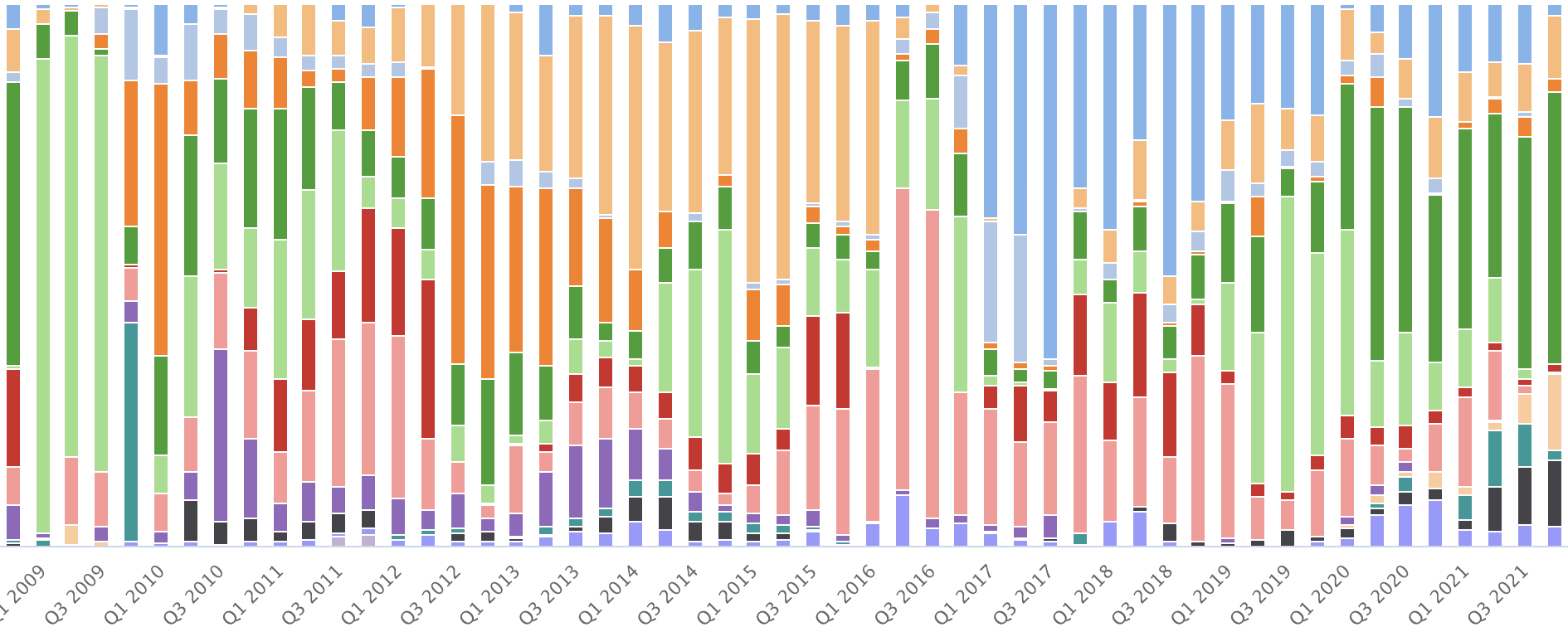
Taconic describes its traders as “opportunistic investors” looking for market inefficiencies. That’s usually Wall Street-speak for “we buy low on assets and squeeze every last dollar out of them.” See: Every time an investment firm buys newspapers.

The above chart, courtesy of the investor-information website “WhaleWisdom,” shows a damn high churn rate for Taconic. The different colors represent different market sectors. As you can see, Taconic specializes on diving into market sectors where they see potential profit and getting out just as quickly.

Given that history, it’s a little hard to credit Taconic’s stated intention to “reenergize” the mall and “build on its success.” First of all, long-term stewardship of an asset doesn’t seem to be Taconic’s game. And second, success?

“That does not compute,” said Mr. Spock when asked for comment.

Continue reading

Performative Lawmaking After All

Hey, remember when Senate President Pro Tem (and Congressional candidate) Becca Balint ended legislative efforts to pass a mask mandate? Because Gov. Phil Scott was certain to veto such a bill, she said pursuing the idea would be nothing but a “performative act.” As if it was a bad thing.

Well, late last week the curtain came down on not one, but two “performative acts” that were allowed to go on into the third month of the session before slinking off the stage. Both measures were co-sponsored by Balint and fellow Congressional candidate Sen. Kesha Ram Hinsdale, among others. But most of the opprobrium falls to Balint for two reasons: She’s the boss, and she’s the one who decried performative lawmaking.

The two doomed bills would have established ranked choice voting in Vermont elections and put limits on qualified immunity for law enforcement personnel.

The RCV bill was introduced with great fanfare — and then got dumped into the circular file. Only a single committee hearing was held, and that didn’t happen until last Friday, the deadline day for bills to clear their committees. Not only were Balint and Ram Hinsdale among the eight co-sponsors, but they both appeared in a VPIRG video ad endorsing RCV with some urgency.

I have to say, if the leader of a legislative body feels that strongly about a bill, it would maybe have gotten more consideration. Unless her stance was more performance than substance, that is.

Continue reading