The Luckiest Man in Vermont

Gov. Phil Scott issued his budget address today (YouTube video here). It was an astoundingly pain-free occasion, considering that we’re in the throes of a pandemic that’s been holding our economy hostage for almost a year now. In fact, rather than proposing painful cuts, Scott offered a generous scattering of funds for a wide variety of programs that, he said, will put Vermont on a sounder footing going forward.

How? Simple. The tsunami of federal Covid relief money. Scott’s budget includes $210 million in one-time money from the feds. As we heard from state economists Tom Kavet and Jeffrey Carr last week, federal money has prevented an economic collapse and even contributed to a boom in some sectors.

Throughout his political career, Phil Scott has benefited from little-known and/or underfunded Democratic opposition in races for state senate, lieutenant governor and governor. In his six races for statewide office, the closest result was the 2010 contest for lieutenant governor — seven percentage points over Steve Howard. He gets credit for being an appealing political figure, but he sure hasn’t had to fight very hard.

And now, once again, he’s the luckiest man in Vermont. You’d think a shattering pandemic would lead to massive cutbacks, but no. Scott could once again boast of a budget that wouldn’t increase taxes or “existing fees.” And according to Kavet and Carr, the state economy will continue to be buoyed by federal infusions for the next two fiscal years. Which will make it a lot easier to craft a pain-free state budget again next year and, if he runs for a fourth term, he may well be unbeatable once again.

Continue reading

Racism wins again

Look out, kid, no matter what you did

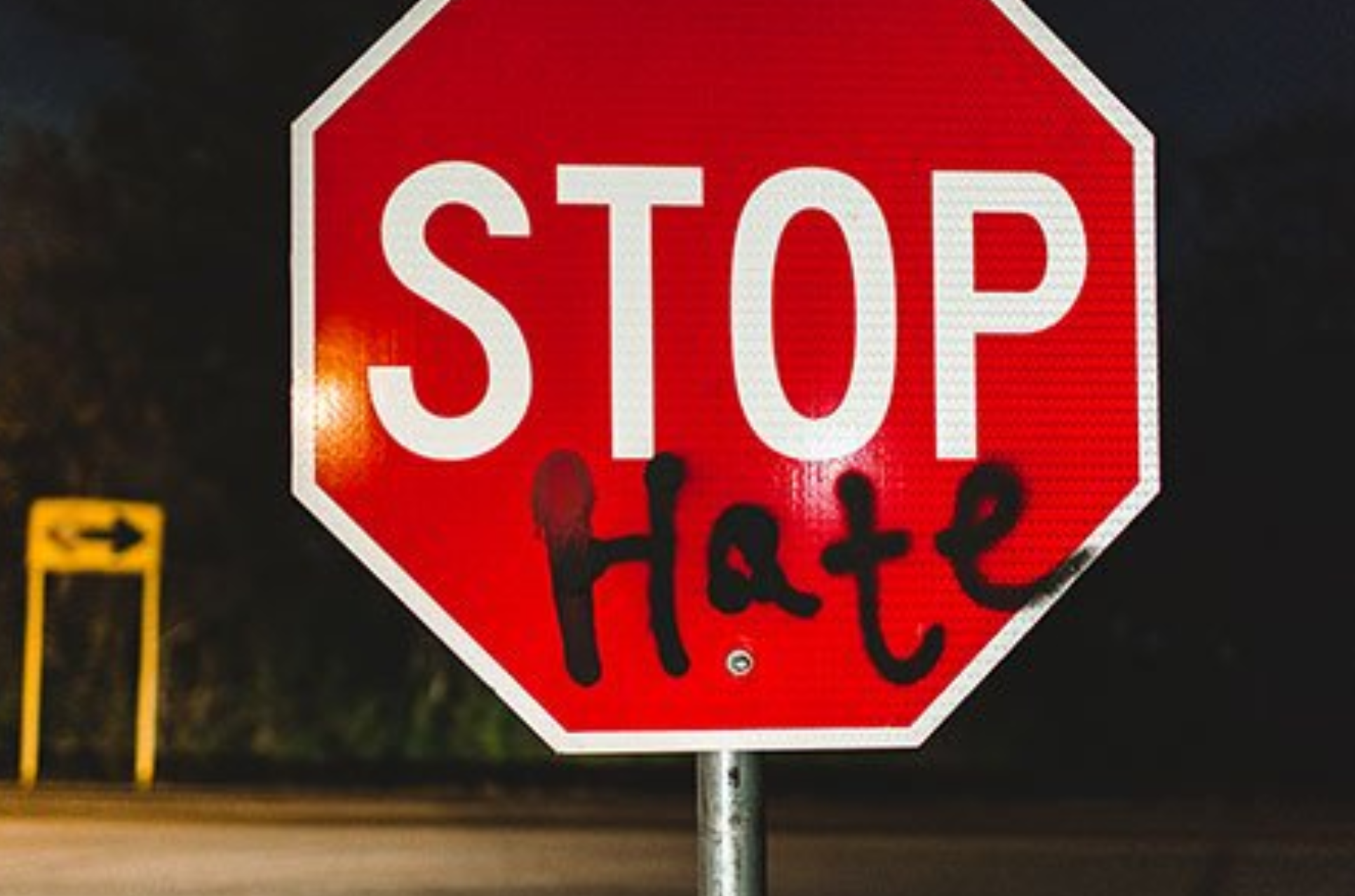
Great. Another person of color has been harassed out of public office. It’s like Vermont is living in a racist Groundhog Day.

This time it’s Alicia Barrow, resigning from the Hartford Selectboard. Funny, I thought the Upper Valley was pretty progressive. Guess not.

“Blatant bigotry,” she wrote in her resignation letter, caused her to “no longer feel safe nor welcome in a place I have called home for 15 years.” She has received, wrote the Valley News, “racial slurs and death threats over the phone, in person and by email during her time on the board.”

And what did local authorities do about it? Jack shit, apparently. Barrow reported one specific threat to the police, who did nothing. In fact, she fears “retaliation” by the Hartford PD because of her advocacy for defunding the police.

Tell me again how Vermont is all open and welcoming and tolerant.

Tell me why law enforcement, up to and including Attorney General T.J. Donovan, can’t help Vermonters of color live their lives in peace and security, and maybe even hold elective office without fearing for their safety.

Because Vermont will not be open or welcoming until we figure this out.

Herp Day!

One of the small delights of covering the Legislature is the occasional discovery of someone with an unusual profession, who’s really good at their job and really enthusiastic about it.

This time, Jim Andrews. He’s a herpetologist, and since 1994 he’s coordinated the Vermont Reptile and Amphibian Atlas. I cannot tell you how delighted I am to discover that there is such a thing, and that the same guy has been in charge of it for 26 years.

Andrews was one of several experts who testified last Friday before the House Committee on Natural Resources, Fish and Wildlife. (Written testimony here, video of the hearing here.) The general subject was the impact of climate change on Vermont’s fauna, which is appallingly considerable. If current trends continue, our wildlife is going to dramatically change.

I’ll get to that, but first I must go on a bit about the herps. The VRAA is essentially a volunteer enterprise, counting on Vermonters to photograph and report sightings of frogs, turtles, snakes, salamanders and suchlike. And they do, in considerable quantity. The atlas’ website has a roster of people who have turned in 100 reports or more.

There are more than 150 people on the list. That’s a lotta herps.

There are, in fact, several operations just like the herp atlas. Collectively they produce the Vermont Atlas of Life, which seeks to identify every living thing in Vermont as well as their range and habitats. The VAL has chronicled over 10,000 species, thanks almost entirely to volunteer observers. It’s ventures like the VAL that allow us to actually measure the impact of climate change on the animal world.

After the jump: the bad news.

Continue reading

VTGOP Chair Fires a Shot Across the Bow of Moderate Republicans

I don’t think Deb Billado is planning to resign anytime soon.

The Vermont Republican Party chair made that clear when she devoted her most recent weekly newsletter to a very fringey speech made by the very fringey South Dakota Gov. Kristi Noem. It was a shot across the bow of Republican lawmakers who recently called for her resignation — and a slap in the face to Gov. Phil Scott.

You see, Scott and Noem are polar opposites on Covid-19 policy. Scott has proceeded with great caution, erring (mainly) on the side of public safety. Noem has kept her state wide open — including the granddaddy of all superspreaders, the Sturgis motorcycle rally.

The result: Vermont has a death rate of 27 per 100,000 residents, the second lowest among the states. South Dakota has lost 189 out of every 100,000, the seventh worst death rate in the nation. In total Covid-19 cases, Vermont is the best in the nation at 1,654 per 100K, while South Dakota is second-worst at 11,958 per 100K. How about testing? Vermont has conducted 133,174 tests per 100K — more than one test per resident. South Dakota? Way near the bottom, at 44,827 tests per 100K.

So, Vermont is doing far better at tracking the virus, keeping people healthy, and keeping them alive. I can’t say that Billado endorses South Dakota’s Covid “strategy,” but she went out of her way to highlight Noem’s views in a message to all Vermont Republicans. Now, maybe Billado didn’t intend it as direct criticism of Vermont’s govenror, but I bet you dollars to donuts that Team Scott sees it that way.

Beyond that, there’s the issue of Billado calling a collection of QAnon-adjacent nutbaggery a “thoughtful speech.” We’ll run it down after the jump.

Continue reading

Tears of a Clown

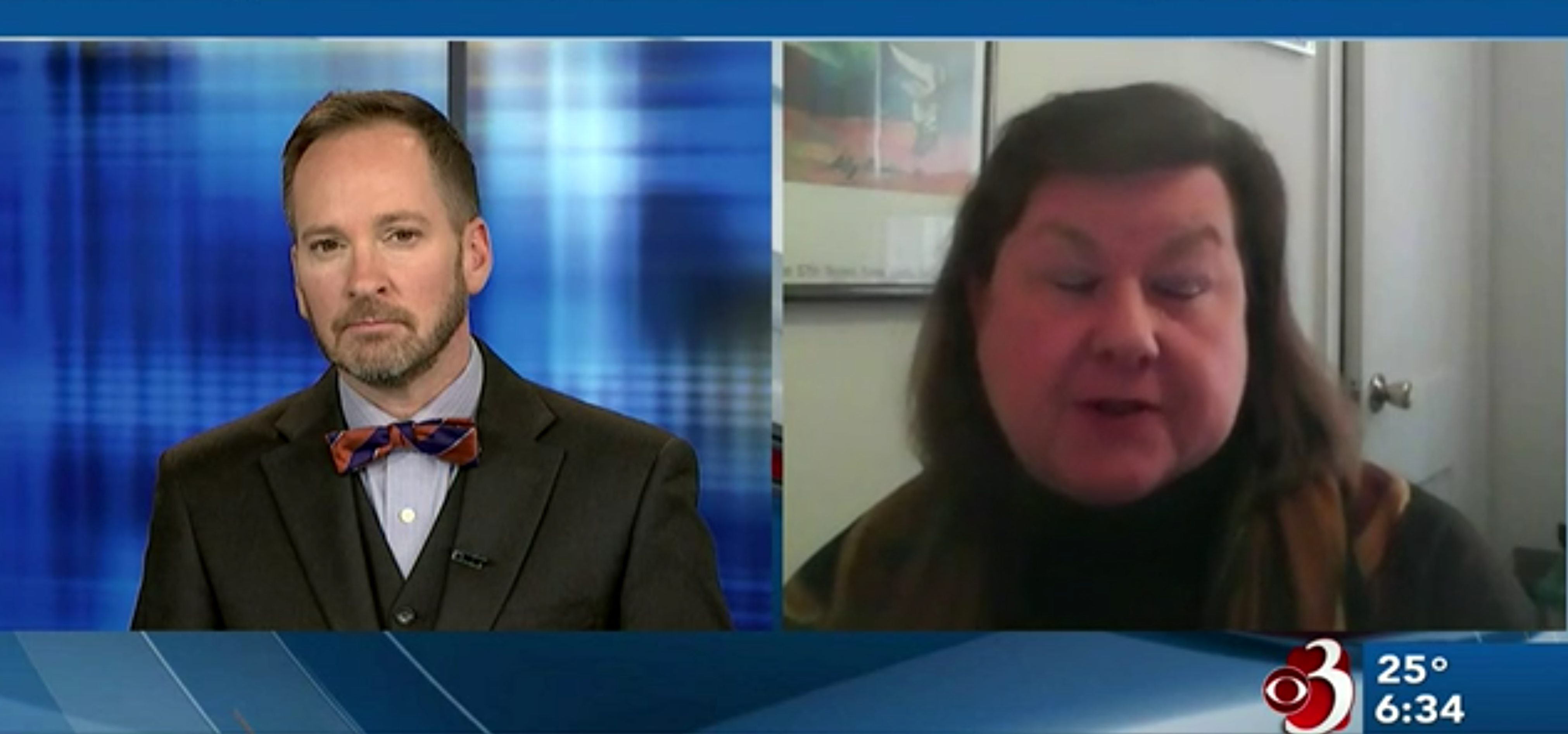
After four years of radio silence, never once speaking to her home-state press, Darcie Johnston emerged from the dank underbelly of the Trump Administration to give a three-minute interview with WCAX’s Darren Perron. During which a tear or three ran down her copious cheek.

(Trigger Warning: This post is going to be kind of mean. All I can say is, she deserves every bit of it.)

Johnston has just concluded an undistinguished four years as a Trump administration political appointee. She was fairly high up in the Department of Health and Human services. And she was deeply involved in the administration’s disastrous handling of the Covid-19 pandemic.

Perron caught her at a vulnerable time, a few hours after she witnessed Trump’s farewell at Andrews Air Force Base. Yep, she was one of the lucky few hundred at the thinly-attended soiree.

Since her chat with Perron was such a rare event, here’s an annotated transcript of her remarks about her tenure in Washington.

Continue reading

And the Hits Just Keep On Comin’

No sooner did I drop a post featuring five different stories about Vermont’s uneasy relationship with racial issues, than two more appeared in our media.

  • From the Bennington Banner, yet another unfortunate comment from a frequent offender on this subject. (No, not Kevin Hoyt.)
  • From VTDigger, Vermont’s racial equity director issues a damning new report.

The latter is the more impactful, but first let’s pick the low-hanging fruit.

UVM’s Designated Racism Detector, Prof. Stephanie Seguino, reported on racial disparities in Bennington traffic stops. Surprise, surprise, she found that Bennington cops were much more likely to pull you over if you’re black — a perpetual issue for the town’s police department.

The kicker was a quote from town manager Stuart Hurd, a steadfast denier that the P.D. has any racial issues whatsoever.

“Unfortunately the updated study may not have changed its analytics, continues to use census data that does not take into account people traveling in and out of Vermont on a regular basis, and continues to disregard the fact that many departments were incorrectly filling in the information requested on the ticket (no training had been provided by the state when the tickets changed).”

Sheesh.

Continue reading

Seems to be a Lily-White Thread Running Through Our News

Since then, it’s been almost completely worn away.

There’s been a cluster of news items this week that point in the same direction: Vermonters are really uncomfortable with racial issues. To wit:

  • Rutland Aldermen split on a resolution condemning the attempted insurrection at the U.S. Capitol
  • Barre Council puts divisive flag measure on Town Meeting ballot
  • Business owners of color feel unwelcome in the Chamber of Commerce
  • House Republicans introduce a bill that would prohibit public schools from flying the “Black Lives Matter” flag
  • The Vermont Senate’s first woman of color says Vermont has a retention problem with people of color rather than a recruitment problem.

First, we go to Rutland, a city with a habit of shooting itself in the foot. This week, Aldermen worked themselves into a tizzy — and ultimately held a tie vote — on a measure condemning the events of January 6 and blaming President Trump for triggering the riot. A couple of racist or racist-adjacent Aldermen led the charge against it.

Tom DePoy offered a substitute resolution to condemn the Capitol riot, but also the Black Lives Matter movement. Apparently he thought of this as a way to unify the community. It was voted down by the panel. Paul Clifford, who has a history of racist social media posts, voted against the original resolution. Sam Gerusso courageously walked away from his computer before the vote, saying “I shut off my camera and volume and went and used the restroom, got the mail, checked on my wife.”

He forgot washing his hair and walking the dog.

Continue reading

Fixing the State College System Will Be a Big Heavy Lift

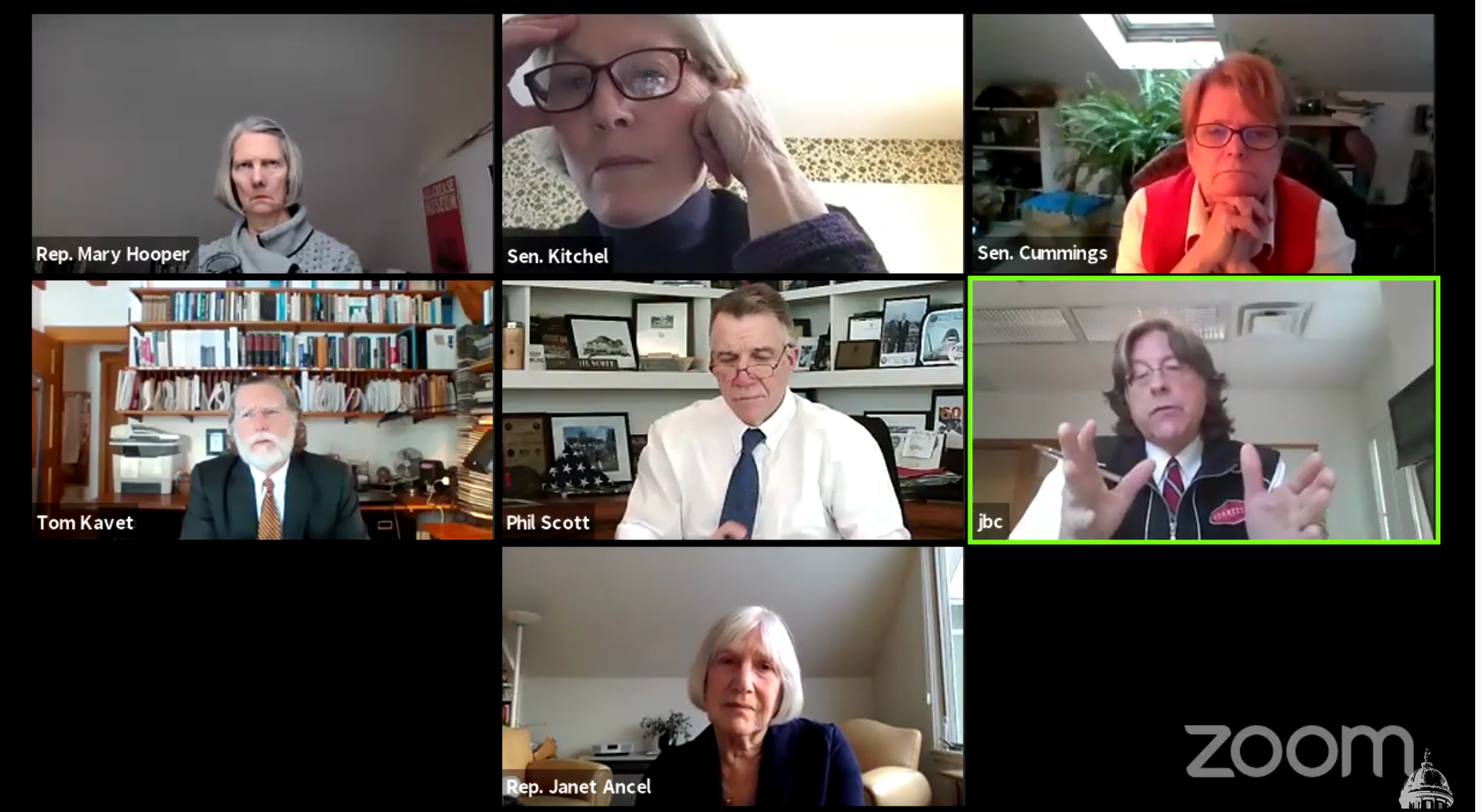
Room rater! Best: Campion, okay background but great lighting. Honorable mention: Helen Mango; the pot lights give a delightful UFO vibe. Worst: Tie between Thomas “Total Eclipse Of The” Chittenden and Andrew “Blank Slate” Perchlik. C’mon, buy a poster or something!

Last year, the Vermont Legislature put off many unpleasant decisions by creating study committees. Well, one of them has come back to roost, and it brings a passel of bad news.

I’m talking about the Select Committee on the Future of Higher Education in Vermont, because the longer the name, the better the work product. The SCFHEV was tasked with studying the money-starved Vermont State College System and charting a path to sustainability. It issued a preliminary report in early December. That document was presented to the Senate Education Committee Tuesday afternoon. (The preliminary report can be downloaded from Senate Ed’s website. The panel’s final report will come out in April, with some changes likely and a lot more detail assured.)

The high points, if that’s what they are: The system needs dramatic restructuring to cut costs; even so it needs a much larger ongoing commitment from state government; and it also has to cut tuition rates, which are staggeringly high compared to public institutions in other states.

Well, that’s quite a lot.

The path ahead is long and arduous. It will involve multiple committees in the House and Senate, discussion of politically unpopular cutbacks, a search for funding at a time when demands for state money are everywhere, and scrounging for legislative time in what’s likely to be the most demanding session in years. Like I said, a big heavy lift.

Besides that, hey, things are going great.

Continue reading

“The Tom and Jeff Show”

Best: Gov. Scott, great lighting, busy but effective background. Worst: Pretty much everybody else.Extra demerits for “Redshift” Cummings and “Tiny” Hooper.

Vermont’s Emergency Board, an obscure but highly influential entity, held its twice-yearly meeting Tuesday afternoon to receive an updated revenue forecast from state economists Tom Kavet and Jeffrey Carr. Or, as the governor dubbed it, “The Tom and Jeff Show.” (The E-Board includes Gov. Phil Scott and the chairs of the Legislature’s four “money commitees” — House and Senate Appropriations, House Ways & Means, and Senate Finance. All of whom are women, it should be noted.)

Their report is posted as a downloadable file on the Legislative Joint Fiscal Office website. It’s recommended reading; it’s full of economic information beyond the basic tax projections. Video of the E-Board meeting available here.

Considering the pandemic and all, the news is astonishingly good. The new outlook for FY2021 predicts a very slight dropoff in total revenue, about $20M in all. That’s peanuts compared to earlier dire predictions. For FY2022, which begins in July, the new forecast predicts $77M in additional revenue. Carr and Kavet also predict a big increase in revenues for FY2023.

(Now, if you’re concerned about the federal deficit, it’s not all good news. Since 2018, deficit spending has gone from 105 percent of GDP to 135 percent. Covid relief is one driver of the increase; the other is the Trump tax cuts of 2017.)

How can this be? One simple explanation: A tsunami of federal recovery funds. And with Democratic control of the presidency and Congress, Carr and Kavet expect at least one more big infusion. (President-elect Biden has proposed a $1.9 trillion relief package.) So far, federal relief funds to Vermont account for a stunning 20 percent of the state’s gross domestic product.

“Without the federal money, I’d be declaring a five-alarm fire on Vermont’s economy,” said Carr. “We’re all Keynesians now. If we throw enough money at a problem, we can mitigate the damage in the aggregate.”

Continue reading

The Statehouse Will Never Be the Same Again

Sad Boi.

Don’t know if it was the heavy security or the heavy snow that deterred the diehard Trumpers on Sunday, but the expected rally didn’t materialize. Now we have to worry about Inauguration Day, when the police will once again be out in force outside and inside the Statehouse.

That won’t be the end of it, of course. Whether the “Stop the Steal” crowd shows up on Wednesday or not, there’s still a lot of folks who think the election was rigged, and they’re angry about it. Most will be peaceful, but it only takes one. There will be an ongoing threat, which means heightened security around government buildings.

That means the Statehouse, as we knew and loved it, is a thing of the past. We’ve long been proud of the openness of The People’s House; the ability of anyone to just walk into the building or into a committee hearing or hobnob with legislators in the cafeteria, the governor and lieutenant governor holding open coffee hours for all comers. It’s just charming to be able to walk the halls and stumble across lawmakers and officeholders and public officials of every rank, and have casual conversations with them all.

It’s a certainty that there will be painful discussions about Statehouse security before lawmakers adjourn for the year. Out of an abundance of caution, new measures will be taken.

Ready for metal detectors at the entrances? A substantially augmented Capitol Police force, probably with body armor and guns? State troopers on hand during legislative work days? A tactical team on site? A lot more locked doors? Security checkpoints outside the House and Senate chambers? Limited or no access to all the hearing rooms unless you’re on the witness list? I mean, those committee meetings get really crowded and each room has only a single exit. Imagine being trapped in there with an armed wingnut.

Wait, I’m not finished. And I haven’t even gotten to the pandemic yet.

Continue reading