Category Archives: Vermont Democratic Party

Milne: I will not vilify Shumlin, but he’s a brazen, bullying, radical ultra-progressive

Warm day in downtown Barre. Small crowd, mainly retirement age (Yr. Obdt. Svt. included) gathering on the front lawn of the Aldrich Public Library. The occasion? Scott Milne’s long-awaited launch of his gubernatorial candidacy.

Phil Scott was there. Jim Douglas was there. My frenemy Senator Joe Benning was there.

Who wasn’t there? Well, as far as I could tell, Barre’s Republican Mayor Thom Lauzon wasn’t there. And he usually manages to make himself conspicuous wherever the cameras gather. Interesting. I seem to recall Paul “The Huntsman” Heintz reporting that Lauzon and his wife donated $2,000 to the Governor’s campaign.

Checking… yes, yes he did.

Still, the front section of the library, comfortably air-conned, was full of Milne supporters and the legions of media desperately looking for a sure-fire story during the summer slump.

Milne was introduced by Douglas, who gave Mr. Bunny a hearty endorsement after delivering what sounded very much like a statement for his own candidacy. (Must’ve made a few hearts flutter in the Republican audience and wish for What Might Have Been; Douglas is their Beau Ideal.)

Douglas lauded Milne’s experience in “the real world” of business and commerce, a person “outside the bubble, unaffected by the stale air of the State House.” That’s rich, coming from a guy who spent virtually his entire adult life in that very bubble.

And then the Man of the Hour stepped to the plate, promising “a campaign of ideas” and said that he would “not be vilifying the Governor.”

In the following few minutes, Milne used these words in direct or indirect reference to the incumbent: doubting that Shumlin’s course is “responsible and realistic,” calling the Governor’s agenda “ultra-progressive,” referring to Shumlin as “headstrong about the need for exuberance and rapid, radical change,” characterizing his Administration as one of “unbridled experimentation,” and decried the use of “bullying tactics” and “brazen displays of power.”

But he won’t be “vilifying” the brazen, bullying, headstrong, radical, ultra-progressive Governor. Bwahahaha.

By contrast, Milne depicted himself as moderate, “cautious,” “responsible,” and reluctant to make any wholesale changes. He said “cautious” a bunch of times.

The strategy, thus, becomes clear: in order to capture the center, Milne will go all-out to portray Shumlin as a fire-breathing radical. Without, of course, vilifying him in any way.

It’s hard to see this working. Shumlin has too many centrist positions, spends far too much time courting the center, and caters to the business community far too often to be convincingly marginalized as an “ultra-progressive.” (When he said that, I could almost hear the guffaws exploding from Prog Central: “Shumlin a progressive? You must be joking!”)
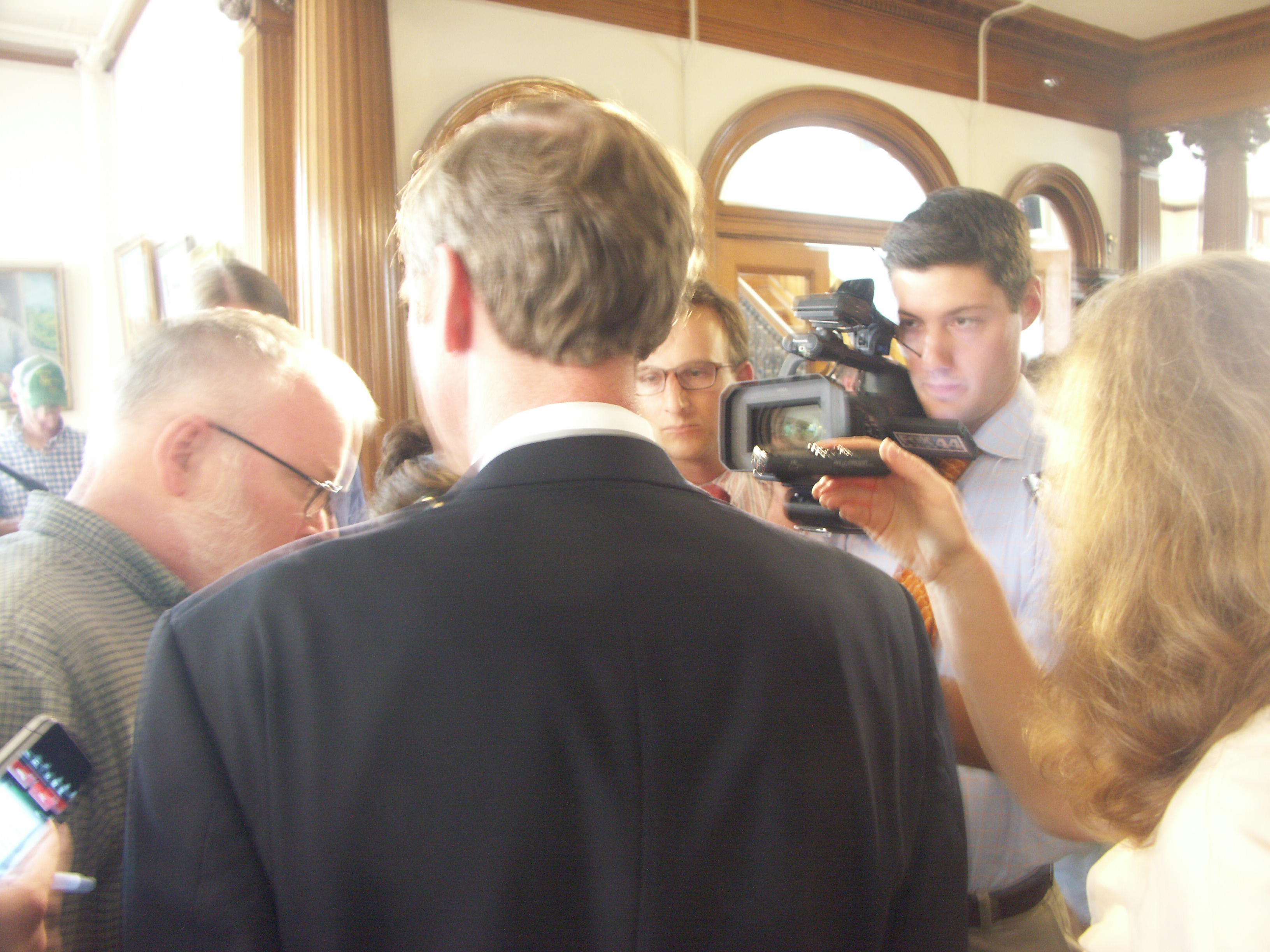
Scrum!

Scrum!

After his speech, his crew made their way to the Elks Club next door for a hamburger lunch. It took Milne a while to get there; he first had to submit himself to his inaugural media scrum. The key point for me was the inevitable exchange about Act 250, given his frustration and anger over the regulatory troubles facing his dream project, the mixed-use Quechee Highlands development. It’s run afoul of the regional Act 250 board and the town of Hartford.

Milne claimed that he is “very supportive of the concept of Act 250,” but then accused Shumlin of “hijacking something into a political ideology rather than a practical program that needs to be applied more pragmatically.”

Not exactly grammatical, but you get his drift. But when asked for specifics on how the Administration had hijacked the process, Milne came up short of the mark:

“I think if you look between the poor management at the Agency of Commerce over the last four years, very poor management at the Agency of Natural Resources, there’s very evidential answers right there.”

Not much meat on those bones, is there? He charges the Administration with “hijacking” the process — an aggressive power grab — and all he can offer as proof is a nonspecific charge of “poor management.”

Hey, a travel agent ought to know that it takes positive, organized action to hijack anything. You don’t do it by accident.

All in all, it was a happy event for the true believers. But if this is the tack Milne plans on taking, he’s gonna get shellacked by the Governor.

Is the ground buckling under Phil Scott’s feet?

Lately, there have been signs aplenty of passengers taking their leave of the Good Ship Moderate Republicanism, helmed since last November by Captain Phil Scott and first mate “Super Dave” Sunderland. Or maybe Scott’s the admiral and Sunderland is captain, whatever works.

Scott and friends came away from last November’s VTGOP meeting with a rather conditional mandate to broaden the party’s base. Make it more attractive to moderate and undecided voters, and the pragmatic business types who’ve made their peace with the Democrats under Governor Shumlin.

It seemed a promising direction. Indeed, the only possible direction, since the Vermont electorate wasn’t suddenly going to turn Texas red. The conservative VTGOP of “Angry Jack” Lindley et al. had hit a glass ceiling at about 35% of the vote.

But it was going to be a tough job for Scott, previously not known for his willingness to tackle tough jobs. He was, by dint of his elective office, the only person who could credibly take it on; but he also, by dint of his personality, seemed unsuited for the task. And even if he rose to the occasion, the odds seemed to be against him. Shumlin and company have done a really good job of co-opting the center, and it’d be a hell of a job for Scott to win back all those voters and supporters without moving so far to the center that he completely alienates the easily alienated conservative base.

It’s only been about nine months, and the Good Ship Moderate Republicanism looks to be taking on water. Recent signs include:

Bruce Lisman’ decision to forego any sort of alignment with the VTGOP, even after he stepped away from leadership of Campaign for Vermont, the self-described nonpartisan policy shop.

Lisman’s brief and pointless flirting with a run for Governor this spring, which lasted just long enough to force State Rep. Heidi Scheuermannf (a Lisman ally) out of the race.

The continued activity of Campaign for Vermont. Its members do include people from across the political spectrum, but the group still tilts substantially toward the right. And many of its key supporters are the kind of people who used to be mainline Republicans.

Roger Allbee’s decision to run for State Senate as a Democrat. The former Douglas Administration cabinet functionary and self-described liberal Republican could have been a powerful ally for Scott. Instead, he’s hoping for a place on the other ticket.

— Former State Rep. Oliver Olsen’s decision to run again for his old seat, but this time as an Independent. In the 2011-12 biennium, Olsen was one of the more vocal and effective members of the House Republican minority; this time, he seems to believe that he’s better off without the “R” next to his name.

— Last week’s VTGOP campaign finance report which, as I reported in this space, was truly horrific. A quarterly fundraising total — during a campaign season, mind you —  of only $7,500. The bulk of that came from a few party insiders. And over the past year, the VTGOP has drawn virtually no small donors, a sign that so far it’s failing to reach the grassroots. In spite of Sunderland’s repeated claims that the people of Vermont are waking up to the failures of the Shumlin Administration. Well, they haven’t awakened enough to write any checks, that’s for sure.

What that dismal report means is that the VTGOP has lost some of its hard-core, ideologically driven donors, but has yet to even begin to attract a new donor base. Nor has it even begun to convince former Republican stalwarts to come back home.

— And finally, this week’s formation of Vision to Action Vermont (V2AVT), a “bipartisan” PAC aimed at supporting candidates who are focused on improving Vermont’s economy. Its co-founder is Scheuermann herself, and her decision to create this independent group is an interesting one. You’d think that Scheuermann would be one of Phil Scott’s most trusted lieutenants, with a bright future in Republican politics. But as with Allbee and Olsen, she has apparently decided that the Republican brand is too toxic to advance her goal of electing lawmakers who are focused on economic issues.

Take all these events together, and it seems like the Republican center-right is fragmenting in all directions rather than coming together behind Scott and Sunderland. That, I think, is a very bad sign for Scott’s effort to broaden his party. The people who might have been part of a new, broader, more vibrant VTGOP are channeling their energy in other directions.

It may seem unfairly early to declare Scott’s project a failure. After all, it’s been less than a year, and it took quite a few years for the VTGOP to get so badly screwed up. But Scott’s party has no resources and few candidates; if he fails to make any headway in Legislative elections, a substantial portion of the party will be ready and eager to unseat Scott’s team and return the party to its former course: down an ideological dead end.

Cronyism and disloyalty in the State Senate

So the Democrats (and Prog/Dems) have a supermajority in the Vermont Senate. They rule the roost. And they’re almost certain to retain a big edge next year; even the Republicans are hoping to win no more than two or three seats.

Which makes me wonder why the two Democratic members of a key committee, plus the chair of a very important committee, have endorsed a Republican for one of Vermont’s highest offices, and are likely to get away with this bit of disloyalty.

I’m talking about John Campbell and Dicks Mazza and Sears. The first two sit on the Senate’s Committee on Committees along with their favorite Republican, Lieutenant Governor Phil Scott. Sears chairs the Senate Judiciary Committee. All three have endorsed their buddy Scott and turned their backs on the likely Democratic standard-bearer* and only liberal in the race, Progressive Dean Corren, in spite of the fact that Governor Shumlin has given public support to Corren.

*Corren has to win the Democratic primary as a write-in. He should be able to do that, but it’s no sure thing; Mazza’s openly talking of a write-in campaign for Scott. Which would lead to a goddamn embarrassment for Vermont’s dominant party: a Republican in the #2 spot on its ticket. 

If these men keep their privileged positions, it’ll be a disgrace. And, based on past history, it’ll almost certainly happen.

The Committee on Committees is an obscure bit of Senate hierarchy, with one big exception. Every two years, they select all the chairs and members of all the Senate committees. That is one big moment of muscle-flexing for an otherwise quiescent body.

The three members of the CoC are: the Senate President (Lieutenant Governor), the President Pro Tem, and a Senator elected by the entire Senate. For many years now, Dick Mazza has been rubber-stamped into this position — even though this is far from the first time he’s endorsed a top Republican. He supported Brian Dubie for Governor in 2010, and has backed Phil Scott every time he’s run for Lieutenant Governor.

The lopsided Democratic majority could eject Mazza in a hot minute and instead reward a more faithful member of their party. They could also choose a President Pro Tem who’s more in step with the party’s mainstream. And the new CoC could replace Sears on Judiciary. But, given the hidebound, clubby nature of the Senate, I fully expect that all three will retain their influential positions this fall.

There’s no good reason for this. The explanation, of course, is the mutual respect of Senators and their unwillingness to publicly embarrass a colleague. Which is not a good reason, just a dearly-held rationale in the hearts of our solons.

Campbell, Mazza, and Sears do not deserve to be rewarded for their disloyalty. If there’s anything like party discipline within the one-sided majority, the Senate’s Committee on Committees will get a makeover. And, ideally, somebody else will wield the gavel come January.

But, as I said, I don’t expect it to happen. The Senate’s too damn clubby for that.

(It’s not often these days that Vermont Republicans get to enjoy a laugh at the Dems’ expense. They must be blowing chortle-bubbles in their Scotch glasses over this.)

Early afternoon thoughts on campaign finance filing day

First, a couple newsworthy Tweets from VPR’s Peter Hirschfeld. He reports that the Scott Milne campaign will report roughly $20,000 in contributions, and that Phil Scott will report about $50,000. Milne’s total is awfully pitiful; Scott’s still got a ways to go to catch up with Dean Corren, who qualifies for up to $200,000 in public financing.

As of 1 p.m., neither candidate had actually filed. Other notes:

— The aforementioned Corren reported just under $20,000 in donations from 862 donors. No single donation is worth more than $50. That’s an impressive show of organization and appeal.

— If you want a snapshot of the relative financial pull of the Democrats and Republicans, take a look at their respective House campaign operations. The Dems have raised a daunting $108,000 for their House campaign kitty and spent almost all of that. Notable on the expense ledger are salaries for two campaign staffers — just for the House campaign. (The Repubs, at last check, had one paid staffer for the entire state party. Might be two.) The Republicans’ House campaign operation has raised a paltry $12,000 and spent about 5K.

— Most of the House Dems’ money has come from two sources: State Representatives financially supporting a joint campaign, and corporations and their PACs. Big bucks from MVP Health Care, the Association of Vermont Credit Unions, the Vermont Realtor PAC, New England Cable and Telecommunications Association, and the Corrections Corporation of America (yuck), among others.

— You know which PAC has taken in more money than the Republicans’ House campaign? The Common Sense Leadership PAC, the brainchild of House Minority Leader Don Turner. He’s raised $26,000 for this cycle and spent $12,000. None of it on donations to House candidates. He has paid $2700 to consultant Shayne Spence, and $900 to Johnston Consulting. Why he’s wasting money on Darcie Johnston’s “expertise” only he can say. Turner raised $10,000 of his money in $2000 increments from two stalwart Republican families: the Vallees and the Pizzagallis.

— In the closely-watched State Senate race in Windham County, Joan Bowman has reported donations totaling $1500. But about three-quarters of that is from herself or her family. Bowman is one of four Democrats running for two Senate nominations in August: the others are incumbent Jeanette White, former Douglas Administration cabinet member “Artful” Roger Allbee, and newcomer Becca Balint. It’ll be interesting to see how much Balint takes in; from the outside, it looks like she and Bowman are in a face-off for the non-White, non-Allbee votes.

Bill Doyle doesn’t have to lift a finger, and isn’t. He’s sitting on a balance of $6,500 from previous campaigns. He’s raised $100 this year and spent nothing. I think he’s rightly confident.

Pat McDonald, the former Republican State Rep who’s now running for one of Washington County’s three seats, has racked up a noteworthy $10,000 in donations. She’s spent about half of that.

Doug Hoffer has raised a modest $4400 and spent most of it. Well, he is essentially unopposed in his bid for a second term as Auditor. The bulk of his spending was in two contributions to the state Democratic organization: $1500 to the party, and $2250 to the Dems’ “coordinated campaign.” I guess Doug’s taking this “Prog running as a Prog/Dem” thing seriously.

— Former Republican Representative Oliver Olsen, on the comeback trail as an Independent, is raking in the cash (by House standards). He’s raised $5,700, and spent almost nothing.

— Who hasn’t been a candidate in four years, but keeps on filing campaign finance reports? Matt Dunne, that’s who. He filed as “not a candidate” and reported a carry-over surplus of $2,856.54.

— Former Democratic State Senator Bill Carris, who resigned for health reasons in 2012 (Eldred French was appointed to fill out his term), has liquidated his campaign funds. He had $9400 on hand, and distributed it to a variety of candidates and the state Democratic Party. Notable gifts: $2000 to Senate President Pro Tem John Campbell, $1000 to French’s re-election campaign, and $1800 to his son William Tracy Carris, who’s also running for a Democratic nomination in Rutland County, which has a total of three Senate seats.

— Perhaps the most active of Republican groups so far, at least in terms of supporting candidates, is the Green Mountain Republican Senatorial Committee, which has raised over $15,000 and given healthy start-up contributions of $1500 each to Senator Kevin Mullin and Senate candidate Brian Cullamore, both of Rutland county; and $1,000 apiece to Senator Norm McAllister and Senate hopefuls Dustin Degree, Pat McDonald, Joy Limoge, and Bob Frenier.

I’ll be watching the filings all afternoon. (What a life.) More updates later. Stay tuned!


The day before campaign finance report deadline day

Tuesday July 15 is the deadline for the latest round of campaign finance reports. We’re still waiting for the big ones — Shumlin, Milne, Phil Scott, et al. But there are some early filers worthy of note.

“The Artful Roger” Allbee, Republicrat for State Senate, pulled down $1,350 in donations, including two $500 gifts from out-of-staters and $250 from himself. (His only expenditure is to the state Democratic Party for voter lists. After all, he’s gotta get to know the Democrats in his district. Being a longtime Republican now running as a Dem.

A few PACs have filed reports. Perhaps most noteworthy is the MVP Health Care PAC (an arm of the health insurer), which split its early gifts: $1500 to the Vermont Democratic House Campaign Committee and $1000 to the VTGOP. Covering the bases, I suppose.

The state troopers, on the other hand, are all-in with the Dems so far. The Vermont State Troopers PAC gave $3000 to Shumlin for Governor (coals to Newcastle, that), $500 to the Vermont Democratic Party, and interestingly, $3000 to TJ Donovan for Chittenden County State’s Attorney. I doubt he really needs the money, so I presume the troopers want to stay on the good side of our Attorney General In Waiting.

The Patient Choices for Vermont Victory Funda pro-health care reform group,* has amassed roughly $23,000 in donations and spent a “mere” $2,500 for Democratic campaigns: $1,000 each for Governor Shumlin and the House Democrats, and $500 for Senate Democrats.

*Update: As a reader has kindly informed me, Patient Choices’ core issue is not health care reform; it’s death with dignity. It’s kind of interesting that they’re still being fairly active considering they got their bill through the Legislature last year. Maybe they’re ensuring against a counter-attack?

Of the few state senate candidates to have filed so far, Alice Nitka has a respectable bankroll. The Democrat still had almost $3,500 from previous campaigns and added another $500 this time, for a total of just under $4,000.

Joy Limoge is doing substantially better than that. She’s the only Republican State Senate candidate in Chittenden County aside from perpetual incumbent DIane Snelling. Limoge, previously known for her cheesy, ungrammatical campaign website, took in a cool $10,000 this reporting period for a total of $14,000 overall. Notable donations include $1,000 from Randy Brock, $1,000 from the Green Mountain Republican Senatorial Committee, and $2,000 from IpCapital Group, a consulting firm.

Margaret Cheney, former State Rep and current member of the Public Service Board, disposed of her remaining campaign funds from 2012, giving $100 to Tim Briglin (who’s running for the House seat she formerly held) and $1,294 to the Vermont Food Bank. Nice touch.

Martha Heath, retiring State Representative, cashed out her campaign fund and gave the proceeds, $483.14 in all, to Liz Subin, the Democratic candidate in Heath’s district.

I’ll be watching for more filings between now and tomorrow afternoon’s deadline. Watch this space!


Vermont Republicans quickly becoming incoherent

Looks like the Vermont Republican Party has decided a guns-a-blazin’, all-out hysterical attack on “the stagnant Shumlin economy” is their ticket to the meager legislative gains they’re hoping for in November.

And, naturally, they’re doubling down on the “F” grade supposedly given Vermont in a national survey of small business owners. Not only are they repeating their earlier claims, they’re getting the facts even wronger.

The VTGOP’s latest news release again refers to “a report by highly respected national magazine The Economist which ranked Vermont among 5 states receiving a grade of ‘F’ for their small business friendliness.”

Okay, where do we begin.

It’s not a “report,” it was a survey. An unscientific survey in which thousands of questionnaires were sent to business owners nationwide.

It wasn’t by “The Economist,” it was by Thumbtack.com.

The Economist isn’t a “national magazine.” It’s a global one, and its headquarters are in Great Britain.

And, once again, Vermont did not receive a grade — at all — in this year’s survey. The “F” came out of the 2012 survey. Thumbtack didn’t receive enough responses from Vermont businesspeople to include the state in this year’s grades.

This is like a game of telephone with only one player — who, even so, manages to thoroughly garble the message as it passes from mouth to ear and on to brain. Ironically, the VTGOP’s news release includes this line:

The first step in solving a problem is recognizing and accurately defining the problem itself.

Uh-huh. And by “accurately defining the problem,” the GOP apparently means “relying on two-year-old figures from an unscientific survey.” Not to mention “exaggerating the issue with overheated rhetoric.”

This whole schemozzle shows how desperate the Republicans are for messaging material, that they have to keep on hammering over and over again on a discredited talking point. It’s embarrassing.

The news release goes on to depict Vermont’s economy as in “crisis,” which it clearly is not. We have our troubles, but crisis? No — “crisis” is what George W. Bush left us with. And President Obama and Governor Shumlin have been trying to dig out from under the Bush rubble ever since.

The Republicans also assert that “Vermont Democrats denied there were any problems with Vermont’s… economy,” which is also patently untrue. I don’t think there’s a Democrat in the state who would argue that we don’t have our share of problems and issues, and the Shumlin Administration has been trying — in its own way, whether you agree with it or not — to make things better. When you consider how awful things were in 2008-09, plus the severe blow of Tropical Storm Irene in the summer of 2011, things in Vermont have gotten a whole lot better.

Republicans are already in danger of losing touch with reality, and losing credibility with undecided and centrist voters. Hysterical, over-the-top rhetoric won’t convince anyone that we’re on the cusp of apocalypse.

Speaking of doubling down, the news release concludes with a challenge for a debate on the economy between party chairs “Super Dave” Sunderland and Dottie Deans “in a neutral forum.” This bit of red-flag theatricality is completely meaningless. The Republicans hope that Deans ignores the challenge, so they can accuse her of ducking the issues.

In fact, the job of the party chair isn’t to take part in debates; that’s what candidates do. Party chairs are supposed to spend their time managing and organizing their parties. And that, in itself, is at least a job and a half.

At least it is for Deans, who leads an active, vibrant organization. Super Dave, on the other hand, has a paid staff of ONE to oversee, a sickly grassroots network, and a meager budget. Maybe he has time for pointless media events, but Deans has work to do.

The oddsmakers have spoken; bet the under

Leaders of the Vermont Republican Party have done their best to set expectations for this year’s elections at an achievably low level: a gain of perhaps three Senate seats plus something close to ten pickups in the House. Well, now comes VTDigger’s Anne Galloway with an outlook on the legislative races; she quotes Vermont Pundit Laureate Eric Davis as projecting two or fewer gains in the Senate and two to four in the House.

And I say, “Bet the under.”

For those unfamiliar with sports gambling, the bookmakers set a “point spread,” which is basically the expected margin of victory. (Technically, it’s the bookmakers’ estimate of where bettors will lay their money; the bookies’ goal is to get half the money on each side of the proposition.) Say, the Patriots are favored by 8 points over the Jets. In order for you to win a bet on the Pats, they have to win by more than 8. If you bet on the Jets and they lose by 7 or fewer points, you win.

That’s called “betting the under.” Davis has basically made the Republicans a two-point favorite in the Senate and two-to-four in the House.

And if I were a (ramblin’) gamblin’ man, I’d bet the under. The Republicans will not even manage to meet Davis’ projection.

The Dems have a huge disadvantage, in that they are defending a large quantity of seats, including (presumably) a number of marginal constituencies that could easily swing Republican. On the other hand, the Dems have many advantages:

Davis says the Vermont GOP’s inability to recruit statewide candidates for state treasurer, secretary of state, auditor and attorney general indicates the party has organizational and financial difficulties that weaken its chances for regaining seats in the state Legislature. The Republicans have one full-time staffer and $36,430 in cash on hand as of the end of May.

The Vermont Democrats have candidates for all but 16 districts, and most are incumbents, which gives the party a huge boost out of the gate. The party also has strong infrastructure, $119,429 in cash as of May 31 and four full-time staffers.

Jinkies, whatever happened to that Republican windfall from last December’s Chris Christie fundraiser? You know, the one projected by party officials to take in perhaps a quarter million dollars? Methinks the take was a hell of a lot smaller than that, based on (1) their current bottom line, (2) the fact that, as far as I can tell, the VTGOP never released a dollar figure after the event, and (3) a cursory look at VTGOP financial reports doesn’t reveal any influx of cash in the six figures, let alone $250K.

Anyway, that’s a daunting list of challenges for Vermont Republicans.

But it doesn’t even include the Democrats’ biggest advantage: the in-depth, state of the art operation they can generate with their financial and organizational edge. You might recall a post-election report by Andrew Stein, then of VTDigger, entitled “Got Ground Game? How Data Drive Vermont’s 2012 Elections.” It detailed how the Democrats exceeded expectations through the use of newfangled voter identification, tracking, and persuasion techniques based on a firm foundation of “robust voter data.” These techniques are actually much more effective than the traditional methods of mass mailings and advertising.

Stein reported that the Dems were much more attuned to these methods than Republicans, who were still reliant on the stuff of traditional campaigns. And while the Republicans came out of 2012 well aware of their deficiencies, they are still drastically under-resourced, while the Dems maintained a sizable full-time staff between 2012 and now. Including John Faas, then a newcomer to Vermont who ‘creatd a database that shows Vermonters’ voting hsitory, contact information, any previous contact with the party, the districts voters live in and party-specific modeling information.”

Well, Faas has remained on the job ever since. You think the Dems’ data has gotten even better in the last two years?

If you are in inveterate politics nerd, I recommend a lengthy article from late April in the New Republic, “How the Democrats Can Avoid Going Down This November.” Reporter Sasha Issenberg goes through the history of campaign strategy and tactics, leading to the data-heavy 21st Century iteration which has fueled Barack Obama’s two successful campaigns and benefited Democrats across the country.

There’s a whole lot of information in the story, but I’ll pull out a couple of key points.

There are two kinds of voters in America, and I don’t mean conservatives and liberals. I mean “reflex voters,” who vote in just about every election, and “unreliable voters,” who tend to vote only in Presidential years. Lately, the Republicans have had an edge in Reflex voters while the Dems have a lot of Unreliables.

The Reflex voters will show up no matter what. The traditional stuff of campaigns — advertising, mailings, phone banks, etc. — doesn’t make any difference for them. The key to successful Democxratic electioneering is getting Unreliables to the polls. And the traditional stuff of campaigns won’t do the trick. Of political ads on TV, Issenberg starkly observes that there’s no proof that they work. Which perhaps explains the faceplant of Vermonters First, the ad-heavy conservative SuperPAC that seemed to have no effect at all on the 2012 race.

What does work is personal contact. Which is extremely time-consuming. But modern campaign research has identified ways to get the benefit of personal contact through printed or emailed material, and to professionalize formerly volunteer-driven field operations. But for all this to work, you have to know which voters to target. And the Dems have built a vast database of their Unreliable voters, which has allowed them to invest their resources in closely targeted, proven effective techniques. In 2012, this resulted in larger-than-expected Unreliable turnouts both nationally and in Vermont. And larger-than-expected Democratic success.

By itself, these methods don’t win elections. But they make a measurable difference, and can mean the difference between defeat and victory in close campaigns.

Vermont Democrats sail into the 2014 campaign season with these advantages fully on their side. And that’s why I’m betting the under: the Dems will limit their losses and might even pull off a gain or two.

In Galloway’s article, Davis identifies several legislative races that could result in Republican pickups. It’s safe to assume the Democrats are well aware of that list, and will concentrate their organizational efforts on the closest of races. That’s a lot of firepower focused on a relative handful of contests, and is almost certain to result in Democratic surprises come November 4. In fact, I wouldn’t be surprised if the Dems actually manage to extend their majorities.

It’s almost enough to make you feel sorry for Jeff Bartley, the VTGOP’s “Victory Director.” He’s fighting a steeply uphill battle against far superior forces, and he’ll be lucky to claim even a few victories on Election Night.


Meet Windham County’s Favorite Republicrat

One of the bigger surprises of last month’s filing deadline was the appearance of an old face in a new place: Roger Allbee, Ag Secretary under Jim Douglas and self-described “liberal Republican,” is running for the State Senate in Windham County.

… as a Democrat.

Well, last Wednesday I guest-hosted the Mark Johnson Show on WDEV*, and I booked Allbee as one of my guests. I thought it worthwhile to try to pin him down on his move to the Democratic side.

*For those unfamiliar with the show, Mark frequently does in-depth interviews with key figures in politics and government. He posts his more noteworthy interviews in an online podcast, available anytime for people outside of WDEV’s range or who can’t listen live between 9-11 a.m. because they, y’know, have to work and stuff. The podcast is a bit out of date right now because Mark’s been on vacation. But it’s worth bookmarking. 

The result, such as it was, has earned Allbee a nickname: The Artful Roger.

He bobbed and weaved, ducked and parried, and determinedly changed the subject at every opportunity. In a very genial way, I should add. It wasn’t at all contentious; he simply wouldn’t say much about it. If you’re a Windham County Democrat wondering about the sincerity of his party switch, well, you can keep on wondering. The Artful Roger didn’t lay any doubts to rest. Indeed, my conclusion is that he hasn’t changed a bit: he’s still a moderate Republican, and his positions are more or less in line with the likes of Phil Scott.

His case for his candidacy as a Democrat: “People who know me know that I have always worked in a very bipartisan manner, and even when I was Secretary, to bring things together.”

Want more?

I’m passionate about Vermont and the values of our community, and believe that with my knowledge of the state and my reputation for working with people on all sides of the aisle in a very bipartisan way, that I can bring my great passion and knowledge to the Senate. I know how it works, and have been there as Secretary and think that my values, my skill and my background can help make a difference.

Prospective slogan: “Vote for Allbee: He’s Very Bipartisan.” Alternatively: “Allbee: ‘Some of My Best Friends Are Democrats.'”

He says he hasn’t moved, but the GOP has moved away from him:

When I grew up in Brookline many years ago, party labels really didn’t mean much. People voted for the individual, and for what the individual believed in. I still believe that, but the Republican Party that I’ve known in the past, the Aiken party, the Dick Snelling party, that party has certainly moved in a way that it doesn’t represent my views today.

True enough, but with Phil Scott trying to make the party more inclusive, this seems like exactly the wrong time for a liberal Republican to jump ship. Allbee replied that he respects Scott, but still believes his views “haven’t been included as much as they should be” in the party. Which doesn’t really answer the question.

Then again, he gave no indication that he has actually jumped ship. When I asked about switching to the Democratic Party, he replied, “I can’t say I really did switch parties.”

As quickly as he could, The Artful Roger launched into a lengthy explication of what he sees as the three big issues facing Vermont: Health care reform, the public school system and how to fund it, and economic development. An explication that lasted more than five minutes.

And it sounded like the kind of stuff you’d hear from Phil Scott (or, Lord help us, Bruce Lisman): long on exploration, short on specifics, plenty of talk about “concerns” with current policies but no outright criticism, and invocations of a more balanced approach to stuff like taxes and regulation.

I redirected the conversation by noting that Allbee should expect skepticism about his candidacy, and asked him to convince me it wasn’t sheer opportunism — his only way to win in a very liberal constituency. His answer was more of the same.

I think people who know me and know what I’ve done and how I’ve worked collaboratively with others and know my personality and my values, know that it’s not opportunism, but it’s using my experience. Obviously there will be some who say that. So be it. I think I have a history of working with all sides, and supporting candidates like Pat Leahy and Peter Welch and working with them, even Bernie Sanders. Governor Shumlin asked me to stay on [as Ag Secretary], because I had the reputation of being collaborative and working on the issues. So some will say that, but my history demonstrates otherwise.

“Even Bernie Sanders.” Nice touch.

My conclusion: Allbee’s a nice enough guy with a lot of experience and knowledge. I think he’s more or less honest about running as a Democrat, although there’s clearly an element of opportunism at work. He’s running in a solidly Democratic county at a time when one of the two incumbents is stepping down, leaving an open seat.

Still, he’d be a fine Republican candidate — from somewhere else, like Rutland or Caledonia. But Windham? One of the most liberal counties in the state shouldn’t be represented by a neo-centrist.

Besides, the State Senate already has too many of these types, both Democrats and Republicans: centrists or center-rightists who’ve helped block a lot of progressive legislation during the Shumiln years. We really don’t need another Dick Mazza, do we?

Postscript. There hasn’t been any coverage of the Windham County race in the statewide media (except my own stuff on Green Mountain Daily), which surprises me. I realize the primary isn’t until late August, but this is a slow time for political coverage and Allbee’s entry sets up perhaps the most intriguing primary race in Vermont: a four-way run for two Democratic nominations, including one incumbent (Jeanette White), two newcomers (Becca Balint and Joan Bowman), and Allbee. And with no declared Republican candidates, the winners of the Dem primary will waltz their way into the Senate.

Holy moly, are Dick Mazza’s knickers in a twist

Crossposted at Green Mountain Daily.

Apparently the race for Lieutenant Governor won’t entirely be the Prog/Dem kumbaya sing that seemed likely when Governor Shumlin endorsed Progressive Dean Corren. Because here comes Dick Mazza, putative Democrat and close friend of Phil Scott, pissing in the communal punchbowl.  Peter “Mr. Microphone” Hirschfeld:

Among Corren’s Democratic detractors is state Sen. Dick Mazza, a political power broker from Grand Isle who will attempt to use his sway to thwart Corren’s bid for the nomination.

… After Democratic Gov. Peter Shumlin expressed support for Corren’s candidacy last week, Mazza says he was flooded with calls from angry pro-Scott Democrats. The result is a newly sprouted coalition of Democrats that Mazza says will work hard to deliver Scott to a third term.

Mazza is talking about an active organization to raise money for Scott and even write him in on the Democratic primary ballot.

Which would be an absolute disgrace.

I detect two strains of thought behind Democrats’ prospective betrayal. First, and relatively understandable, is that some moderate Dems would feel more ideologically at home with Phil Scott than Dean Corren. I can accept that.

What I can’t stomach is the other thing: that some Dems just hate the thought of supporting a Prog, even if there’s broad agreement on the issues.

Look, I realize I’m not a member of this Mutual Aggravation Society that some Dems and some Progs are part of. Because of past slights, real or imagined, they just can’t stand the other guys. A couple years ago a local Democrat wrote a letter to the Times Argus complaining that Shumlin had had the gall to appoint a Progressive to some state commission, and that this Dem would never again vote for Shumlin.

That kind of attitude astounds me.

Maybe if I were part of the long history of the Dem/Prog competitive coexistence I’d get it. But in this day and age, when the two parties work closely together on many issues — and many campaigns — it seems remarkably retrograde. Which is as good an adjective as any to describe Dick Mazza, Senator For Life and Friend Of Phil.