Category Archives: Uncategorized

The Quango Follies

Funny little piece of news, strikes me as just a bit off.

Mike Smith, former Douglas Administration functionary, then president of FairPoint and briefly co-prez of Burlington College, has a sweet new gig. He’ll be paid $70,000 for a six-month consultancy at the Emergency 911 Board.

This comes after the extremely sudden retirement of longtime E-911 chief Douglas Tucker. Smith’s brief is, curiously, both comprehensive and vague.

Smith will examine staffing and call volumes, and assist the interim executive director with day-to-day management issues.

… Smith will be responsible for developing a process to recruit and hire a new executive director. He will need to prepare a report for the E-911 board about how emergency telephone services should be organized in Vermont, and what models “could result in efficiencies.”

Now, the E-911 Board is what the Brits call a “quango” — a quasi-autonomous non-governmental organization. It’s an entity with a public purpose but not directly answerable to central government authority. Quangos can perform critical functions; they can also be dumping grounds for hangers-on who need to be parachuted into a well-paid but not terribly demanding job. (See the classic “Yes, Prime Minister” episode, “Jobs For the Boys.”)

The E-911 Board didn’t have to get approval for the Smith contract from the Shumlin administration. And the contract is an interesting move for a number of different reasons:

— Smith is a notable Republican who serves as part-time “political analyst” for WCAX-TV. He has also written some unflattering opinion pieces about the Democratic administration.

— The E-911 Board faces a substantial budget cut that would force consolidation of its four call centers into two.

— The Shumlin administration has proposed folding the Board’s responsibilities into the Department of Public Safety, which would bring an end to its quango status.

— Because of his tenure at FairPoint, Smith “will not involve himself in any matters concerning FairPoint in order to avoid any perceived conflicts of interest.” Well, considering that FairPoint is in the middle of implementing an $11.2 million state contract for a new E-911 system, Smith will have to recuse himself from an awful lot of Board activities. If he keeps his promise, it seems to me that his ability to fulfill his duties will be limited.

Know what this looks like to me? An independent but publicly-funded agency, under pressure to cut costs and submit to administrative controls, has hired a prominent Shumlin critic to look for ways out of its situation — thus inflating its spending in the short run. If Smith comes up with savings comparable to the proposed call center cuts, then the Board will have grounds for insisting that the cuts don’t have to be made and its independence doesn’t need to be taken away.

Yeah, kinda smells a little.

Dumbest Bill of the Year: We may have a winner!

This one’s being referred to the House Committee on Goofy Shit.

Tomorrow may be April Fools Day, but one of our lovable, huggable freshman lawmakers chose today to introduce the early front-runner for Dumbest Bill of the Year.

The sponsor is Republican Job Tate of Mendon, he who sent gasps through the House chamber last week when he proposed cutting lawmakers’ already minuscule pay. His new brainchild is H.495. It’s very simple, about a half page long. It’s the very first bill on which he is the one and only sponsor — his first big idea. And what would it do?

It would shift the Legislature from a Tuesday-Friday schedule for four months, to a Saturday-Sunday schedule for eight months.

Let that sink in for a moment. The Legislature meets on weekends exclusively for eight months every year.

The intent, I guess, is to make serving in the Legislature more accessible to those with full-time jobs. And on behalf of working men and women across Vermont, let me just say “Bwahahahahaha.”

Are you kidding me? Do you think anyone with a full-time job would want to devote their weekends for eight solid months to working under the golden dome? As one observer noted, “The divorce rate would skyrocket.”

Not to mention that everyone who has dealings with the Legislature, including numerous state employees, would have their choice of working seven days a week when the Leg is in session, working five-day weeks including Saturday and Sunday and taking two weekdays off, or working weekdays and being constantly on call for legislature-related obligations every weekend.

Lobbyists, who constantly prowl the corridors of power, would be royally screwed. But ehhhh, they’re lobbyists. (How does that joke go, “What do you call a hundred lobbyists buried up to their necks in sand?”)

Okay, of course this bill is going nowhere. But why introduce it in the first place? How did Mr. Tate seize upon this as his inaugural voyage into the waters of lawmaking?

Job Tate is not a fool. He was a Navy Seabee and remains in the reserves. According to his legislative bio, he was…

…a heavy equipment operator, explosives expert, squad leader, and combat warfare specialist who has worked with teams to build vital infrastructure in some of the world’s most challenging conditions.

That takes some brain power and the ability to correctly deploy it. But stuff like H.495, he should know, is a good way to get yourself typed as the Clown Prince of the House.

The Kingdom EB-5: Spiders in the attic. Lots of ’em.

About 15 years ago, a retired military man appeared in Dover, New Hampshire with an audacious plan: he had a revolutionary design for midsized passenger aircraft, and he was going to start a company — Alliance Aircraft — to build them. He claimed to have solid interest from some of the world’s major air carriers, and he planned to build a factory in some underutilized mill buildings in the middle of town. Good jobs, economic activity, what could be better?

At the time, I was a reporter/anchor for New Hampshire Public Radio, and I did a story about the project. At first everything seemed ideal, but the more I looked into it, the shakier it became. When I talked to experts in aviation and finance, I learned that this guy wasn’t especially well known and that it’s harder than Hell to launch a successful startup in a capital-intensive field like that.

My report raised questions about the project’s viability and public officials’ enthusiastic embrace of same. In the end, Alliance Aircraft fizzled out. No plant, no planes. Mind you, it wasn’t a scam; the head guy was a true believer. There was little or no public investment involved; the project didn’t even get that far.

Which brings us to today in the Northeast Kingdom. If you haven’t read VTDigger’s latest story about Bill Stenger’s EB-5 project, go and do so. It is a must-read.

The story by Anne Galloway focuses on AnC Bio, the biotech facility planned for Newport and funded by EB-5 investment — the federal program that gives green cards to foreign investors who put money into job-creating projects that would otherwise go unfunded. And the story is so full of authentic jaw-dropping “Holy Shit” moments that my mind was drawn back to the halcyon days of Alliance Aircraft.

I’ll recount some of the lowlights here, but please do yourself a favor and read the whole thing. It’s lengthy, but worth your time.

— AnC Bio Vermont is partnered with AnC Bio Korea, which has developed some promising products but has also been in severe financial straits for several years. How severe? Try “its headquarters was auctioned off in 2012” severe.

The Vermont firm is a separate corporation, but it’s entirely dependent on the Korean company for the intellectual property that would be the lifeblood of a Newport plant.

— Stenger’s group said nothing about AnC Bio Korea’s difficulties in its filings with investors or its communications with the state. Galloway: “State officials… weren’t aware of AnC Bio Korea’s problems until in the course of their own research in May 2014, they learned that the Korean headquarters had been sold at auction to satisfy banks and other creditors.”

— After learning of the Korea mess, the state ordered the Stenger group to cease any communication with investors about the Newport plan. This order was ignored. Thanks, Bill.

— Here’s a biggie buried deep in the story. The proposed site of the factory (plus 18 nearby acres) was purchased in 2011 for $3.1 million by a corporation owned by Stenger’s partner Ariel Quiros. Part of the land was sold to the EB-5 consortium, little more than a year later, for $6 million. That’s a tidy profit for Mr. Q. He’d profit even more if the plant is built and his 18 acres are adjacent to a booming factory.

— AnC Bio has yet to seek or receive FDA approval for any of its products, usually a lengthy process. Stenger: “…the FDA approval of products and services will in part be facilitated by the completion of the building.”

Cart before the horse, Bill?

I could go on, but you can read it all at VTDigger. Suffice it to say that this reeks eight ways from Sunday. And beyond the potential implications for the company, its investors, and the city of Newport, this could blow up big-time in Governor Shumlin’s face. He’s been Head Cheerleader for the Stenger projects, frequently traveling overseas to help Stenger and Quiros court investors. His administration set up a conveniently Stenger-friendly regulatory mechanism.

Not to mention that Shumlin’s former right hand, Alex MacLean, was working with the Stenger group through much of this troubled time. If she wasn’t pipelining information back to the administration about all this, she certainly wasn’t doing her political mentor any favors.

If the Newport project implodes or suffers any of several extremely realistic setbacks, it will be another black eye for Peter Shumlin’s tattered reputation for good management. A largely self-inflicted black eye, at that; he didn’t have to identify himself so closely with this project. But he got stars in his eyes, and he may well pay a heavy price.

Don’t play poker with Shap Smith

ItsNotGamblingAs one lawmaker pointed out yesterday, the Speaker of the House has never lost a vote he wanted to win.

Which is either testimony to Shap Smith’s backstage adroitness or his overabundant caution, depends on who you ask. In reality, it’s both.

His gifts were on full display yesterday, although not on the floor of the House. There, the apparent drama was high as votes approached on the big tax and budget bills of 2015. A coalition of liberal, Progressive and independent lawmakers were prepared to vote no — and that, combined with the Republican minority, would be enough to sink the measures and send the House back to the drawing board. Or the back rooms, anyway.

Indeed, on Thursday morning the tax bill was headed for defeat and the budget vote was going to be close.  But the Democratic leadership made a deal with Minority Leader Don Turner to ensure enough Republican votes to pass both bills. The tax bill passed 76-67, and later the budget bill passed by a roughly two-to-one margin.

What did Turner receive for, as VPR’s Peter Hirschfeld put it, ensuring “Passage of a Budget [the Republicans] Don’t Support”?

Well, in a lighthearted Tweet yesterday, I estimated his take as three paper clips, a rubber band, and some pocket lint. The reality wasn’t that bad, but it wasn’t much better.

Reportedly, Turner got a couple concessions that will actually increase spending: three more months of funding for the two Emergency 911 call centers slated for closure, plus more money for the Vermont Veterans’ Home. The two call centers are in heavily Republican areas and veterans are part of the GOP base. And constituency trumps consistency.

Beyond that, Turner folded to a big fat bluff by pokermeister Smith.

“Because their alternative was to increase spending to attract the more liberal side of the House,” Turner says.

Yeah, maybe. The hallway chatter told another story: Smith had no interest in dealing with the liberals, but it was a very convenient lever to get the Republican votes he wanted.

At day’s end, Smith raked in the winner’s pot. He got very tough tax and budget bills through the House with amazingly little disputation; he kept his undefeated streak alive; and he cemented his reputation as a moderate Democrat who can be dealt with and trusted to deliver.

Is Adam Silverman an obnoxious little jerk, or does he just work for an obnoxious little newspaper?

Great Moments In Journalism, courtesy of the Great Journalist who recently Tweetblocked me. This is the first sentence — the first sentence, I kid you not — of an article posted on the Freeploid’s website.

The Burlington Free Press was first to report about the Dec. 10, 1971, disappearance of Lynne Schulze, an 18-year-old freshman at Middlebury College whose case recently has been linked to Robert Durst.

Jesus Christ on a cracker. Joseph Pulitzer spins in his grave. A.J. Liebling farts in your general direction. Charles Foster Kane gives a sly nod of approval.

If that isn’t the most shameless, blatant, tone-deaf example of self-promotion I’ve ever seen, I don’t know what is.

According to Silverman, the number-one fact you need to know isn’t the 44-year-old unsolved murder or the new revelations about the case. It’s the fact that the freakin’ Burlington Free Press “was first to report” Schulze’s disappearance, and God damn it, we deserve the credit!

On the other hand… the fact that the Addison Independent was the first to report the possible link between Schulze and Durst?

No, the Free Press doesn’t mention that.

Assholes.

Why it’s important to proofread your press releases

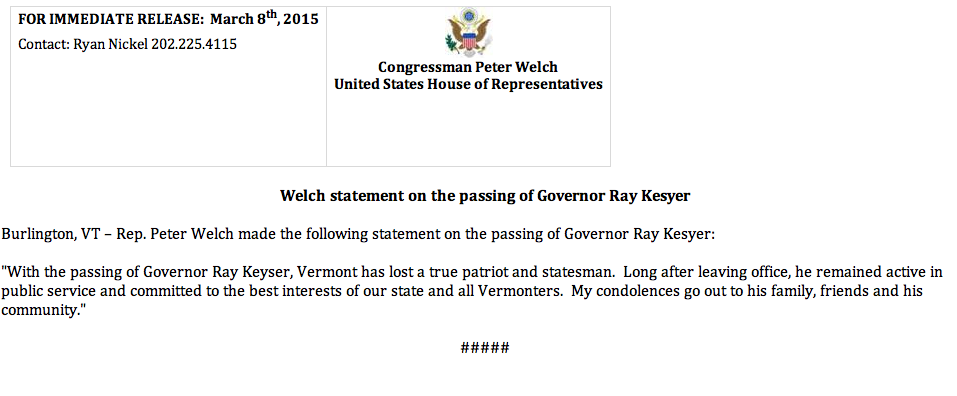
Vermont has lost one of its former governors. F. Ray Keyser, Jr., died yesterday. He served one term in the early 60s, and is most remembered for the end of his tenure. He lost his bid for re-election to Phil Hoff, the first Democrat to win the governorship since the founding of the Republican Party.

Standard operating procedure for politicians, when one of their own shuffles off this mortal coil, is the issuance of a press release. Congressman Peter Welch dutifully did so. Unfortunately, this being a weekend, the staff failed to give their full attention to the formality.

The result?

Welch.Keyser

Ehh, Keyser, Kesyer, whatevs.


Shap the Triangulator

“It’s probably better to have him inside the tent pissing out, than outside the tent pissing in.” 

                      –Lyndon B. Johnson

ICYMI, House Speaker Shap Smith has done something a bit unusual on two key issues, education funding and economic development. He solicited public input, and created special brainstorming committees to evaluate ideas.

Let's… Make… a Deal!

Let’s… Make… a Deal!

The existence of these committees is interesting enough; it smacks of a legislative leader angling for the bigger stage. This process amounts to an informal, back-office policy shop, and gives Smith  a very central role in crafting policy instead of, say, waiting for Governor Shumlin to initiate. His work with the committees also can’t help but endear him to some pretty prominent people.

More evidence of ambition can be found the makeup of the two groups. The education panel included ten current and former lawmakers: Democrats, Republicans, and independents. Good for building nonpartisan street cred.

The economy group included many of The Great And Good of Vermont’s business community, including Betsy Bishop of the Vermont Chamber of Commerce, Tom Torti of the Lake Champlain Regional Chamber of Commerce, and (Lord help us) Bruce Lisman of Campaign for Vermont Prosperity. The chair, Paul Ralston, is a former Democratic legislator who alienated many of his caucus mates during his single term*, and ended by partnering with Republican Rep. Heidi Scheuermann in Vision to Action Vermont, a PAC that’s just about as nonpartisan as Campaign for Vermont.

*I’ve heard him described as a junior-grade version of Peter Galbraith for his self-centered ways. Love his coffee, though.  

The group also includes a healthy share of relatively progressive businessfolks, like Andrew Savage of All Earth Renewables, Andrea Cohen of Vermont Businesses for Social Responsibility, and Cairn Cross of FreshTracks Capital. But there was no one from the labor movement, and no one from any progressive or environmental organization.

It smacks of triangulation, the favored strategery of upwardly mobile Democrats and the bane of liberals. And it smacks of building networks of support among the deep-pocketed donor class. Which tends to lead to centrist policymaking, not to mention one of Gov. Shumlin’s favorite pastime, kicking the hippies.

I’m not ready to call Smith a sellout. A recent report on VPR lists some ideas emerging from the job-creation committee, and they actually sound pretty good: identifying ways to unlock capital for small businesses and startups, matching technical-school curricula with the needs of Vermont tech companies. Also, Cross is quoted as saying that Vermont’s business climate has more to do with quality of life and a clean environment than the old bromides of tax breaks and deregulation.

That sounds like a relatively progressive approach to economic development. And truth be told, there’s a need for a strategy that cuts through the standard liberal/business debate — that encourages job growth without abandoning liberal principles.

For instance, there is probably room for — and please don’t shoot me — some modest reform in the permitting process. The very phrase “permit reform” has been uttered by so many Republicans for so many years, it raises immediate hackles in the liberal community. Can we find a way to ease the process for the kinds of enterprise that create good jobs and contribute to our economic vitality without simply greasing the skids for strip malls and subdivisions? We probably can, and maybe — just maybe — Smith is trying to break the usual pattern and find a third way.

I’m willing to wait and see what emerges before passing judgment on the process and on Smith’s motivations.

As for the political question: Is Shap Smith running for governor? I don’t know. And at this point, he probably doesn’t either. But he’s certainly developing relationships and laying the groundwork for a future run, should he decide to do so.

Same song, different verse

Hey, who switched the teleprompter to Español?

Hey, who switched the teleprompter to Español?

Reactions to the Governor’s budget address…

First, I hope the Republicans are happy. Last week they complained about a lack of attention to some major issues. Today they got a whopping hour and fifteen minutes. Be careful what you wish for.

This speech followed Shumlin’s usual pattern. There’s a whole lot of incrementalism — small, inexpensive approaches to big challenges — and, to spice things up, a handful of bigger proposals almost certain to go nowhere. It strikes many observers as a deliberate tactic: offer an unpalatable solution, and force the legislature to find an alternative. Example from a previous year: his plan for a major cut to the Earned Income Tax Credit.

I’ll give him credit, he’s very good at incrementalism. He finds modest improvements that don’t cost much, if anything. In today’s speech, he was constantly talking of leveraging federal funds, private-sector participation, and partnerships with entities of all sorts. A classic example: his plan to offer “motivated high school seniors” a free two-year Associates’ Degree in engineering technology “with no additional cost to the Education Fund.”

The plan involves the state Agency of Education and participating employers identifying students, and leveraging existing programs plus employer contributions to get them free tuition and a summer internship if they stay and work in Vermont after graduation.

It’s classic Shumlin. It sounds good, it will actually help some people, it’s cheap, and it can be effective as far as it goes.

But it doesn’t touch on the underlying problems: high college costs and stagnant earnings for all but the very wealthy. Even if the incremental stuff works, it seems like small potatoes for those of us who vote Democratic.

How big is the budget gap? It's soooooo big.

How big is the budget gap? It’s soooooo big.

Then there’s the other thing we get: the “big idea” that probably won’t go anywhere. I could mention a few; the double ban on teacher strikes and contract impositions, giving power to the state school board to close schools that fail to meet spending or achievement targets, the payroll tax increase to fund better Medicaid reimbursement.

Indeed, his entire education package seems designed for rejection. For one thing, it seems to do nothing to immediately mitigate rising property taxes. That’ll be lawmakers’ top priority, after last year’s election.

Shumlin’s broader reforms are an odd mix of distant and scary. Neither the teachers’ unions nor the school boards are likely to accede quietly to a plan that will strip them of their ultimate bargaining chips. The idea of eliminating “contradictory incentives” like the small schools grant may be good ideas, but they’ll be tough to support for lawmakers with small school in their districts.

Finally, the idea of Agency of Education “evaluation teams” going into every school to measure achievement and spending performance — with those who fail to meet benchmarks in line for state funding cuts or even closure — is DOA. It’s mandatory consolidation and top-down control via carrot and stick, rather than direct mandate. Kinda the worst of both worlds; no immediate impact, and a whole lot of state interference (as it will be perceived) in local decision-making.

He calls it a “partnership,” but one partner has the ultimate power.

If you think I’m too gloomy on Shumlin’s prospects, just take a look at this reaction statement from House Speaker Shap Smith:

…the Governor acknowledged Vermonters’ concerns about the unsustainable cost of health care, burdensome property tax increases, and the need to clean up our waterways. …I look forward to working with the Administration to make Vermont the best possibly place to work and live, and one that provides opportunity for all Vermonters.

He applauds the Governor for addressing the big issues — but not a peep about the Governor’s proposals. I expect lawmakers to consider Shumlin’s ideas, but he won’t get priority over others’ ideas.

This is all part of the game, as it has been since Shumlin took office. It’ll be even more so after an election that was largely a personal rebuke of the Governor, not the Democrats.

His budget message was a starting point. From here on, it’s a matter of top lawmakers devising proposals of their own that they can convince Shumlin to support.

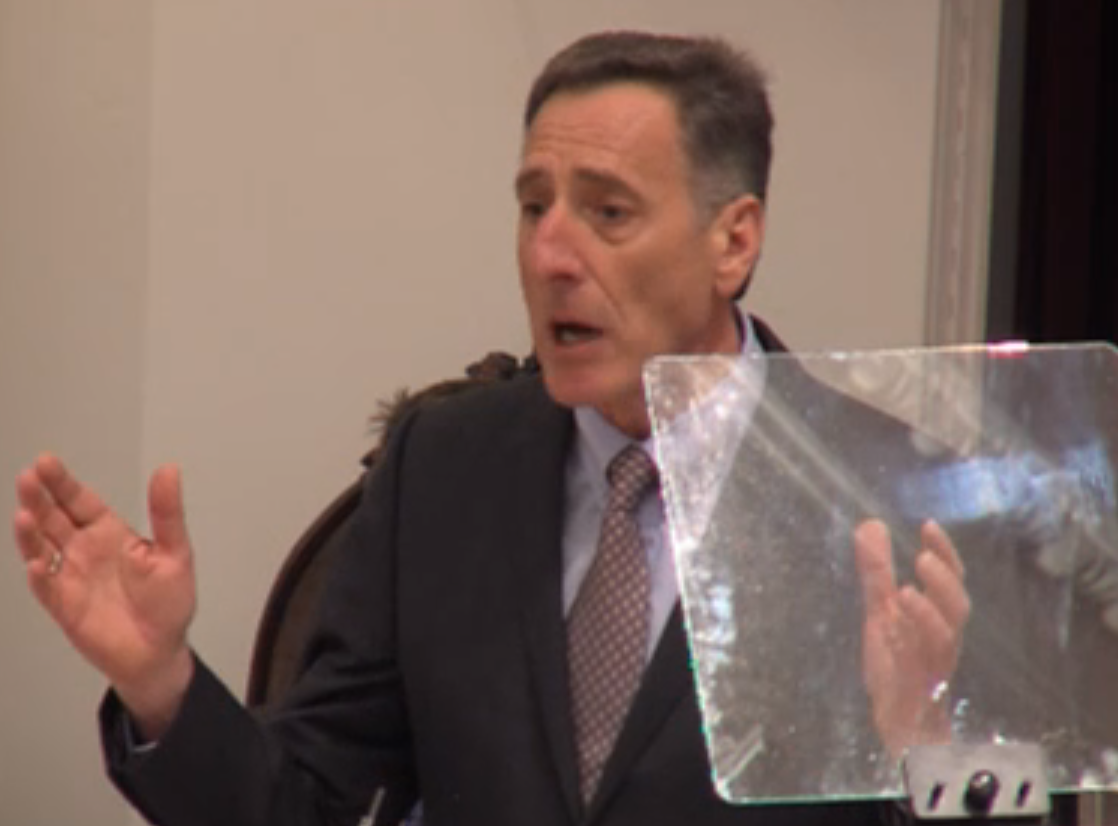
Multimedia note: if the photos seem a bit blurry, it’s because they’re screengrabs from the Vermont PBS livestream. Workin’ from home today. 

With all due respect to Hal Cohen…

So yesterday Governor Shumlin filled two vacancies in his cabinet. Justin Johnston was announced, in a brief flurry of bad Aussie jokes, as Jeb Spaulding’s replacement in the role of Shumlin’s Rasputin Secretary of Administration.

And Hal Cohen will become Human Services Secretary.

Justin Johnson, Gov. Shumlin, and -- barely visible in back - -Hal Cohen.

Justin Johnson, Gov. Shumlin, and — barely visible in back — Hal Cohen.

Now, I’m sure Hal Cohen is a nice guy and he’s clearly dedicated to the field of social services, having served as head of Capstone Community Action for 18 years. You don’t keep that job for that long unless you’re committed to the mission.

But is he really the best guy for the biggest agency in state government? And even worse, an agency facing an immediate mandate to cut its current-year budget by ten million bucks?

I know virtually nothing about Hal Cohen. But here are a few numbers that portray his challenge in very stark terms.

AHS: 3,500 staff. Annual budget, from general fund: nearly $600,000,000.

Capstone: 180 staff. Annual budget, $16,000,000.

In short, Hal Cohen is making a quantum leap as a manager. At a time when he will face a massive management challenge from Day One.

Cohen does bring some positive qualities to the job. He is deeply involved in delivering services to those in need, which is a very good thing. He has managed a nonprofit social services agency for a long time, and that’s a very good thing.

But he has never managed an organization anywhere near the size and complexity of AHS. When you manage a staff of 180, you do a lot of hands-on, day-to-day management. You have a personal relationship with a sizeable chunk of your employees, and you probably know them all by name.

When you manage a staff of 3,500, you’re delegating almost all of the work. You’re managing the managers — or, more likely, managing the managers’ managers. And if you spend time building personal relationships with your staff, you’re probably not doing your job.

That’s the basic challenge in making this quantum leap.

And then you add the fact that, between this year’s budget and the next, he may well be asked to make spending cuts equivalent to the entire annual budget of Capstone.  

I’m sure that if Shumlin had pulled someone out of the business world, or out of some other state agency, we’d all be howling about hiring a bean-counter who cares more about the bottom line than helping people. (For example: Johnston saying that the primary goal of the budget is “affordability.” Meaning no new taxes.) But I have to wonder if Cohen is the right person for this job at this time. And I also have to wonder, with all due respect to Hal Cohen, how many other people might have said “no” to the idea of becoming the head of an overstretched agency facing major budget cuts. It’s hard to imagine that Cohen was the first name on the list.

I hope, for the sake of Vermont’s poor, that my misgivings are proven to be groundless.

Some backstory on the militarization of our police

Last week, while I was out of town for a family Thanksgiving, Mark Davis wrote a nice little story in Seven Days about Vermont police agencies picking up a whole lot of military-grade weaponry, thanks to a federal program designed to shore up military contractors’ bottom lines provide local police with “military equipment left over from America’s foreign wars and stockpiles.”

Which brought to mind some of my own past coverage of specific events tied to this story: a small New Hampshire community talked into buying an assault vehicle by a Rush Limbaugh-listenin’, Tea Party-believin’ salesman, and the small-scale invasion of a small Vermont town.

Instrument of peace?

Instrument of peace?

First stop in the Wayback Machine is February 2012, when Keene, NH had received a $300,000 Homeland Security grant to buy an eight-ton armored vehicle called the Lenco Bearcat. This, for a city with a population of 23,000 and virtually no history of violent crime.

But there was all that federal money dangling in front of the city fathers…

During a City Council meeting, the Mayor was heard whispering to a City Councilor “We’re going to have our own tank.”

Better than Viagra. Of course, the grant won’t pay for operating costs like maintenance, training and insurance.

The most fascinating part of the story, to me, was Jim Massery, salesman for vehicle manufacturer Lenco. His pitch was laden with fearmongering about the need for high security everywhere. In fact, one of his quotes was the following:

I don’t think there’s any place in the country where you can say, “That isn’t a likely terrorist target.” How would you know?

There was a whole lot of that, and you can read more in my 2012 post on Green Mountain Daily. Massery, as I discovered, was a true-blue conservative who believed that President Obama was trying to steal our freedoms, and that the government was spending us into oblivion. And yet he had no problem helping the government militarize local police and wastefully spend $300,000 on a Lenco Bearcat that nobody needed. (The notorious Free Staters of Keene probably thought he was an enemy agent tasked with bringing the power of the police state to their own little community.)

One of Massery’s other pitches went like this:

When a Lenco Bearcat shows up at a crime scene where a suicidal killer is holding hostages, it doesn’t show up with a cannon. It shows up with a negotiator.

And, he might have added, that negotiator shows up in grand style, hunkered down in eight tons of steel. Which brings me to story #2. In June of 2012, a man named Alfred Perreault unknowingly touched off a minor invasion of his town of Washington, VT…

A summer scene befitting a Norman Rockwell portrait was spoiled Monday morning when more than a dozen police cruisers, an armored vehicle and the big box truck that houses Vermont’s equivalent of a S.W.A.T. team set up shop in Washington to take what proved to be one unarmed man into custody.

That armored vehicle was, as it happens, a Lenco Bearcat. Purchased by the Vermont State Police with, you guessed it, a Homeland Security grant.

Perreault was known to possess a goodly quantity of firearms, hence the heavy-handed police response. Which must have triggered (sorry) a sizeable panic reaction among townspeople who suddenly saw this caravan o’death roll into town and set up roadblocks.

It all ended peacefully. But as I wrote at the time, there’s an old saying: To the man with a hammer, everything looks like a nail.

Our police agencies have been outfitted with military-grade, up-armored hammers. So naturally, Alfred Perreault looked like a nail.

It’s a lot easier for the authorities to escalate a response when they have the tools of escalation close at hand — indeed, when they may well feel a need to justify the purchase and upkeep of all those hammers. Alfred Perreault clearly needed to be dealt with. But did he warrant such a robust response?

You can bet we’ll be asking these kinds of questions again in the future.