Category Archives: The media

The Brave New World of Journalismism is Upon Us

Oh boy, here we go… apparently Executive Editor Michael Townsend now occupies the Burlington Free Press Chair in “Good News” Editorials, recently vacated by Jim “Party City” Fogler. Because there it is, the dawning of the thorough Gannettization of Vermont’s Largest Newspaper, under the ominous title “Free Press Resets for the Future.”

The piece begins with a lengthy humblebrag about a recent Dan D’Ambrosio story on IBM that Townsend labeled “epic,” “readable and educational.”

Epic, eh? Guess that puts Homer in his place.

We are Gannett. You will be assimilated.

We are Gannett. You will be assimilated.

Right off the top, I had a strong feeling I was wading through bullshit. There was the title, first of all. But also because it was such a lengthy “soft lede” as they say in the news biz that I figured Townsend was burying the bad stuff; and finally, because I’ve been watching the news about how Gannett newspapers are “resetting for the future.”

By forcing all their newsroom staff to re-apply for their jobs. By cutting total newsroom staff. By getting rid of the formerly rigorous editorial process and relying on reporters to crank out publication-ready copy. By promoting clickbait over serious journalism. And by tearing down the walls between news and sales.

At FreePressMedia, we, as the rest of our colleagues in the Gannett company, are resetting the structure of the newsroom to better enable us to focus on the information and the presentation that you tell us via choice are most important, including accountability journalism and topics that Vermonters are known to be passionate about, such as the environment, local food and the creative economy. These changes are significant for our operations to produce content more tuned to the digital experience.

Part of this resetting is developing a new operational structure to enable us to focus more on the local content that deeply interests readers. With systemic changes in the media business in recent years including changes in approach, format and staff size, we are redefining journalism jobs for the future and our vibrant website, BurlingtonFreePress.com. During the next several weeks, the staff will apply for these jobs with new expectations. We expect time for adaption to the change in structure.

Emphases mine.

“You tell us via choice” means “we’ll abandon journalistic principles and pursue the stories that generate the most pageviews.” See that list: “The environment, local food and the creative economy”? What’s missing?

Oh, how about politics and public policy? Health care, welfare, corrections, infrastructure, taxation, investigative journalism, to name a few. Even transparency, until now a Freeploid bugaboo.

“Redefining journalism jobs” means higher expectations for production, along with lower salaries and worse benefits.

And “staff will apply for these jobs” meaning, well, senior writers, you’re probably S.O.L. We want younger, cheaper staffers more comfortable with multimedia technology.

Yesterday’s retirement announcement by senior writer Sam Hemingway suddenly makes a whole lot of sense. He saw the writing on the digital wall.

I’d expect a bunch more to follow him out the door, voluntarily or otherwise.

A heapin’ helpin’ of credulity at the Bennington Banner

The toughtest task for a daily newspaper — especially a small, cash-strapped one — is to fill the Monday morning news hole. Little or no staff over the weekend; a shortage of easy stories, like public meetings, official releases, and news conferences. So I can sympathize with the folks at the Bennington Banner for seizing on a story with a grabby header: Vermont ranks near the bottom in a national ranking of “parental input” into their children’s education.

Or, as the Banner ineptly put it:

Vermont recently ranked 45th out of the 51 states and Washington D.C. in a report designed to rank states based on how much power parents have over their childrens’ education.

Hey, congratulations to Puerto Rico! I guess they achieved statehood while nobody was looking.

There’s also the small matter of the double-plural form of “children.” But that’s not why I’m writing.

Why I’m writing is that the Banner swallowed, hook line and sinker, a bogus “study” from an ersatz “reform” group, the Center for Education Reform, which is part of the American Legislative Exchange Center (ALEC) web of innocuously-named astroturf organizations. And whose governing board is loaded with high-profile proponents of for-profit and charter schools.

If the Banner had spent two minutes on The Google, it could have uncovered that extremely relevant information, instead of regurgitating CER’s pregurgitated propaganda.

But really, you didn’t even need to go that far to realize that something was rotten in Denmark. Just take a gander at CER’s four — count ’em, four — criteria for evaluating parental input, thoughtfully entitled the Parent Power Index:

School choice, charter schools, online learning, and teacher quality.

Okay, the first two are gimmies. The only form of parental “input” recognized by CER is whether parents can choose their kids’ schools. Which kinda-sorta ignores the most important kinds of parental input available at every public school: teacher conferences, interactions with administrators, school board meetings, and school board elections.

See, public schools are, well, “public.” And members of the public can have just about as much input as they choose to have. Most teachers and administrators welcome parental involvement in their children’s education. And in my years covering school board meetings, I’ve seen countless examples of boards bending over backwards to accommodate the squeaky wheels among their constituencies.

If your idea of “parental input” is limited to one single act of choice, not unlike going to Walmart to buy a new microwave, then I feel sorry for your children. But that’s how CER sees it.

The other two criteria sound more benign, but not when you read the fine print.

“Teacher quality” isn’t a measurement of, oh, the actual quality of a state’s teachers. It amounts to this: Are there state-mandated annual teacher evaluations? Are tenure and retention tied to those evaluations?

In other words, have the teachers’ unions been whipped into subservience?

As for the fourth, “online learning,” CER advocates the availability of “a full-time online caseload.” Which is great, if you want your kid’s education supplied by the University of Phoenix or some other for-profit scam artist.

I’m not saying there’s no place for online learning in K-12 education. But is it really one of the four pillars of “parental input”? No freakin’ way.

In short, this CER report is pure ALEC-style horse hockey. And the Banner should be ashamed of itself for uncritically serving it up to its readers.

In the pursuit of objectivity, the truth is often a casualty

One of the faults of contemporary journalism is its tendency to bend over backwards in the name of “balance.” You have to represent both sides, even if it means including a climate change denier. You have to quote Annette Smith in any coverage of wind turbines, or Darcie Johnston in any piece about health care reform. And you have to pretend that a one-sided campaign is competitive before Election Night because it’d be “unfair” to the obvious loser.

Submitted for your approval, from the Freeploid’s political tag team of Terri Hallenbeck and Nancy Remsen (or, quite possibly, from their timorous editors):

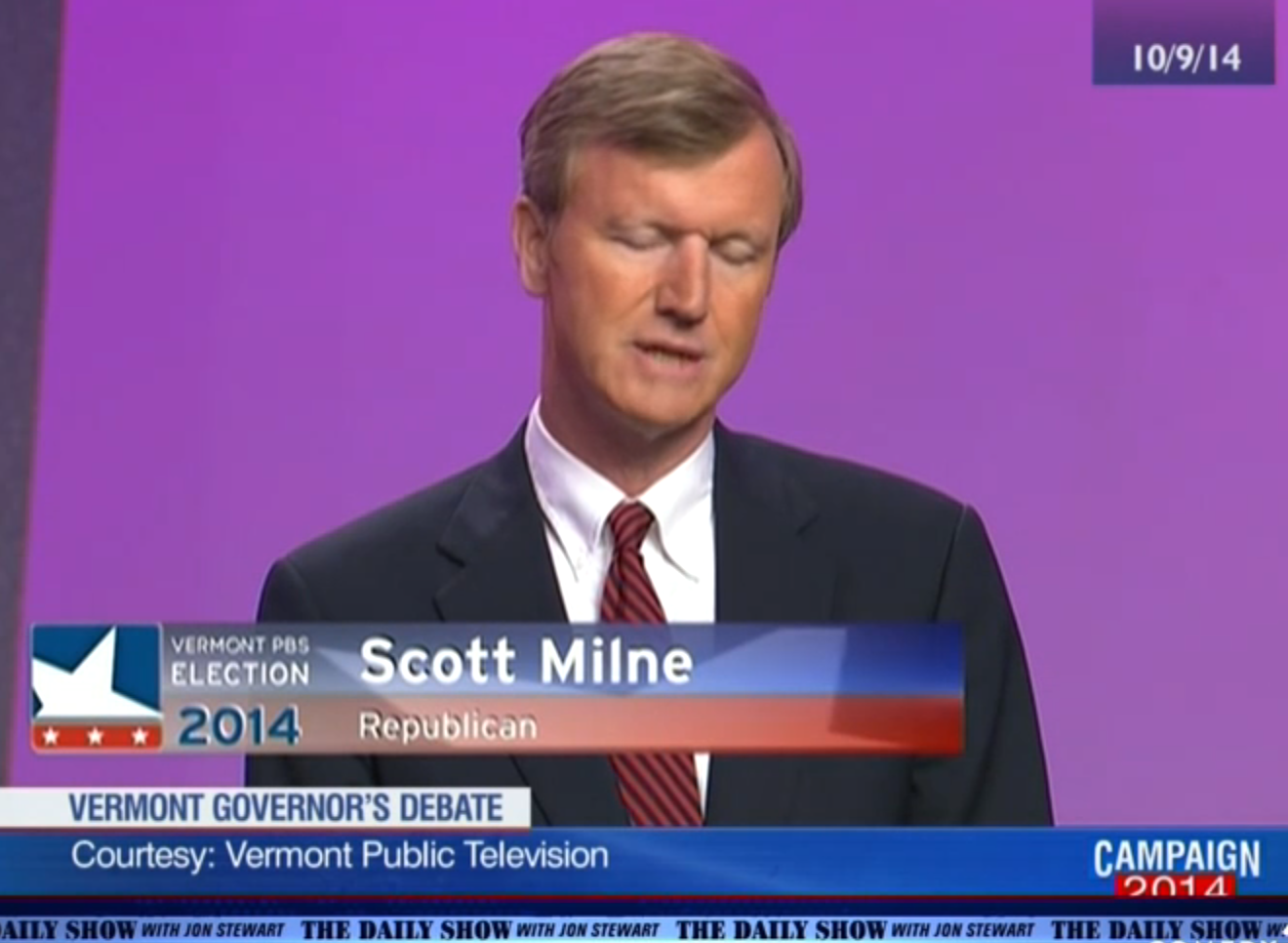
Scott Milne, the Republican gubernatorial challenger who has been accused of getting off to a slow start, showed a surge in his fundraising…

“Accused of getting off to a slow start,” eh?

“Accused”???

That’s not an accusation, it’s an observation. It’s plain fact. Scott Milne launched his campaign on the last possible day — the filing deadline. He left everybody up in the air until that afternoon. And in his first two months on the trail, he raised virtually zero money outside of his own family and that of his business partner David Boies III.

If I published a Lexicon of Political Terms, I’d use Scott Milne’s mugshot to accompany the definition of “slow start.”

We know that Milne reacts very badly to criticism of his campaign. I’ll bet he’s had some angry calls with Freeploid editors, and this excessive timidity is the result.

Shumlin’s second TV ad: nice, but…

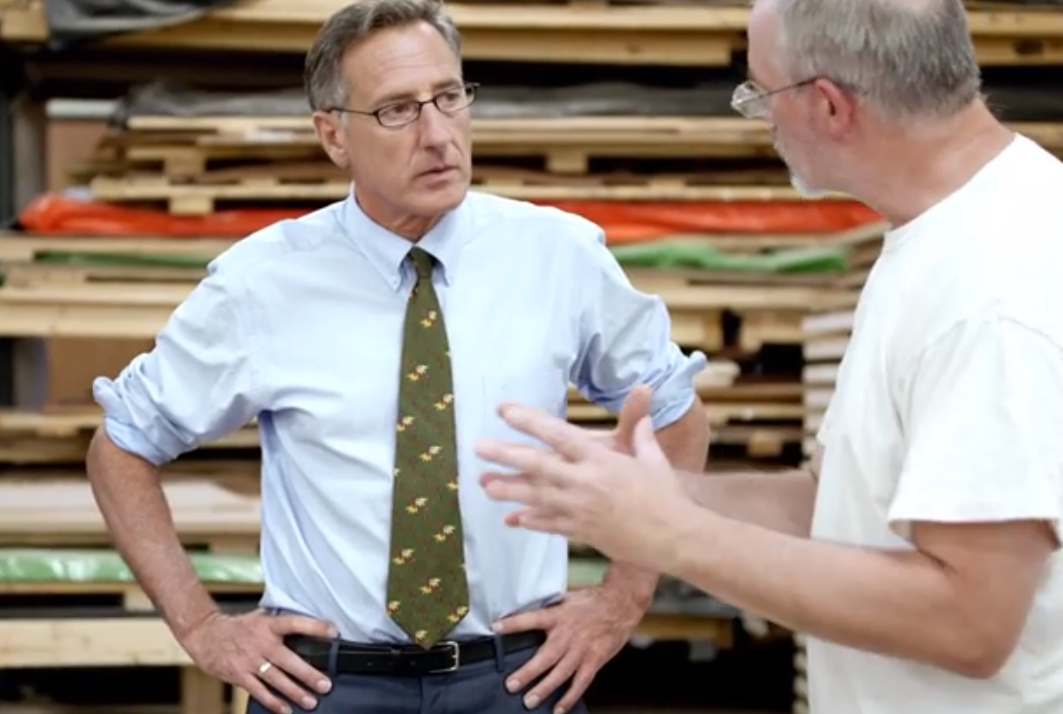
The Governor’s first ad featured a number of Vermonters talking about Shumlin initiatives that had helped their lives. The second spot connects two themes: post-Irene recovery and helping Vermont businesses survive and thrive.

Nice glasses, Gov.

Nice glasses, Gov.

The spot is narrated by John Wall of WallGoldfinger, a furniture maker located in Randolph. Wall tells how his factory was hit hard by Tropical Storm Irene, and how the Administration responded “within a week,” facilitating loans to keep the company afloat.

“It was the difference between life and death,” says Wall. Now, he says, the company is poised for further growth.

It’s a good story, and having it told first-person gives the spot instant impact and credibility.

My only qualm?

I hope we’re not leaning too much on Irene.

It did, after all, happen three years ago, during the first year of Shumlin’s governorship. He deserves full credit for pushing the recovery forward… but I hope he doesn’t lean too heavily on Irene.

In the first ad, one of the four brief testimonies was about Irene; it’s the dominant subject of the second. More are on the way, I’m sure; and if other spots focus on other issues, I’ll be fine with the overall balance. Irene deserves to be part of the story, but let’s have some more recent stuff as well.

Fogler Departs, Crudification of Free Press To Accelerate

Big news in Vermont media: Jim Fogler is stepping down as president and publisher of the Burlington Free Press. And leaving the newspaper business entirely, for a rewarding and soul-enriching gig as a vice president at Party City, the national chain of party supply stores.

Those journalistic ethics should come in handy over there.

I have made my share of sport at Fogler’s expense in the past — if I recall correctly, I wrote that when Jim Fogler writes an optimistic column in the Freeploid, readers (and staff) run for cover. But if I were to guess, I’d say his departure is not good news for Vermont’s Largest Newspaper.

First, there are the circumstances. His resignation is announced on September 25, and his last day at the Freeploid will be October 1. That’s a nanosecond by the standards of executive turnover. I have no inside information whatsoever, but it does make me wonder if his departure was voluntary. Not that he was fired; but rather that they let him know that he’d be replaced, and gave him time to arrange a soft landing. He had spent 26 years with Gannett, after all, so perhaps a little consideration was in order.

The big change comes as Gannett’s newspapers are transitioning into a new era of newsroom organization. A few Gannett papers have already gotten the makeover, which has resulted in the following:

— More reporters, but fewer editors. A smaller newsroom staff overall. Get ready for an explosion in typos, bad writing, and bad grammar.

— Everyone has to reapply for newly redefined jobs. Presumably with lower pay and benefits.

— A dependence on “audience analytics,” i.e. covering stories because of reader interest (pageviews!) rather than importance.

— What appears to be a troubling degree of “synergy” between news and ad sales.

Expect Gannett to parachute in a corporate loyalist (after a, cough, “nationwide search”)  to institute the new regime at the Freeploid.

Copy editors? We don’t need no stinkin’ copy editors!

On Friday, Governor Shumlin released his 2013 income tax form. The Freeploid’s Nancy Remsen  wrote up the story… which included this little gem:

He lists five vehicles, a boat and farm equipment with total value of $128,300. One car, a 1964 Porsche, is valued at $55,000. The other vehicles are older and much less valuable. Since becoming governor, Shumlin gets little chance to drive as he is always chauffeured by his State Police guards.

Huh. Five vehicles. One is a 1964 Porsche. The others “are older.”

Let me guess…

— 1962 Chevy Nova

— 1958 Trabant P50

— 1952 Nash Metropolitan

— 1951 Fuldamobil

— 1948 GAZ-M20

Yeah, that sounds about right.

Funny; I would have guessed that our millionaire Governor would  own at least one car newer than 1964. But hey, the Freeploid reported it, I believe it, and that settles it.

Mahatma’s meltdown

Scott Milne, the man who famously called himself “Gandhi-like,” is finding that it’s awfully hard being a pacifist when the bullets are flying. He made an unplanned call to WDEV’s Mark Johnson Show on Friday morning and… well… spent about 20 minutes ranting about the media’s unfair treatment of the Milne campaign. And specifically impugning the good name of Our State Pundit Laureate, Eric Davis. That will never do, Mr. Milne.

Davis had been a guest during the first hour of the program. He and Johnson discussed the gubernatorial race. The consensus was that Governor Shumlin had left himself vulnerable because of various scandals and issues. And that it’s too bad the Republicans didn’t have a better candidate, because Scott Milne had made a mess of things.

Apparently it was enough to make even a Gandhi-like person’s blood boil. A little while later in the show, Milne called in to rebut Davis’ analysis. Or to slap it around, anyway. At great length and in pretty extreme terms: at one point, he accused Davis of “laughing at me.” Sorry, Mahatma, I don’t think I’ve ever heard Eric Davis laugh at anyone. If he’s anything, he’s a straight arrow, cautious to a fault.

Here’s a sample of Mahatma’s Meltdown:

When you’re bringing people on the air that influence people with, ah, you know, tenured professorships from elite institutions, you need to ask the tough questions and bring out the contradictions in what they said. If you look back on Mr. Davis’ track record of picking things in Vermont over the last few elections, it’s not stellar. And I think it’s a form of, uh, you know, uh, you know, journalistic malpractice. You just let him get away with saying some of those things.

I’m sure the folks at Middlebury College are happy to be considered an “elite institution,” but otherwise, good God. Eric Davis’ track record hasn’t been perfect, but it’s been awfully good. That’s why he’s the go-to political analyst for Vermont media. He knows his stuff, he’s conscientious, he doesn’t take chances, and he certainly doesn’t engage in gratuitous attacks. He has earned the respect he is given by the media and by news consumers.

Milne railed against the notion that his campaign lacks ideas. Which isn’t accurate; what we say is that he lacks policy positions and proposals. Milne’s definition of “idea” includes such things as “Peter Shumlin spends too much time out of state” and “the economy isn’t growing quickly enough.” What Milne is criticized for is his real, true, honest-to-God lack of proposals. He tries to make this a virtue by saying, on issue after issue, that he’s going to get all parties together and work out the best solution.

That’s awfully thin gruel. And besides, his current definition of ideas is at odds with what he was saying earlier on: that he would spend August attacking Shumlin, and start rolling out his own proposals in September. He hasn’t delivered on Part 2. “Give me 30 days,” he said on July 25. It’s been 50 days since then.

Milne also repeated one of the more extraordinary statements he’s made during the campaign:

I am uncomfortable about calling people and asking them for money to support a public policy campaign, and feeling 100% like I don’t owe them something afterwards.

I guess you could say that has a certain freakish nobility. But it’s a fantasy: Politicians have to raise money. Yes, there’s too much money in politics. But Milne has raised a laughably small amount — and virtually all of it from his family, friends, and his own back pocket.

Now we know why. He doesn’t want to ask for money, and he doesn’t want to be obligated.

Somebody should. tell Phil Scott about this. He’s been raising money right and left from contractors and gas companies and rich Vermonters and his vast network of cronies, and insisting that it doesn’t make any difference in his politics. Scott Milne would beg to differ.

Somebody should also tell the Scott Milne of midsummer about this. At the time, he said he planned to raise and spend about $200,000, which would be enough to wage an “unconventional campaign.” As of early September, he’d raised about 20% of that total. And since then, his full-time professional campaign manager has resigned. And we haven’t seen any TV ads or mailings or yard signs or any other tangible measures of an adequately resourced organization.

Milne was upset Eric Davis’ characterization of his campaign as “running on fumes.” He said, “If [Davis] hasn’t talked to my bank, he has no way of saying that.” And he pointed to his paid staff of five people as evidence he had money.

And then he contradicted himself.

We’ve got a strategy. Granted, it’s not perfect. I’m going to make mistakes. But I think our strategy is, you know, we’re running an insurgent campaign. We’re going to use our lack of money as best we can as an asset.

“Our lack of money.” Yep, he said it.

And about this “insurgent campaign” stuff. Yes, Milne is running an unconventional campaign. And yes, Eric Davis and Mark Johnson and me and all the rest of the punditocracy are basing our judgments on political convention: you have to take time to build name recognition, you have to generate news coverage, you have to have a robust infrastructure from the central office to the grassroots, you have to have a decent amount of money to run advertisements and do mailings and staff phone banks and print signs and all that other stuff of retail politics. You have to have ideas and positions that give people positive reasons to vote for you. You need a certain capacity for public speaking and pressing the flesh and handling the media.

And, preferably, you need a track record of accomplishment in the public sector.

Scott Milne has none of that. And he’s made a bunch of obvious blunders.

And so, when measured against every available standard for judging a campaign, Milne comes up short.

Now, if his “insurgent campaign” taps into a vast unseen reservoir of support, then all us conventional thinkers will get our asses kicked on November 4.

And I, for one, will be more than willing to admit I was wrong.

But I am extremely confident that I’m not wrong.

Of course, if Milne loses it’ll be Eric Davis’ fault.

What I need are people who want change and balance in Montpelier, to be naive enough to believe that they can make a difference by voting. And having people like Eric Davis that don’t think that, there’s a  lot of that, but somebody like you giving him a microphone week after week, when he’s got a track record he has of saying things that are factually inaccurate, I believe he purports an awful lot of opinions like they’re facts and you let him get away with it, and I don’t think that’s fair.

He went off the rails in mid-sentence there, but his point was that Eric Davis’ negativity was going to keep him from building momentum, and cause him to lose the election.

Sigh.

Like I’ve said before, pundits and reporters and even little old partisan bloggers like me simply don’t have that kind of influence. The vast majority of voters have already made up their minds. And the rest of ’em won’t spend the next seven weeks poring over media coverage of the campaign. The crowd of political junkies who pay a lot of attention to this stuff is a very small crowd indeed.

No, Mahatma, Eric Davis won’t kill your insurgency by the power of his punditry. Peter Shumlin will kill it with his superior organization, warchest, and advantages of incumbency. The Vermont Republican Party will kill it with its nonexistent grassroots organization, lack of resources, and internal divisions. The voters will kill it because a solid majority of them are liberal or progressive, and the Democrats have a built-in advantage.

And Scott Milne will kill it with his lack of political experience and smarts, and his poor performance on the public stage.

By all conventional measures, Scott Milne has run a terrible campaign. And I’m a guy who, when Milne first came on the scene, had some hope that he’d turn out to be a solid representative of moderate Republicanism. If he were doing a good job, I’d be reporting as such. But he’s not.

The most significant thing about Governor Shumlin’s first TV ad of 2014

The Shumlin campaign has taken to the airwaves with a 30-second commercial that features real-life Vermonters who have benefited from Shumlin initiatives. The aim of the ad is to remind viewers of the administration’s many accomplishments — to counteract the stream of bad news about Vermont Health Connect and the Department of Children and Families, and to remind liberal voters that the Governor has, indeed, delivered on many of his promises.

All he needs is rainbows and unicorns.

All he needs is rainbows and unicorns.

Pretty standard stuff, and it’s been duly reported in the media. But they haven’t noticed* the most significant thing about the launch: its timing.

*Correction: All but one of them failed to notice. Sevan Days’ Paul Heintz reported it two days before I did. That’s why they call him The Huntsman.

In 2012, the Shumlin campaign didn’t take to the airwaves until roughly two weeks before Election Day.

This year, the campaign hits your TV screens almost a full month earlier.

According to campaign finance reports, the Shumlin camp spent $125,000 on ad buys in 2012. Campaign manager Scott Coriell isn’t saying how much they’ll spend this year, but it figures to be a lot more.  They’ll be filling airtime for six weeks instead of two, so it’s fair to guess that they’ll triple their spending this year. Or more.

So, why?

In 2012 Shumlin faced an underfunded, underorganized, mismanaged opponent. Shumiin’s re-election was never in doubt. This year, he faces one opponent who’s far worse in all three categories, and another who represents a fringe viewpoint with a proven track record of appealing to a sliver of the electorate. Recent polls (and deeply flawed polls at that) notwithstanding, his re-election is once again in the bag.

But the Governor isn’t aiming his campaign at the broad electorate. He’s trying to pump up the base and generate higher turnout by core Democratic voters. Hence the reminders of popular Democratic initiatives.

If he can get a pure majority of the vote — at least 50% plus one — he’ll have a lot of political capital to spend in next year’s debate over single-payer health care.

But if he wins with a plurality and, worse case, he gets fewer votes than the Republican and Libertarian candidates combined, he’ll have a lot less pull with the Legislature. And right now, he’s polling in the mid-40s. He needs a boost.

Plus, of course, the higher his vote total, the more Dems and Progs will ride his coattails to victory. And he’ll need every liberal vote he can get, if single-payer is to pass next year.

That’s the significance of the early TV launch this year.

The Burlington Free Press: Your Shameless Hometown Daily

Last week, I called attention to a bit of hypocrisy from Vermont’s Largest Newspaper: Veteran reporter Mike Donoghue Tweeting a complaint that WCAX had poached his story without attribution. Which was a clear example of Pot/Kettle Syndrome, since the Freeploid has a reputation among journalists as a serial story poacher. Like ESPN, the ‘Loid likes to pretend it’s the only news source in its market.

At the time, I pointed out just one recent example of the Freeploid failing to give credit to another outlet, to wit Paul “The Huntsman” Heintz at Seven Days.

Well, they’re at it again.

On September 3, Seven Days published an article about John Barone, superintendent of schools in Milton, receiving his advanced academic degrees from an institution known to be a diploma mill.

And hey, whad’ya know, on today’s Freeploid front page, there’s a story about John Barone, superintendent of schools in Milton, receiving his advanced academic degrees from an institution known to be a diploma mill.

And it gives no credit to Seven Days.

If you think that’s a coincidence, I’ve got a bridge you might be interested in buying.

And the Free Press had the brass-plated balls to COPYRIGHT the story.

I’m sure they have some ass-covering explanation for this, but I ain’t buying.

Burlington Free Press, serial story-poacher.

On hiring a “disgraced journalist”

Remember Scott Milne’s new “flat organization”? The one with no campaign manager? The one that includes his son Keith and a few others?

Well, VPR’s out with a story about one of them.

Scott Fletcher, a former managing editor for the Times Argus. Fletcher was fired in 2002 for a front-page story that didn’t seem to be based in reality.

And after the brouhaha over that one story, serious questions emerged about others penned by Fletcher. He couldn’t, or wouldn’t, provide tangible evidence to support the stories.

So I guess you’re expecting This Partisan Blogger to go all medieval on Fletcher’s ass and the Milne campaign’s.

Nope, got some nuance to peddle.

A disgraced journalist, like any offender, deserves a second chance. Hiring a past offender isn’t, by itself, worthy of criticism. Indeed, it’s often praiseworthy.

There are some issues, however.

First, Fletcher is unrepentant. He insists his stories were true. Which makes me wonder if he’s learned any lessons and if he’s capable of doing the same stuff again.

Which leads to the second: Fletcher’s role in the Milne campaign.

That role, Milne said, is “research and background stuff that he’s doing directly for me.” The candidate said he has no concerns that Fletcher is bringing forth anything but the truth.

Why NOT? Good grief, Fletcher’s current job directly relates to the duties that got him in trouble in the first place. And to judge by his professions of innocence, I’d have a hard time trusting him as a researcher and writer. I’d have no problem hiring him to run my phone banks or buy ad time or drive my freakin’ car — but hiring an unrepentant serial fabricator to do my research? Hell no.

If Scott Milne knew about Fletcher’s past, the hire is yet another example of the candidate’s tone-deafness. If he didn’t know, well, he should have.