Our county sheriffs are engaged in a Sideshow Bob rake routine, and the timing couldn’t be worse. The Legislature is considering a package of reforms to the system, including an end to profiteering off contract work and tightening up the standards for unprofessional conduct.
And the sheriffs seem bent on ensuring the reforms become law.
We’d previously seen numerousdisgracefulaspects of the sheriffin’ trade. Now, just in time for committee hearings on the reform bill, we’ve got a fresh crop including more badness from former Orange County sheriff Bill Bohnyak, a retiring sheriff tossing bags of loot around the office, and the questionable finances of a newly-elected sheriff who won office despite facing an assault charge.
Every reporter loves to get a scoop — a story with some impact that you’ve got all to yourself. It’s a badge of honor, to be sure. But more often than not, it doesn’t make much of a difference.
The latest comes from Seven Days‘ Courtney Lamdin, who hit the sweet spot by uncovering a lucrative side hustle negotiated by the Burlington Police Officers Association. It made a deal with a luxury condo development to provide security with off-duty city cops.
Her story may affect the outcome of the hottest issue on the Burlington ballot: A proposed police oversight board that would exclude members of the force from serving. That idea has prompted opposition from Mayor Miro Weinberger and Interim-For-Life Police Chief Jon Murad, among others.
Well, Lamdin’s article makes me think there’s a real need for police oversight, and it would be best done without any officers on the board.
Since the beginning of his fourth term, Gov. Phil Scott has been busily drawing lines in the sand and daring the Legislature to cross them. It’s a strategy that seems to borrow much more from his years at Thunder Road than from his allegedly collaborative approach to governing.
But he’s not stopping with public defiance of the Democratic majority. He’s also putting out a series of aggressive policy stances that threaten to further inflame relations with majority Democrats. First there was the proposal to shift state retirees’ health insurance from Medicare to Medicare Advantage, the Potemkin Village of senior coverage. That proposal was cheekily unveiled during campaign season, when you might think he’d at least pretend to be friendly to the state employees’ union. Second, his proposal to spend $900,000 to study an issue that’s already being studied by the state’s Climate Council.
And third, the Department of Public Safety’s transparently political plan to publish a politically motivated (and dismally stupid) crime “heat map” that won’t help the public understand crime trends but will give the administration another cudgel for its attacks on criminal justice reform.
More evidence that the long-awaited “culture change” at the Vermont Department of Corrections is still purely conceptual: A new study shows that the Southern State Correctional Facility at Springfield is a hellhole for inmates and staff alike.
It’s bad. Really, really bad. It’s not only an administrative and regulatory failure, it’s a moral failure. It reflects badly on anyone who’s had anything to do with our prison system in recent times: DOC officials, successive governors, union leadership, and the legislators with oversight responsibility. Anyone else? The Judiciary? Prosecutors?
Abigail Crocker, co-founder of the Justice Research Initiative, found many of the study’s results “alarming.” I think that’s an understatement.
One of those findings: 37% of the prison population, and 30% of prison staff, have had suicidal ideations.
So. In a place that’s supposed to be preparing inmates for productive re-entry into society, more than one-third of them are in despair or painfully close to it.
Well, you might say, of course people serving hard time might feel bad. But then you have to explain that 30% figure among staff, which indicates that the prison is just about as horrible for the workers as for the inmates.
It’s been a long, strange week chez VPO. Along with many other Vermonters, our power went out on the morning of Friday the 23rd. Unlike most other Vermonters, we didn’t get our power back until the evening of the 28th. (Our neighborhood suffered the downing of multiple power poles and the damaging of its substation.) Most low-key Christmas ever.
So that’s why no blogging in a week. In the meantime, things kept happening (on a reduced-quantity holiday schedule), so here I am to proclaim the return of POWERRR and to catch up on stuff I might have missed. Today’s bits include a surge in criminality that can’t possibly be the Progressives’ fault, a minimal sentence for a “savage beating,” how the F-35s put Burlington in Putin’s crosshairs, and a country-rock revenge fantasy from a very unsuccessful House candidate. En avant, mes amis!
Rutland Crime Wave Fails the Preferred Narrative. On December 27, VTDigger reported on Rutland’s dramatic rise in property crimes. Thefts from cars up 400% from the previous five-year average, and a more than threefold increase in stolen cars, thefts from buildings, and retail theft.
I don’t know how they’re going to pin this on Radical Socialist Chittenden County State’s Attorney Sarah Fair George or “defunding the police,” but I’m sure they’re looking for a way. After all, Rutland doesn’t exactly fit the profile of a crime-friendly center of rabid progressivism, and yet here they are suffering a crime wave. Some are blaming restrictions on bail, but the obvious cause is substance use. According to the Rutland PD, 75% of suspects in retail theft are known narcotic users, as are 64% of auto theft suspects and 100% of robbery suspects.
Yeah, I think we’ve pinned down the problem there. Opioid deaths continue to set new records. Opioid-related crime appears to be fueling any increase in lawlessness. Can we stop nattering about progressive criminal justice reform and address the real problems?
You know it’s serious when a report from State Auditor Doug Hoffer (a) gets a lot of media attention and (b) prompts a chastened response from state officialdom.
That’s just what happened Monday with the release of Hoffer’s performance audit of the Department of Corrections’ prisoner grievance process. A process that was so lacking that Hoffer couldn’t even conduct a full audit because of poor recordkeeping. A process so lacking that to even call it a “process” is an indignity against the English language.
And no, I’m not exaggerating. Hoffer found that DOC records do not “have reliable, basic information to determine the number, type, status or outcome of prisoner grievances.”
Aside from that, Mrs. Lincoln, how was the play?
But wait, there’s more! Inaccurate data, missing records, no submission or response dates, inadequate training for staffers who use the system, and no DOC administrator specifically tasked with managing the grievance process.
It’s a great system if your goal is to avoid accountability.
Note: This post has been updated with figures from Lamoille County.
It’s been almost five years since Gov. Phil Scott signed a package of gun bills into law on the Statehouse steps. One of them was a so-called “red flag” law, which allows police to temporarily take firearms away from people deemed to be an immediate risk to themselves or others.
This was a popular alternative to tougher gun restrictions, endorsed by quite a few Republicans including then-president Donald Trump. But how has the idea worked in practice?
Well, according to the Associated Press, not all that well. The AP reported that in many jurisdictions, red flag laws are so rarely used they might as well not exist.
AP found such laws in 19 states and the District of Columbia were used to remove firearms from people 15,049 times since 2020, fewer than 10 per 100,000 adult residents. Experts called that woefully low and not nearly enough to make a dent in gun violence…
In Chicago, the Illinois law was used only four times. New Mexico’s law was employed eight times. In liberal old Massachusetts, the red flag law was used a whopping 12 times.
It’s a different story in Vermont. But there are still questions to answer about our red flag law in practice.
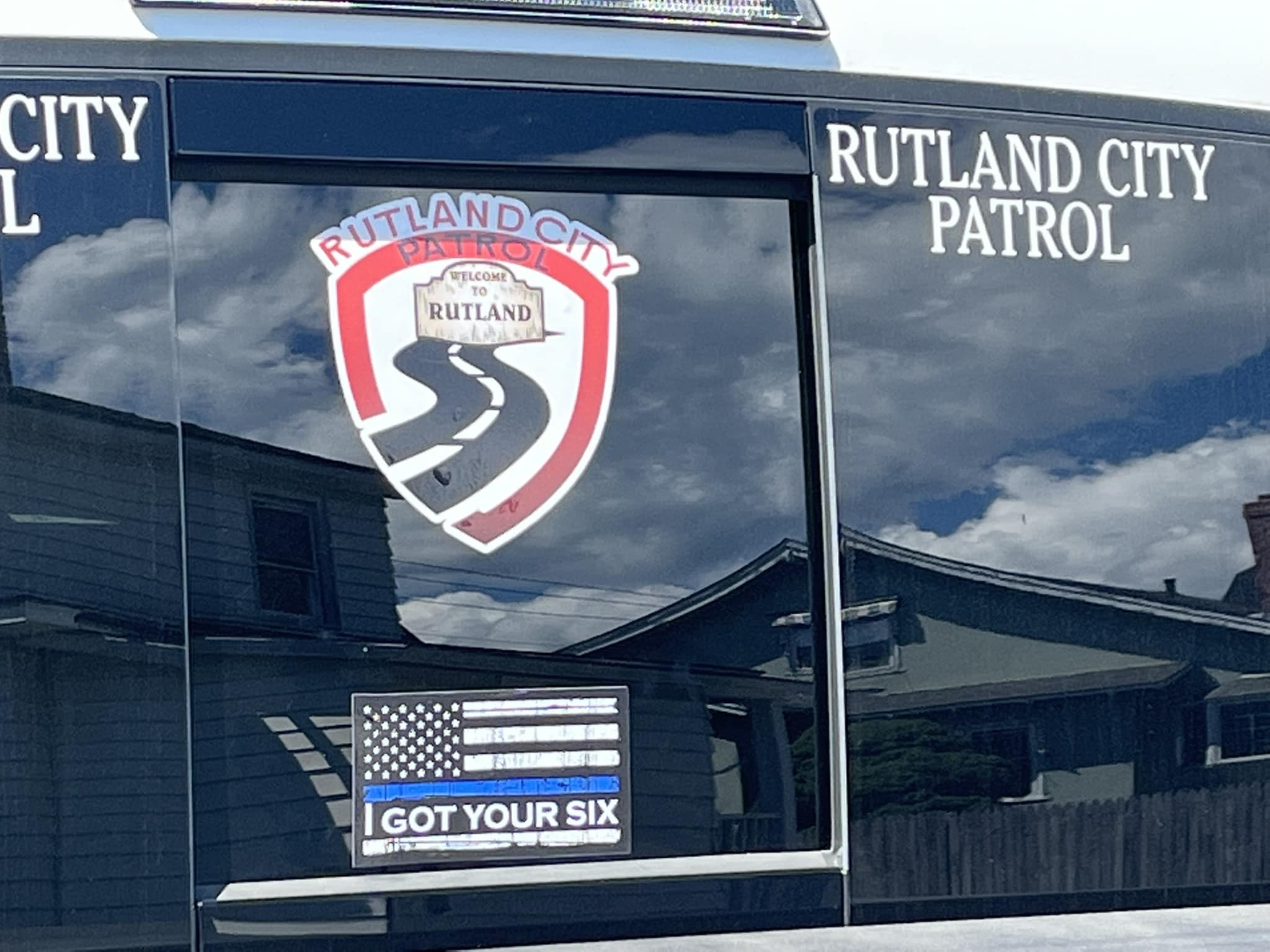
VTDigger greets us with a happy little tale from Rutland of a vigilante band taking the law into their own hands. The story is pretty thorough and goes on at some length. It’s alarming stuff, although the local cops and county prosecutor seem to be just fine with it. I mean, this could be nothing more than Neighborhood Watch on steroids, but the story leads with a shoplifter being confronted and assaulted by members of the “Rutland City Patrol.” Not a good sign.
Especially when you look at the above photo, which accompanied the Digger story. There’s the cheap-looking “Rutland City Patrol” magnetic sign. And then there’s a second sign that’s clearly associated with Blue Lives Matter.
The article doesn’t mention that. Kind of an important point, don’t you think?
“I got your six” means “I’ve got your back.” It’s used in many contexts. On its own, it’s benign. But when it’s paired with the black, white and blue flag, it’s Blue Lives Matter. And that creates a whole different context for the story and for the City Patrol.
Recently, I totted up all the recent scandals involving Vermont’s county sheriffs and asked whether we could do without that archaic institution.
Well, now I’ve dipped a toe into sheriff’s department finances, and this whole thing is a lot weirder than I realized. Not necessarily corrupt, but curious, inconsistent, poorly conceived, and sometimes mismanaged.
This is going to take a while, so I’ll summarize the key points up top.
Sheriffs are effectively proprietors of sizable small businesses. They have to be entrepreneurial to keep the lights on because state funding accounts for only a fraction of their expenses. The sheriffs make up the rest by selling their department’s services to anyone who needs policing or security. Sheriffs often handle policing for small communities — for a price. They also work for road contractors, public events, school districts, and other entities both public and private. (The Rutland County Sheriff collected close to $60,000 from the Diamond Run Mall.)
By law, sheriffs are entitled to a 5% cut of all their service contracts. They don’t all take it. Some plow the money back into the department to cover expenses. In many counties, there’s no way of telling how much of a cut the sheriff is collecting. But that 5% can hit the high five figures or even cross into six figures. It’s a lot of money.
The need to be entrepreneurial, and the prospect of collecting a share of every contract, create a strong incentive to expand offerings and find new “markets” for armed officers of the law. This is what leads to scams like the speed trap in Bridgewater, which benefits the town and the Windsor County Sheriff at the expense of inattentive drivers. Honestly, I’d be surprised if there weren’t more such things going on.
The aggravating case of John Grismore may be an outlier, but it’s only one of many problems and scandals involving county sheriffs. So much so, that it makes you wonder if the office itself is worth all the trouble.
Grismore is the sheriff-elect of Franklin County, a fact only explicable by the fact that most voters have no idea what they’re doing when they choose a sheriff. Or side judge, for that matter.
Grismore has had quite the year. He was a captain in the FCSD who won the endorsement of outgoing sheriff Roger Langevin. That was enough to scare off any other potential candidates. Then, two days before the primary election, he was caught on security camera kicking a suspect in custody multiple times (in the groin at least twice) while the man was shackled to a bench.
Then, before the assault became public knowledge, Grismore won the Republican and Democratic primaries. Nine days after the primary, Langevin announced that Grismore had been fired, and also rescinded his endorsement. The leaders of both county party committees said they considered Grismore unfit to serve.
Even after all that, Grismore won the November election against two write-in candidates. Now, Franklin County lawmakers are considering impeachment, but that seems unlikely because it’s a time-consuming process and many lawmakers don’t like going out on a limb. So this guy will apparently be sheriff for four long years despite the fact that the county state’s attorney is preparing a Brady letter branding Grismore as an unreliable witness.





 The Vermont Political Observer.