
Since October 5, there have been seveneight suspicious deaths in rural Vermont. Yes, that’s a lot. But it’s not so far out of character as we’d like to believe for our oft-celebrated countryside. Which in our mind’s eye looks less like the above and more like the below:
There is, in truth, plenty of both in rural Vermont. On balance, though, probably more of the former than the latter. Rural Vermont, like rural America, can be beautiful and ghastly, peaceful and dangerous, prosperous and abandoned.
It would behoove us to hold both pictures in mind. It might help break down the imaginary barriers between our suspect cities, full of drugs, crime, and recent arrivals, and our countryside, a paradise of scenic beauty and hardworking people. You know, the “real Vermonters” living in the “real Vermont.”
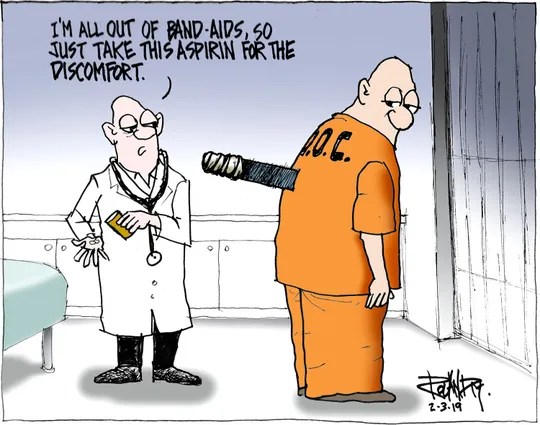
Vermont’s three-year prison health care contract with troubled provider Wellpath is off to a whizbang start. Right off the bat, 15 inmates at the Northwest State Correctional Facility were given the wrong medication by Wellpath providers for their substance use disorder. And now, we have a Wellpath employee in a highly responsible position who has — well, I’d call it a “checkered past” except that all the squares seem to be the same color.
In September, Wellpath hired Robert Stevenson to be its top employee at the Southern State Correctional Facility. Turns out Stevenson lost his nursing license in three different states for “diverting or wasting opioids,” according to VTDigger.
And we only know this because one of his subordinates looked up his record, discovered his malfeasances, and reported it to Wellpath. Its response? The whistleblower was fired.
I’d call this a clown car, but that would be unfair to clowns.
In one of his novels, Vermont’s own crime novelist Archer Mayor chose the well-kept, comfortable town of Middlebury as the scene of a Hollywood-style gun battle with the goodies and baddies firing away at each other as they drove through the center of town. Many years ago I interviewed him about the book, and he confessed to a certain sly pleasure at foisting his fictional violence on that tony, tweedy community.
Well, now the good folk of Middlebury are suddenly experiencing, if not volleys of hot lead, an uncharacteristic feeling of insecurity. And we can lay this directly at the feet of state leaders, executive and legislative, who have failed to come to grips with our crises of homelessness, substance use, and mental health.
Remember last winter when housing advocates predicted dire consequences if the state were to end its emergency motel voucher program, and warned that the short-term savings from killing the program would be far outweighed by the costs of dealing with the fallout?
Welcome to Middlebury, where unhoused folk are camping on public land. There have been incidents of vandalism. People feel unsafe. Merchants are installing cameras and exterior lights and worrying about lost business. Police are overextended. Helping agencies are struggling with too many cases and too few resources.
It all came to a head at the October 10 meeting of the town selectboard, viewable on YouTube and recounted quite skillfully by John Flowers of the Addison Independent in a story entitled “Local Merchants Rail Against Uptick in Downtown Crime.” And rail they surely did.
Last month, the Vermont Department of Corrections signed a two-year contract to continue sending inmates to a for-profit prison conveniently located in Mississippi (a mere 21-hour, 1,400-mile drive from Montpelier. Great for family visitation, no?
The news filled my head with numbers and questions. The biggest is revealed in the above chart, provided by the Corrections Department: Vermont’s inmate population has plunged by nearly half since 2009, from a high around 2,400 to 1,331 (population average since January 2019 per DOC).
So if the prison census has dropped so dramatically, why can’t we keep all our inmates right here in Vermont?
Well, the short answer is, we probably could. Especially if we enacted some basic criminal justice reforms. But the Scott administration doesn’t take kindly to such ideas, and our Democratic Legislature tends to be extremely skittish about them. So, contract extension with everyone’s favorite prison profiteer, CoreCivic. Yay?
It’s been a long, long time since Seven Days began its life as a scrappy alt-weekly in the grand tradition of the Village Voice and the Boston Phoenix. Credit for sheer survival unlike those spiritual ancestors, but it’s safe to say that 7D is now the voice of comfortable Burlington, the Good Folk who habituate Leunig’s and the Flynn Center and love to amble undisturbed on Church Street and in Battery Park.
That’s my conclusion from co-founder Paula Routly’s latest Publisher’s Note, “Burlington Blues.” She’s far from alone in expressing dismay about crime, drugs and homelessness in the Queen City. But what’s missing in her column is the tiniest shred of compassion or empathy. She seems to be describing a plague or an infestation of vermin with no sense at all that there are living, struggling human beings on the other side of this equation.
Routly seems to expect that her “beautiful burg” will forever be a playground for the well-to-do, a clean, safe, secure landscape that can be enjoyed without a second thought. She doesn’t roll out the reactionary language of “lock ’em up” or call for the BPD to let loose a SWAT team, but she makes it clear that she just wishes The Unwashed would just go away, doesn’t matter where, somewhere, anywhere, and leave this “beautiful burg” to those who rightfully deserve it.
I guess the good folks of Pawlet know how Kiah Morris felt.
When she was subjected to racist abuse and threats, the former state representative got no backing from law enforcement on any level, from the local police to the state attorney general’s office. And now the people of Pawlet have gotten the same quality service from the Rutland County Sheriff’s Office and Vermont State Police, who failed to enforce an order for the arrest of militia training center chief Daniel Banyai.
And now the arrest warrant has expired, so Pawlet is seeking an extension with the addition of court oversight so the cops can’t stall out the clock once again.
The expiration was first reported last week by the Bennington Banner, and re-reported this week by VTDigger. The details show two police agencies with no heart for the task, making excuses for their lack of action.
I get it. Driving onto the grounds of the heavily-armed Slate Ridge compound with the intent of arresting its founder seems like a perilous endeavor. But still, it’s their job.
Two stories on a common theme appeared Monday morning on VTDigger. The first was about a “spate” (their term) of deaths in Vermont’s prison system, mainly at the Springfield facility. The second was about another rise in opioid-related deaths that puts us on track to break the all-time record set in 2022.
In both, I heard echoes of the lamentable deal struck by the Legislature and Scott administration for a partial extension of the motel voucher program — an extension loaded with poison pills. Not only does the program leave 800 or so households without shelter, it also makes the voucher experience as unpleasant as possible for its clients from now on. Who are, just a reminder, some of Vermont’s most vulnerable. You know, the ones Gov. Phil Scott likes to say he’s committed to protecting. Echoes also of a fundamental approach toward human services programs for the poor: Make the experience difficult and unpleasant so recipients are incentivized to GTFO, one way or another.
It’s like a soup kitchen that dumps vinegar into its food because if it tastes good, people won’t be incentivized to get their own damn dinner. Mind you, not enough vinegar to make anyone sick; just enough to discourage them from partaking unless they’re truly desperate.
This approach is all too common in our social programs. It’s a lousy way to meet the needs of our most vulnerable. It’s morally questionable, and if you’re not into the “morality” stuff, it’s also counterproductive in terms of financials and outcomes. People suffer needlessly and face tougher barriers to achieving self-sufficiency, which I think is what we’re supposedly aiming for.
And he was, somehow, a legit national figure in his field.
Submitted for your consideration: Bill Bohnyak, former Orange County Sheriff and second runner-up in the Tunbridge Fair’s hotly-contested Alexander Lukashenko Lookalike Contest, now revealed to be a financial mismanager on an epic scale.
Reminder: This guy was president of the National Sheriffs’ Association. Well, he was until he somehow managed to lose his bid for re-election last year, after which he no longer qualified to hold the position. In the past I’ve wondered if Vermont really needed sheriffs at all; if Bohnyak was a prominent national leader of his kind, I wonder if the whole country would be better off without them. Actually, check that. I don’t wonder. I’m convinced.
Bohnyak was also a frequent and respected presence in the Statehouse, strutting around in his physics-defyingly skin-tight uniforms, advocating for the interests of law enforcement in general and the sheriffs in particular.
And now here we are, with auditors throwing up their hands and walking away from a mandatory audit of the Orange County Sheriff’s Department because its financial records were a complete shambles.
I can’t say for sure what happened in the University of Vermont Medical Center’s emergency department last August. But I can say two things: It stinks, and it makes me wonder why Burlington Mayor Miro Weinberger is so bound and determined to elevate acting Police Chief Jon Murad to permanent chief.
I mean, he’s been trying since January of 2022. And the city hasn’t had a non-interim chief since December of 2019. That’s not a healthy state of affairs.
And the ER incident, in which Murad reportedly threatened to arrest a trauma surgeon who was treating a critically wounded gunshot victim, raises legitimate questions about Murad’s temperament and respect for the law.
But even worse is how Weinberger and Murad have handled the matter since. They’ve done everything they could to cover it up and minimize the consequences. That doesn’t speak to the soundness of their position.
We wouldn’t even know about the incident were it not for Seven Days‘dogged pursuit of the story. As it is, Weinberger managed to keep it out of sight until after the defeat of a ballot measure to create an independent police oversight board.
Even better, they already know their way around the place. The new provider is Wellpath, a private equity-owned firm whose name just screams “Corporation Pretending to Care.” Under its former monicker Correct Care Solutions, it held Vermont’s prison health care contract from 2010 to 2015.
None of this is heartening, not the private equity ownership, not the trying-too-hard name, not the return engagement, not the recent rebranding, not the fact that it was one of only two bidders for the contract.
But let us not rush to judgment. Maybe Wellpath is different from all the others. Maybe it does business honorably and with the best of intentions. Wait, I know, let’s DuckDuckGo “Wellpath scandal” and see if we get any — oh dear.
Wellpath Founder and CEO Pleads Guilty to Federal Bribery Charges
Yep, that’s the first hit. It’s from March 2022, when former CorrectCare CEO Gerald “jerry” Boyle faced up to five years in the slammer for bribing a Virginia sheriff over a period of 12 years in exchange for the county’s jail health care contract. (Shortly after htat article was posted, Boyle was sentenced to three years in prison, a substantial penalty for a purely white-collar crime by a top corporate executive.)
But hey, after Boyle was indicted his former company thoroughly distanced itself from him, so it’s all good, right?
Boyle’s case may be an outlier, but this is an industry rife with incentives for abuse. Wellpath is one of its biggest and most experienced players. I’m not sure which I have less confidence in: Wellpath’s dedication to its duties, or the Vermont Department of Corrections’ ability to perform effective oversight of the deal.