Category Archives: Housing

Man, the Agency of Human Services is Really Bad At This Emergency Housing Thing

Well, in this context, “incompetence” is the charitable interpretation. The alternative is that the responsible Scott administration officials are deliberately biffing the emergency housing effort and obfuscating slash lying to try to cover it up. Fortunately, they’re pretty bad at obfuscation, too.

Actually, there’s a third thesis, and my money’s on this one: The administration has so thoroughly starved AHS of needed resources that its staff can’t possibly handle the workload, and its leadership is tap dancing around the inconvenient truth.

Let’s go back to last week’s appalling performance before the Legislature’s Joint Fiscal Committee, where AHS leaders presented their first mandatory report on the disposition of motel voucher recipients. For those just joining us, the last-minute budget compromise reached in late June continued the voucher program for most recipients, set some stringent conditions for those receiving vouchers, and mandated that AHS report once a month on progress toward ending the program and providing alternative housing for all recipients.

The report was an embarrassment, starting with a rundown of the 174 recipients who left the program in July. Of those 174, a mere 34 had found apartments to live in. (There was no breakdown on how many were helped by AHS in finding new housing and how many managed the trick on their own.) That’s less than 20% of those no longer in motels. The vast majority — 113 in all, a staggering 65% — left the program for destinations unknown because they had failed to renew their benefits, a process that appears to be devilishly difficult.

AHS Secretary Jenney Samuelson told the committee that “we had not been able to make contact with” those 113 despite multifaceted efforts. But a very different story was told by advocates for the unhoused.

Continue reading

And While We’re At It, Why Not Bring Back Eugenics?

Can somebody do a wellness check on Bill Schubart, prominent denizen of Vermont’s shallow, brackish pool of “public intellectuals”? Because he just published an essay that brings to mind the toxic excesses of early 20th Century liberalism — you know, the fine folks who enthusiastically took up the eugenics movement.

No, he didn’t call for sterilization of the unfit. But he did advocate a return to the Good Old Days when there were asylums to warehouse the many, many types of people deemed “unfit” for proper society.

He did his level best to craft a frame of compassion around this appalling idea, but it didn’t work. When you start talking about removing certain people from society, you are headed down a dangerous road.

Continue reading

It’s Going to Get Late Early Out There

I went to Shaw’s earlier this week, and was met by this massive display of Halloween candy occupying a giant bloc of high-traffic real estate almost three months before the holiday. Thought it was funny, took a pic and posted it on The Platform Formerly Known as Twitter.

It’s awfully early to be laying in the holiday treats. But it’s rapidly getting late for those trying to restore flood-damaged homes. Cold weather is just around the corner, and with it will come “the second wave of the disaster,” as homeowners and renters who can stay where they are for now could be displaced when the leaves turn and thermometers drop toward the freezing mark.

“The second wave” is how Barre attorney John Valsangiacomo, chair of the board of Capstone Community Action, expressed his concern over what’s coming in a matter of weeks. His words ring true, and there may be no way to avoid another massive displacement on top of what we’ve already seen.

Valsangiacomo was a guest on the August 9 edition of “Vermont Viewpoint,” broadcast on WDEV Radio and now available as a podcast. The show came to you live from Nelson’s Ace Hardware in downtown Barre, where host Kevin Ellis skillfully brought us the experiences and views of civic leaders and Main Street merchants.

There is much to say about the show, as well as Ellis’ equally insightful August 2 broadcast from downtown Montpelier. For now, let’s stick with Valsangiacomo’s words of warning.

Continue reading

Our Shadow Governor at Work

People occasionally tell me that I “like” a political figure I’ve praised, or “don’t like” one I’ve criticized. It’s a way of consigning my views to little boxes of emotion. It’s not about policy or character, it’s about “liking.” Or not. I find it subtly demeaning.

Former gubernatorial candidate Brenda Siegel is one of those I supposedly “like,” and Gov. Phil Scott is on my perceived “don’t like” list. Neither is true, really. With Siegel, it’s not about liking or not liking, it’s about respect. She acts on her principles. She’s the only political figure who’s put herself on the line for our most vulnerable. The much more “likable” Phil Scott has not, not at all, not ever.

He did help out a neighbor with his backhoe, an action posted on Twitter by a former member of his cabinet. The tweet triggered a widespread fluttering of hearts in #vtpoli circles. What a great guy! What an authentic Vermonter, helping out a neighbor in time of need!

Yes, well, I’ve always thought Phil Scott would make a fine neighbor. I’m sure he’s always ready to help out, especially if it gives him a reason to haul out one of his big-boy toys. But there are no circumstances that would find him slogging through floodwaters, rescuing unhoused Vermonters from a riverside encampment as Siegel has done.

Continue reading

“They are building a prison, not a shelter”

Hearty congratulations to the good people of Hyde Park, who have “amicably resolved” a dispute over the siting of a homeless shelter. “Amicably” is the word chosen by VTDigger’s social media poster to describe a deal that will severely restrict the civil rights of shelter residents, so the amicability does not extend to the unhoused.

The story as a whole, originally posted by the News & Citizen of Lamoille County, betrays a complete blind spot where the unhoused are concerned. Nowhere are their thoughts or feelings expressed, nowhere are they seen as anything other than pawns in a game. And I must confess a similar blind spot; the import of the story didn’t hit me until housing activist Josh Lisenby pointed it out on Twitter, which I refuse to call X. In fact, I borrowed the headline of this post from one of Lisenby’s tweets.

The tale of this amicable resolution is a tawdry one all round. It begins with Lamoille Community House proposing to open a shelter at what is now the Forest Hill Residential Care Home. That much is fine; cue the tawdriness, in the unshocking form of a California tech entrepreneur who looks, well, exactly how you’d expect he looks.

Continue reading

One “Minor” Consequence of the Flood: A Dramatic Shortage of Legal Representation for Renters

Even in the best of times, the court system is stacked against renters. When landlord/tenant disputes arise, property owners can afford lawyers while renters cannot. The flood will seriously exacerbate this imbalance. As I predicted back on July 14 and VTDigger reported on, ahem, July 31, the flood “disproportionately hit Vermont’s affordable housing stock.”

All those renters occupying flood-ravaged housing will find legal resources very difficult to come by. The scope of this problem has yet to unfurl, and it’s going to be bad for months to come. At minimum. A lot of tenants are going to get screwed.

“There are very few private attorneys who will represent tenants, who are generally low income and unable to pay,” said Sam Abel-Palmer, Executive Director of Legal Services Vermont, a nonprofit focused on civil litigation. His organization and Vermont Legal Aid try to make up for the failure of the free market, but they can offer perhaps 10 full-time attorneys to help all the renters in Vermont. Besides that, there are a few private lawyers who take some cases on a pro bono basis and the state Bar Association pays reduced fees to some members who represent renters.

That’s about all. It falls short of meeting the need, even in the absence of a major disaster. “We sometimes can take cases, sometimes we can offer advice,” said Abel-Palmer.

And now?

“It’s not remotely enough,” Abel-Palmer said.

Continue reading

From the Dept. of Utterly Predictable: Small Towns Dealing with Rise in Homelessness (UPDATED)

This space, April 11, regarding the Legislature’s intent to end the motel voucher program:

Much of the impact will fall on municipalities. You’d think the Vermont League of Cities and Towns might declare an interest in preventing their members from taking it in the shorts. You’d think the mayors would be tramping to the Statehouse to beg the state to bear the responsibility instead of fobbing it off.

Well, the mayors did not, in fact, tramp to the Statehouse, nor did the very influential VLCT bring its considerable muscle to bear. Cue the consequences.

WCAX: “Smaller Vt. Towns Now Coping with Unhoused Population.” Comment from St. Johnsbury Town Manager Chad Whitehead: “This is happening across the entire state. I have talked with numerous town managers, and many population centers have been having this issue.”

The Journal Opinion: “For the second time this month, community members asked the Bradford Selectboard for help in addressing escalating homelessness in town.”

UPDATE. WCAX just ran a piece about downtown Burlington merchants “experiencing some challenges with foot traffic,” according to Colin Hilliard of the Burlington Business Association. One merchant reported “an increased population” of the unhoused on Church Street because of changes in the voucher program.

Yep, those merchants and their organizations should have been in there fighting for shelter, but they weren’t.

Continue reading

Anything for the Unhoused? Anything at All?

The news is full of stories about the aftermath of the great flood. Our political leaders are fully engaged on the issues of flood relief. We hear about the plight of homeowners, renters, small businesses, and the various public and private efforts to help them in time of need. But there’s one group we hear little to nothing about.

It’s the people who had no home or shelter when the rains came on July 10.

The attitude among our leaders appears to be that after all, the unhoused had nothing before the flood, so did they really lose anything?

That may strike you as an unfair characterization, but it’s kind of baked into the disaster relief system. People and businesses get help based on tangible, reportable property losses. No property, no losses, right?

This includes the 750 or so households we sentenced to homelessness on June 1 when Gov. Phil Scott and Legislature tightened eligibility standards for the motel voucher program. The state made no particular effort to track those people after their forced exit. No one seems to know where they are or what their living conditions are like.

WCAX-TV just ran a story entitled “Where are evicted hotel-motel program recipients staying?” Unfortunately, it made no real effort to answer its own question. There were estimates from Burlington about the increase in the unhoused population since June 1, but nothing beyond the city limits.

And now we’ve added God knows how many more to their number. I’m sure God knows, but I don’t see any effort by our earthly leaders to track the newly unhoused. Have there been any efforts to expand shelters that were at or near capacity before the first drop of rain fell? Has anything been done for them besides handing out tents?

Continue reading

This Is the Easy Part

Gov. Phil Scott is getting positive reviews for standing tall in the public eye, projecting an aura of confidence and strength, displaying leadership in a time of crisis.

All good things, to be sure. But I remember in 2011 when his predecessor Peter Shumlin got the same kind of plaudits for his handling of Tropical Storm Irene. But it turned out that Shumlin was a much less skillful administrator in the absence of a crisis. From this I learned that crises are not the true test of a leader. You need definite skills in such moments, but they are not the same skills that make someone an effective manager in “normal” times or a visionary who can steer the ship of state in a positive direction.

Phil Scott’s true test will come after the immediate crisis, when he will have to learn the right lessons from the Flood of 2023 and craft policies to minimize the chances of similar disasters in the future. And to do so even if it means re-examining his own beliefs and preconceptions, something that hasn’t been his strong suit in the past.

Continue reading

Have Our “Most Vulnerable” Become Our “Most Disposable”?

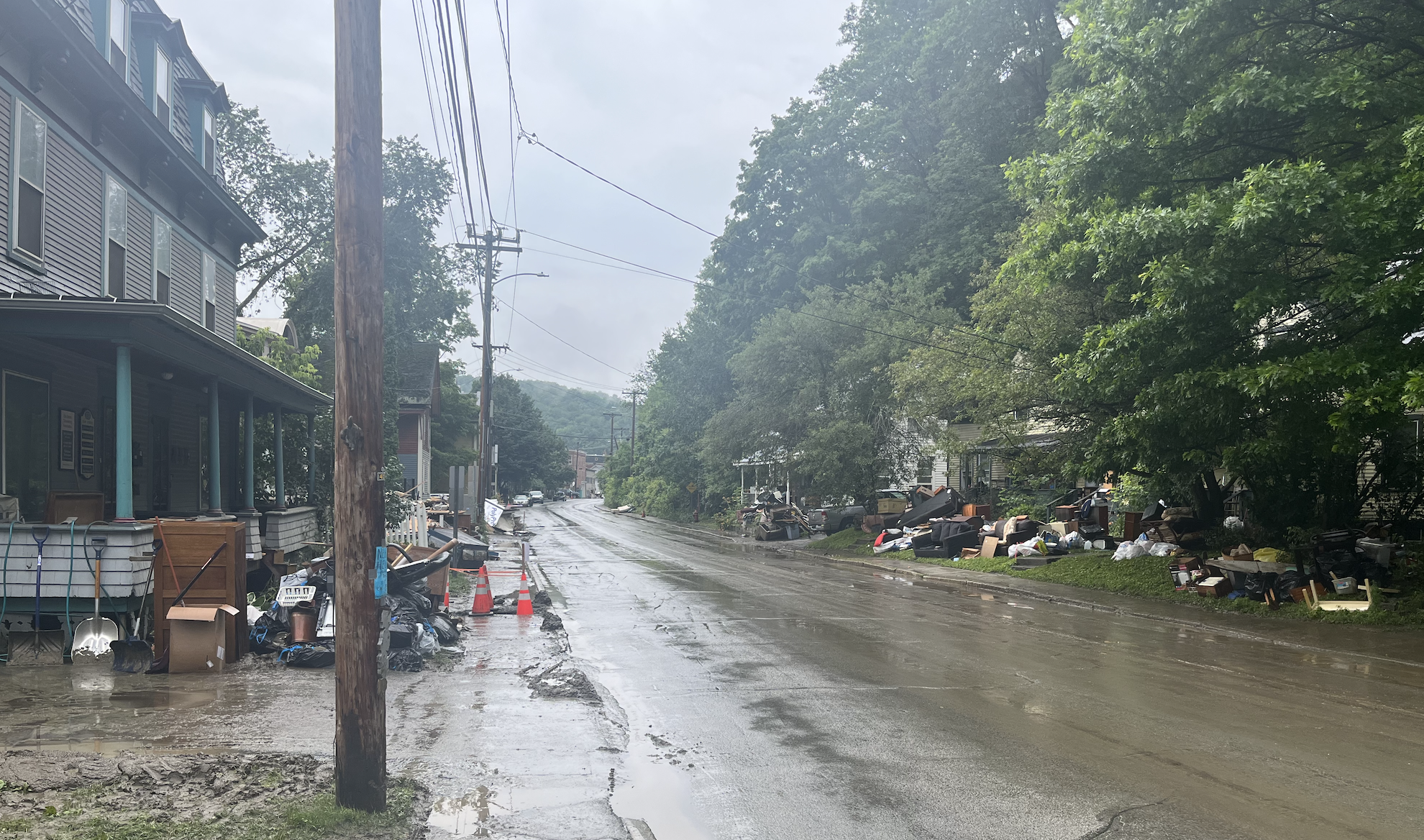
The scene above is on Elm Street in Montpelier, one block over from Main. It’s a low-lying stretch running parallel to the North Branch of the WInooski River. And it’s one of thousands of similar city and town streets where poor and working class people live.

Or used to, anyway. Where they live now, I have no idea.

Vermont’s cities and towns were largely built along waterways, which were used as open sewers for industries of all kinds. That’s why your typical Vermont town has its back to the river. Nobody wanted to be anywhere near it.

So, of course, that’s where the poor and working class people lived while their bosses took the high ground. You didn’t see any mounds of trash, each one representing a ruined life, in front of the stately homes on College Street, now did you?

And still today, the poor and working class people live in low-lying areas prone to flooding because that’s where the affordable housing is. Those areas are more and more flood-prone as climate change bears its fangs. It’s a huge and largely unspoken climate justice issue that we have yet to address in any comprehensive or meaningful way.

In the meantime, how many of those people have just joined the ranks of the unhoused — just as Our Betters have shut down eligibility to the motel voucher program except in rare circumstances?

Continue reading