Category Archives: Energy issues

The Inaugural Address: A pretty good start

The speech by Governor Shumlin — which he billed as the first of two parts — included some welcome elements. It left a lot unsaid; presumably he will confront property taxes, school governance, health care, and government spending in his budget address next week.

Today’s address focused on two areas: energy, and the environment. In the latter category, his primary focus was on Lake Champlain. It was, if I recall correctly, the first time he’s drawn attention to these issues in a major January speech. To me, it’s a welcome development.

It’s also an opening for him to regain some credibility among liberals. When Peter Shumlin was running for Governor in 2010, his two big issues were single payer health care and the environment (climate change, green energy and Vermont Yankee). But while his administration has made some good incremental gains on the latter issues, they’ve never seemed to get the spotlight. Now they have.

With single payer off the table, perhaps Shumlin is returning to his other signature issue and hoping to put his stamp on Vermont’s future on energy and the environment. If he can’t be the single-payer governor, perhaps he can be the environmental governor. It’s a good strategy.

The caveat, of course: Now he’s gotta deliver.

He also opened the door to raising taxes as part of the effort to close a $100 million budget gap. In a brief preview of next week’s budget address, he said this:

We cannot simply cut our way out of our fiscal challenge year after year – taking away services that are important to so many Vermonters. Nor can we tax our way out of the problem.

Which would seem to indicate that his plan will include a mix of cuts and “revenue enhancements.” I’d urge him to take a long look at the plan that nearly passed the House a couple years ago, which would have raised taxes on the wealthy (by closing loopholes and limiting deductions) and provided some tax relief to the middle and working classes. I say “nearly passed the House” because it was stopped in its tracks by Shumlin’s stubborn opposition.

As for the details on energy and the environment:

The centerpiece on energy is a new renewables strategy, as the current (and, in some circles, controversial) SPEED program is sunsetted in 2017. The Energy Innovation Program is aimed at further boosting our investment in renewables and energy efficiency. Shumlin called the EIP “our single biggest step so far toward reaching our climate and renewable energy goals.”

Sounds good. We await the legislative process with anticipation and a bit of trepidation.

On Lake Champlain, Shumlin came up with a decent-looking package. It doesn’t go far enough, but it’s better than anything he’s offered before. He realizes, as he told the legislature, that if the state fails to meet EPA muster, we’ll face some burdensome federal regulations.

His plan includes:

— New transportation funding to curtail runoff and erosion around our roads and streets.

— New funding and technical assistance for farmers and loggers, to help them meet water-quality standards.

— More thorough efforts to enforce current water quality regulations.

— Making a change in the Current Use program, which would take away that tax break from farmers who fail to reduce pollution.

As for funding, his plan includes two new fees: One on agricultural fertilizers, and one on commercial and industrial parcels in the Champlain watershed.

The revenue would go into a newly created Vermont Clean Water Fund, a repository for state, federal and private funds. The first private money, he announced today, is a $5 million donation (over the next five years) from Keurig Green Mountain, which Shumlin called “a company that depends upon clean water.” He expressed the hope that KGM’s generosity will “inspire others.”

If he can leverage substantial donations from the private sector, his plan could accomplish quite a bit without too much stress on the state’s bottom line. Maybe enough to get the EPA off his back, at least for a while.

From this liberal’s point of view, it’s a good start. But as VPR’s Bob Kinzel said today, the Governor effectively served us dessert before dinner. Next week’s budget address will be a much less appealing dish. Plenty of mushy steamed vegetables scattered around a hunk of gray meat.

Beyond that, well, actions speak louder than words, and we’ve heard plenty of words from this Governor in the past. The political question is: Can he deliver on this agenda in a way that will repair his reputation for effective governance and bring liberals back into the fold? He can; but will he?
Bernie bullies the tycoons

Oh noes, the tender hearts of Wall Street have been bruised beyond healing. And the man responsible for this crime against humanity?

Bernie Sanders, of course.

Oil trading data that exposed the extensive positions speculators held in the run-up to record high prices in 2008 were intentionally leaked by a U.S. senator, sparking broader concern about industry confidentiality as Congress moves on Wall Street reform.

Senator Bernie Sanders, a staunch critic of oil speculators, leaked the information to a major newspaper in a move that has unsettled both regulators and Wall Street alike.

For those with short memories, the 2008 oil price spike immediately preceded the mortgage meltdown and near-implosion of the economy. In retrospect, the oil business may have gotten lost in the shuffle. But it was huge at the time; there were predictions that oil prices would shoot through the roof, sending many Vermonters scurrying to pre-buy their heating oil. At what turned out to be the very peak of the market.

The primary cause of that spike was not demand or global instability or exploration failures; it was the severe warping of the market at the hands of speculators. The notable non-Socialist Matt Cota of the Vermont Fuel Dealers Association put it this way in 2008:

The problem is that the trading of oil has been deregulated. And large financial players are dominating the market. A recent Washington Post article showed that 81 percent of future oil contracts are controlled by non-physical players — people who don’t own trucks, people who just trade paper.

…It’s provided volatility to a market that, frankly, is so vulnerable to volatility. We’re talking about a product that people need to get to work and to heat their homes. And for this to be used as a financial tool, so Wall Street traders can make billions, is shameful.

Shameful indeed. And now comes Bernie Sanders, revealing the extent of speculative perfidy:

“The [Commodity Futures Trading Commission] has kept this information hidden from the American public for nearly three years,” he said. “This is an outrage. The American people have a right to know exactly who caused gas prices to skyrocket in 2008.”

… The leaked data contains long and short positions held by oil traders in 2008, the same year that oil prices spiked to $147 a barrel. Critics at the time accused oil speculators of driving up prices, leading lawmakers to later insert a provision into the Dodd-Frank Wall Street overhaul law compelling the CFTC to place stricter limits on how many commodity contracts any one trader can control.

Sanders was perfectly within his rights to release the data. According to Reuters, the CFTC is legally barred from such releases, but it is bound to give information to members of Congress upon request. They are not constrained from releasing the information.

But regulators and Wall Street sharpies are worried that making the data public makes them look really bad might have “a chilling effect on derivatives trading,” according to John Damgard, the head of the Futures Industry Association.

Heavens to Betsy, I certainly hope so. Our economy would be a lot healthier and more stable if there was a lot less dicking around with futures and derivatives, and more focus on productive activity that makes stuff, creates jobs, and generates honest profits.

(Great line from Lewis Black: There should be a law that says if you have a company, and you can’t describe what it does in one simple sentence, it’s illegal.)

Sorry, Mr. Damgard. I ran a thorough self-diagnostic, and I found no trace of sympathy. Take your hurt fee-fees and go swim with the other sharks.

Closing time

Shoutout to my favorite one-hit wonder of all time…

So gather up your jackets, move it to the exits

I hope you have found a friend.

Closing time

Every new beginning comes from some other beginning’s end

And here we are, on The Last Day of Vermont Yankee. Or, as @GovPeterShumlin put it:

Yeah, well, as if.

Problem: today is not “the end of years of controversy.” It is, in the questionably immortal words of Semisonic, “some other beginning’s end.”

What ends today is the productive phase of Vermont Yankee’s history. What begins is the long slow wait for decommissioning. The chances of an accident will diminish, but we’ll still have a whole lot of hyper-toxic stuff SAFSTOR’d on the banks of the Connecticut River.

Look at it this way. The “lifespan” of Vermont Yankee was 42 years. The “deathspan,” if I may coin a word, will be AT LEAST 30 years. That’s the optimistic forecast for decommissioning. And that’s heavily dependent on the always-reliable, ha ha, stock market: Entergy’s decommissioning fund sits at $665 million, a little more than half the estimated cost of decom. Entergy says it won’t start decom until the fund grows to cover the entire (estimated) $1.24 billion price tag.

But hey, the markets always go up, right?

The way Entergy puts it, they’re doing us a big fat favor by planning the decom for the 2040s. By federal standards, they don’t have to do it until 2075.

Sixty years away.

In that scenario, the “deathspan” of the plant will have been 50% longer than the lifespan.

That’s the problem with nuclear energy. I’m not necessarily against nukes; if managed correctly, they do provide reliable carbon-free power. But there’s that long, lingering afterlife — and corporate America has never shown much dedication to long-term responsibilities.

Nor has public America, for that matter; we have yet to devise a long-term storage plan for all that nuclear waste.

Anyway, I suppose @GovPeterShumlin is only doing what a governor has to do: putting the best face on a decidedly mixed reality.

But I’d be very surprised if this was, in fact, “the end of controversy.”

And in the words of Semisonic, wherever they are today:

I know who I want to take me home,

and it ain’t Entergy.

The gang that couldn’t dig straight

That was quite a heapin’ helpin’ o’ bad news served up by Vermont Gas this morning. It announced yet another big cost increase for Phase 1 of its pipeline project, and asked state regulators to put the case on hold.

Which is, if nothing else, a sign that they realize how bad their situation is. How bad?

Yeeeesh. Company officials insist the pipeline is still economically viable, but it’s a lot less viable than originally thought. That changes the cost/benefit equation — which should include the environmental questions — quite a bit. In other late-breaking realizations…

Mm-hmm, I’ll bet. As I wrote in early September, Vermont Gas has been its own worst enemy, coming across as bullies with landowners, and as questionable managers with state regulators.

Whether its bumblefuckery is enough to shelve the project remains to be seen. Today’s announcement is the beginning of a new phase in the history of this proposal. Up till now, the economic arguments in favor of the pipeline had been strong enough to overcome resistance from the environmental community and a small number of landowners.

Those arguments are a lot less strong today. Vermont Gas has given the state a big fat excuse to kill the project — at a time when Governor Shumlin (to be entirely political about it) desperately needs a high-profile issue on which he can pander to the left. Well, if he wants one, he’s got one.

Update. The Governor has released a statement, and yes, he sees an open door in front of him.

Although I am pleased that the new leadership at Vermont Gas is taking the time to reevaluate the proposed projects, this further cost increase is very troubling. In the coming weeks my administration will be evaluating all of this new information and looking at these projects as a whole to ensure that they remain in the best interest of Vermont. Meanwhile, I expect Vermont Gas to also reevaluate its communications and negotiations with affected landowners to help improve relations. I trust those steps will continue.

The need for SPEED

Vermont’s SPEED program is in the news again. And, as is usually the case, much of the coverage misses the point. As does all of the criticism.

SPEED, for those just joining us, is short for Sustainably Priced Energy Enterprise Development. It was enacted by the legislature in 2005; its aim was to encourage development of renewable energy, which at the time was in an embryonic stage and suffered from competitive disadvantages.

(It was more expensive than fossil fuels. Which, of course, benefit from tax credits and other forms of government largesse, and the harm they do to the environment is not factored into their pricing, so they are much cheaper than they ought to be.)

As I explained in a nice long 2013 thumbsucker on Green Mountain Daily:

SPEED was designed to surmount the chicken-or-egg problem with renewables: the upfront investment is relatively large, making renewables uncompetitive at the beginning. Over time, their costs drop dramatically because, well, they’re renewable: no need to keep on buying fuel. SPEED provided a market-based solution to the initial-investment problem by allowing utilities to sell long-term contracts for renewable power. Without SPEED, adoption of renewables in Vermont would have been much, much slower.

The program’s critics say the trading scheme means that our renewables are, in effect, enabling the use of dirty energy elsewhere. In particular, SPEED’s been used as a punching bag by opponents of wind and solar power.

Today, there are stories on VTDigger (pretty good) and VPR (not so good) about the Shumlin administration definitely (VTDigger) or possibly (VPR) planning to phase out SPEED in 2017.

Well, hell. That was the plan from the very beginning. SPEED was meant to goose the renewables market. And it’s worked: according to VTDigger, “The state has built wind, solar and other renewable power generation that could supply about 15 percent of the state’s electric retail sales.” That’s substantial progress.

Rep. Tony Klein, D-East Montpelier, displays some of his vast knowledge.

Rep. Tony Klein, D-East Montpelier, displays some of his vast knowledge.

SPEED was designed to be temporary, and was set to expire in 2017. It could have been extended, to be sure; but one of the House’s top energy people, my own state representative Tony Klein, has been saying for a long time that SPEED would sunset on time.

And on Saturday, Governor Shumlin told the House Democratic caucus that SPEED would be scuttled on schedule. VPR’s John Dillon somehow missed this; he has the administration merely considering a change to SPEED. (The VTDigger story has the administration “calling for an end” to SPEED, which is closer to the mark but not quite there.) In his story, Dillon gives extensive time to the Vermont Law School’s Kevin Jones, who’s had a bug up his butt about SPEED for a long time.

“For me, it’s at least a step in the right direction for the Public Service Department and the Shumlin administration for finally acknowledging that the SPEED program does not work in terms of providing any climate mitigation,” he said. “As a matter of fact, it has increased Vermont’s carbon footprint, by something, according to their analysis, like 70,000 tons in greenhouse gas emissions in 2013 alone.”

Jones’ interpretation is ignorant at best, disingenuous at worst. The DPS and administration are not “finally acknowledging” anything; they are letting SPEED expire on schedule.

And the purpose of SPEED was not to immediately mitigate Vermont’s carbon footprint; it was to hasten development of renewables so our longer-term footprint would decrease.

Also, SPEED may have “increased Vermont’s carbon footprint,” but only technically: the renewable credits were sold out of state, but the energy was still being produced, thus reducing the region’s carbon footprint while  — again, technically, and only in the short term — increasing our own.

Finally, a misperception from VTDigger’s article:

The state’s goal is to generate 20 percent [of electricity via renewables] by 2017, but there is no requirement in state law that this power is to be sold to Vermont customers.

This reflects a fundamental misunderstanding of electric markets. In the absence of large-scale storage technology, electricity is produced, transmitted, and consumed all at the same time. The power grid is a regional creature, networked to the national grid. There is no way to tease out which energy came from where and ensure its consumption within the state of origin. Such a “requirement in state law” would be technologically laughable.

Vermont’s power — renewable, dirty, Vermont Yankee, whatever the source — goes into the grid at the same time as power from out-of-state sources; it’s shunted around the grid to where it’s needed at that moment, and consumed. It’s like taking a cup of your tap water, pouring it into a bucket of water, and then wanting to take back your own water. Can’t be done.

Which is at the heart of the anti-SPEED absurdity. The renewable energy whose development was fostered by SPEED went into that big bucket. Whether or not it was immediately credited to Vermont’s account, it exists, and it helps reduce the region’s dependence on dirty energy.

The SPEED program has had a purpose. It has served that purpose well. Now it’s time to move on. And we will.

Shumlin: “We have a structural deficit” and other happy tidings

The Governor addresses the multitudes. (The bearded man begging for change is Dave Gram of the Associated Press.)

The Governor addresses the multitudes. (The bearded man begging for change is Dave Gram of the Associated Press.)

An uncharacteristically subdued Governor Shumlin held an agenda-free news conference this morning. I emphasize “agenda-free” because his past practice has been to piggy-back news conferences onto photo opportunities or policy announcements, leaving much less time for general questions.

Today there were a lot of questions and a lot of substance. In no particular order…

The Vermont Health Connect website will go back online this Saturday, which happens to be the first day of open enrollment. So the relaunch will come on the last possible day. Gee, hope things go right; there’s no margin for error.

Shumlin pronounced himself “optimistic,” saying “I’m encouraged by what I’m hearing.” But given how often he, and we, have been burned in the past, he was reluctant to make any predictions. “I’m always hoping it will work.”

— He dismissed Republican calls to shut down VHC and go with the federal exchange, and he had several good arguments. First of all, it’s far too late to make the change this year, so we’d be limping along with VHC for another year in any case. And there are signs it’s finally getting on track. “We’re turning a corner,” he said. “Why not give it a chance?”

There’s also the fact that the federal exchange’s premium subsidies aren’t as generous as Vermont’s. Switching to the federal system would mean higher premiums for thousands of Vermonters who earn between 100-300% of the poverty line.

And, as he pointed out, the US Supreme Court may well strike down federal subsidies, in which case only states with their own exchanges will be able to offer subsidies.

— Get ready for a slam-bang legislative session. Shumlin is still talking about the next step in health care reform (see below), the legislature is hell-bent on property tax and/or school funding reform, Shumlin is talking about significant changes to energy policy, and perhaps worst of all, the quote atop this post: “We have a structural deficit at this point.” Meaning huge challenges in fashioning a budget. That’s a hell of a lot of big, contentious issues to tackle.

Temba, his arms wide.

Temba, his arms wide.

— Speaking of the budget, Shumlin acknowledged that Vermont and many other states “thought the recovery would be more robust,” and its weakness has caused revenue shortfalls. He’s talking about a second round of rescissions in this year’s budget, although he said nothing is final just yet. And he’s talking about major changes in next year’s budget in order to put an end to annual budget crises.

He wants to put the state on a more sustainable path. Which must be making a few Republicans chuckle, since they’ve been preaching this for years. On the other hand, Shumlin has a valid point: the recovery has been weak. If we’d had a normal recovery with decent wage gains, our tax revenue would be stronger and we wouldn’t be facing this dilemma. The big news on this front is that the Governor now believes we’re facing years of sluggishness, and we need to ratchet down the budget to make it sustainable.

When asked whether this might mean tax increases, he didn’t rule them out, but he made it clear that his first choice is to rein in spending.

— On the push for single-payer health care, he repeated his longstanding support for the idea, but acknowledged that in the wake of the election, everything is on the table. He is aiming for a system that combines affordability with universal access to health care. His preference remains single-payer, but it’s looking like we might settle for less than that.

— He made it clear that yes, he won the election, and he has no doubt that he will serve a third term. He pointed to Vermont’s long tradition of electing the top vote-getter when no one wins a majority: ‘The person who gets the most votes, wins.” He cited the 2002 election for Lieutenant Governor, in which he and Progressive Anthony Pollina combined for a liberal majority but Republican Brian Dubie won the most votes; he and Pollina urged lawmakers to elect Dubie, which they did.

— On school funding and organization, he declared “We have a spending problem,” with high per-pupil costs and administrative structures. In some cases, he said, small class sizes can be harmful to achievement rather than helpful. He’s not in favor of mandatory school consolidation, but it’s clear he will push for consolidation by trying to convince local districts that it’s in their best interest.

He did mention the idea of “prioritizing funding to schools that voluntarily consolidate.” That kind of legislative payola may be effective, but it kinda stretches the definition of “voluntary.”

— In a less wide-ranging news conference, his comments on energy policy might have made headlines. They’re likely to get lost in today’s news. He noted the pending sunset of the SPEED program, which has helped spur the renewables industry in Vermont but has also created controversy because it allows the sale of “green” energy credits in other markets. He and the legislature are working on “ideas to replace SPEED.”

He was asked about the prospects for a carbon tax with offsetting cuts in other taxes — a plan likely to be announced tomorrow by a coalition of environmental groups. He was cool to the idea, saying “It’s tough for a small rural state to do it alone,” and pointing particularly to its impact on gas stations near our state borders. He prefers a regional carbon tax instead; but he said he’s had no conversations with other northeastern governors about the idea. Methinks the enviros will have a hard time gaining traction, when you combine Shumlin’s reluctance with an extremely busy legislative session.

— Finally, he was asked about marijuana legalization. He said he wants to wait until the release of a report on the idea in January before proceeding, but noted that “I support legalization. The question is “when.”

Sometimes, no matter what the cost, you just gotta make a stand

In the course of human events, there comes a time for a single heroic action that can spell the difference between ruination and glory. At moments like these, great figures arise, making statements that ring true across the centuries, imspiring new heroes with the sheer power of their words.

“I regret that I have but one life to give for my country.” — Nathan Hale

“Don’t give up the ship!”  — James Lawrence

“Damn the torpedoes, full speed ahead!”  — David Farragut

“I shall return!” — Douglas MacArthur

“We will bury you!” — Nikita Khruschchev

Oops, I don’t know how that last one got in there. Sorry. But you get my drift.

And today, in the midst of desperate times, another hero strode forth:

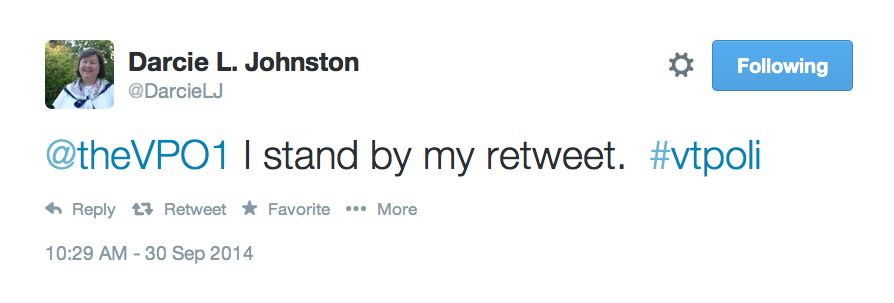
Screen Shot 2014-09-30 at 4.55.42 PM

“I stand by my retweet.” George S. Patton couldn’t have said it any better.

Really, I’m glad I wasn’t drinking coffee when I read that, because I would have had hot java up my nose and down my shirt.

A bit of context, for those just joining us. Earlier today, I wrote about a fatally flawed essay by James Conca of Forbes Magazine, which blamed rising energy prices in New England on “Vermont’s choice” to close the Vermont Yankee nuclear plant.

Which is nonsense; the plant’s owner pulled the plug for financial reasons. But that didn’t stop Vermont conservatives, who should know better, from latching on to the erroneous column. One of the guilty was Darcie “Hack” Johnston, hapless campaign consultant, who eagerly retweeted a link to the Concatenation. And when I noted the duplicity of glomming onto a fundamentally flawed essay, Johnston issued her broadside.

“I stand by my retweet.”

That’s gotta be one of the most ridiculous attempts at inspirational rhetoric I’ve ever seen.

Go ahead, @DarcieLJ. Stand by your tiny evanescent masterpiece.

When a crucial omission becomes a Big Lie

On Monday, the Forbes website posted a piece by columnist James Conca entitled “Closing Vermont Nuclear Bad Business For Everyone.” Judging by Conca’s oeuvre, he is a complete apologist for nuclear energy… but that’s not my point here.

My point is the fundamental dishonesty of his column, based upon one crucial omission. And I quote:

Two electricity distribution companies in Massachusetts and New Hampshire announced electricity rate increases for this winter. This collateral damage results from Vermont’s choice last year to close the Vermont Yankee nuclear power plant. That choice has hurt rate-payers in their neighboring states.

Catch it? “Vermont’s choice.”

As anyone with the most glancing exposure to the facts could tell him, it was not Vermont’s choice to close Vermont Yankee. It was plant owner Entergy’s choice, For financial reasons having to do with changing market forces, not with Vermont’s overzealous radical socialist hippie-dippie hatred of Big Nuke.

Sure, Vermont had a more skeptical regulatory eye than other host states. Completely justified, IMO, because of Entergy’s terrible track record as plant operator. But Entergy made the decision to close VY on its own. It was a surprise to everyone in Vermont, because it came in the midst of Entergy’s full-court-press legal battle to keep VY open. Indeed, by all indications, Entergy was very likely to win the case and a 20-year license extension.

Mr. Conca is either criminally uninformed for an energy columnist at a major publication, or he’s ignoring the facts to suit his argument. In short, he’s either stupid or a liar.

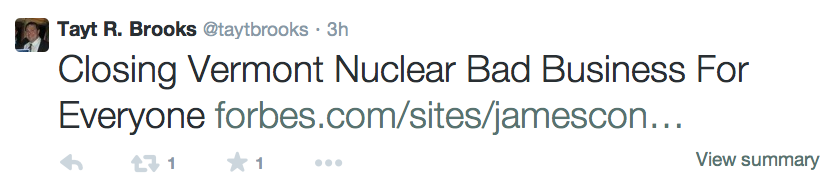
All that is bad enough. But now, at least three members of Vermont’s terminally frustrated conservative minority have picked it up.Screen Shot 2014-09-30 at 10.58.34 AMScreen Shot 2014-09-30 at 11.20.05 AM

Ah, the immortal Tayt Brooks, former Douglas Administration functionary, former secretive head of the very secretive Lenore Broughton’s failed SuperPAC, Vermonters First, now the Vermont rep for American Majority, part of the Koch Brothers’ far-flung empire of innocuously-branded nonprofit organizations.

And then there’s Brian Keefe, bagman for Central Vermont Public Service. Retweeted by serially failed campaign consultant Darcie “Hack” Johnston, currently serving as unpaid consultant to the Dan Feliciano campaign.

As an outsider, James Conca may have the slightest figleaf of deniability for basing his argument on a canard. But Brooks, Keefe, and Johnston cannot possibly claim ignorance.

No, they’re spreading this column around because it suits their political interests, regardless of how it misrepresents the real situation.

I’m sure this is just the beginning of Vermont conservatives’ efforts to trumpet Conca’s essay as more proof of the evil Democrats’ anti-business agenda. Even though they know full well that the entire column is built on a foundation of quicksand.

Rob Roper? El Jefe General John McClaughry? “Super Dave” Sunderland? Scott Milne? Dan Feliciano? I’m lookin’ at you.

Meet the new bird, not the same as the old bird

Oh, goodie.

[Vermont’s state bird, the] hermit thrush is just one of half of Vermont’s more than 200 nesting bird species threatened by rising temperatures that are reducing the breeding range of flyers that prefer cooler climates, according to a new National Audubon Society study.

“Every year migrating birds tell us that the seasons are changing,” says Jim Shallow, Audubon Vermont’s conservation and policy director.

… “The potential is there for about 50 percent of our birds in Vermont to see big shifts in their ranges,” Shallow says.

If we’re taking nominees for a replacement State Bird, how ’bout the flamingo?

Seriously, though. One of the arguments from the anti-renewables crowd is that we need to preserve Vermont as it is. Only problem is, that Vermont is under assault from climate change. If you think a few ridgeline wind farms will fundamentally change the character of Vermont, just wait till global warming starts kicking our ecological ass. If you don’t want to see any turbines in your viewing space, just wait till we lose all the maple trees and snow cover.

And then there’s the follow-on argument: We can’t affect the course of climate change because of China or tar sands or Al Gore’s travel schedule or NASCAR or Shumlin’s SUV, so why should we even try?

To which I say: (1) we have a moral obligation to do our best, (2) if we all think that way we’ll never get anything done, and (3) as with health care, Vermont can serve as a model for others to follow.

If we’re ever going to get a handle on carbon emissions, it’ll be through creating a fundamentally different system for energy generation and distribution — a smaller-scale, more broadly distributed system where the environmental footprint is much lighter because it’s spread evenly. That’ll require, among other things, a goodly helping of wind, solar, and hydro power — the resources Vermont can tap in abundance.

It might not be enough to save the hermit thrush, but it might help prevent its replacement by a bright pink bird that likes to stand on one foot.

Scott v. Corren, round one: a spirited, informative debate

The two major-party candidates for Lieutenant Governor stood their ground and clearly articulated their positions in their first debate this morning. Incumbent Republican Phil Scott and Prog/Dem Dean Corren debated on WDEVs Mark Johnson Show, broadcasting from a windy, chilly Tunbridge World’s Fair.

(Johnson has posted the audio as a podcast for your listening pleasure. Also, the video is available here, thanks to CCTV.)

Scott and Corren provided the voters with a clear choice… although the Scott option involves his usual bobbing and weaving on the issues. But that’s Phil Scott, and he said as much in his closing statement: if you like the job I’ve been doing, I promise two more years of the same. Corren made a strong, understandable case for his progressive agenda, particularly single-payer health care.

Neither candidate made any notable stumbles. If you went in a Phil Scott fan, you almost certainly left as one. Ditto Dean Corren. Undecideds were given a lot to think about, and a clear choice between two contrasting styles and philosophies.

I also have to say a word on behalf of host/moderator Mark Johnson. He conducted the proceedings without a hard-and-fast format, which often results in a stilted faux-conversation; instead, Johnson was able to maintain a flow and pursue follow-up questions as he saw fit.

The first half of the debate was dominated by health care reform, and especially whether to

Dean & Pete: Best buds

Dean & Pete: Best buds

pursue single-payer. That was to Corren’s advantage; since he has a clear position.

He began with the fiscal case for single-payer. He argued that single-payer would be simpler than the former or current system, and far better for controlling health care costs. It will require new taxes, he acknowledged, but the current system is extremely burdensome; single-payer will reduce the overall burden. As Lieutenant Governor, he would be an advocate for single-payer, communicating its virtues and being a “watchdog” to ensure that the details are done correctly.

Cost control efforts have failed, Corren argued, because no one entity has full control over all the costs. If a reform cuts costs in one area, those costs are actually shifted to an unregulated area. Single-payer would allow for a unified effort to cut costs.

Phil & Pete: Best buds

Phil & Pete: Best buds

Scott remains “skeptical” — his favorite word, as he himself admitted. He wants to see the details before making a decision on single-payer, but he clearly prefers to stick with the current system instead. Which involved a bit of tortured logic: he said that the rollout of Vermont Health Connect has been “disastrous,” but that nonetheless, having a health care exchange “makes sense.”

He also said that reform may be difficult because Vermont is such a small state, and offered the idea of a tri-state insurance “coalition” involving Vermont, New Hampshire, and Maine.  Not sure he articulated the advantage of such an approach, but there you go.

Personality and approach: Scott kinda tried to have it both ways — but hey, that’s the way he is. He played up the advantage of his “collaborative” approach but also claimed that “I stick to my guns.” When asked to cite an example of an issue he feels strongly about, he offered the environment and growing the economy. Not a convincing display of passion or principle; everybody is in favor of both. The devil is in the details.

Corren portrayed himself as a strong progressive voice on the issues. As such, he’d be a valuable part of Governor Shumlin’s team. But at the same time, he’d be independent enough to take stands when he sees fit. As such, he argued, he’d be a better “watchdog” over health care reform than Scott because he truly wants it to be successful: “We need a Lieutenant Governor who will work for reform, not be skeptical.”

Party problems: When asked about past differences between Progs and Dems, including his own criticism of the Dems, he said that was all behind him, and asserted that the Democratic Party and the electorate in general have moved to the left, making a better fit between D and P. “I feel very comfortable working with the Democrats,” he said. “I’m proud of what the Democratic majority has done.”

Scott was asked why the Republican Party struggled so much in Vermont. He blamed perceptions of the national party’s stands, especially on social issues. He said the “core of Vermont Republlicanism” was embodied by leaders like George Aiken, Bob Stafford, and Jim Jeffords, and said “We lost that, and we need to refocus.”

Property taxes and school funding: Scott said he was “disappointed in the Legislature” for failing to tackle the issue this year. He said “we need to do it,” but acknowledged that “it’s difficult.” He said that education costs need to be brought under control and acknowledged that might require some school consolidation. But he said it should be on a “case by case basis” instead of an overall mandate.

Corren said the school funding system has hurt the middle class more than anyone; the wealthy pay a smaller proportion on a per capita basis, and income sensitivity eases the burden on poor and working Vermonters. He advocated expanding income sensitivity to the entire populace — which would presumably shift some of the burden upward. He also pointed out that health care is perhaps the biggest driver of school cost increases, and again stumped for single-payer.

Energy. Corren is a strong proponent of developing renewables, including wind. He referred to the “imagined horrors” of living near wind farms, which won’t make him any friends in the Annette Smith camp. He did say that the state should have a clear plan that includes specific areas where wind should be developed and where it should not.

Scott is, to use his favorite word, a wind power “skeptic.” He declared himself a “big proponent of renewable energy,” but emphasized solar power over wind. He repeated his earlier support for a moratorium on new wind projects.

On the Vermont Gas pipeline, Scott tried to have it both ways, expressing his support for the project as a “bridge to the future,” but also supporting a second look at the project by the Public Service Board. Corren declared himself a “skeptic,” saying the economic and environmental benefits of the pipeline are “not proven.”

Children and DCF: Neither candidate had much to offer. Corren said that “problems persist” but acknowledged that he’s “not sure what to do.” Scott said that the Department of Children and Families is full of “good people doing good work,” and wondered if they needed more resources without committing to it. And he returned to his hobby-horse of economic development, arguing that the “affordability crisis” puts more “stress on families.”

Top priorities: As a closing question, Johnson asked each man what they would pledge to do in the next two years.

Corren: He would “work on the details of health care reform, and make sure we have a sustainable plan.” He also promised to work on jobs and development, particularly in the renewable energy sector. He sees that as a major growth opportunity for Vermont.

Scott promised “the same thing as in the past. A collaborative effort to bring people together as a team to move Vermont forward.”

And then, given the last word, he fired a shot at the Democrats. In the last legislative session, he said, there were hundreds of bills, but only about 20 of them had to do with growing the economy. And most of those, he added, failed to pass.

The truth of that assertion probably depends on your definition of bills that have to do with the economy. But Corren didn’t have the chance to respond.

With that, the debate was over. I have to say that, thanks to Johnson’s stellar work as moderator and two candidates who can articulate their positions well, it was one of the more informative debates I’ve ever heard. Too bad there will only be three more, thanks to Phil Scott’s reluctance.