Category Archives: child care

Governor Nice Guy Fears That Undeserving Students WIll Get a Free Meal

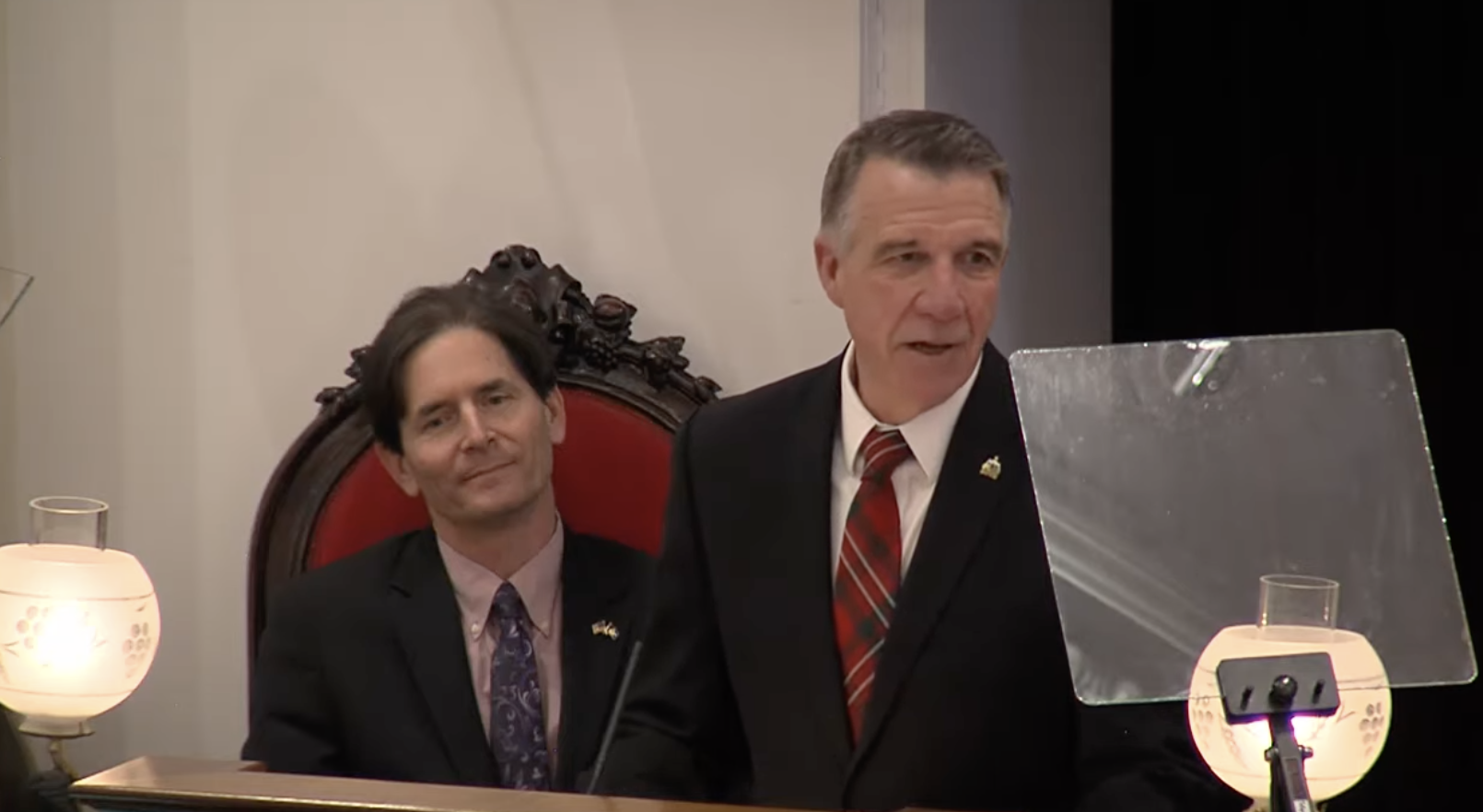
In allowing a universal school meals bill to become law without his signature, Gov. Phil Scott adopted an interesting philosophical position. Take it away, VTDigger:

He noted that the program will fund free meals for even wealthy students. 

“That’s not progressive education funding policy, it’s regressive policy that hurts the very families we are trying to help,” he said. 

Oh yes, heaven forbid that an undeserving child should receive a free lunch. That would be an abuse of the public purse and — follow closely here, things get a little thick — a punishment on the kids who really need a handout.

As the kids used to say, “lolwut?”

This is another case where the governor can’t say the quiet part out loud — that he doesn’t want to provide free school meals despite their proven benefits — but he still has to register his disapproval, so he comes up with transparently phony arguments like “free lunches hurt poor kids” and “a veto fight would distract me from my neverending fight for better schools.” As if we can’t walk and chew gum at the same time.

I wouldn’t mind if he were in the least bit consistent in this position. But he’s not. In fact, this is the only issue where he argues that a non-means-tested government benefit is a bad thing.

Continue reading

As Phil Scott Prepares to Launch His Paid Leave Program, Chris Sununu’s Is Off to a Rocky Start

It went unnoticed at the time because our media was dominated by stories of the newly-unhoused being evicted from state-paid motel rooms, but last Thursday Gov. Phil Scott announced what he called “continued progress” toward his voluntary paid family leave program.

You remember that, don’t you? It’s the plan he and New Hampshire Gov. Chris Sununu came up with in 2019 as an alternative to universal paid leave plans. It was supposed to be a joint effort, but that quickly unraveled. Instead, each governor set out to establish equivalent programs in their respective states.

Phase 1 of Scott’s plan takes effect on July 1, ironically enough on the next scheduled mass eviction event. On that day, Vermont state employees will be enrolled in a paid leave plan that will offer up to six weeks of leave at 60% of an employee’s average weekly wage for new parents or those dealing with urgent family situations. The state workforce will then serve as a base for a voluntary program to be offered to Vermont employers in July of next year.

Sununu’s plan took effect last year for New Hampshire state employees. The second phase was announced last summer with a $1.9 million state-funded “publicity blitz.” December 1, 2022 was the date that private employers could start enrolling.

And although Sununu officials are furiously lipsticking that pig, the program is, in fact, off to an unimpressive start. So unimpressive that it casts serious doubt on the prospects for Scott’s program.

Continue reading

Really, House Democrats? Shelter vs. Child Care?

Oh, boy. House Democrats, desperately searching for a way to spend as little money as possible while ducking responsibility for the crisis waiting for us at the end of the emergency motel voucher program, have come up with a real doozy.

They’re offering to put up another $20 million in housing-related spending — but they put one hell of a turd in the punchbowl.

The new, one-time $20 million appropriation for unhoused Vermonters will come out of a $92 million line item that was initially set aside in the budget for child care.

Oh, come on. Those are the only choices we get?

What’s the reasoning here? There’s only so much money for compassionate purposes? You couldn’t find the cash anywhere else? Really?

This sets the stage for a needless battle between housing advocates and child care advocates, two groups that should be able to expect better from Democratic leadership.

Continue reading

Again With Splitting the Baby?

For the second time in three months, a prominent Democratic officeholder has described the debate over when to end Vermont’s transitional housing program as “splitting the baby.” In mid-November it was outgoing House Human Services Committee chair Rep. Ann Pugh, interrupting a housing advocate to say “I’m looking for your recommendations as to splitting the baby. What are our priorities?”

Yesterday, Senate Appropriations Committee Chair Jane Kitchel cast herself in the role of King Solomon on the same issue: “I feel a bit like Solomon here. How do you split the baby?”

After the jump I’m going to get all exegetical on the Solomon comparison, but first let’s take a look at the product of Kitchel’s wisdom.

The Scott administration’s proposed 2023 budget adjustment would have ended the program on March 31. The House version included $21 million to keep the program going through June 30.

Kitchel? Her version extends the full program through the end of May and trims eligibility in June. The difference between her version and the House’s? About $2 million, per VTDigger.

Two million.

Is that what the administration has come to? It needs some sort of victory so badly that it seems willing to spend $19 million out of the House’s $21 million? (The admin hasn’t officially committed, but I doubt that Kitchel would have approved a plan that the governor wouldn’t sign. She’s the one who wanted to “split the baby,” after all.)

Continue reading

An Investment is an Investment Except When It’s Not

Gov. Phil Scott delivered a budget address full of “investments’ in Vermont’s future. It’s a great concept, but he fails to apply it consistently. Public sector expenditures he favors are “investments,” but other stuff is just wasteful spending.

The most recent example of this came with the release of a new report on the costs of improving Vermont’s wretched “system” of child care. (As with health care, it’s not so much a “system” as an abstract sculpture made of chicken wire and spit.) The RAND Corporation figures the price tag is between $179 million and $279 million, depending on how generous the package is.

Scott spox Jason Maulucci offered the usual bromide: Scott really, really cares about child care, just not enough to raise any revenue for the purpose. It’s the governor’s customary Susan Collins kind of caring.

The assertion underlying Scott’s position is this: Raising revenue for child care is pretty much exactly like putting tax dollars in a big pile and setting it on fire. Trouble is, there’s all kinds of evidence that improved child care would more than pay for itself — both in short-term economic growth and longer-term outcomes for kids.

You might even say it’s a bargain. Well, I’d say so.

Continue reading

In Which Let’s Grow Kids Suddenly Discovers That Phil Scott’s Child Care Advocacy is Mostly Lip Service

Let’s Grow Kids” has been around the block a few times. It is, according to VTDigger’s Final Reading, “the state’s leading child care advocacy group.” There’s no way they don’t know the score.

How to explain, then, that LGK endorsed Gov. Phil Scott for re-election and did not endorse his Democratic challenger Brenda Siegel?

If you come up with an explanation for that, then riddle me this: How is it that LGK is shocked and disappointed that the governor still holds to his consistent position — that he wants to do something to improve child care but he won’t sign on to tax hikes or LGK’s benchmarks for progress? In the words of VTDigger’s Final Reading:

Scott has long called for additional investments in child care, but never on the scale that advocates argue will be necessary to make a real dent in the problem. Crucially, he’s remained consistent in his belief that the state does not need to levy new broad-based taxes to expand access.

Key words: “remained consistent.” His stance cannot possibly be a surprise to LGK leadership or anyone else who’s been paying attention. It couldn’t have been a surprise when LGK was deciding on its endorsements last year. It’s not only his approach to child care; it’s his default on any social issue. He acknowledges the need, but refuses to commit actual resources to the task. Or actual effort, for that matter.

Continue reading