Category Archives: Business

The Phil Scott Policy Engine gets off to a slow start

In a little-noticed press release, Phil Scott’s Economy Pitch project announced three bills “aimed at growing the state’s economy.”

Little-noticed because of the odd and counterproductive timing: the release was issued on Friday afternoon, the traditional dumping ground for bad news you hope will go uncovered. Well, this one surely went uncovered.

But also little-noticed because the three bills are completely underwhelming in scope. Even if they all sailed through the Legislature, they’d have a negligible effect on the course of Vermont’s economy.

One could charitably assume that the Scott Gang is tactically aiming low: introduce some small incremental ideas first, and get to the real meat later on. After all, the Economy Pitch series is still ongoing: there was a meeting last night in Rutland, and another is coming up next week somewhere in Franklin County. (Location TBA.”) More ideas could emerge. But if that’s the case, don’t oversell.

On the other hand, one could less charitably conclude that this whole project is nothing but classic Phil Scott centrist incrementalism, and that a cattle call for business owners is unlikely to produce anything terribly visionary.

The three bills, and try not to laugh:

— H. 80 would declare a state sales tax holiday on August 29 and 30. Oh, Lord, this again? A sales tax holiday is like a waffles-and-Coke breakfast: a short-term burst followed by an equivalent decline. Sales tax holidays do nothing to grow an economy. All they do is concentrate consumer purchasing into a couple of days.

Well, business purchasing as well. Indeed, I suspect that businesses are best poised to take advantage of a sales tax holiday; they can easily schedule their purchases to take advantage.

— H. 83 would establish a brand marketing effort under the rubric “Vermont: Innovative By Nature.” This would be a combined effort aimed at both economic development and tourism, which is kind of a misfit. How does “Innovative By Nature” appeal to potential tourists?

Beyond that, the bigger problem is the inherent limitation of marketing. You can’t put lipstick on a pig and call it a supermodel. It’s fine and dandy to tout Vermont’s advantages, and we do have quite a few; but a marketing campaign in and of itself will have, at best, a limited long-term effect. It’s far better to address the underlying problems. But that’d cost real money. A marketing campaign is cheap by comparison.

Still, it’s a strange approach for a guy who sympathizes with the struggles and complaints of Vermont’s business community. A marketing campaign does nothing to improve Vermont’s business climate, and I’d think the business community would realize that immediately.

— H. 146 would exempt “software as a service from Vermont’s sales tax.” The so-called Cloud Tax is said to create “an image that Vermont is not a business-friendly place for the technology sector.” Hey, wait — didn’t I read somewhere that Vermont is Innovative By Nature, an excellent place for a high-tech startup?

Mixed messages, people.

Repealing the software tax may or may not be a good idea, but it shouldn’t be done for the alleged, and amorphous, benefit of enhancing Vermont’s “image.” This is a big step with growing ramifications. It should be considered as part of a thorough re-examination of the sales tax in light of changing technology, not as a short-term move to enhance our “image.” (Of course, the urgency behind this move has nothing to do with growing Vermont jobs; it’s all about  Amazon.com’s attempt to bully us into surrendering more of our taxing authority.)

Software used to be a commodity, a tangible item subject to sales tax. Now, increasingly, it’s cloud-based. Should it be taxed? Maybe yes, maybe no. But if we exempt it, we’re closing off a large and growing source of revenue. Is that what we want to do?

Similar questions abound. Vermont already loses an unquantifiable, but significant, amount of revenue thanks to Internet retail. Now, more and more “products” are intangible in the same way as cloud-based software: e-books, audio content, subscription access to news content. Are you actually “buying” anything when the products are intangible and/or access is limited in scope or duration?

Our tax code contains many references to “downloads.” That term is almost an anachronism, and its application to cloud-based content is questionable. Example: At a recent hearing of the House Ways and Means Committee, no one knew whether digital “newspaper subscriptions” were subject to sales tax, or whether newspapers are collecting and paying the tax. I’m sure someone knows, but nobody in that room did, and they’re the ones pondering changes to the tax code.

Enough of that. Color me underwhelmed with the initial product of the Economy Pitch. If there were any creative, original, or far-reaching ideas broached at the first session, they didn’t make it into proposed legislation. We can hope for better things from future pitch sessions.

Talk about a waste of money…

Governor Shumlin appears to have his knickers in a knot over Vermont Information Technology Leaders’ decision to buy ad time during the Super Bowl.

Bear in mind we’re not talking about a Budweiser-level national buy; VITL bought one spot on channel 5 at a cost of $13,000. A waste of money? Arguably, perhaps; but VITL is trying to raise its public profile, and that 13K was part of a $195,000 marketing campaign.

Shumlin told the Vermont Press Bureau’s Neal Goswami that he was “disappointed” by VITL’s move. Well, he put it more grandly: “Many Vermonters joined me in being disappointed that state and federal funds were being used for an advertising buy during the Super Bowl.”

Yeah, “many Vermonters.” Why, just the other day I heard the folks at Coffee Corner’s front table griping about that waste of $13,000.

Not.

And then Shumlin got to the real meat of his objection.

“This should highlight the need for the Green Mountain Care Board to regulate VITL’s expenditures,” Shumlin said Sunday.

Aha, the penny drops. VITL is currently an independent nonprofit organization that “helps health care providers adopt and use IT systems.” Shumlin wants GMCB to have authority over VITL spending. And now he’s publicly scolding VITL for its horrifically wasteful use of… ahem… $13,000.

Smells like a power play to me.

Now, I’d love to have an extra 13 large. It’s nothing to sniff at. But as part of a sizable organization’s marketing campaign? Certainly not worth the Governor’s attention. Let’s say, hypothetically, that GMCB already had the authority. Would it be micromanaging VITL’s budget to that extent? I don’t think so.

Besides, if you want to talk about wasting money, let’s look at the taxpayers’ $2.5 million donation to GlobalFoundries, as ordered by our provident Governor.

GlobalFoundries, you may recall, “bought” IBM’s computer chip operations, including the facility in Essex Junction, for a whopping negative $1.5 billion. Last month, Shumlin announced he intends to hand over $2.5 million in state incentives to GlobalFoundries. That’ll clean out the Vermont Enterprise Fund, which was created last year at Shumlin’s behest. It’s supposed to help encourage large employers to remain or relocate in Vermont, and spending it is a gubernatorial prerogative.

As VTDigger’s Carolyn Shapiro reported, it’s unclear “how the money will be used and what conditions, if any, GlobalFoundries will have to meet.”

If any. Snort.

The Governor said the money “will help the state build a relationship” with its new corporate occupant.

Think of it as a $2.5 million corsage for a prom date.

Because when you’re talking about a giant corporation that does business in billions, $2.5 million is nothing but a gesture. Will it do anything to keep GlobalFoundries in Vermont or get them to expand? No. Corporate decisions will be made with global concerns in mind. On that scale, $2.5 million is a rounding error.

The Governor might as well have taken that money, in bags of small bills, to GlobalFoundries’ front gate and set fire to it, in hopes that the sweet, sweet smoke would appease the corporate gods.

The fundamental problem is, Vermont can’t move the numbers significantly enough to affect decisions at that level. We will always be at the mercy of large employers, and we’ll be playing with a short stack against bigger states (and countries) that can offer much bigger incentives. We’d be better off taking that $2.5 million and investing it in something that might actually make a difference — say, in a revolving loan fund for startup businesses.

Or here’s an idea: A revolving loan fund for students pursuing two-year degrees in technology fields. Why, just the other day one of IBM’s top executives said that GlobalFoundries “is struggling to fill positions because they can’t find enough workers with a two-year technical degree.”

You want to keep them in Vermont and simultaneously grow opportunities for Vermonters? Access to education is much more relevant to GlobalFoundries than a burnt offering at their front gate.

Just spitballing. My point is that there have got to be better, more effective, business-friendly ways to spend that $2.5 million. And that’s a lot bigger waste than VITL’s $13,000 Super Bowl ad.

Hey, maybe those ski leases are on the table after all.

I heard something very interesting on the latest edition of “Vermont This Week,” the usually bland and boring (see below) Statehouse news roundup on Vermont PBS.

One of the topics was Auditor Doug Hoffer’s report on the state’s outdated and not very lucrative public-lands leases with our biggest ski resorts. One of the guests was Tim McQuiston, editor of Vermont Business Journal. He ought to have his finger on the pulse of the Vermont business community, right?

Conventional wisdom is that the leases can’t be reopened, because resort operators would have to agree to the move, and the Powers That Be don’t seem to be inclined to push the issue. McQuiston thinks otherwise:

I would suspect, in knowing a lot of these people, that they would come back to the table under reasonable circumstances. They know their industry has changed a lot.

Interesting. And what kinds of circumstances are we talking about?

There’s a lot of environmental law they have to comply with. Act 250 is still out there. They’re very involved with other regulatory entities.

So they might be willing to negotiate better lease terms if they get their way on some regulatory matters. That’s one of those good news/bad news situations, isn’t it? Redoing the leases would bring the state more revenue, but it opens the door to some backroom weakening of environmental standards.

Postscript. I say “Vermont This Week” is bland and boring because, well, it usually is. It comes across as overly scripted, and the panel acts like they’re walking on eggshells. Maybe this is a natural consequence of our political media tending to be on the young side, and having relatively little experience in a panel setting. But I do wonder if part of the problem is how the show is planned and produced. If there was more free interchange, if they tossed out the script once in a while, it’d become appointment television for geeks like me. As it is, I rarely watch. This morning, I was channel-surfing and happened to catch the rebroadcast. I don’t go out of my way for it.

How to get those ski leases reopened

Last Tuesday, State Auditor Doug Hoffer issued a report on Vermont’s leases with ski resorts. The leases, he said, were outdated and were not bringing a fair return for the resorts’ highly profitable use of public lands.

At the time, you may recall, the state Parks and Rec Commissioner Michael Snyder basically threw up his hands and said there was nothing the state could do until the leases expire — decades from now.

Well, I’ve been reminded by someone more aware of state finances than I (which probably includes a substantial percentage of my readership) that the state does, indeed, have a hammer it could hold over the resorts’ heads.

It’s a tax exemption, granted in 2002, on ski lifts and snowmaking equipment. This exemption cost taxpayers $1.42 million in foregone revenue in fiscal year 2012.

It’s been suggested that this is basically a giveaway to a lucrative industry. Sen. Tim Ashe, chair of the the Senate Finance Committee, has called for a cleanup of Vermont’s cluttered, nonsensical “tax expenditure” system, and cited the ski equipment exemption as a clear example of the problem. As he put it, “every time they pay less, we all pay more.”

Well, hey. Why not dangle that juicy tax break in front of resort owners, and say something along the lines of “Gee, it looks like you’re getting a sweetheart deal on your leases AND a questionable tax exemption. Tell you what, we’re feeling generous; you can have one or the other, but not both.”

Makes all kinds of sense, at a time when the Governor and lawmakers are scrambling to find revenue and/or cut the budget. Problem is, the underlying reality hasn’t changed since I last wrote about this. Resort owners are politically connected (how many trips has Gov. Shumlin made with Bill Stenger?), and generous with campaign contributions. It would be difficult, if not impossible, to take either of their windfalls away.

Need proof? How about the sound of silence from the Statehouse in the aftermath of Hoffer’s report? Nobody wants to touch this one. It’s a shame. I expect better from my Democratic majority.

Theme from “Jaws” heard in southern Vermont newsrooms

Looks like the Vermont journalism scene is about to take another step into the abyss. Paul Heintz has a story on the Seven Days website, headlined by a bit of consolidation at the Brattleboro Reformer and Bennington Banner: both papers will now share a single managing editor, Michelle Karas. (When asked if she could handle both papers, her less than reassuring response was “I’m hoping so.”)

To me, though, the more important — and more worrying — news was several paragraphs down in Heintz’ piece: DigitalFirst Media, the corporate parent of both papers, wants to get out of the newspaper business. It’s in the process of selling its entire portfolio of more than 100 papers nationwide. It would prefer to unload the whole shebang in a single transaction, although it may wind up selling things piecemeal.

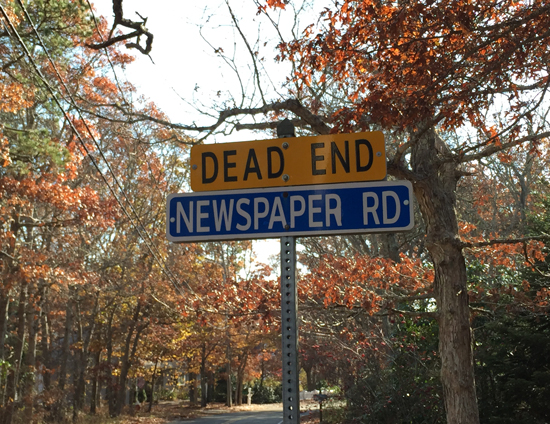
Newspaper Rd. Dead EndDFM’s stash includes such notable properties as the San Jose Mercury News, Salt Lake Tribune, St. Paul Pioneer Press, and Denver Post. Our southern Vermont dailies are afterthoughts by comparison.

And they are about to be thoroughly buffeted by the winds of corporate change.

Possible buyers include a passel of private equity firms, many of which have no experience in newspapers. That’s bad enough, but even worse are the experienced operators said to be in the running. They include Gannett, currently engaged in a slow strangulation of the Burlington Free Press; and GateHouse Media, whose name is poison in Massachusetts.

GateHouse is the creation of another private-equity firm, Fortress Investment Group. Fortress has seen its share of financial trouble in recent years; it nearly went bankrupt in the market crash of 2008. This caused it to default on a huge loan deal to fund construction of the athletes’ village for the 2010 Vancouver Winter Olympics. That forced the City of Vancouver to pony up $450 million (Cdn) to get the village built.

Oh well, you know what they say about eggs and omelets.

Even as it has struggled, Fortress has built a newspaper entity that seems to break all the rules of business. According to the Boston Globe, GateHouse “has never made an annual profit as a public company,” and in 2013 filed for bankruptcy “under the weight of nearly $1.2 billion in debt.”

Even so, Fortress finagled the finances in a way that allowed GateHouse to scoop up 33 more New England newspapers. After which, it immediately imposed draconian staff cuts. Poynter Institute media business analyst Rick Edmonds says GateHouse has a reputation as a “bottom-line, lean operator” that isn’t squeamish about making cuts. “In a case like this, they’ve probably looked at the numbers and said, ‘We can squeeze more [savings] out of this,’” he said.

Through its holding companies, Fortress controls “nearly every newspaper south of Boston,” and also “dominates Boston’s western suburbs.”

Brattleboro and Bennington, just a hop and a skip away. Looking at the two behemoths said to be in the running to buy DigitalFirst, I’d say GateHouse makes a lot more sense than Gannett. And if Gannett winds up buying all of DFM, I wouldn’t be surprised if it spun off the two Vermont dailies, which are teeny-tiny by Gannett standards but right in GateHouse’s comfort zone.

Either way, look for more slashing in southern Vermont’s already sad print-media scene. Which is a real shame; the healthier Vermont media properties, VTDigger, Seven Days, and VPR, all have a clear northern Vermont slash statewide focus. Very seldom does southern Vermont show up on their radar.

There is one thin ray of hope in Heintz’ story. As the Brattleboro Reformer has declined, he notes that an independent weekly, The Commons, has expanded its circulation in recent years.

This may be the next mutation of journalism: a Seven Days approach, including a single weekly print edition and a Web presence with more frequent postings. To be sure, there’s no sign that daily papers will do anything other than continue to diminish in size and quality.

Art Woolf To The Rescue!!!

Throughout the history of its big pipeline project, Vermont Gas has been its own worst enemy — alienating landowners, indulging in ham-fisted PR, and repeatedly raising its cost estimates for pipeline construction.

Nonetheless, the odds are still in VG’s favor. Well-meaning protests notwithstanding, if VG can make a plausible economic case, the thing’s gonna get built.

And who’s helping them build a plausible economic case, according to VTDigger?

The construction of the project will create as many as 444 direct and indirect jobs, according to a report by the Vermont consulting firm, Northern Economic Consulting, Inc.

That’s the consulting firm co-owned by our least-favorite economist Art Woolf, he of the reliably awful “How We’re Doing” column in the Burlington Free Press.

Yes, Art’s a professor at UVM, but I suspect he makes a lot more money from NEC than he does for his academic work. His consulting firm has a number of revenue streams:

— Consulting to a variety of high-paying clients, mostly of the corporate persuasion.

— Providing expert witness services for civil suits of all kinds. (“Have you been hurt in a slip and fall accident? Dial 1-800-CALL-ART for expert testimony on your financial losses.”)

— Running an annual Vermont Economic Outlook Conference. The most recent conference was a five-hour affair, with admission priced at a cool $170/person.

— Publishing a monthly Vermont Economy Newsletter, subscription a mere $150/year.

In short, Woolf is more hired gun than objective expert. Which might explain why his weekly columns, more often than not, come across like they were written on behalf of the Associated Industries of Vermont. George W. Bush once told a roomful of wealthy supporters that they were his base; well, the Vermont business sector is Woolf’s base.

So, about his rosy estimate of the pipeline’s economic impact. Without doubt, the vast majority of those 444 “direct and indirect jobs” are temporary, construction-related jobs.

TransCanada has claimed that the Keystone Xl pipeline would create tens of thousands of jobs. But almost all of those are temporary, appearing and disappearing during the projected two-year construction cycle. Operating the pipeline, once it’s built, would take about 50 workers.

As far as I can tell, nobody’s asked Woolf about the quality or duration of those 444 pipeline jobs. But if his math is similar to Keystone’s, then we should expect no more than a handful of permanent positions at Vermont Gas.

Don’t blame Woolf; he’s only doing what bespoke experts do for their money: putting forth the best possible case for his client.

One more thing. The identifier that accompanies Woolf’s column in the Freeploid mentions only that he’s a faculty member at UVM. Nothing about his corporate clients, nothing about the subscriber base for his costly publication. Considering how many business interests are paying Woolf, how often do you suppose there’s been a direct or indirect conflict of interest that’s gone conveniently undisclosed?

Oh, one more one more thing. There’s a typo in the title of last Thursday’s “How We’re Doing.” In the TITLE, for God’s sake. It’s spelled “minuscule,” not “miniscule.” Any copy editors left at the Freeps?


The microfruits of capitalism

The decrying of “burdensome regulation” is often heard in our land. It discourages entrepreneurship; it’s leaving us behind in the global economy; it raises prices on everything we buy.

All true, to some extent.

But regulations don’t just happen. They are responses to excesses in the marketplace. They are necessarily imperfect responses; bureaucracy is not a precision instrument. Dodd-Frank, whatever its flaws, would not exist if the Wizards of Wall Street had a smidgen of foresight or conscience, if they’d been able to resist the temptation to make a quick billion off toxic derivatives and Collateralized Debt Obligations.

And now we have a new exhibit in our Gallery of Free Market Excess. It’s completely unnecessary, it’s hazardous to the environment, and even industry leaders acknowledge they don’t need it.

Mmmm, fish food!

Mmmm, fish food!

I’m talking about nonbiodegradable microbeads, “barely visible plastic scrubbing grains used in personal care products.” There’s a bill before the state legislature to outlaw them. John Herrick at VTDigger:

Environmentalists and water quality advocates want them outlawed because the non-biodegradable plastic waste is washed down the drain and slips through nearly all of the state’s wastewater treatment plants.

… No studies measure quantities of microbeads in Vermont’s waterways. But scientists who study Lake Champlain say the beads can be spotted along the shores.

Marine animals consume the microbeads, which can cause internal blockages. Scientists also say that toxic pollutants “attach themselves to the plastic beads like a sticker,” and then head up the food chain.

Who the hell thought it was a good idea to put teeny-tiny nonbiodegradable plastic bits into consumer products? Why do Vermont lawmakers have to spend their time debating a bill to ban them?

Well, now you know where regulations come from.

What’s worse, the microbeads are completely superfluous, according to Martin Wolf of Seventh Generation, a Vermont company that uses natural alternatives.

“Microbeads are nonessential. Substances exist that are mineral or biodegradable, perform the same function, and have no meaningful impact on the economics of the products in which they are used,” he told the Fish and Wildlife Committee.

Mike Thompson, who put his soul in escrow to take a job representing the Personal Care Products Council, says “the industry is committed to phasing out microbeads on a timely basis.”

Of course, his definition of “timely basis” may not be yours. The Vermont bill would ban microbeads on January 1, 2017. That’s too fast for Thompson; he wants December 31, 2017, to match a law already on the books in Illinois. And Jim Harrison, the ever-vigilant head of the Vermont Retail and Grocers Association, “prefers a bill that gives retailers time to sell existing inventories.” What, two years isn’t enough?

How many bazillions of microbeads would be flushed into our rivers and lakes during the year 2017? Can’t the industry manage to make the change in two years, instead of three?

Government regulation is, at times, wasteful, inefficient, and counterproductive. The only thing worse than regulation, thanks to the madly-spinning engines of commerce, is no regulation.

A powerful display of self-interest, enlightened and otherwise

Lt. Gov. Phil Scott And Friends held their little Vermont Economy Pitch thingy last night. I couldn’t attend, more’s the pity. Scanning the available news sources, I see only two reports: one from VPR’s Steve Zind, and one from WCAX’s Eva McKend.

The event’s purpose was to solicit input from the business community on how to improve Vermont’s economy. (And, thinking cynically, position Scott as the business community’s leading advocate in Montpelier.)

Because, as we all know, no one in Montpelier ever listens to the business community. Truly, they are the voiceless among us. Cough, choke.

From what I read, the event failed to produce anything like a consensus. Quite the opposite: it seemingly delivered a parade of self-interest. Speaker after speaker suggested ideas aimed at helping his or her own sector.

Zind has a businessman from Stowe calling for more promotion of tourism. There’s a shocker.

On the other hand, representatives of manufacturing and technology called for the state to market itself less as a rural throwback and more as a great place to live and run a business.

Enough with the covered bridges already! Let’s fill our tourism brochures with pictures of factories, subdivisions, and strip malls!

Here’s my favorite:

Frank Cioffi of the Lake Champlain Chamber of Commerce suggested that up to 10 businesses in each county be designated strategic employers and the state should focus on helping them.

How about that. The number-one cheerleader for IBM says we should focus on the state’s biggest businesses. Seems short-sighted to me; for one thing, big employers often make siting decisions without regard to Vermont policy. Including IBM itself, of course. For another, it’s reactive instead of proactive: we’d be helping the already established, instead of encouraging the up-and-comers who are actually creating new jobs. But what else would you expect from Frank Cioffi?

And here’s a tidbit from WCAX:

Matthew Dodds of Brandthropology says the state has a branding problem…

Gee, the head of a firm that helps clients “steward brands intelligently” thinks Vermont needs better stewardship of its brand.

Next we have an educator who says the biggest problem is, you guessed it, education.

Vermont Technical College President Dan Smith… said employers are eager for the college’s graduates, but financial woes caused by the low level of state funding are preventing VTC from meeting the demand for skilled workers.

One more, and I hate to do this because he’s a good guy. But Cairn Cross of Fresh Tracks Capital, believes the problem is inadequate access to capital. (I do give him credit for spotlighting a single statute, the Licensed Lender Law, as a roadblock. Far better than the usual “cut regulations, lower taxes, permit reform” blah-blah-blah.)

I’m sure there’s some wisdom in all these suggestions, but it adds up to a “Blind Men and the Elephant” scenario, with speakers interpreting the situation in light of their own viewpoints.

VPR’s Zind does report that there were some “recurring themes,” including job training, making housing more affordable, and (yes) access to capital.

But there’s not much new there. And the business community isn’t helping its cause in Montpelier if they’re all preaching from their own separate Scriptures.

Woman, ever the nurturer

Odd experience today.

A bit of background first. We have an older car that we’ve been taking to the same independent repair shop since we moved here. Never been to the local dealership.

Until today, when I wanted to replace a burnt-out headlight before the weekend. So I called the dealership (which shall go unnamed), and got an incredibly chirpy female who answered the phone with a clearly rehearsed, boss-mandated greeting. I asked for Service, and she sent me to voice mail. I left a message.

An hour later, I called back. Got the same chirpy greeting from a different female. She checked around a bit, and told me I could come in anytime today. And informed me that “Jim” hadn’t had time to return my call because they were short-staffed. Okay.

So I go in. The gents on duty in Service are old-school Grunt ‘n Scratch types. The one who didn’t return my call is clearly just a little bit pissed that I made a second call. But what do I know? The longer I waited, the less chance I had of getting the headlight replaced. On a Friday.

The guys are all either staring at their computer screens or talking on the phone or both. They don’t tell me Jack Squat, so I hang around the desk. Waiting for, oh, maybe a time estimate? An invitation to sit down and have a cuppa joe? I don’t even know whether they’re taking action on my car or just typing stuff into their computers.

About ten minutes later, Randy the Service Guy tells me it’s all set and charges me sixteen bucks.

That’s nice, fast and cheap. But it left me wondering: if the dealer took all that trouble to train his female receptionists to be cheerful and order them to use an overly chirpy rehearsed greeting, then why doesn’t he send his Service Guys to charm school? Whatever good will the female receptionists may have created with their obviously canned greeting was more than undone by the Service Department’s complete lack of communication skills.

And, more broadly, why is it the gals’ job to be the business’ smiley face?

I look forward to returning to my independent garage, where the owner is a woman and the female receptionist actually knows quite a lot about cars. And everybody is equally polite and businesslike.

A Fair Point

A top Vermont pol not known for podium-pounding or rabble-rousing has sent some unusually fiery language in the direction of Vermont’s leading telecom provider.

House Speaker Shap Smith says he has doubts that FairPoint Communications will continue to provide telecommunications services to Vermonters for the long term as its workers continue to strike and service complaints pile up.

Smith, a Democrat, said he believes the company is looking to shed labor costs in order to sell.

You may have missed that little New Year’s Day newsflash, because it was written by the Mitchell Family Organ’s Neal Goswami, and appeared in the paywalled Times Argus and Herald. Nobody else has reported it so far.

FairPoint workers have been on strike since mid-October. Top Democrats have pressured the company to settle, but it has refused to budge. In fact, CEO Paul Sunu recently sent a response to those Dems, portraying his company as the willing negotiator and the unions as the hard-heads.

Smith told Goswami he was “insulted” by the letter, and said FairPoint was putting itself “in a tough place.” And he’s got capitalism’s weapon of choice in his pocket: money.

Smith said the state has provided subsidies to FairPoint in recent years to help it deliver service to rural areas. But the company is not likely to receive a warm reception from lawmakers in the new session, he said.

He accused FairPoint of “trying to basically bust [the] union[s],” and added that “they’ve got a real problem on their hands in the Legislature.”

FairPoint may also have “a real problem” with state regulators. It has proposed a new rate plan that would cap rates for basic phone service (the loss leader) while allowing FairPoint to raise other rates (advanced phone packages, business phones, Internet, satellite TV) without seeking regulatory approval.

Gee, that’d be a big fat giveaway, wouldn’t it now?

At a time when service problems have spiked since the unions walked out, and FairPoint has had one major interruption in its E-9-1-1 system, you’d hope that state regulators would be keeping an eagle eye on these mooks instead of giving them open access to non-basic customers’ wallets.

Beyond the immediate situation, Smith questioned whether FairPoint would still be in Vermont five years down the road — and whether it would be able to find a buyer for its northern New England business. And he’s got a (cough) fair point: the landline business is shrinking everywhere, and rural phone service means high maintenance costs and low profits.

That’s why Verizon dumped our business on FairPoint a few years back.

Smith wants state government to be proactive about the situation, rather than wait for FairPoint to bleed us and its workers dry and then dump the business entirely.

He said the Legislature should begin exploring options with the Public Service Department to ensure the state has quality telecommunications services in the future.

What might that mean? A quasi-public Vermont Telecom? Or a fully public one? Not sure what Shap has in mind, but it’s an important issue we should face before it turns into a crisis.