Category Archives: Business

Big Beverage’s Hired Guns pt. 2: Mountain Dew wishes and Twinkie dreams

“When you work in this building long enough, you notice things like thread count.”              — Anonymous Statehouse scribe

The House Ways and Means Committee heard a full morning’s worth of testimony today on the proposed sugar-sweetened beverage tax. The most interesting witness, not in a good way, was one Kevin Dietly of Massachusetts-based Northbridge Environmental Management Consultants, speaking on behalf of the beverage industry. He definitely had the fineest suit in the room, not to mention bright pearly-white teeth. (Oh, and a Google search indicates that he’s a member of the Chautauqua Yacht Club. Must be nice.)

And he acknowledged, in answer to a question from the committee, that he has represented the food and beverage industries since 1986.

That’s a long time serving the same paymasters.

Dietly managed to actually travel to Montpelier, unlike his fellow soulless industry flack Lisa Katic, discussed previously. I don’t imagine it was a sacrifice for ol’ Kev, since he presumably drew full expenses and a fat hourly rate for his visit to Montpelier. (He stuck around for the full morning, billable to “Stop The Vermont Beverage Tax.”)

(This wasn’t his first trip to the Statehouse; in 2013 he testified for the beverage industry against a proposed expansion of Vermont’s Bottle Bill. Surprise, surprise.)

His testimony was a carefully-crafted web of industry-friendly statistics and studies, plus back-handed dismissals of the academic experts who’d preceded him in the witness chair. You know, the economists, doctors, public health experts and nutritionists who have consistently found that…

— Sugar-sweetened beverages are a scourge of the American diet, leading to high rates of obesity, diabetes, and other severe illnesses.

— Taxing a specific commodity invariably leads to lower consumption.

— Lowering consumption of sugary drinks will have a beneficial impact on public health and public-sector healthcare spending.

— There’s no evidence of a significant “border effect”; in fact, there’s quite a bit of evidence that any “border effect” would be minimal or nonexistent.

— The impact on employment is neutral to mildly positive. Consumption of sugary drinks goes down, but people buy other stuff instead.  The equation balances out. Plus, the tax revenue funds jobs in government or the healthcare sector.

Pish-tosh, said Dietly, slamming “academics” who live in “a different world,” a “theoretical world.” When they retreat to their “ivory towers, things get a little wacky.”

Welp, so much for scientific research. Can’t trust anything they say.

As for Mr. Dietly, when you Google his name you get a massive quantity of testimony before various legislative bodies around the country on behalf of the food and beverage industries. Here’s a sampling of The Expensive Wisdom of Kevin Dietly:

He spoke to a New York Senate committee in 2010 in opposition to a proposed beverage tax. His arguments were essentially the same, then and now: a beverage tax would have disastrous economic consequences (but he entirely leaves out the fact that consumers will substitute other items for taxed beverages, thus mitigating the dreaded financial and employment impact), and it wouldn’t have any effect on public health (carefully selected statistics cited, inconvenient ones waved away).

In 2012, California voters faced a ballot measure to require labeling of foods that contain GMOs. (The measure was defeated after a very costly “No” campaign bankrolled by Big Food.) And oh looky here: Kevin Dietly was a hireling of the “No” campaign, and offered a very high estimate of the cost of GMO labeling — as much as $400 per year for each California household. His estimate was based on the assumption that producers would universally switch to costlier ingredients in order to avoid the GMO label (a dubious assumption at best), although he admitted that “We certainly don’t know what will happen.”

Speaking to Nevada lawmakers in 2011 on the subject of recycling and bottle deposits, Dietly positioned the beverage industry as having been “among the leading packaging innovators of the past 100 years,” and touted the industry as supporting a range of programs “to promote recycling.” And then he makes forceful arguments against deposit laws. If you read through his testimony, there are striking parallels in method, style, and type of argument with today’s testimony against the beverage tax.

In 2014 he addressed Connecticut lawmakers about a proposal to expand the state’s bottle bill. He asserts that it would impose unbearable costs on manufacturers and retailers, and had the audacity to depict the deposit/refund system as “counter to the goals of sustainable recycling and materials management.”

In 2002 he spoke before a U.S. Senate committee (chaired by Jim Jeffords) which was considering a “Beverage Producer Responsibility Act.” The concept of “producer responsiblity” has been a mainstay of advancement in environmental law; in Germany, for instance, producers have cradle-to-grave responsibility for their products — from bottles to automobiles. Its economy seems to be getting along just fine, no?

But according to Dietly, such an act would have been costly to consumers and businesses, and had little or no environmental benefit. Hmm, if he thinks there’s a disconnect between the Ivory Tower and reality, I sense a greater disconnect between industry-funded experts and reality.

I could go on, but you get the idea. Kevin Dietly is a well-traveled, amply-compensated spokesflack for the beverage industry, fighting for its interests in legislative halls around the country. His testimony should be judged accordingly.

Beverage tax pipped at the post?

This should have been a good day for the sugar-sweetened beverage tax. State lawmakers were unconvinced by Governor Shumlin’s proposed payroll tax, and many had turned to the beverage tax as a way to help close the Medicaid cost gap. Today, the House Ways and Means Committee is considering the beverage tax, and advocates on both sides are pointing to this hearing as a key moment.

(Last year, the beverage tax passed the House Health Care Committee but died on a close vote in Ways and Means. Things were looking better for the tax this year.)

But wait, what’s this? Shumlin’s posse has come riding over the hill with a revised payroll tax plan that, according to VPR’s Peter Hirschfeld, “looks to have new life” in the Health Care Committee. Fortuitous timing, neh?

The new plan is friendlier to business, cutting the payroll tax rate in half and eliminating an employer assessment on businesses that don’t offer health insurance to their workers.

Chief of Health Care Reform Lawrence Miller says the smaller tax would generate enough money to pay for Shumlin’s plan to close the Medicaid gap. Which makes me wonder how he can now accomplish this with less than half the revenue of his original plan. What got cut?

We’ll find out soon enough, as the Governor’s new plan gets an airing in legislative committees. But its very introduction may well be enough to throw the beverage tax, once again, into the dumpster.

An obvious conflict of interest in the House

In January of last year, the supposedly nonpartisan Campaign for Vermont raised a stink about conflict of interest in the Vermont House. Specifically, it accused then-Rep. Mike McCarthy of same.

Then-CFV spokesflack Shawn Shouldice noted that McCarthy, an employee of SunCommon, had voted for a net-metering bill in the House… a bill that stood to benefit his employer. Shouldice accused McCarthy of breaking House rules by voting on the bill.

Fast forward to today, when the House approved a massive energy bill going under the name RESET. One provision was struck from the bill; it would have boosted funding for Efficiency Vermont. The charge to strike that provision was led by Independent Rep. Adam Greshin. All of this is chronicled very nicely by VPR’s Peter Hirschfeld. Except for one small fact:

Adam Greshin, looking suspiciously Photoshoppy.

Adam Greshin, looking suspiciously Photoshoppy.

Greshin is co-owner of the Sugarbush ski resort. Two more facts:

The ski industry is a voracious consumer of electricity.

Efficiency Vermont is funded by ratepayers, with rates approved by the Public Service Board.

Do I need to connect those dots?

The Efficiency Vermont cut would reduce utility rates; Greshin’s business would directly benefit. Not only did he vote for the measure, as in McCarthy’s case; he spearheaded it. He pushed strongly for it as a member of the House Ways and Means Committee, where his arguments carried the day.

In the interest of nonpartisanship, I ask Campaign for Vermont to raise the same kind of stink about Greshin that they did about McCarthy. Also, is to too much to ask our media to report obvious connections when a lawmaker sponsors legislation that would benefit his/her own interests?

Big Beverage can afford the very best hired guns

Almost two weeks ago (Feb. 26, to be precise), the House Health Care Committee held a hearing on the health impacts of sugar-sweetened beverages. There was an interesting name on the guest list: Lisa Katic, registered dietician.

Registered dietician speaking on behalf of the American Beverage Association, the trade group that includes Coke, Pepsi, and other mass-market sugar peddlers.

Seems like an odd juxtaposition: a professional dietician talking up sugary beverages.

Sold my soul for a Beltway consultancy.

Sold my soul for a Beltway consultancy.

Which led me to take a closer look at Lisa Katic. Basically, she’s the #1 dietician-for-pay for the food industry. She has her own DC-based consultancy firm, and her clients include the American Beverage Association, the Snack Food Association, and the Grocery Manufacturers Association.

Before she hung out her own shingle, she was on staff at some of the largest Big Food interest groups in the country. In short, she’s made a very lucrative career out of selling her professional credential to the highest bidders.

Further down the page, I’ll tell you about a fascinating talk she gave in 2009 before an industry group. But first, her testimony to our humble legislative committee, delivered by speakerphone.

Her carefully curated pitch: Obesity and diabetes need to be addressed, but taxing a single class of food will do nothing to prevent the twin scourges of the American way of eating. Which ignores a growing body of evidence that beverage taxes do, indeed, have a pronounced and immediate impact on consumption. See, for example, the first year’s returns from a beverage tax imposed in early 2014 by the Mexican government. (Katic brushed off a question about Mexico’s experience, claiming not to have “seen specific data.”)

Not to mention the obvious effects of tobacco taxes: price goes up, consumption goes down. It’s a pretty clear and direct link.

Her next pitch: Sugar-sweetened beverages are one small part of the problem, accounting for “only six percent of the calories in our diet.” Which may be true, but I’ll bet you dollars to (ahem) donuts that sugary drinks would figure much more prominently in the diets of our overweight population.

Katic also parroted the party line in saying that the real problem is the “severe imbalance between calories consumed and physical activity.” This is straight out of Big Beverage’s PR strategy. See its “Mixify” campaign, which touts a balanced approach to life including the occasional shot of sugary drinks. And which is full of buzzwords aimed at millennials: “the deets,” “#Realtalk,” “emoji,” “that bod of yours,” Mixify is your “balance wingman.”

Her point is true, but she undercuts her own argument by saying that a modest reduction in calorie intake, plus more activity, can make for a healthy lifestyle. For sure. But the flip side is that cutting out the soft drinks would have a modest effect per day and a massive impact over time.

Immediately following Katic’s testimony, the committee heard from Kelly Brownell, one of the nation’s leading experts on the subject, a former Yale prof who’s now a dean at Duke University. He hadn’t heard Katic, but he pretty much knocked her “facts” into the nearest trash bin. He pointed to “very strong scientific evidence tying added sugars to obesity and diabetes.” He said a beverage tax “makes all the sense in the world,” because “the largest percentage of added sugar comes from sugar-sweetened beverages.”

In other words, it might be only six percent, but that’s a huge part of the problem and a very simple fix.

Brownell also testified about research indicating that sugar may have the same effect on the brain as “traditional substances of abuse,” triggering increased tolerance and need for sugar, plus withdrawal symptoms.

And he cited economic projections showing that an increase in beverage prices would, indeed, reduce consumption.

And now, let’s close the Katic/Brownell circle.

In 2009, Lisa Katic gave a talk to the National Institute of Animal Agriculture, a subset of Big Agriculture. She was there to provide an overview — a sort of “know your enemy” briefing — of the top activists opposing the interests of Big Food. (Audio of her talk can be found on Swinecast, an appropriately named podcast service of the pork industry.)

One of her targets was Kelly Brownell. She said he’d been “instrumental… in drawing parallels between the food industry and the tobacco industry” in their response to rising health concerns. Deny, delay, and deflect, basically.

In discussing Brownell, Katic told her Big Ag audience that “there are people who want nothing more than to line up CEOs of food companies or commodity groups and haul them in front of Congress and be able to grill them like they did with the tobacco companies.” And, she concluded, “Kelly Brownell is one of those people.”

Which, in her mind, is a bad thing. You can draw your own conclusions.

Katic’s other targets included Marion Nestle, Michael Pollan, Alice Waters, and Eric Schlosser. She lamented the fact that Schlosser’s book “Fast Food Nation” is required reading in some college courses, “which is a problem.” In discussing Waters, she mispronounced the name of Waters’ groundbreaking restaurant — “Chez Panay.” And she even slammed the American Dietetic Association; of one of its subgroups, she said, “They’re not always talking about sound science.”

Katic’s definition of “sound science” is analogous to that of climate-change deniers. Nothing that threatens her clients’ interests is absolutely proven, the real problem lies elsewhere. She’s smart enough to acknowledge problems with the American diet, but she’s bought and paid for enough to try to deflect attention elsewhere.

When Katic testified before the Health Care Committee, she was billed as a representative of the American Beverage Association. But committee members seemed unaware of the depth of her ties to Big Food, or her career-long track record of defending the interests of her paymasters. She is a very well compensated mouthpiece for Big Food, Big Beverage, Big Snack, and Big Agriculture, and her testimony should be evaluated in that light.

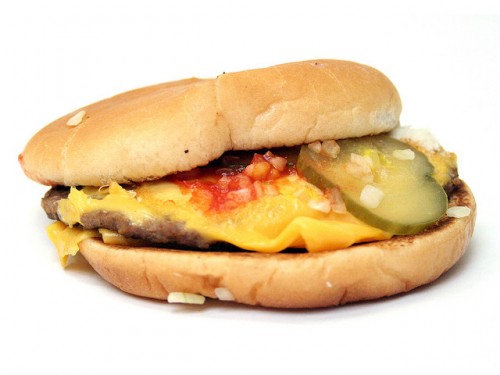
McDonald’s tries to kill kale

Any kale with that?

Any kale with that?

Sad to say, but it looks like Vermont’s favorite vegetable may have jumped the shark.

McDonald’s will debut kale as an ingredient in the not-too distant future as the fast-food giant continues its efforts to adapt to changing consumer preferences, according to a recent note from Janney Capital Markets.

“Possibilities include kale for use in salads, or perhaps a kale smoothie,” wrote Janney analysts in a note to clients. “More generally, McDonald’s clearly aims to raise consumers’ perception of the quality of its food. Adding kale to the menu in some way could help be a step in this direction.”

See, Mickey D’s has a problem. More and more Americans are realizing its food is shit, so they need “to raise customers’ perception of the quality of its food.”

Please note: not necessarily the actual quality… just our perception of it. And McDonald’s has no idea what to do with kale; it just wants to do something.

Kale, thanks to Bo Muller-Moore and foodies everywhere, is a powerful image shaper. Sure, it’s nutritious and all that; but its most potent effect is on “customers’ perception.” You wouldn’t get the same bang for your buck from chard or arugula or collards.

One franchisee’s director of operations said adding kale was a good move for McDonald’s, which continues to battle negative trends domestically.

“We’re here to give what our customers want,” he said. “If that’s what our customers want, we’ll give it to them.”

I guess they’ve finally gotten sick of mystery meat. Maybe this kale stuff will help.

Not all businesses think alike. Or, Mr. Barlow, your table is ready.

We have a winner in theVPO’s first-ever giveaway.

In some secluded rendezvous…

In some secluded rendezvous…

As you may recall, earlier this week the Lake Champlain Regional Chamber of Commerce made an ass of itself: one day, its president issued a clarion call for action on Lake Champlain, and the next, its lobbyist strenuously insisted that the LCRCC would fight tax increases to fund cleanup efforts.

Hypocrisy, thine initials are LCRCC. Anyway, in light of that, I offered a free dinner to the first lobbyist who accepted a measure of financial responsibility for his/her group, industry, or membership.

Well, we have a winner, and it’s just who you might expect: Dan Barlow of Vermont Businesses for Social Responsibility.

Dan didn’t nominate himself; a friend in the media, who’d just love to see me spend my money, pointed out to me that at a Statehouse press conference yesterday, Barlow (speaking for VBSR) endorsed Gov. Shumlin’s proposal to close the Medicaid cost gap through a payroll tax. I wasn’t at the presser, but Barlow’s statement has been reported by VTDigger, which is good enough for me.

So Dan, if you want to strap on the ol’ feed bag, let me know.

This brings to mind something that’s been bugging me for a few days. On Monday, the usually impeccable Anne Galloway of VTDigger posted a story entitled “LEGISLATIVE MANDATES HAMPERING RECOVERY, BUSINESS GROUPS SAY.” The story recapped the usual litany of complaints about taxes and costs and regulations — and that hoary old chestnut, “uncertainty.”

Which is just bullshit. Life, by its very nature, is uncertain. Potential legislative changes are one of the smaller aspects of it. To cite just one obvious example: the price of oil. Who predicted its nearly 50% drop in recent months? That alone plunged a fatal dagger into Vermont Gas’ pipeline to Ticonderoga. Fuel costs are a much bigger factor in running a business than anything the legislature might reasonably do.

Galloway’s piece could have been written by a functionary in Jim Harrison’s back office, so one-sided was it. The only note of dissent was a brief comment by House Speaker Shap Smith in the very last paragraph.

Now, you could make an argument for this article as part of VTDigger’s ongoing coverage of the legislature: let’s take a look at how business groups are feeling about the course of the session. Other views will get a hearing elsewhere.

But even on that narrow pretext, the article falls short. By focusing on The Usual Suspects, it fails to reflect the range of views within the unmonolithic “business community.”

It doesn’t, for example, quote VBSR. Not even a little bit. It doesn’t quote business types like Small Dog’s Don Mayer or Fresh Tracks Capital’s Cairn Cross, who have much more nuanced views of the potentially positive role of government in economic development. It doesn’t mention former State Rep. Paul Ralston of Vermont Coffee Company, who’s chairing Shap Smith’s working group on improving the economy. It sure as hell doesn’t quote Ben Cohen or Jerry Greenfield.

EVen if you accept the premise that an overview of the business community is a worthwhile use of VTDigger’s media platform, this article was woefully incomplete. A rare FAIL for a diligent and trustworthy news source.

The costs of undevelopment

Sunday’s Burlington Free Press brought us a lengthy cover story about artists in the Pine Street corridor, and their fear of potential gentrification in the area.

The Pine Street corridor is a delightful, funky mix of startups, small businesses, a few larger businesses, food enterprises, art studios, and various creative types. Hipster’s paradise.

It owes its existence to a historical quirk in zoning. As the Free Press’ Molly Walsh reports:

New residential development is prohibited along parts of Pine Street under city zoning rules going back several decades. The rules were created to preserve space for industrial and commercial uses in a 225-acre Enterprise Zone that encompasses much of Burlington’s historic manufacturing section…

Today major industry has largely moved out of the area. In its place art studios, offices and smaller-scale makers of everything from bread to beer to jewelry have sprung up along with start-ups and more established business such as Lake Champlain Chocolates.

That Enterprise Zone has had the unintended consequence of keeping rent artificially low, making it possible for this Creatives’ Colony to develop. The worm in the apple: the corridor would be an ideal place to develop more housing, which Burlington needs badly. But if the zoning were changed to allow housing, propertly values would go up. And rents. And many current tenants of the old industrial buildings would be priced out.

Of course, if you leave the zoning intact, every resident of Burlington is subsidizing the Colony through inflated costs for housing and property taxes.

So the question: is that a tradeoff worth making? If you live in Burlington, are you willing to underwrite the artists and entrepreneurs, and forego the property tax revenue and easing of housing demand?

This is a question that usually goes unasked when we consider development ideas. We see the potential costs (financial, social, environmental) of a proposal, but we don’t as easily see the costs of not developing.

Same question applies to the land formerly owned by Burlington College. The easy question is, “Do we want to preserve it as open space?’ The harder questions are, “Do we all want to subsidize that space through higher property taxes?” and “If we don’t want development there, where are we willing to allow it?” Because we can’t say “no” to everything. We can’t turn Burlington — or Vermont — into a Colonial Williamsburg, frozen in time like a beetle in amber.

Walsh interviewed quite a few Pine Street artists. Frankly, some of them seem a little whiny and entitled. One, for example, acknowledged the need for more housing but asked, “‘Why here?’ is my question. Does it have to be here?”

Well, no, it doesn’t HAVE to be there. But, given the fact that more people want to live in Burlington, it has to be somewhere. If not in the South End, if not on the former Burlington College land, then where? More suburban sprawl in Williston and Essex? (You want to see bad development? Drive a few miles north from I-89 Exit 12, past the endless and growing expanses of strip malls and subdivisions in Williston and Essex.)

If Burlington says “no” to any significant upgrade in housing stock, who does it hurt most? The low- and middle-income people who’ll be priced out of the city, and the environment of the outlying areas, where development pressure will grow.

I hope there will be a reasonable compromise on Pine Street, relaxing the strictures of the Enterprise Zone or trimming its borders. Personally, I’d like to see the Pine Street Corridor retain its character — but I’d also like to see more housing that would make use of existing infrastructure and give residents a short commute by car, bike, or bus to downtown (or Pine Street) jobs.

Overall, I’d like more attention to be paid to the hidden costs of undevelopment. It’s possible to do this intelligently, allowing desirable development while retaining our character.

The real lessons of Plasan

Vermont’s pro-business community couldn’t hardly wait to score a cheap political point (and, as usual, soil the state’s reputation) after Plasan’s announcement that it was relocating to Michigan. Decent interval, bah: we’ve got a boilerplate press release ready to go.

Lt. Gov. Phil Scott did the honors for the VTGOP, offering a quick word of sympathy to Plasan’s workforce and then pivoting to the red meat:

This announcement is yet another clear sign that we in Montpelier must put our full focus on not only protecting, but on growing Vermont’s economy and face the reality that we are competing in a regional, national and global marketplace. We cannot continue to blame “forces beyond our control” for our job losses, but turn the mirror back on ourselves and ask ourselves: “What can we do to change the direction of this trend? How can we make Vermont better?”

The best part is Scott’s dismissal of “forces beyond our control,” when Plasan made it abundantly clear that Vermont’s business climate had nothing to do with its decision, and Vermont couldn’t have done anything to change it. But let’s not let a little inconvenient truth get in the way of a stale talking point.

Former Wall Street supremo Bruce Lisman kept it simple; he made time for one self-congratulatory Tweet, with nary a word of sympathy for the workers.

(The link is to WCAX’s story about the Plasan closing.)

Nice, Bruce. Way to show your concern for the common folk.

Okay, so the Usual Suspects reacted in the usual way: grabbing at any available pretext for regurgitating their political cud. (Please chew with your mouths closed.) But there are lessons we can learn from the departure of Plasan and other industries, and things we should bear in mind.

FIrst, let’s re-examine the unique strengths of Vermont. We do have our share of weaknesses, even if you omit the tired bromides of rightist politicos. So why do so many businesses establish themselves here or move here? Why does anybody stay? Why don’t they all move to Michigan or Texas or Mississippi?

Quality of life must be near the top of the list. Our topflight public school system is a draw. We have some very nice cities and small towns, good places to call home. Low rates of violent crime. Abundant recreation. A market small enough that entrepreneurs can gain a foothold before venturing out into the big time. (Ben & Jerry’s would have had a much harder time starting out in a big state with big distribution systems.)

I’m sure there are others. My point is, before we try to tear down Vermont, let’s figure out what we’re good at, do what we can to make it even better, and market the hell out of it.

Okay, so now: what are our weaknesses?

We should certainly review the items on the VTGOP hit list. If there are ways to smooth regulatory pathways without selling our souls, great. If forms or bureaucratic procedures are cumbersome, simplify them. But there’s no way we can compete with bigger states or other countries on things like taxes and incentives. Vermont can’t come anywhere near the packages being offered by New York state, for instance. We can’t be as low-tax as Florida or as development-friendly as Arizona, nor would I want us to be. That’s why our first priority should be identifying and maximizing our strengths.

Beyond the usual GOP talking points, I see three major areas that are drawbacks for Vermont’s business climate. In no particular order:

The high cost of post-high school education. It’s the one thing we consistently hear from business owners (as opposed to their political mouthpieces): “We can’t find enough skilled workers. We can’t fill available jobs.”

The cost of attending our public colleges and universities is absurdly high — especially at the community college level. Governor Shumlin has done some incremental things to nibble away at this problem, but has failed to tackle it in a thorough, systemic way.

Getting around. When Chris Graff wrote his memoir a few years ago, he ranked the top stories in recent Vermont history. His pick for #1: the coming of the interstate freeways. They made it possible to travel and transport goods much more quickly, at least in certain corridors. They brought dramatic change to Vermont — mostly for the good.

But large stretches of Vermont are still remote — or remote enough that it’s a significant competitive disadvantage. The biggest obstacle for places like Bennington and Rutland is the lack of high-speed roadway. The best thing we could do for them is turn U.S. 7 into a freeway. We could also use speedier corridors across central and southern Vermont.

(We pause while liberal readers gasp for breath.)

Also, and just as significantly, we need more public transportation. This is a tough nut to crack in a place with a small, scattered population, but if it was easier to get around Vermont without a car, it’d help convince people to live somewhere besides Chittenden County.

The lack of housing, for purchase and rental. One of the biggest drags on our economy is the aging demographic. What do young families need? Rental properties and small- to mid-sized houses. Just what we don’t have.

This is one area of regulation that needs to be loosened in a targeted way. We need to do more to encourage affordable housing — by which I don’t just mean Section 8 or mobile homes, I mean houses costing less than $250,000 and enough rental stock to keep rents reasonable. I’d like to see an emphasis on in-fill housing in existing cities and towns. I don’t want to open the regulatory door to more suburban sprawl.

Housing affordability touches on a fundamental problem with our 21st Century economy: wage stagnation in the middle and working classes. Part of the problem with affordability is depressed wages, something that’s beyond the scope of this post. But as long as young people are starting their lives with college debt and low salaries, we need to help them find housing that fits their budgets.

So there you have it. My initial prescription for improving Vermont’s business climate. And it has nothing (much) to do with taxation or regulation.

The New Hampshire Chimera

See also previous post, “The Bag Man carries a heavy load.” 

The Monster of Jim Harrison's nightmares.

The Monster of Jim Harrison’s nightmares.

Previously in this space, I examined the various arguments against a proposed tax on sugar-sweetened beverages unleashed, helter-skelter, by Jim Harrison of the Vermont Retail and Grocers Association. But I saved the best for last: his frequent invocation of the great mythical devourer of Vermont businesses, the New Hampshire Chimera.

Yes, every time someone proposes a new tax or tax increase, its opponents summon the spectre of businesses shuttering en masse and countless jobs fleeing to the tax haven on our eastern border. There’s some truth in this dire outlook — just enough to keep the fear alive — but far less than its proponents would have you believe.

Let’s start with population. Fewer than 170,000 Vermonters live in the counties that border New Hampshire. Most of those people live close enough for major shopping excursions, which is why you see relatively few large malls or superstores on the Vermont side. That’s a tangible loss to our economy, but its true value is questionable: most of the jobs are low-quality, and we avoid the environmental costs of large-scale retail development. (Just look at the West Lebanon strip. Bleurgh.)

For more casual shopping, such as picking up a few groceries, filling your gas tank or getting a snack, a much smaller fraction live close enough to the border — say, five miles or so. Any more than that, you’re not going out of your way for a quick stop.

Now there’s the matter of crossing the border. There are long stretches where you’d have to travel five miles or more to access the nearest bridge.

Then you come to shopping availability on the other side. The scaremongers see a New Hampshire border bristling with retailers from Canada to the Massachusetts line. In fact, there are three major retail zones in western New Hampshire: Littleton, West Lebanon, and Keene. Otherwise, there are long stretches of Not Much.

Once again, the greatest impact of higher Vermont taxes is not on the mom-and-pop stores so dear to the rhetorical heart of Jim Harrison; it’s on the supermarkets, megamarts and strip malls that you can find in those three retail hubs. And nowhere else.

In sum, New Hampshire is a major draw for mega-shopping, but it’s a relatively minor threat to other economic activity. And border communities with some creativity, like White River Junction and Brattleboro, find ways to juice their economies even in the shadow of the New Hampshire Chimera.

(Harrison likes to throw in Massachsetts and New York as well, but they are no threat. Their taxes are also pretty darn high; relatively few Vermonters live near those borders; and there’s virtually no destination shopping within easy driving distance in either state.)

Given all of these factors, New Hampshire looks like a much smaller threat than it is in the mind of Jim Harrison. There is no reason for us to be a captive of our neighbor’s policies. We should set our tax policies on their own merits, not out of fear of New Hampshire.

Let’s take an example right out of the Jim Harrison playbook. Here’s one of his vague-on-details anecdotes:

Two years ago, the legislature needed some more money for roads and bridges. They increased Vermont’s gas tax. At that time, the gas tax was 13 cents more per gallon than it was in neighboring NH. Within months, four gas stations on the Vermont side of the Connecticut River Valley closed.

Wow. That’s an oddly specific and limited horror story. It raises a host of questions.

— Where, exactly, were these gas stations?

— Can a direct line be drawn between their closures and the gas tax hike?

— If they closed “within months,” were they marginal businesses before the gas tax took effect? It sure sounds like it.

— Had any of them been planning to close anyway? Small businesses do tend to come and go at a rather alarming rate under any circumstances.

— How many gas stations are there in that zone? I’m guessing several hundred. And while the closure of any business is a sad thing, four is a pretty small number by comparison.

— If the gas tax increase had that great an impact, I’d think the closures would have continued beyond “within months.” Did they, or was the damage limited to four?

And finally…

— Is Harrison saying we shouldn’t have raised the gas tax? If not, then what exactly is he arguing for?

He would probably reply that border convenience stores have already taken a hit, so we shouldn’t hit them again. That’s an arguable point, but how much of a gas station’s business consists of customers buying sugary drinks and nothing else? If the gas tax didn’t chase them across the border, why would a tax on sugary drinks, which represent a smaller slice of their business?

The more likely outcome, it seems to me, is that customers will pay the extra freight or switch to unsweetened beverages — diet sodas, iced tea, flavored waters. There’s quite a variety of drinks with no added sugar. Dairy drinks, even with added sugar, wouldn’t be covered by the tax. Coffee wouldn’t be, no matter how sweet you like it. (Smart retailers will load up on the non-sugary options and feature them in shelving and advertising.)

This is especially true for the typical convenience store stop: filling the tank, using the restroom, buying a drink for the road.  The drink is one small part of the equation. And again, if you’re not going to New Hampshire for the cheaper gas, you’re not going there because your Coke costs an extra quarter.

The bigger burden of a beverage tax would fall on — say it with me, children — Big Retail. Places you go when you want a 12-pack or a case or some two-liters at the lowest price. You wouldn’t drive an extra ten miles to save a quarter on a Mountain Dew, but you would to save a few bucks on a case as part of a big trip to the supermarket.

Which is the point I made in my previous post: the tax poses the biggest threat to Big Retail and Big Beverage, and they’re the ones providing the big money behind the opposition to the beverage tax. The mom and pops are the poster children, but their actual victimhood is significantly limited.

And if you’re worried about the loss of Big Retail in Vermont’s economy, bear in mind that the border regions are largely empty of Big Retail. They’ve already departed for the low-cost option.

In sum, there is a cost to the beverage tax. It should be considered as part of the equation. But the effect is nowhere near the monster that inhabits Jim Harrison’s dreams. And it should not be a decisive consideration in the coming legislative debate.

The Bag Man carries a heavy load

Listening to Jim Harrison on VPR’s Vermont Edition last Friday led me to one inescapable conclusion: as a public debater, he makes a mighty fine bagman.

Harrison, for those with a bliss-inducing level of ignorance about Statehouse matters, is one of the most effective lobbyists in Montpelier. Harrison heads the Vermont Retail & Grocers Association, and his current bête noire is the proposed two-cents-per-ounce tax on sugar-sweetened beverages.

The recommended daily allotment of sugar is 8 teaspoons for a male adult, 6 for a female adult, and 2-3 for a child.

The recommended daily allotment of sugar is 8 teaspoons for a male adult, 6 for a female adult, and 2-3 for a child. So go ahead, kids: Enjoy your daily two ounces of Coke!

Harrison appeared on VPR with the chief pro-tax lobbyist, Anthony Iarrapino of the Alliance for a Healthier Vermont. Harrison’s presentation was pretty much all over the place: he’d shift from one prehashed talking point to another with not even an attempt at segue, he pulled trusty (and rusty) anecdotes out of his back pocket; he’d throw multiple talking points into a single answer, making it impossible to examine them closely. His overall approach could be summarized as, “Throw everything at the wall and hope something sticks.”

If you summed up all his various statements, it’d go something like this:

— The tax will do nothing to change behavior.

— The tax would be the death knell for countless independent businesses.

— Soda consumption is already trending downward, so we don’t need a tax.

— The tax won’t work because people will just shop where the beverages are cheaper (i.e. New Hampshire).

— There is “no comparison” between tobacco and sugary drinks. So the success of the tobacco tax at reducing smoking says nothing about the potential impact of a beverage tax.

Is your head swimming from all the contradictions? It should be. But I feel for Harrison, because he’s basically defending the indefensible: the right to sell grossly unhealthy drinks at the lowest possible price. When, in reality, sugary beverages are artificially low in price because the corn and sugar industries benefit vastly from federal handouts and favorable tax policy.

Harrison’s favorite argument boils down to “We’ve got to compete with New Hampshire.” There’s so much to say about that old canard, I’m going to tackle it in a separate post. For now, let’s focus on Harrison’s other recurring theme: It Won’t Work.

“This is a social experiment. No other state has done anything like this.” True enough, but we do happen to have a wonderful example of a sugary-beverage tax at work. On January 1, 2014, Mexico imposed a one-peso-per-liter tax (about 7 cents) on sugary drinks. The move came in response to rapidly climbing rates of obesity and diabetes. The results? A University of North Carolina researcher is working with Mexican officials on that question, and here’s what they found:

… preliminary results show that during the first three months of 2014, purchases of sodas and other taxed beverages declined by 10 percent compared to the same time period last year.

Meanwhile purchases of untaxed drinks, like 100 percent fruit juice and milk, went up 7 percent, and purchases of bottled water went up 13 percent.

If that’s not enough, the Wall Street Journal reports that a survey of Mexicans found that they are drinking fewer soft drinks, and are more aware of the link between sugary beverages and health problems since the tax was imposed. Another survey indicated that more than half of all Mexicans had cut back on sugary drinks.

Also, Coca-Cola’s biggest Mexican bottler reported a 6.4% sales drop in the first half of 2014 compared to the same period in 2013.

Those are impressive results for the early days of a relatively small tax. Vermont’s would be eight times as large. Imagine the impact it would have on sales of sugary drinks. (Again, I’ll deal with the cross-border argument in a later post.)

As for the comparison with the tobacco tax, Harrison really didn’t have an answer. The tobacco tax has, indeed, helped to drive down smoking rates. He didn’t try to argue that point; he simply bristled at the notion that tobacco and sugary drinks are in the same category.

Well, obviously, they’re not. They’re closer than Harrison would like to admit, but tobacco is clearly a bigger health threat. However, the real comparison isn’t “how bad is it for you?” It’s “Will a tax reduce demand?” On that question, the success of the tobacco tax is strong evidence that a beverage tax will work. Just in case Mexico isn’t enough for you.

Whenever Harrison is fighting a fee, tax, or regulation, he brings out the mom-and-pop types who are, as he puts it, constantly teetering on the brink of oblivion. “Most of our members are smaller, independent stores,” he says. That’s true if you count every store as one. But if you count total sales, the supermarket and megamart chains far outweigh the small independents.

And it’s not the moms and pops who put up the $600,000-plus spent on defeating a sugary-beverage tax in 2013, and are spending hundreds of thousands more this year. No, that money comes from Big Retail and Big Beverage. The moms and pops are politically convenient props.

Harrison also cited some statistics showing that soda sales have trended downward in recent years, and used that fact to question the link between sugary drinks and rising rates of obesity and diabetes. The problem there is, not all sodas are sugary (DIet Coke, et al.) and not all sugary drinks are sodas. And while it’s true that soda sales are dropping, sales of non-carbonated sugary drinks are through the roof: energy drinks, sports drinks, “juice” drinks containing very little juice, sweetened iced tea, etc.  It’s not just soda that represents a public-health threat; it’s the vast cornucopia of sugar-laden beverages on the market.

There were many more points in Harrison’s presentation. Each of them sound plausible when presented in a rapid blur of talking points, but all are full of holes when inspected more closely.

Coming soon to this space: “The New Hampshire Chimera.”