Category Archives: 2014 election

The absurd extremities of the public financing law

The Vermont Democratic Party, having lopsidedly endorsed Prog/Dem Dean Corren as its candidate for Lieutenant Governor, seems to be doing all it can to strip away any value from that endorsement.

The Vermont Democratic Party this week sent glossy color mailings to reliably Democratic voters, urging them to vote for its slate of statewide candidates. But Corren wasn’t mentioned.

Dean Corren at the Democratic State Committee meeting in September.

Dean Corren at the Democratic State Committee meeting in September. Photo courtesy of… well… me.

When the Democratic State Committee endorsed Corren, party officials made it clear that there were significant restrictions on their ability to offer him any tangible support — voter data, Coordinated Campaign, etc. — because by accepting public financing, Corren had to forswear all other fundraising avenues. Including in-kind support. Indeed, they said they would have adhered to the same limits if the Democratic hopeful, John Bauer, had qualified for public financing.

The Dems were advised by their lawyers to steer clear of anything that might run afoul of the law. Which allowed them to circumvent questions about the wisdom of sharing the party’s legendary database with a Progressive, who might then share it with his party. A valid concern, when the Progressive Party often runs candidates against Democrats.

But to exclude any mention of Dean Corren from mailings? To me, that seems an excess of caution. And a serious handicap for his campaign.

And while Corren was in full agreement with the Dems on their withholding of voter data and the Coordinated Campaign, he seems less satisfied with this move:

Corren said he’s prevailing upon Democratic officials to include him on the next round of mailings.

“The conversations go on,” Corren said. “We’re in the midst of conversations. So it’s not like it’s a one-shot deal.”

Corren has dutifully played nice, and I commend him for that. But excluding Corren from a mass mailing, to me, is stretching the legal point. It raises doubts about the Dems’ real motives.

I’ve been told that the Dems don’t want to turn “tangible assistance” into an issue for Phil Scott; but issues like that are inside baseball, and have little or no effect on voters. Maybe the risk is small enough to merit the potential reward.

At the very least, it points out a serious shortcoming with the public financing law. The qualification standards need to be loosened, so more candidates can qualify. And, apparently, there needs to be a better definition of “tangible assistance” so that parties don’t have to pretend that one of their own doesn’t exist, just because s/he qualified for public financing.

In the pursuit of objectivity, the truth is often a casualty

One of the faults of contemporary journalism is its tendency to bend over backwards in the name of “balance.” You have to represent both sides, even if it means including a climate change denier. You have to quote Annette Smith in any coverage of wind turbines, or Darcie Johnston in any piece about health care reform. And you have to pretend that a one-sided campaign is competitive before Election Night because it’d be “unfair” to the obvious loser.

Submitted for your approval, from the Freeploid’s political tag team of Terri Hallenbeck and Nancy Remsen (or, quite possibly, from their timorous editors):

Scott Milne, the Republican gubernatorial challenger who has been accused of getting off to a slow start, showed a surge in his fundraising…

“Accused of getting off to a slow start,” eh?

“Accused”???

That’s not an accusation, it’s an observation. It’s plain fact. Scott Milne launched his campaign on the last possible day — the filing deadline. He left everybody up in the air until that afternoon. And in his first two months on the trail, he raised virtually zero money outside of his own family and that of his business partner David Boies III.

If I published a Lexicon of Political Terms, I’d use Scott Milne’s mugshot to accompany the definition of “slow start.”

We know that Milne reacts very badly to criticism of his campaign. I’ll bet he’s had some angry calls with Freeploid editors, and this excessive timidity is the result.

A rare bit o’ sunshine falls on Scott Milne’s shoulder

I have to admit, I didn’t think he had it in him. But Scott Milne did it: he actually had a solid fundraising effort in September.

It’s too little, too late to get him elected. But it’s a nice solid turnaround.

Mahatma’s October 1 campaign finance report shows that he raised $78,529 during September, plus $2,600 in “in-kind” contributions, for a total of $81,129.

Very respectable. And roughly double his fundraising total before September 1.

But wait, there’s more good news. As many Republicans were quick to point out, the vast majority of Milne’s money came from in-state donors. He also did extremely well with small donations, racking up 348 separate gifts of less than $100 each. He had a lot of donations in the $100-500 range, and relatively few top-dollar gifts. His total number of unique donors in September was almost 450, or abut 15 per day. Not bad at all.

There were a couple worms in the apple, of course. He’s spending money faster than he’s raising it, having laid out more than $95,000 in all. Which leaves him with a net balance of about $41,000. In terms of cash on hand, Governor Shumlin has a 26-to-1 advantage. It’s still Bambi vs. Godzilla.

Also, more than $38,000 of Milne’s fundraising came from himself or his immediate family. And he had earlier loaned his campaign a cool $25,000. Overall, he’s much better off than he was a month ago, but he’s nowhere near competitive financially.

My conclusion: This was a good month for Milne, but it’s inconsequential to the Shumlin machine. The person for whom this is really bad news is Dan Feliciano, the Libertarian candidate who’s hoping to steal a sizeable chunk of the Republican vote. Feliciano continued to fundraise in dribs and drabs, pulling in only about $3,500 last month.

Milne beat him handily. What that says to me is that, among Republican voters, the GOP brand still carries a lot of cachet. They will vote for the Republican candidate no matter what. And quite a few of them will give money to the Republican candidate no matter what.

It makes me think that Feliciano’s upside may be more limited than us politi-geeks had thought. We heard the insider buzz for Feliciano, and party apparatchiks’ palpable disdain for Milne, and projected Feliciano to take a decent chunk of conservative votes — perhaps driving him into the teens, percentage-wise. Milne’s latest finance report makes me think the Feliciano buzz is mostly confined to the insider crowd, and that the Republican grassroots are likely to stick with their party’s man — even if (especially if?) they don’t know who he is.

Which makes me think that Feliciano won’t get out of the single digits. Sure, he got into the teens in the August primary as a write-in candidate, but that was a very small, self-selected sliver of the broader electorate. He’ll have a very hard time matching that performance in November.

(Note: If Feliciano’s seemingly ill-considered 48-hour, $100,000 fundraising blitz actually succeeds, I’ll have to eat a bunch of my words. And I’d be happy to do so. But I’m not getting out the ketchup bottle just yet.)

Dick-swinging time

Apologies for the crass title, but it seems singularly appropriate for the early returns on this campaign finance deadline day. Particularly when it comes to Governor Peter Shumlin and, to a lesser extent, Lieutenant Governor Phil Scott.

Shumlin maintained his frenzied fundraising pace during September, and his campaign spending went straight through the roof. He raised a total of $100,875 during the month — three thousand dollars a day, including weekends and Labor Day — which is insane enough, but then you get to the Expenditures line:

$234,898.90.

Congratulations, Governor, for holding the line under $235,000.

The lion’s share of that money went to TV advertising: $215,147.

I recall Scott Milne castigating the Governor for spending $20,000 a week on TV ads. Well, Mahatma was wrong: Shumlin spent twice as much. More than $40,000 a week. Yikes. 

Later Note: That was a mental leap too far. Shumlin’s campaign spent $215,147 on TV in September, but some of that money — perhaps most of it — may have been prepaid for ad time in the coming weeks. So I can’t say how much Shumlin is spending per week. 

At this time two years ago, Shumlin hadn’t even begun to advertise. And he faced a stronger opponent — well, a less sickly opponent, anyway. As of October 15, 2012 (there wasn’t an October 1 report that year), he had spent a total of $160,387. For his entire campaign.

He spent more than that on TV ads alone. In the past month alone.

And he’s got enough cash on hand to keep up the pace through Election Day even if he doesn’t raise another dime, which, ha ha. His campaign fund has a positive balance of just over $400,000. Add in the money left over from his Hulk-Smash victory over Randy Brock in 2012, he’s got more than a million bucks in the bank.

Scott Milne, who hadn’t filed as of 2:30 pm, has told VPR’s Peter Hirschfeld that he’d raised over $80,000 in the past month. Which is impressive by his standards, but still nothing compared to Shumlin’s stash.

Libertarian Dan Feliciano, as I reported earlier today, raised about $3500 in the past month and $17,000 for the entire campaign. And his bottom line is actually underwater. Or it would be if he hadn’t donated $10,000 to his own campaign.

Money-wise, the Governor has nothing to worry about. So, given the fact that his challengers are woefully underfunded and undertalented, why is he spending like a drunken sailor in a state liquor store?

My theory is that he really, really wants to get a pure majority of the vote. And hopefully approach the 57% he received two years ago. If he wins with a mere plurality against puny competition, he’ll enter the big push for single-payer health care a diminished political figure. He doesn’t want that. So expect to keep on seeing plenty of Shumlin for Governor ads on your TV screen.

Phil Scott’s package is nothing like Shumlin’s, but he’s doing just fine by the standards of the Lieutanant Governorship. He did crack the $200,000 mark in total donations, which was his stated goal — to raise as much money the traditional way as Prog/Dem Dean Corren would receive in public financing. And Scott still has more time to raise more money.

And more space, too. He’s getting plenty of money from business groups and PACs, but he’s getting a goodly share of smaller donations as well. Uniquely among Vermont Republicans, Phil Scott actually has something of a base.

He’ll need to keep fundraising if he wants to maintain his spending pace. He’s managed to spend over $150,000 so far. He did enter this cycle with over $42,000 left over from 2012, so he’s up around $100K in cash on hand. But if he’s spent $150K so far, he’s likely to spend a lot more by November 4. The Governor won’t break any campaign spending records, which were set in 2010’s Shumlin/Dubie contest. But Phil Scott must be shattering the previous campaign spending marks for his office. His ceremonial office.

If only he had time left over for his alleged VTGOP-rebuilding project.

This should go well.

Hey, what’s this on my Twitter feed?

Now, there’s big news. Dan the Libertarian Man wants to raise $100,000 in two days.

Ahem. As it happens, today is campaign finance filing day, and Dan — being the efficiency maven that he is — filed his report early. And it says here that in the past month, he’s raised a massive $3,528. Which brings his campaign total to $17,014.

So… in 48 hours, he’s going to beat his total for the entire campaign by a factor of six.

Yeah, let me know how that goes for ya.

Unless he’s got a whole buncha Sugar Daddies waiting in the weeds, he won’t raise 100 G’s or anything like it. But with a bit of luck, he might raise enough to get his campaign out of debt. Expenditures to date: $28,505.59. He’s only been able to pay the bills and keep the lights on because he donated $10,000 to his own campaign.

So much for #Felicianomentum. If a grassroots movement is afoot, it sure doesn’t show up in his finances. In the past month he received a mere 15 donations, or roughly one every two days. Seven were less than $100 apiece. Of the other eight, six came from outside of Vermont. And for the campaign to date, only 32 people have opened their wallets on Dan’s behalf. For those unfamiliar with campaign finance, let’s just say those are really small numbers.

In his situation, any little boost he can get from this fundraising blitz will help. But he’s certain to fall embarrassingly short of his extremely large goal. (Again, unless he’s got a lot of Ayn Rand fans on his “In Case Of Campaign Emergency, Break Glass” list.) Why not aim for $20,000? He might possibly, maybe, achieve that. Or get close enough to plausibly declare victory.

The short answer is, he needs $100,000 to build #Felicianomentum toward Election Day. But no matter how much he actually raises, it’s going to look small compared to his stated goal.

Oh well, I wish him luck.

p.s. The Grammar Lady in me can’t resist noting that “& etc” is redundant. Use your characters wisely, Dan; you only get 140 at a time. 

Dan, the man whose outer shell of principle conceals a melty nougat center

My man Mark Johnson hosted Dan Feliciano, Libertarian candidate for Governor, on his eponymous radio show Monday morning. And I have to say, it was a puzzling and underwhelming performance.

Feliciano proclaims himself as the candidate of principles. Those rock-solid beliefs include pulling the plug on single-payer health care, cutting state spending, and opening the public school system to competition and choice. Feliciano articulated those points clearly.

…………. But then, when it came down to details, Dan Feliciano revealed himself to be almost as soft and squishy as Scott Milne. On issue after issue, Feliciano punted on specifics. The details would be worked out later on, or he’d have to consult with these people or those people, or a new policy would be crafted through a collaborative process. It seemed to me that Feliciano was trying to preserve ties to his Libertarian/conservative base without closing the door to any centrist or independent voters.

A prime example: His two-faced response to a listener question about marijuana legalization. Feliciano began by saying “If a bill came across my desk, I would sign it.” But then he raised public-safety questions, claiming that there was no “appropriate test” for driving under the influence of marijuana.

So, he’d acquiesce to a bill that he sees as a threat to public safety. Hmm. How principled.

The question of legalizing heroin came up. This is a Libertarian principle, decriminalizing any “victimless crime.” Feliciano dodged, lamely offering that such a bill “wouldn’t pass the Legislature” and there are many other things higher on the priority list.

I am shocked, shocked, to hear such weasel words coming from a Libertarian.

Feliciano’s approach to health care reform didn’t stand up under scrutiny either. He wants to ease state regulations to entice more insurers to enter the marketplace, with the ensuing competition working its usual magic. But he’s surprisingly vague on how he’d attack the regulatory burden. He doesn’t call for the dismantling of the Green Mountain Care Board; he just wants it to be  “more of an overseer, less of a policymaker,” and that it needs to be “more accountable to the people.”

Including, perhaps, the popular election of its members.

That goes beyond lame, all the way to harebrained.

Feliciano was boxed into a corner on what regulations to cut, because he’s already been burned by questioning the community-rating system, which bars insurers from charging inflated prices to the old, sick, and high-risk. It’s a bete noire of the far right, but it’d be political poison to call for its repeal. So instead, he offers only the vague “our regulatory environment is too restrictive” and says he will “talk to insurance companies about what makes Vermont so onerous.”

Now, that’s right out of the Scott Milne playbook.

Johnson then reminded Feliciano that community rating was the single factor in driving many insurers out of Vermont. Feliciano’s response: if Vermonters want community rating we’ll keep it, but “I think there’s still opportunity — there must be something else that drove the companies out of the state.”

Oh, Dan, Dan. I thought you were a man of principle.

Later on, when the subject of health care returned, Feliciano tossed out a weak appeal to price advertising for medical services. He actually mentioned laser eye surgery as an example.

Do I have to enumerate the problems with that example? Perhaps I do. Well, laser eye surgery is a very specific and highly automated process. Unlike most medical procedures, your choice of practitioner doesn’t markedly change the odds of success.

When you get into the trenches of medical work, it’s not a matter of specific identifiable procedures; it’s a course of treatment, it’s an educated response to complications. It’s seeing the patient through to recovery. For many patients, it’s a multidisciplinary effort to combat a variety of different conditions in a single body. You can’t post that stuff on a billboard.

And Feliciano ought to know this. He’s got a special-needs daughter, and during the interview he talked about his family’s struggles to get her the best possible treatment. He praised his high-quality insurance coverage that allowed, among other things, a course of care at Johns Hopkins.

But when it comes to health care reform, he wants up-front pricing. And if you don’t want to settle for the cheapest provider, then he says, “If you want to pay a little more, you’ll have to pay something.” If I interpret that correctly, he means “you’ll pay for everything extra.”

Which doesn’t fit my definition of universal coverage, but I guess I’m just an old radical progressive softy. And to ask a hard-hearted question, if Feliciano had been seeking specialized care for his daughter under a Dan Feliciano health care system, would he have been willing to pay the extra freight? Including her treatment, fully covered by his insurance, at Johns Hopkins? That’d cost him a pretty penny under FelicianoCare.

There was also a dismal exchange on cutting the state budget. Johnson asked Feliciano for two or three examples of specific cuts.

Feliciano didn’t come up with any. He began by noting that the lion’s share of general fund spending is on Human Services and Education,  so that’s where he’d look for the biggest savings. But no specifics; just a call for a refocusing on “our core services.” As opposed to the Truffles ‘N Premium Cable Package we currently offer our welfare recipients.

And then he fell back on a truism from his days as a business turnaround specialist: “In my experience, in the private and public sectors, we can cut five to ten percent easily.”

Oh, really? He can’t offer a single line item, but it’d be easy to cut ten percent. Wow.

Things also got weird on school reform. Feliciano trotted out the school choice/voucher idea, in which “class sizes will get larger and outcomes will get bigger.” I think he meant “better,” but… how do larger class sizes, by themselves, lead to better outcomes?

But the real topper was when he said he’d “get everybody together to design a system, and if it didn’t work, we’d need an exit strategy.”

“If it didn’t work”?? You’re going to upend the entire public education system and you don’t know if it’s going to work? Good God.

In his closing response, Feliciano made a belated return to Libertarian dogma. Johnson asked him why the Democrats are so dominant in Vermont. After an unsettling series of nervous chuckles, he credited the Dems for “framing issues in terms of social problems, not individual responsibility,” and relying on “scare tactics” to induce a sense of “learned helplessness” in the hearts of We, The Sheeple.

Well, I, for one, am insulted. Am I a liberal because I’ve been brainwashed by the Democrats?  Have I abdicated my personal responsibility for some false promise of social equality?

Sorry, but no way, Jose. I am a liberal because I see the inequities and shortcomings of the free market system. And I see in government, as imperfect as it is, the only real counterweight to the raw power of capitalism. I don’t want to end capitalism, I just want to rein in its excesses. And there are lots of those.

So no, Dan, I am not a sheep. I am a person who, out of my own experience and knowledge, has freely chosen to believe in a robust role for government in our society. I’ll thank you to stop insulting me and all the other Vermonters who share my beliefs.

But I digress. Let’s just say that Dan Feliciano does best in small doses. When he has to talk at greater length, the many holes in his game become obvious. And the biggest one of all is that, when push comes to shove, he’s got the same basic ideas as Scott Milne: Elect me, and we’ll figure out the policies later.

We eagerly await good tidings from the VTGOP

As you might know, although they did little to publicize the fact, the Vermont Republican Party had its fall fundraising dinner last Friday. The guest of “honor” was Islamophobic national-security nutbag Peter King, undistinguished Congressman from New York.

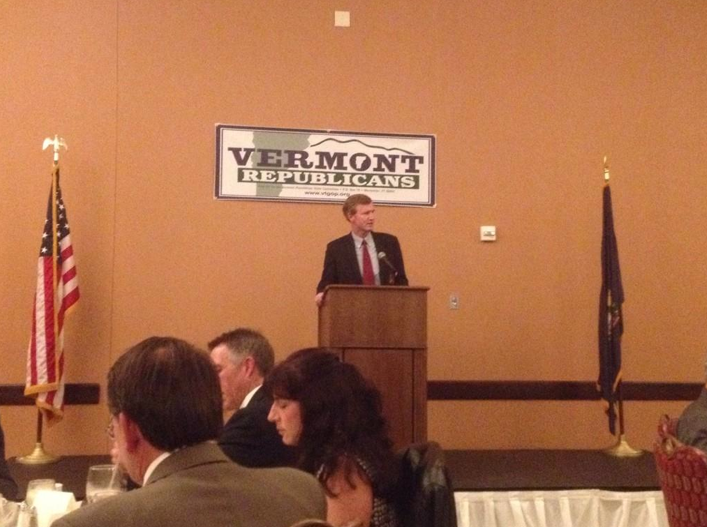
During the course of the evening, the operator of the VTGOP Twitter account posted four photos form the event. All four showed one of the evening’s speakers at the podium; all four were taken from angles that showed very little of the crowd. One example:

Screen Shot 2014-09-29 at 1.29.38 PM

Okay, so we know there were at least three people in the audience. Which is more of the crowd than you can see in any of the other photos, all of ’em focused on the podium.

No crowd shots, VTGOP?

What, too embarrassing? In my mind’s eye, I’m picturing a few dozen people crowded around the front tables, with plenty of empty seats farther away.

You may think my surmise unfair, just another example of theVPO’s liberal bias. But riddle me this, Batman:

— Right up to the day of the event, the VTGOP was sending out reminders that tickets were still available. The last one was sent at 10:43 a.m. Friday, less than seven hours before go-time.

— Since the Twitter posting of those four photographs, we’ve heard not a peep from the VTGOP about the success of the fundraiser. Or anything else, for that matter.

— This, in spite of the fact that I’ve been sending them gentle reminders via Twitter:

Screen Shot 2014-09-29 at 1.38.41 PM

And still no response.

I see a pattern. Last December, the VTGOP was very free with very generous pre-event estimates for its Chris Christie fundraiser. After the event, not a peep. Then in the spring, the Vermont Democrats hosted Sen. Elizabeth Warren; shortly after the event, the Dems announced attendance and fundraising totals.

Now another Republican event comes along, and once again, they’re being tight-lipped about the actual results.

As I said in one of my subsequent Tweets to @VTGOP, “I’ll take that as bad news.”

If the Vermont Republican Party does release totals for tickets sold and dollars raised, I’ll be happy to report them in this space, with whatever comments they provide. And if the totals are respectable or better, I’ll be happy to retract my cynicism and congratulate them on a successful event.

I’m not holding my breath.

Shumlin’s second TV ad: nice, but…

The Governor’s first ad featured a number of Vermonters talking about Shumlin initiatives that had helped their lives. The second spot connects two themes: post-Irene recovery and helping Vermont businesses survive and thrive.

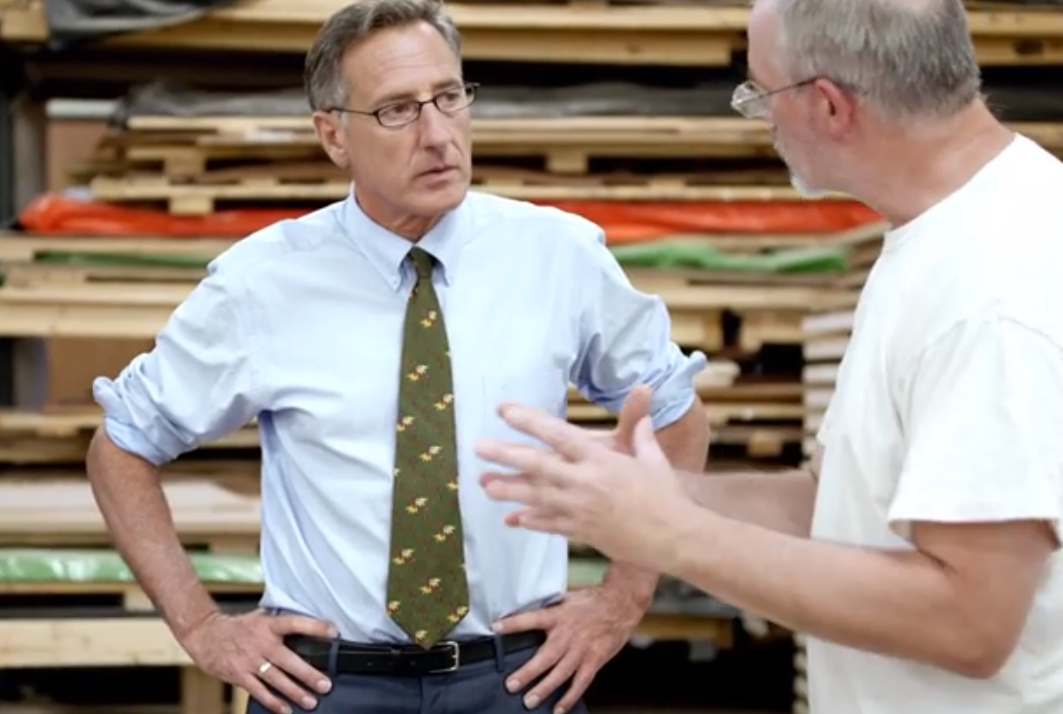
Nice glasses, Gov.

Nice glasses, Gov.

The spot is narrated by John Wall of WallGoldfinger, a furniture maker located in Randolph. Wall tells how his factory was hit hard by Tropical Storm Irene, and how the Administration responded “within a week,” facilitating loans to keep the company afloat.

“It was the difference between life and death,” says Wall. Now, he says, the company is poised for further growth.

It’s a good story, and having it told first-person gives the spot instant impact and credibility.

My only qualm?

I hope we’re not leaning too much on Irene.

It did, after all, happen three years ago, during the first year of Shumlin’s governorship. He deserves full credit for pushing the recovery forward… but I hope he doesn’t lean too heavily on Irene.

In the first ad, one of the four brief testimonies was about Irene; it’s the dominant subject of the second. More are on the way, I’m sure; and if other spots focus on other issues, I’ll be fine with the overall balance. Irene deserves to be part of the story, but let’s have some more recent stuff as well.

The universal Milne

The Scott Milne campaign has a number of albatrosses around its neck.There’s the newbie candidate’s inept performances on the stump and in debates. There’s his apparent allergy to fundraising. There was, of course, his late start. There’s the devastated, improverished infrastructure of the Vermont Republican Party. (Tickets Still Available for the Congressman Peter King fundraiser tonight!) (Please buy a ticket!) (Pretty please?) There’s the fact that he still hasn’t managed to articulate actual positions on the issues.

And on top of all that, there’s his remarkably incoherent political positioning. Because, you see, Scott Milne is trying to be all things to all people. He’s simultaneously opening his big-tent flap to conservatives, moderates, and even liberals.

Scott MilneLiberals?

Yup.

He’s trying to present himself as a thoughful, moderate leader who will consider all points of view, including the most progressive. He’s depicting Governor Shumlin as a bad manager; his pitch to liberals is, “If you replace Shumlin, state government will work better and you’ll see more of your policy dreams come true.”

It’s an impossible balancing act to maintain. And Scott Milne is definitely not the man for the job.

Look at his runaround on the GMO labeling bill during this week’s debate.

First, he said the GMO bill was “a good example of the radical, progressive management of a bill by this Administration.” Then he said he wouldn’t repeal it. Then he couldn’t say whether he would have vetoed it if he’d been Governor. And finally, he returned to the theme of “managing the bill,” saying that if Shumlin hadn’t been so ham-fisted about it, the bill could have been passed “in a much more business-friendly way.”

To sum up: the bill itself isn’t necessarily bad. In fact, it could even be a positive. But Shumlin’s “management of the bill,” whatever the hell that means, was the problem.

If only Scott Milne had been Governor, we would have gotten the same outcome with completely different results. The liberals would have gotten their way, but we would have remained somehow “business-friendly.” Or something like that.

My theory also explains his odd stance on health care reform. Vermont Health Connect was a radical, progressive program — but single-payer health care is NOT necessarily radical. It could turn out to be the best option. Milne ain’t saying.

What he is trying to say to us liberals is, Shumlin’s made a mess of Vermont Health Connect. Elect me, and I’ll make it work so smoothly that it’ll pave the way to single-payer. Maybe.

On issue after issue, Scott Milne is trying to appeal to everybody at the same time. On school funding, he wants to cut costs but he also wants to retain local control. He wants a freeze on the statewide property tax, but he apparently doesn’t want schools to suffer any cuts. And he’s unwilling to even hint at a new school-funding plan. Because he doesn’t want to lose a single vote.

Many issues are simply too “complicated,” and all he promises is to work with the Democratic Legislature on the details. To conservatives, the message is: I’ll hold the line. To liberals, it’s I’ll let you have your way a lot of the time. Somehow he’s not convincing any of us.

Most telling of all is his stance on legalizing marijuana, which sounds like it came from a chronic doper:

“It is a bad idea but if I get a bill, I’ll sign it.”

In the words of the candidate himself, Holy Shamoley.

I realize the man thinks he is “Gandhi-like,” but even the original Mahatma couldn’t have pulled this off.


The boy in the bubble

Scott Milne is honestly convinced he’s got a chance to beat Governor Shumlin.

He thinks, in spite of all available evidence, that all he needs is for voters to believe, and the Evil Pirates of the media to stop insisting his candidacy is dead.

He do believe in fairies. He do. He do. 

He do believe in fairies. He do. He do.

So, how did a successful businessman, who must be keenly aware of the hard knocks of the real world, become so self-deluded?

Well, he’s living in a bubble. And he’s mistaken that bubble for reality.

He spends his time on the stump, interacting with people who hate Governor Shumlin and yearn for deliverance. They welcome his presence and cheer his words.

Everybody else, he never sees. He’s living among a small, self-selected, and heavily skewed sample of Vermonters.

This is his experience everywhere he goes. It’s intoxicating stuff for someone who’s never played at this level before.

On the other hand, he never holds news conferences, so he hasn’t experienced that ego-deflating fandango. From the looks of things, he has little contact with fellow Republicans who are now regretting the day they ceded their precious nomination to him. (Has he ever, even once, made a joint appearance with Phil Scott since the launch of his candidacy?) He’s got a small campaign staff who also have little experience, and are presumably loyal to their man.

Inside the Milne Bubble, there’s a broad groundswell across the state that will carry him to the governorship. Surely, he believes, stuffy old Eric Davis must be wrong; after all, our Pundit Laureate is up in his ivory tower all day, while Scott Milne travels among the Real People of Vermont. Surely Milne’s experiences are more significant than Davis’ private musings.

And when the fairy dies on Election Night, Scott Milne will know who to blame. Not himself, and not the people of Vermont. The real killers will be Eric Davis, Mark Johnson, Anne Galloway, Paul Heintz, and the rest of those damn pirates.