Author Archives: John S. Walters

Unknown's avatar

About John S. Walters

Writer, editor, sometime radio personality, author of "Roads Less Traveled: Visionary New England Lives."

Hey, I think we finally found a conspiracy theory too nutty for Vermont

Saturday was a big day for a certain group of Internet-based nutbars. Namely, the Chemtrail folks — the ones who believe the water-vapor contrails emitted by jet planes are actually “chemtrails” meant to control the weather and make us sick. Or something like that.

Well, it would’ve been a big day if anybody had showed up. It was promoted online as the Global March Against Chemtrail and Geoengineering. Its webpage showed a map with dozens of protest sites around the planet… including one in Montpelier, Vermont!

Problem is, the actual turnout at the marches was so underwhelming as to be positively comical. Each city’s “march” had its own Facebook page, and some of the post-event comments are downright sad.

Some poor sap in Rhode Island was the only one who showed up for his “mass protest.” The ringleader in Philadelphia posted some photos that show no more than a handful there. Louisville had four. A dutiful correspondent in Denver plaintively inquired, “Am I missing something? I saw no one here.” A similar “Nobody showed” from Hartford, Connecticut.

The diligent nutbars in Omaha posted a brief video of their march — featuring four protesters.

The NYC organizer posted a photo of three people leaning on a railing — but he had perhaps the ultimate conspiracy theorist’s explanation for the dud turnout: the sky was clear. CLEAR, do you understand??? “They” called off the Chemtrail spraying for the day “which, of course, portrayed protesters as ‘fringe crackpots’ in an attempt to take the wind out of our sails.”

Ohhhhh. I see. No vapor trails in the sky for one day, so all your thousands upon thousands of invisible NYC supporters stayed home. Uh-huh. Don’t let nothin’ stand in the way of your pet theory.

Nice, professional-looking logo anyway.

Nice, professional-looking logo anyway.

Anyhoo, the alleged Montpelier event apparently didn’t happen. No sign of anyone posting on its Facebook page — not before, not during, and not after. Most of the Facebook pages had at least a smattering of people promising to attend — and then not doing so. And the plaintive wails of the few who did.

But in Montpelier? Not a whisper.

I didn’t think it was possible for there to be a fringey cause beyond the pale of us quirky Vermonters, but I guess I was wrong. Congratulations, Vermont: your annoying streak of crazy has its limits.
We eagerly await good tidings from the VTGOP

As you might know, although they did little to publicize the fact, the Vermont Republican Party had its fall fundraising dinner last Friday. The guest of “honor” was Islamophobic national-security nutbag Peter King, undistinguished Congressman from New York.

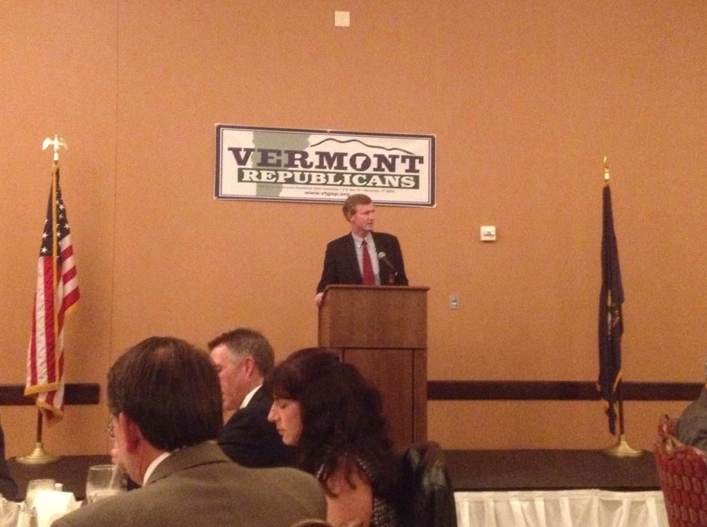
During the course of the evening, the operator of the VTGOP Twitter account posted four photos form the event. All four showed one of the evening’s speakers at the podium; all four were taken from angles that showed very little of the crowd. One example:

Screen Shot 2014-09-29 at 1.29.38 PM

Okay, so we know there were at least three people in the audience. Which is more of the crowd than you can see in any of the other photos, all of ’em focused on the podium.

No crowd shots, VTGOP?

What, too embarrassing? In my mind’s eye, I’m picturing a few dozen people crowded around the front tables, with plenty of empty seats farther away.

You may think my surmise unfair, just another example of theVPO’s liberal bias. But riddle me this, Batman:

— Right up to the day of the event, the VTGOP was sending out reminders that tickets were still available. The last one was sent at 10:43 a.m. Friday, less than seven hours before go-time.

— Since the Twitter posting of those four photographs, we’ve heard not a peep from the VTGOP about the success of the fundraiser. Or anything else, for that matter.

— This, in spite of the fact that I’ve been sending them gentle reminders via Twitter:

Screen Shot 2014-09-29 at 1.38.41 PM

And still no response.

I see a pattern. Last December, the VTGOP was very free with very generous pre-event estimates for its Chris Christie fundraiser. After the event, not a peep. Then in the spring, the Vermont Democrats hosted Sen. Elizabeth Warren; shortly after the event, the Dems announced attendance and fundraising totals.

Now another Republican event comes along, and once again, they’re being tight-lipped about the actual results.

As I said in one of my subsequent Tweets to @VTGOP, “I’ll take that as bad news.”

If the Vermont Republican Party does release totals for tickets sold and dollars raised, I’ll be happy to report them in this space, with whatever comments they provide. And if the totals are respectable or better, I’ll be happy to retract my cynicism and congratulate them on a successful event.

I’m not holding my breath.

Why state IT projects fail: a much-overlooked factor

Oliver Olsen, the once and (perhaps) future State Representative from southern Vermont, recently wrote an essay entitled “Why IT projects fail.” It was, more specifically, about why state-contracted IT projects fail.

Olsen began with the question, why can’t we bulid a software system when we manage to build large-scale complicated stuff like highways, bridges, and suchlike. His explanation: while the basics of civil engineering have been in place for quite a while, the world of high technology is young and ever-changing. And it’s harder to deal with the intangible world of IT than with the steel-and-concrete world of construction.

Good enough, as far as it goes, and I recommend reading the piece.

But I’d add one big factor that no one else seems to have noticed.

One of the problems throughout the history of the Affordable Care Act and Vermont Health Connect is a lack of competition for IT contracts. CGI was the big dog, by a long shot. Vermont chose CGI in large part because it had won so many other ACA contracts that it seemed the clear choice. Turned out, of course, that CGI wasn’t really up to the job. And when Vermont went to find a replacement, the only real choice was Optum, upon which our hopes are now pinned.

So the question: Computers and software are huge growth industries, and the US excels at both. Why can’t we get more, and smarter, companies to bid for health care exchange contracts?

I’d turn that question around: why are so many high-tech companies staying away?

Could it be because public-sector projects are complicated, fraught with peril, and more likely to yield failure than success?

Just looking at how the market moves, I have to conclude that it’s a lot more profitable to build newfangled gadgets, computer games, and smartphone apps. And the cost of failure is a whole lot lower: you put out a device or a game or an app. If it fails, you move on to the next one and write off the development costs. If you’re trying to build a health care exchange, you’d better damn well get it right. You can’t just walk away in the middle, and you can’t unilaterally postpone the launch.

Also, whereas a game or an app is pretty much a stand-alone item (as long as it plays nice with the operating system), public-sector IT projects are complicated systems that have to interface with other complicated systems.

There are lots of things IT experts can do that are higher-return and lower-risk than public-sector IT projects. Which is why most of them stay away from the business, and the public sector is left with a relative handful of bidders.

And somehow I doubt that those bidders represent the best and the brightest of the IT world.

Shumlin’s second TV ad: nice, but…

The Governor’s first ad featured a number of Vermonters talking about Shumlin initiatives that had helped their lives. The second spot connects two themes: post-Irene recovery and helping Vermont businesses survive and thrive.

Nice glasses, Gov.

Nice glasses, Gov.

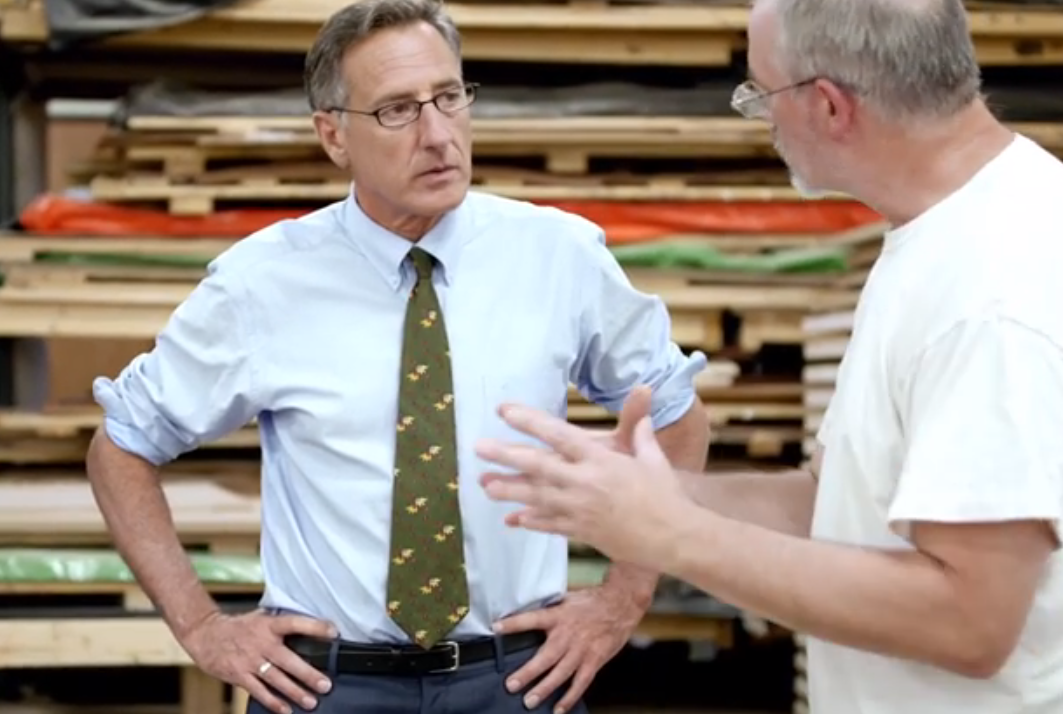
The spot is narrated by John Wall of WallGoldfinger, a furniture maker located in Randolph. Wall tells how his factory was hit hard by Tropical Storm Irene, and how the Administration responded “within a week,” facilitating loans to keep the company afloat.

“It was the difference between life and death,” says Wall. Now, he says, the company is poised for further growth.

It’s a good story, and having it told first-person gives the spot instant impact and credibility.

My only qualm?

I hope we’re not leaning too much on Irene.

It did, after all, happen three years ago, during the first year of Shumlin’s governorship. He deserves full credit for pushing the recovery forward… but I hope he doesn’t lean too heavily on Irene.

In the first ad, one of the four brief testimonies was about Irene; it’s the dominant subject of the second. More are on the way, I’m sure; and if other spots focus on other issues, I’ll be fine with the overall balance. Irene deserves to be part of the story, but let’s have some more recent stuff as well.

The universal Milne

The Scott Milne campaign has a number of albatrosses around its neck.There’s the newbie candidate’s inept performances on the stump and in debates. There’s his apparent allergy to fundraising. There was, of course, his late start. There’s the devastated, improverished infrastructure of the Vermont Republican Party. (Tickets Still Available for the Congressman Peter King fundraiser tonight!) (Please buy a ticket!) (Pretty please?) There’s the fact that he still hasn’t managed to articulate actual positions on the issues.

And on top of all that, there’s his remarkably incoherent political positioning. Because, you see, Scott Milne is trying to be all things to all people. He’s simultaneously opening his big-tent flap to conservatives, moderates, and even liberals.

Scott MilneLiberals?

Yup.

He’s trying to present himself as a thoughful, moderate leader who will consider all points of view, including the most progressive. He’s depicting Governor Shumlin as a bad manager; his pitch to liberals is, “If you replace Shumlin, state government will work better and you’ll see more of your policy dreams come true.”

It’s an impossible balancing act to maintain. And Scott Milne is definitely not the man for the job.

Look at his runaround on the GMO labeling bill during this week’s debate.

First, he said the GMO bill was “a good example of the radical, progressive management of a bill by this Administration.” Then he said he wouldn’t repeal it. Then he couldn’t say whether he would have vetoed it if he’d been Governor. And finally, he returned to the theme of “managing the bill,” saying that if Shumlin hadn’t been so ham-fisted about it, the bill could have been passed “in a much more business-friendly way.”

To sum up: the bill itself isn’t necessarily bad. In fact, it could even be a positive. But Shumlin’s “management of the bill,” whatever the hell that means, was the problem.

If only Scott Milne had been Governor, we would have gotten the same outcome with completely different results. The liberals would have gotten their way, but we would have remained somehow “business-friendly.” Or something like that.

My theory also explains his odd stance on health care reform. Vermont Health Connect was a radical, progressive program — but single-payer health care is NOT necessarily radical. It could turn out to be the best option. Milne ain’t saying.

What he is trying to say to us liberals is, Shumlin’s made a mess of Vermont Health Connect. Elect me, and I’ll make it work so smoothly that it’ll pave the way to single-payer. Maybe.

On issue after issue, Scott Milne is trying to appeal to everybody at the same time. On school funding, he wants to cut costs but he also wants to retain local control. He wants a freeze on the statewide property tax, but he apparently doesn’t want schools to suffer any cuts. And he’s unwilling to even hint at a new school-funding plan. Because he doesn’t want to lose a single vote.

Many issues are simply too “complicated,” and all he promises is to work with the Democratic Legislature on the details. To conservatives, the message is: I’ll hold the line. To liberals, it’s I’ll let you have your way a lot of the time. Somehow he’s not convincing any of us.

Most telling of all is his stance on legalizing marijuana, which sounds like it came from a chronic doper:

“It is a bad idea but if I get a bill, I’ll sign it.”

In the words of the candidate himself, Holy Shamoley.

I realize the man thinks he is “Gandhi-like,” but even the original Mahatma couldn’t have pulled this off.


Vermont schools get a top grade from a surprising source

Those stinkin’ commies at the U.S. Chamber of Commerce have put together a state-by-state “report card” on K-12 educational effectiveness, thoughtfully entitled “Leaders and Laggards.”

And guess who got an “A”?

Vermont. 

Yes, the state with the terrible awful expensive union-dominated monopolized anti-choice public school system got an “A”.

From the U.S. Chamber of Freakin’ Commerce. 

Let’s see you spin that, conservative public school critics.

The Chamber did downgrade Vermont in some areas. We got an “F” in “Parental Options” (no vouchers) and in “Technology” (“limited access to… digital learning options”).  And we got a “D-” in “21st Century Teacher Force,” which basically means we don’t fire teachers often enough for the Chamber’s liking. And there were a couple of middling grades.

But Vermont got a lot of top marks in key areas: Academic Achievement, which is kinda the point of a school system; Postsecondary and Workforce Readiness, which is something our schools are often criticized for; International Competitiveness; and (here’s the real shocker) Fiscal Responsibility.

Wow. If the U.S. Chamber of Commerce thinks Vermont’s schools are excelling in fiscal responsibility and academic achievement, and the Chamber has put Vermont in the top echelon of “Leaders,” I think that’s cause for celebration.

Somehow I doubt it will quiet the critics on the right, although it sure as hell should.

Art Woolf’s arguments of convenience

Welp, Vermont’s Loudest Economist is at it again. Art Woolf’s latest dispensation of wisdom in the Thursday Burlington Free Press is chock full of half-baked research, lazy reasoning, and politically convenient conclusions.

The main conclusion, as is often the case: Vermont sucks.

The topic of Art’s latest “How We’re Doing” effort was outmigration – the fact that Vermont’s population is roughly stable (or stagnant if you prefer, as Art does) and a lot of people are leaving.

This week’s entry in the digital Freeploid is entitled “Ex-Vermonters Vote With Their Feet.” (The print edition had a different title.)

As if every decision to move is a “vote” against Vermont. Every birth, a “yes” vote; every death, a “no” vote. (The Medical Examiner ruling: Death By Taxes.)

popchgsept25The accompanying chart shows three factors in population change: births/deaths ratio, immigration (from outside the US), and Net Domestic Migration. It shows immigration as a constant: we have a relatively small trickle of foreigners setting here. The births/deaths ratio was healthy until 2008, when the birthrate began to drop. But the biggie is Net Domestic Migration, which has been negative since about 2004.

(The chart is, of course, scaled to dramatize the net-migration plunge.)

Woolf chalks up the declining birthrate to our aging population, which is reasonable (although I wonder how much the Great Recession played into it): we do have more people beyond the usual child-rearing age. Woolf speculates that our birthrate will continue to fall as our population ages.

But later, when he’s expounding on the causes of our negative Net Migration, he completely ignores the aging population. Did it occur to him that a lot of our outmigrants are senior Vermonters heading for the Sun Belt? Not to judge by his column:

When people vote with their feet, they are saying something about the desirability of a state.

Those people are saying that despite its many attractions, Vermont is not a popular place for people to live and work.

For some that’s true, but not for an 80-year old who’s tired of hauling firewood and shoveling snow.

Woolf uses our aging population as a cudgel when it’s convenient; he ignores it when it’s not.

Also, as usual, Woolf doesn’t bother to compare Vermont to similar states. The outmigration of young people is a common problem for small, rural states; is Vermont’s better or worse than, say, Maine’s or Wyoming’s? Or northern New Hampshire’s?

Finally, let’s bring up a sacred cow that Woolf would never touch: the role our employers play in making Vermont undesirable. Generally speaking, Vermont’s pay rates are on the low side. Even if you’re talking about comparable jobs, the pay is often lower in Vermont than elsewhere.

Two examples I have some familiarity with: medicine and academics. Pay scales at UVM (and Dartmouth) are lower than at similar institutions elsewhere — sometimes substantially lower. Like, 50% or more. Our institutions get away with that because (a) Vermont offers such a high quality of life that many professionals will settle for a lower salary, and (b) our cost of living is relatively low compared to, say, Boston or New York or even Albany.

Many Vermont employers, especially in technology fields, complain that they can’t find enough qualified workers. Well, maybe they aren’t paying enough. Maybe they’re not recruiting hard enough.

No, that’s not it. Must be the taxes.

To be fair, Woolf doesn’t come out and blame taxes and regulation for Vermont’s outmigration. But he omits a lot of factors that lead to other conclusions: that we have built-in disadvantages, that our employers skimp on pay and aren’t aggressive enough in attracting new residents. And that our aging population is likely a major factor in growing outmigration.

This week’s entry, like many of his columns, is meant to undergird the business point of view — that we need to fling open the door to growth by cutting taxes, regulations, and those pesky environmental laws. As a thorough, honest look at How We’re Doing, the best grade you can give is Incomplete.

Fogler Departs, Crudification of Free Press To Accelerate

Big news in Vermont media: Jim Fogler is stepping down as president and publisher of the Burlington Free Press. And leaving the newspaper business entirely, for a rewarding and soul-enriching gig as a vice president at Party City, the national chain of party supply stores.

Those journalistic ethics should come in handy over there.

I have made my share of sport at Fogler’s expense in the past — if I recall correctly, I wrote that when Jim Fogler writes an optimistic column in the Freeploid, readers (and staff) run for cover. But if I were to guess, I’d say his departure is not good news for Vermont’s Largest Newspaper.

First, there are the circumstances. His resignation is announced on September 25, and his last day at the Freeploid will be October 1. That’s a nanosecond by the standards of executive turnover. I have no inside information whatsoever, but it does make me wonder if his departure was voluntary. Not that he was fired; but rather that they let him know that he’d be replaced, and gave him time to arrange a soft landing. He had spent 26 years with Gannett, after all, so perhaps a little consideration was in order.

The big change comes as Gannett’s newspapers are transitioning into a new era of newsroom organization. A few Gannett papers have already gotten the makeover, which has resulted in the following:

— More reporters, but fewer editors. A smaller newsroom staff overall. Get ready for an explosion in typos, bad writing, and bad grammar.

— Everyone has to reapply for newly redefined jobs. Presumably with lower pay and benefits.

— A dependence on “audience analytics,” i.e. covering stories because of reader interest (pageviews!) rather than importance.

— What appears to be a troubling degree of “synergy” between news and ad sales.

Expect Gannett to parachute in a corporate loyalist (after a, cough, “nationwide search”)  to institute the new regime at the Freeploid.

The boy in the bubble

Scott Milne is honestly convinced he’s got a chance to beat Governor Shumlin.

He thinks, in spite of all available evidence, that all he needs is for voters to believe, and the Evil Pirates of the media to stop insisting his candidacy is dead.

He do believe in fairies. He do. He do. 

He do believe in fairies. He do. He do.

So, how did a successful businessman, who must be keenly aware of the hard knocks of the real world, become so self-deluded?

Well, he’s living in a bubble. And he’s mistaken that bubble for reality.

He spends his time on the stump, interacting with people who hate Governor Shumlin and yearn for deliverance. They welcome his presence and cheer his words.

Everybody else, he never sees. He’s living among a small, self-selected, and heavily skewed sample of Vermonters.

This is his experience everywhere he goes. It’s intoxicating stuff for someone who’s never played at this level before.

On the other hand, he never holds news conferences, so he hasn’t experienced that ego-deflating fandango. From the looks of things, he has little contact with fellow Republicans who are now regretting the day they ceded their precious nomination to him. (Has he ever, even once, made a joint appearance with Phil Scott since the launch of his candidacy?) He’s got a small campaign staff who also have little experience, and are presumably loyal to their man.

Inside the Milne Bubble, there’s a broad groundswell across the state that will carry him to the governorship. Surely, he believes, stuffy old Eric Davis must be wrong; after all, our Pundit Laureate is up in his ivory tower all day, while Scott Milne travels among the Real People of Vermont. Surely Milne’s experiences are more significant than Davis’ private musings.

And when the fairy dies on Election Night, Scott Milne will know who to blame. Not himself, and not the people of Vermont. The real killers will be Eric Davis, Mark Johnson, Anne Galloway, Paul Heintz, and the rest of those damn pirates.

Weird Uncle Pete and the Fringe Brigade

Just about every family has that one relative. The one you try to stay away from. The one you never ever ever talk politics/religion/race with. The one who drinks too much, or gives creepily extended hugs. For our purposes, let’s call him Weird Uncle Pete.

Not Peter Diamondstone.

Not Peter Diamondstone.

As uncomfortable as Weird Uncle Pete makes everyone, he still gets invited to Thanksgiving dinner. Because he’s family.

But that doesn’t mean you have to invite him to a gubernatorial debate.

Well, it does, but only in Vermont. There, occupying the designated Fringe Candidate chair at Tuesday night’s debate, was Peter Diamondstone, perpetual candidate of the Liberty Union Party. (At the first debate, it was Hempily Peyton.)

And I have to say, as admirable our attention to inclusion may appear, people like Weird Uncle Pete add absolutely nothing to a high-stakes political debate. They occupy space, they take up time, and they limit the opportunity for real interaction between the candidates who have a prayer of actually being elected. Their inclusion is a disservice to the voting public.

Now, I don’t mind if Peyton and Diamondstone get one round. But I sure as hell hope I don’t have to hear either one of them again this year.

This ain’t the Special Olympics, folks. Everyone doesn’t get a ribbon for participation. I don’t mind that Vermont’s ballot access law is extremely lenient, but you don’t deserve a place on center stage or 20+ minutes of my time just because you got your name on the ballot.

Emily Peyton got on the ballot by collecting 500 signatures. Diamondstone got on the ballot because in 2012, the Republicans and Progressives didn’t run a candidate for Secretary of State, which left the Liberty Union candidate alone against Jim Condos. And of course, she got enough votes to guarantee her party ballot access for 2014. Diamondstone didn’t do a damn thing to “merit” a seat at the debate.

You may think me undemocratic, but I ask you: what is the purpose of these debates? I argue that they exist to serve the voting public. And the voting public is best served by an uncluttered presentation by candidates who, again, actually have a prayer of becoming Governor. Debates are designed to help the undecided make up their minds. The vast majority of those undecideds are never, in a million years, going to even consider voting for the likes of Weird Uncle Pete and Aunt Hempily.

We only get four gubernatorial debates this year. We can’t afford to hand them out like participation ribbons.