Author Archives: John S. Walters

Unknown's avatar

About John S. Walters

Writer, editor, sometime radio personality, author of "Roads Less Traveled: Visionary New England Lives."

It ain’t over till the Fat Man sings

All'alba vincerò! Vincerò, vincerò!

All’alba vincerò! Vincerò, vincerò!

Interesting. WCAX’s Kyle Midura, last seen as Twitter Guy during the gubernatorial debate, made his way eastward to beautiful Berlin, New Hampshire, where he caught up with New Jersey Governor Chris Christie, stumping the North Country “on behalf of the state’s Republican candidate for Governor, Walt Havenstein.”

And, being a good Vermont reporter, Midura asked Christie if he’d be visiting Vermont to campaign for Mahatma Milne. (Well, I don’t think he said “Mahatma.”)

“We’ve got to focus with 25 days to go on those place where we think we’ve absolutely got the best chance,” Christie said. “That’s where I’m focusing my time.”

Okay, let’s look at that.

The latest polls have shown Scott Milne behind Governor Shumlin by 12 percentage points. And in New Hampshire?

The latest poll places Havenstein 10 points behind incumbent Democrat Maggie Hassan.

Hmm.

Two points.

He won’t cross the river for two points.

Either he knows something about the Vermont race that he’s not telling, or it has less to do with gubernatorial races than with first-in-the-nation presidential primaries.

Either way, congratulations, Governor, on kicking a Republican candidate for Governor when he’s down. I assume that’s one of your duties as head of the Republican Governors Association.

A double standard at the Free Press? I am shocked! Shocked!

Ah, the Burlington Free Press: Champion of transparency everywhere outside its own doors.

The Gannett property steadfastly refuses to explain — or often even confirm — the organizational changes, comings and goings, mostly the latter, that affect the quality of its product and the ability of its readers — or should I say multiplatform consumers? — to depend on the Free Press for reliable, comprehensive journalism.

I’m sure the response from Michael Townsend would be, “Well, we’re a business! We have to protect our trade secrets and business strategy. Besides, we’re not bound to the same accountability standards as the public sector.”

Or, as he more succinctly put it to Paul “The Huntsman” Heintz earlier this week,

“I don’t talk to you guys,” he said. “I’m old-fashioned when it comes to competition.”

Oh, really? Well then, riddle me this, Batman: How come your reporters felt free to question WCAX-TV News Director Anson Tebbetts about the station’s mistaken broadcast of a photo of a murder victim?

And how come Tebbetts answered those questions?

“We’ve spent the last 24 hours apologizing for our terrible mistake,” Tebbetts told the Burlington Free Press. “We apologize to the family, her friends, the community and everyone that surrounded this case. It was a terrible mistake, and we’re deeply, deeply sorry.”

If the two men were in each other’s shoes, would Townsend have told Free Press reporters “I don’t talk to you guys”?

The Freeploid has plastered a thorough exploration of the WCAX incident in the prime spot on its webpage, seizing the opportunity to besmirch its’ competitor’s reputation.  And yet, it refuses to answer Heintz’ perfectly reasonable questions about newsroom cutbacks that will affect the quality of the Free Press’ product.

Anson Tebbetts feels a responsibility to his audience. Michael Townsend, apparently, does not.

The Burlington Free Press, transparency hypocrite.

Condos v. Eastwood: A surprisingly tame encounter

I had some hopes for VPR’s big Secretary of State debate at noon today. Incumbent Democrat Jim Condos, who also won the Republican nomination on a write-in vote but threw it back like a dead fish, faced off against Progressive Ben Eastwood.

I was expecting some sparks to fly. After all, it was Eastwood who spiked a motion at the Progs’ June convention to endorse Condos, referring to Mr. Secretary as a “crony capitalist.” And Eastwood has shown himself to be a loose cannon in the public sphere. So I was expecting Young Ben to come out with guns a-blazin’.

Well, he didn’t. He was, for the most part, rather passive. Also nervous, occasionally uninformed, and in general gave listeners no real reason to vote for him.

In fact, Jim Condos was the more aggressive of the two, pressing Eastwood on his past characterizations of corporations and lobbyists and Condos himself, and his ability to take on the numerous duties of the office. I’d expected Condos to just sail above the fray and basically ignore his challenger, but apparently some of Eastwood’s criticisms had hit a nerve.

For his part, Eastwood occasionally mentioned his past criticisms of Condos, but mostly in passing — as a way to add a little color to his questions and statements.

He did manage to do one thing that, for instance, Scott Milne failed to do: when given the opportunity to ask his opponent a question, he was ready with a good, solid, pertinent one about using the Secretary’s office to oversee lobbyists. Condos had no trouble answering it, but at least it was a solid effort.

Overall, though, Eastwood didn’t have much to offer. Which figures; he’s a young man with a background as an activist, but little or none as an administrator. And the Secretary of State’s office, more than anything else, is a big honkin’ bureaucracy that requires a steady administrative hand. As a political writer, I interact with one piece of that office — elections and campaign finance. There are four other major divisions: Corporate registration, professional regulation, archives and records, and providing information and advice to local governments. That’s a lot of responsibility.

Eastwood did offer a few ideas, but almost all of them had to do with campaigns and elections, and most are actually outside of the office’s purview. His top priority, he said, would be to create an online information exchange where the public could access legislation, testimony, and other information — and also provide input. A Reddit sort of community marketplace of ideas.

Condos’ rejoinder: that’s something for the Legislature to do online, not the Secretary of State. He has advised the Legislature on updating its website and enhancing transparency, but he can’t create the kind of open forum that Eastwood wants to see.

I could cite other examples, but the point is, Ben Eastwood is young, inexperienced, and enthusiastic. Some of his enthusiasms are germane; many are not. But in this debate, he failed to make a case against Condos, and failed to establish himself as a serious applicant for the job.

He did manage one thing, though: he didn’t embarrass himself or his party.

No, I did not watch the freak show.

A study in pink.

A study in pink.

In front of a Susan G. Komen-worthy bright pink backdrop, the recently rebranded Vermont Public Television (now d/b/a Vermont PBS) rolled out the Clown Car O’ Democracy last night.

Yes, the one and only gubernatorial debate featuring all seven candidates for Governor.

Which produced the amusing spectacle of Scott Milne standing uncomfortably next to a Duck Dynasty stunt double, and Dan Feliciano braving sudden death from the razor-sharp brim of a Church Lady hat.

“Amusing spectacle” it was, and amusement was all it was good for. As a way for actual voters to actually make an actual decision, it was a waste of time. And I haven’t seen the overnights, but I wonder if Vermont PBS got as many viewers (74 max) as the ill-fated Burlington Free Press livestreamed debate.

Certainly they could have done better with a rerun of Bob Ross’ “The Joy of Painting.”

In fact, I’d vote for Bob Ross over some of those candidates. And he’s dead.

This notion of an all-inclusive gubernatorial debate seems to bring cheer to some of my friends in the media. It’s so… Vermont, you know?

Well, yeah. But so are rural poverty and frost heaves and agricultural runoff in Lake Champlain.

Vermont law makes it very easy to get a spot on the ballot. Which is fine; I don’t mind having eleventy-bajillion candidates if they get enough petition signatures. But it doesn’t mean they deserve my attention or consideration.

There are, at most, three serious candidates for Governor: Peter Shumlin, Scott Milne, and Dan Feliciano. Ironically, in all the debates so far, we have yet to see the three of them sharing a stage by themselves. More debates are in our future, and maybe we’ll get to see the only matchup that matters. I hope so.

How to waste $142,000

Two suggestions:

1. Get yourself 7,100 $20 bills. Scatter them in a big pile. Douse in gasoline, add one lit match.

2. Spend it on Republican advertising in Vermont.

Image from the RSLC ad. Or maybe from a Cialis spot.

Image from the RSLC ad. Or maybe from a Cialis spot.

As first reported by VTDigger, a national organization called the Republican State Leadership Committee has chosen the second course, pouring $142,000 into a TV/radio ad campaign for Republican legislative candidates.

They might have asked Lenore Broughton how this kind of big-money, old-media, carpet-bombing technique works. She spent at least a million bucks in 2012 on a TV/radio/bulk mail blitz attacking the Dems, and failed to move the electoral needle at all.

But the RSLC didn’t ask her. In fact, they didn’t talk to anyone in Vermont. Just ask one of the first guys they should have talked to.

Rep. Don Turner, R-Milton, the House minority leader, said he welcomed the media campaign, but was unaware of it until VTDigger showed him the ad.

So a D.C.-based Republican organization is running generic ads for nameless candidates, and they didn’t even consult the House’s top Republican. Somehow I don’t think the Democrats are too worried about this. Oh wait, here’s a Democrat now:

It’s just like in 2012, when there was a single Republican donor spending approximately $1 million here in Vermont. The VTGOP is just trying to bankroll their way towards relevance. It’s not going to work. Vermonters have already made it clear that the right-wing agenda has no place in our state, and they will make it clear again on November 4th. The RSLC is spending six figures on behalf of VTGOP candidates and that money comes directly from the Koch brothers and other insidious sources.

That’s from Ben Sarle, the VT Dems’ communications director. Now, naturally you’d expect him to say that. But the facts on the ground support his assertions. No matter what RSLC does, the Dems are extremely unlikely to lose more than a handful of legislative seats; it’s even possible that they’ll add a few to their outsized majorities.

But shed no tears for the RSLC. They’ve got money to burn, with a donor list that’s a Who’s Who of corporate America. In 2012 alone, RSLC spent some $39 million in state campaigns. So a lousy $142,000? That’s pocket change.

Oh, for your further entertainment, here’s the RSLC’s Top 20 donors for the year so far, according to the Center for Responsive Politics.

Screen Shot 2014-10-10 at 12.45.55 AM

Mmmm, delightful. Big Tobacco, Big Oil, Big Banking, Big Pharma. Big Telecom. Wal-Mart. Gambling. The US Chamber of Commerce. They’re all there.

Inclluding at least a couple of Bigs that have been generous to Governor Shumlin: Blue Cross/Blue Shield and Comcast.

Huh.

Say, Ben, perhaps you’d best tone down that talk about “insidious sources.”

The new polls, part 2: The only thing Shumlin has to fear is Shumlin himself

(See also part 1, which addressed the Phil Scott/Dean Corren results.)

The latest gubernatorial poll from the Castleton Polling Institute (courtesy of WCAX-TV) is a picture of stagnation, with an electorate disappointed in the incumbent, but finding no acceptable alternatives. The results are right in line with other recent surveys, with the helpful addition of Dan Feliciano clarifying the picture somewhat.

The numbers: Shumlin 47, Milne 35, Feliciano 6, and undecided at 8.

A secondary result, underpinning the above: 45% approve of Governor Shumlin’s performance, 41% disapprove. Bad numbers for an established incumbent, especially for one who was in the 60s at his height.

But while the poll is bad for Shumlin, it’s also bad for his challengers. As WCAX’s dueling analysts put it:

“I don’t think Mr. Milne has given the public a reason to vote for him and that is what Mr. Milne’s challenge is going to be in the next six weeks,” said Mike Smith, Republican political analyst.
How about a shot of 5-Hour Energy?

How about a shot of 5-Hour Energy?

“I think these numbers show that there’s one candidate against Peter Shumlin and that is Peter Shumlin,” said Steve Terry, Democratic political analyst.

Milne is stuck in the mid-30s. And Feliciano, for all the insider buzz about his candidacy, is only taking a small chunk of the conservative vote. Six percent is a lot for a Libertarian, but not much for someone who’d positioned himself as the real alternative to Shumlin. As I wrote before, there’s a whole lot of value in the Republican brand, and a deep loyalty among core Republican voters.

As for the independents and undecideds, they’re stuck. Given the 41% Milne/Feliciano total, I infer that Milne has gained a small number of centrists simply by Not Being Shumlin, while he’s lost a few percentage points to Feliciano among the True Believers. Overall it’s a wash, and not nearly enough to win. And the Governor is the only candidate with the resources to get his message out between now and Election Day. Although the big headline was that Shumlin is under the 50% mark, he still stands a solid chance of not only gaining a pure majority, but getting up into the mid-50s. That’d be a decent, if not overwhelming, mandate.

So, in a solidly blue state, why are Shumlin’s numbers so mediocre? The experts point to the obvious: Vermont Health Connect, the human services troubles, and the Jeremy Dodge land deal.

The first two I buy. The last, nope. I don’t think anybody outside the political media remembers that deal. After initial missteps, Shumlin dealt with it wisely and effectively. Remember “it’s not the crime, it’s the coverup”? Well, in the Dodge deal, there was no coverup. There was a fast and fair resolution.

All right, so now I have to offer my own explanation. In two words:

The doldrums.

Which is partly the VHC and human services problems. But more than that, it’s the lack of real, tangible, landmark achievements.

Which is reflected in Shumlin’s third campaign commercial, focusing on the GMO bill. Now, nice as that bill was, it was a sideshow in this year’s legislative session. And, as Paul Heintz pointed out, it’s a stretch to give the Governor much credit:

For years, Shumlin said he backed GMO labeling in concept, but believed that mandating it was legally perilous. He argued that any such attempt would suffer the same fate as Vermont’s 1994 law requiring dairy products produced with recombinant bovine growth hormone to be labeled as such. The Second Circuit Court of Appeals struck it down in 1996 and awarded damages.

But leave that aside for the moment. The bigger question: Is the GMO bill really the Governor’s signature accomplishment for 2014?

I guess it is. Given the size of the Democratic majority and the big issues facing Vermont, that’s a little bit underwhelming. And I think the voters are underwhelmed. One of Scott Milne’s best lines in yesterday’s WCAX debate concerned school funding: “The Governor had huge approval ratings and big majorities, and he didn’t do anything.”

Shumlin’s signature issue, single-payer health care, is still a mystery shrouded in an enigma. He can’t brag about it, because he hasn’t done it yet. Or even offered a plan. That’s not exactly motivational.

There are solid reasons to defend the Governor’s record. He’s dealt with the aftermath of the 2008 recession and Tropical Storm Irene. He’s had to pull rabbits out of his hat to keep the state budget under control as the federal stimulus funds ebbed away. He’s also taken some good, incremental steps in areas like human services and college affordability. The minimum wage hike was nice. He’s done a lot on renewable energy. His opioid initiative holds great promise, but has yet to bear fruit.

Those are not accomplishments to be sneezed at. They are strong indications of substantial administrative competence. That’s important. But it’s not inspirational.

I think that, more than anything else, Vermont voters are uninspired. When Shumlin launched his active campaign in early September, his challenge was to light a fire in his supporters — and perhaps even in himself. So far, he hasn’t really done it.

IF he does it between now and Election Day, he’ll get into the mid-50s. If he doesn’t, he’ll limp across the finish line in the 50-52% range.
Bit by bit, ever so slowly, Scott Milne is turning himself into a candidate

It’s way too late, of course. As I’ve said before, Milne is now doing the kind of stuff he should have done six months to a year ago: traveling the back roads of Vermont, meetin’ folks. Getting his name out there. Learning the ropes of a brand-new trade: running for statewide office. Becoming a halfway competent debater.

Fundraising.

That kind of stuff.

Shumlin/Milne at WCAX debateAnd if you squint a little bit and look closely at last night’s debate performance on WCAX-TV, you can get a glimpse of a real live candidate emerging from the primordial ooze.

It’s way too late, of course. But I’ll give him credit: Milne was a lot less twitchy and erratic than he was a few weeks ago. He was reasonably calm most of the time. When he wasn’t speaking, he held his face practically motionless. Which was a good thing, because WCAX used a split screen much of the time. He scratched his nose a couple times, but he didn’t pick it.

His message remains a mess. He recycles the same handful of tired attacks on Governor Shumlin (how many times did he say “reckless experiment”?). He works in snide little comments at every opportunity. (He responded to a viewer question about his vision for Vermont’s future by saying, ungrammatically, “My vision is a governor that doesn’t make promises that end up broken.” Cute, but not at all visionary.)

He also made a royal botch of his opportunity to ask Shumlin a direct question. His opening was so rambly that co-moderator Kristin Kelly had to interrupt, “Do you have a question for the Governor?” After which he meandered slowly through the firing of Doug Racine as head of Human Services, and Racine’s statement that he hadn’t met with Shumlin in over a year, Shumlin’s out-of-state travel… and at the end, his actual question was a batting-practice fastball down the middle of the plate: “Can you look in the monitor and tell them you’ll be a better Governor in the next two years?” Which gave Shumlin the opening to turn the question immediately back to his agenda.

Stupid.

And most of all, Milne still has nothing like a coherent plan for his hypothetical governorship. He has little or nothing to offer on health care, the state budget, school funding and governance, social services, or the economy. He preaches caution on all fronts; he says he will “listen before I act.” On multiple occasions, he said he would sign specific bills that he disagrees with — apparently signaling that he would frequently defer to the Legislature. As Shumlin pointed out, that’s an odd definition of leadership.

And once in a while, just when you least expect it, he slips out a scrap of a policy idea. Answering a question about improving the economy, he tossed off a passing reference to “tax incentives.” No details, no elaboration. Just a couple of quick words, and then onward.

This is how you roll out a major policy proposal? Really?

I’ll say this. Scott Milne has improved — from an F to maybe a C minus. Give him another 18 months or so, he might turn himself into a credible contender for the governorship.

Wait a minute… checking the calendar here… nope, sorry, he doesn’t have 18 months. He has less than four weeks.

Like I said: it’s way too late, of course.

@bfp_fail: We interrupt this debate to bring you a picture of Peter Diamondstone nodding off

Well, I tried to watch it.

The Burlington Free Press hosted a gubernatorial debate at noon today, and livestreamed it online.

Or tried to.

The first half hour was fine. After that, it kept freezing and crashing. I spent most of the ensuing half hour waiting for isolated bits of audio. Which, as Darcie Johnston pointed out on Twitter, always seemed to happen when Peter Diamondstone was talking. And the frozen image on the screen was usually Diamondstone with his eyes closed. Around 1:00, I gave up.

The Freeploid can’t blame its failure on too many viewers, either. There was a counter onscreen that tracked the number of viewers, and the highest it hit was 74. That’s not enough to crash a livestream.

Well, it shouldn’t be, anyway.

Of course, since the Freeploid only yesterday announced a corporate “reset” that includes forcing newsroom staff to reapply for their jobs, this disaster may have been an inside job. Whatever the cause, it’s a dismal performance.

Speaking of dismal performances, Scott Milne continued to hammer on the shortfalls, real and imagined, of the Shumlin Administration without offering any plans of his own.

Single-payer? Let’s wait six years.

How to cut the budget? Get rid of the governor’s SUV and out-of-state travel.

When asked for specific cuts, he tried to make a joke, talked about bringing in smart people from outside who’d be willing to take pay cuts to work in his administration, made a half-hearted call-out to the long-discredited Challenges for Change, and concluded by saying “I don’t know.”

School funding? He slammed Shumlin for failing to make tough choices, but offered nothing of his own.

And, according to the Freeploid’s Twitter feed (I’d stopped watching the unwatchable livestream by then), MIlne actually said he’d unveil a Lake Champlain cleanup plan by Election Day. 

Sheesh.

At one point, he briefly paused his attacks on Shumlin to day “It’s easy to be a Monday morning quarterback. I’m talking about the future.” And then he resumed the attacks.

Milne has managed to dribble out a few ideas, inadequate and half-assed though they are: a two-year statewide property tax freeze, Challenges for Change, maybe a regional health care exchange. But with less than four weeks until Election Day, he remains the Man Without a Plan, with apologies to Fred Tuttle.

His excuse is that he doesn’t “have a background” in government. Well, sure. But is that a positive asset for filling our top executive position? What if an applicant came to Milne Travel and said “I don’t have a background in the travel business, but you’re doing a terrible job and you should hire me”?

And even if you put a value on bringing in a fresh perspective, why can’t Milne consult with some of his “expert advisers” and come up with a few specifics? He doesn’t need years of government experience to do that.

I’ll say it again: I had some hopes for Scott Milne when his campaign began. And there’s plenty of room for an informed critique of the Shumlin Administration. But he’s just been a disaster.

Postscript. I’d slam the Freeploid for its inexplicable decision to invite Peter Diamondstone and not Dan Feliciano, except that it led to the most entertaining moment of the debate. Diamondstone wasn’t there at noon; he appeared at about 12:10, panting furiously. And continued to pant for a couple of minutes, directly into his microphone, while Milne was trying to answer a question.

The new polls, pt. 1: Vote for Bud

Yesterday brought new polls in the races for Governor and Lieutenant Governor. I’ll get to the Shumlin/Milne numbers later. This post will address the easy one: Phil Scott 58%, Dean Corren 24%.

Yeah, that race is over. Commence victory lap.

Corren’s 24% is bad enough, but the worse news is Scott’s 58. Corren would not only have to sweep the undecideds to make this competitive, he’d have to unconvince almost 10% of Scott voters. That ain’t happening.

The poll is credible, coming from the Castleton Polling Institute (and commissioned by WCAX-TV). The 4% margin of error is a drop in Phil Scott’s bucket.

Corren’s response, of course, is defensive optimism, per VPR:

“It was done… before our ads started to kick in. And we’re going to be doing a lot more ads,” Corren says. So I think it’s mostly a name recognition thing.”

Which raises a question about Corren’s campaign strategy. As of October 1, he’d spent about one-fourth of his $200,000 publicly-financed warchest. He waited an awfully long time to amp up a race between a basically unknown challenger and an extremely well-known incumbent.

Maybe he was misled by the success of his drive for public financing, or the outcome of his write-in bid for the Democratic nomination. Corren’s got an enthusiastic core following, but that doesn’t help him in the general campaign. In the language of beer, Dean Corren is Heady Topper: a tremendous niche-market success.

Phil Scott is Budweiser. Uninspiring, bland, perennial best seller.

You can see the contrast in these words from Corren, meant to support his candidacy but actually outlining the reasons Phil Scott will win:

“You have an incumbent who has spent four years doing things that make everybody in the state feel like he’s a nice guy and not hold him to account on any particular issues, and really know where he stands on issues, because he’s done a really good job of ducking that.”

Yeah, exactly. Everybody in the state thinks “he’s a nice guy.” And he’s running for the ultimate nice-guy office. Also, being a nice guy makes him the perfect token Republican: he’s not going to aggressively challenge the status quo.

Now, there’s no way the final result is going to be anything like 58-24. I expect Corren to gain 15-20 percentage points. He’ll almost certainly do better than Cass Gekas’ 40% two years ago. But not nearly enough to matter.

Heady Topper’s great. But it’ll never challenge Bud.

The Brave New World of Journalismism is Upon Us

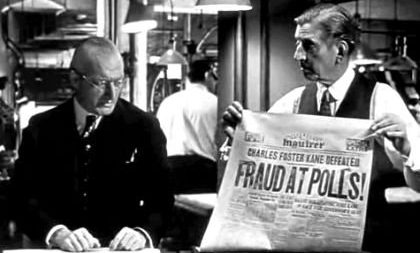
Oh boy, here we go… apparently Executive Editor Michael Townsend now occupies the Burlington Free Press Chair in “Good News” Editorials, recently vacated by Jim “Party City” Fogler. Because there it is, the dawning of the thorough Gannettization of Vermont’s Largest Newspaper, under the ominous title “Free Press Resets for the Future.”

The piece begins with a lengthy humblebrag about a recent Dan D’Ambrosio story on IBM that Townsend labeled “epic,” “readable and educational.”

Epic, eh? Guess that puts Homer in his place.

We are Gannett. You will be assimilated.

We are Gannett. You will be assimilated.

Right off the top, I had a strong feeling I was wading through bullshit. There was the title, first of all. But also because it was such a lengthy “soft lede” as they say in the news biz that I figured Townsend was burying the bad stuff; and finally, because I’ve been watching the news about how Gannett newspapers are “resetting for the future.”

By forcing all their newsroom staff to re-apply for their jobs. By cutting total newsroom staff. By getting rid of the formerly rigorous editorial process and relying on reporters to crank out publication-ready copy. By promoting clickbait over serious journalism. And by tearing down the walls between news and sales.

At FreePressMedia, we, as the rest of our colleagues in the Gannett company, are resetting the structure of the newsroom to better enable us to focus on the information and the presentation that you tell us via choice are most important, including accountability journalism and topics that Vermonters are known to be passionate about, such as the environment, local food and the creative economy. These changes are significant for our operations to produce content more tuned to the digital experience.

Part of this resetting is developing a new operational structure to enable us to focus more on the local content that deeply interests readers. With systemic changes in the media business in recent years including changes in approach, format and staff size, we are redefining journalism jobs for the future and our vibrant website, BurlingtonFreePress.com. During the next several weeks, the staff will apply for these jobs with new expectations. We expect time for adaption to the change in structure.

Emphases mine.

“You tell us via choice” means “we’ll abandon journalistic principles and pursue the stories that generate the most pageviews.” See that list: “The environment, local food and the creative economy”? What’s missing?

Oh, how about politics and public policy? Health care, welfare, corrections, infrastructure, taxation, investigative journalism, to name a few. Even transparency, until now a Freeploid bugaboo.

“Redefining journalism jobs” means higher expectations for production, along with lower salaries and worse benefits.

And “staff will apply for these jobs” meaning, well, senior writers, you’re probably S.O.L. We want younger, cheaper staffers more comfortable with multimedia technology.

Yesterday’s retirement announcement by senior writer Sam Hemingway suddenly makes a whole lot of sense. He saw the writing on the digital wall.

I’d expect a bunch more to follow him out the door, voluntarily or otherwise.