Author Archives: John S. Walters

Unknown's avatar

About John S. Walters

Writer, editor, sometime radio personality, author of "Roads Less Traveled: Visionary New England Lives."

No good deed goes unpunished

(Note: those visiting this page for the first time may also want to read two follow-up posts: one exploring the historical roots of the proposed motto, and one about a state Senate committee’s consideration of the motto.)

_________________________________________

You try to do something nice…

Last spring, Senate Minority Leader Joe Benning got a letter from an eighth-grader at The Riverside School in Lyndonville. She was studying Latin, and wanted Senator Joe to introduce a bill to give Vermont a Latin motto. We’ve got “Freedom and Unity,” but no Latin.

As the idea developed, those involved came up with a motto: Stella quarta decima fulgeat. The translation: “May the Fourteenth Star Shine Bright,” is a nod to Vermont’s status as the fourteenth state to join the union. Nice. Poetic in both languages. Benning brought the student to Montpelier and introduced her to the Government Operations Committee, which would consider her proposal.

*Also possible endorsement deal with the new 14th Star Brewery in St. Albans?

It was too late in last year’s session to launch the idea, but Benning introduced it this month. Senate Bill 2 would not affect “Freedom and Unity” at all; it would simply establish the Latin motto as a separate thing.

A nice harmless moment, no? A reward for a hardworking, creative student, yes?

Funny thing. Last week, WCAX did a story about Benning’s bill. And the reaction, as Benning told me in an email?

I anticipated suffering the backroom internal joking from my colleagues in the legislature.  What I did not anticipate was the vitriolic verbal assault from those who don’t know the difference between the Classics and illegal immigrants from South America.

Sen. Joe Benning, perhaps on his way back to Mexico. (Photo from his Facebook page.)

Sen. Joe Benning, perhaps on his way back to Mexico. (Photo from his Facebook page.)

That’s right, the WCAX Facebook page was inundated with angry posts from ignorant Vermonters spewing their hatred in barely readable fractured English. (Spelling and punctuation as-is) Warning: Teh stoopid, it burns!

Dorothy Lynn Lepisto: “I thought Vermont was American not Latin? Does any Latin places have American mottos?”

Norman Flanders: “What next Arab motto??”

Kevin P. Hahn: “How about ‘go back south of the boarder'”

Richard Mason: “We are AMERICANS, not latins, why not come up with a Vermont motto that is actually from us”

Judy Lamoureux: “Throw him out of the country tell him to take obama with him!”

Phil Salzano: “My question is, are we Latin, or are we Vermonters? Alright then, English it is…..”

Lori Olds: “I thought this was USA why are they trying to make Americans aliens”

Chris Ferro: “That’s a BIG NO, if you live in the United State YOU need to learn ENGLISH!!”

Julie Kellner: “No, you a USA citizen!.. Learn & understand the language!!!.”

Kurtis Jones: “No cause vt ain’t no Latino area. Leave the motto alone”

Zeb Swierczynski: “ABSOLUTLY NOT!!!! sick and tired of that crap, they have their own countries”

Ken Curtis: “Just when I felt our represenatives could not possibly get any dumber , they come up with this…get real… this is the USA, not some Moslim or Mexican country…stop given in to these people…PRESS 1 for English and forget the rest… worry about the problems you were elected to do”

Ronald Prouty Jr. “No way this is America not Mexico or Latin America. And they nee to learn our language, just like if we go there they want us to speak theirs”

Kristen Wright: “thats un called for this is the usa”

Kelley Dawley: “How do you say idiotic senator in spanish? I’d settle for deport illegals in spanish as a back up motto”

Heather Chase: “Seriously?? Last time I checked..real vermonters were speakin ENGLISH.. NOT LATIN..good god…”

I could go on, but that’s more than enough.

And really, it’s only the tip of the iceberg. For every commenter who didn’t know the difference between Mexico and Rome, there were ten who were apoplectic over the notion that Our Representatives Are Wasting Their Time (as if this bill will take more than a few minutes anywhere), and that Joe Benning is a moron who should be voted out of office and/or evicted from Vermont.

The good Senator is reacting to this with admirable equanimity:

I figure this is a good opportunity for my now ninth grader to learn how to respond to such attacks with fortitude and grace.  I hope to be meeting with her and her parents this weekend to continue the educational experience.

Good on ya, Senator. Illegitimi non carborundum.


Here’s an idea: Lock up the social workers

Is it just me, or is this the early front-runner for Worst Legislative Proposal of the 2015 Session?

Anyone who cares for but fails to prevent harm to a child could be charged with a felony and face up to 10 years in prison under a new crime created as part of a long-awaited child protection bill unveiled Wednesday.

…The penalty for failure to protect a child would be up to 10 years in prison or a fine of up to $20,000.

This proposal is part of a bill to impose “sweeping changes in the state’s child protection system. And maybe the rest of the package makes sense. But that?

We have a child protection system that’s understaffed, underfunded, and poorly organized, according to not one, but three separate studies of the Department for Children and Families, all carried out last year after the deaths of two young children under state supervision.

So we know that social workers are overworked and inadequately trained. And our response is to hang the Sword of Damocles over their heads?

Honestly, if I were a social worker, there’s no way in Hell I’d work for the state of Vermont if the threat of a felony conviction and incarceration were hanging over my head.

But that’s not the only problem with the “lock ’em up” solution to DCF’s problems.

The crime of “failure to protect a child” is vaguely defined: it’s when someone knows or “reasonably should have known” that a child is in danger. Public Safety Commissioner Keith Flynn “said the new crime would likely be difficult to prosecute.”

No kiddin’.

The bill would not just apply to social workers, but to anyone having “custody, charge or care of a child.” Like, for example, babysitters.

Well, in the real world the chances of a babysitter facing a felony charge are probably remote. But why open that door with such a broadly-worded statute?

Speaking of broadly-worded:

Drug crimes include exposure to unlawful possession of a list of drugs, including narcotics and two or more ounces of marijuana.

Okay, you’re telling me that anyone with “custody, charge or care of a child” should be expected to know if that child’s parent has a couple ounces of weed stashed in a kitchen cupboard?

Dick.

Dick.

The “brains” behind this awful bill is Sen. Dick Sears, who seems to believe that the threat of prison will help social workers more than, say, adequate staffing and support.

“If there are kids who need protection and this system leads to protecting kids, what’s the problem?” he said.

Hmmmm. Maybe he’s got a point. But if we’re going to apply it to social workers, why not to DCF administrators who oversee a flawed system? If poor training and high caseloads led to a social worker’s mistake, shouldn’t they be held responsible?

How about the folks who made such a pig’s breakfast of Vermont Health Connect? Or the economists who spun out the overly-optimistic forecasts that left our state in a $100 million budget hole? Or maybe a Governor who dumps his signature initiative after vowing action through three election cycles?

Or lawmakers who know, or “reasonably should have known,” that they were passing budgets that starved DCF of the resources necessary to protect children?

“If there are kids who need protection and this system leads to protecting kids, what’s the problem?” he said.

You’re right. What’s the problem?

Felony crime, ten years in the slammer. What’s good for the goose is good for the gander, right?

Inmates aren’t people; they’re fungible assets

For those who believe that shipping prison inmates to distant for-profit prisons is immoral (human rights), unconstitutional (judge’s decision, uncontested), or simply counterproductive (isolation may lead to recidivism), this week brought just a little bit of good news courtesy of the soon-to-depart Laura Krantz at VTDigger.

After bringing home a few dozen inmates this week, Vermont has roughly 360 inmates in a Kentucky prison and another 40 in Arizona — the lowest number in a decade.

With the good news came some bad: a provision in Vermont’s contract with the Corrections Corporation of America imposes penalties if the inmate population falls below 380. We are now very close to that figure.

Corrections Commissioner Andy Pallito admits that the provision creates a disincentive for Vermont to bring more prisoners home, even if there’s space in state prisons.

Then came the Governor’s budget address on Thursday. One of the revenue upgrades is $1.7 million from the lease of 60 inmate beds to the U.S. Marshals.

Hmmm. A lower inmate population could trigger higher payments to CCA… but now we’re leasing five dozen beds, putting the squeeze on in-state prison space… Hey presto: Synergy! We save money on CCA and we make money from the U.S. Marshals.

Fiscally, it’s a win-win.

If you don’t mind treating your inmates like commodities instead of human beings.

If the Governor is worried about the wealth gap, he could maybe do something about it

Gov. Shumlin’s budget address began with a bit of boilerplate that’s been a recurring feature in his recent public remarks: bemoaning the wealth gap in America.

At a time when the wealth gap between the people at the top and everyone else is more extreme than since before the Great Depression, Vermonters hear about the recovery both in Vermont and nationally; they hear about our state’s low unemployment numbers; and they wonder: Why aren’t I seeing it? Why is my family being held back?

The bemoaning is appreciated, but when he does so little about the wealth gap, it comes across as an empty rhetorical gesture — the last ghostly trace of a progressive agenda.

Okay, I don’t expect Peter Shumlin to single-handedly fix our profoundly unbalanced economy. But there’s one big thing staring him in the face that would help the middle class and help close the state’s budget gap.

Raise the effective tax rate on top earners. Not the actual rate, but the effective rate.

Yes, I’ve said this before; and yes, Shumlin blocked a House proposal to do just that a couple years ago. But our tax system has gotten worse since then, and our budget shortfall has grown.

Just look at this chart.

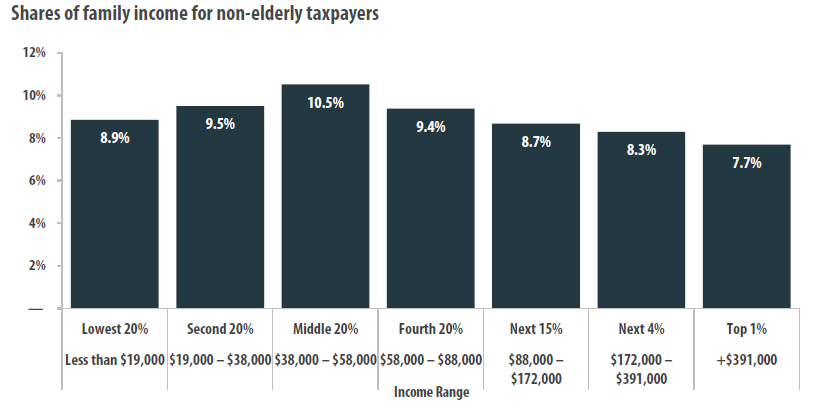
ITEP 2014 tax chart

Sorry, I should have warned you: seeing that chart may result in nausea and vomiting.

According to figures released this week by the Institute on Taxation and Economic Policy (ITEP), Vermont’s tax system hits the working and middle classes the hardest, while top earners pay the least of all (as a percentage of their incomes).

In the past, the Governor has praised the fairness of our tax system. He should never, ever do that again until he fixes it.

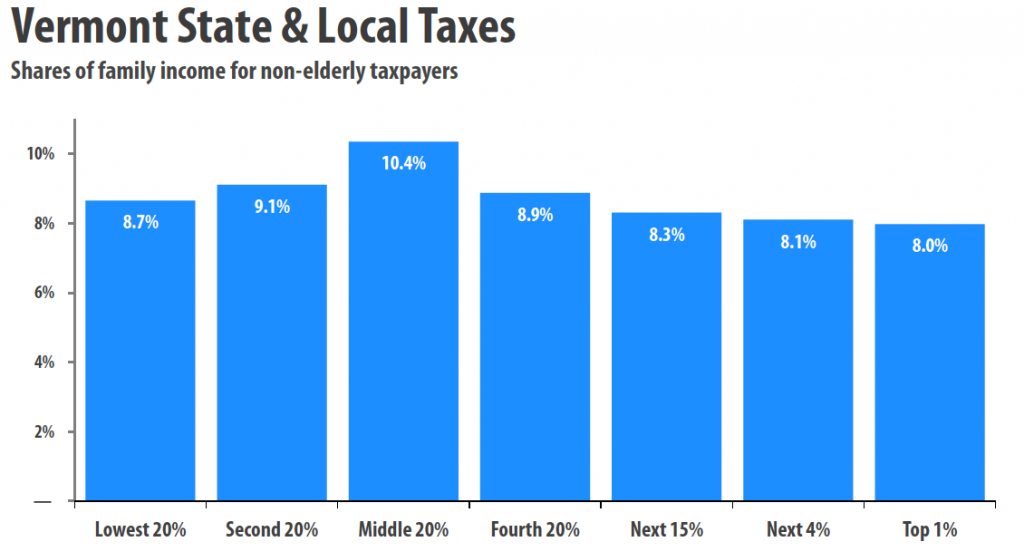
Not only has he failed to do so… not only has he blocked efforts to do so… but during the last two years, Vermont’s tax system has actually gotten worse. Here’s the ITEP chart from two years ago.

ITEP 2012 tax chart

Compare the two charts: Higher shares of family income for the bottom 60%, and lower shares for the very top. No relief for the middle class, despite the Governor’s rhetoric.

In many ways, our state tax system is relatively progressive, but there are problems. The sales tax is extremely regressive; the property tax hits the working and middle classes the hardest. And as Paul Cillo of the Public Assets Institute points out: 

“The regressive property tax is Vermont’s largest single revenue source supporting state and local public services, and the Legislature has been shifting more and more public costs onto the property tax.”

And while income tax rates are very progressive, the actual taxes paid are much less so. Vermont’s tax rate for top earners is 8.95% — but because of generous rules on taxable income and deductions, those top earners pay an effective rate of only 5.1%. 

In addition to the fairness issue, the disparity puts pressure on Vermont’s budget, as PAI points out:

If the nation fails to address its growing income inequality problem, states will have difficulty raising the revenue they need over time. The more income that goes to the wealthy (and the lower a state’s tax rate on the wealthy), the slower a state’s revenue grows over time.

What have we seen throughout the past several months? Income tax receipts coming in lower than expected, forcing cuts in the budget. Hmmm.

There was one modestly progressive tax proposal in the Governor’s speech: he wants to end a tax deduction for state and local taxes paid in the preceding year, a tax break that mostly benefits upper tiers.

Otherwise, he left our unfair, broken, and inadequate tax system untouched.

Just about every time he opens his mouth, he talks about how Vermonters are taxed to the limit of their ability to pay. This is clearly true for most Vermonters, but clearly untrue for the most fortunate among us.

There is a glimmer of hope. Shumlin yesterday took a tiny step away from his past opposition to raising income, sales, or rooms and meals taxes:

You have heard many times over the past four years my opposition to raising income, sales, and rooms & meals tax rates to fund state government.

When he delivered this line, he gave the word “rates” some extra oomph. And making the income tax fairer wouldn’t require a change in rates; it’d just mean closing loopholes and limiting deductions.

Reasonably. I’m not calling for confiscatory taxes on the rich; I’m just calling for them to pay their fair share in an economy that has bestowed most of its benefits on them.

How about it, Shap?

Mikey Pom-Poms is at it again

I can explain everything.

Nobody was Tweeting, officer. We were all in the back seat singing.

Last night saw another outbreak of TwitBoasting from serial offender Michael Townsend, the Burlington Free Press’ Cheerleader-In-Chief.

The first one wasn’t that bad:

Okay, fine, share a little love with one of your hard-working scribes. Nothing wrong there. But then came Step Two in Townsend’s descent.

Mike Donoghue was at the Statehouse yesterday, but I’m told he wasn’t covering Shumlin’s budget address; he was dogging people about this delinquent-taxpayer list. Short version: earlier this week, the state released a list of its top 100 tax scofflaws — 50 business, 50 individual. But just the names; not the amounts owed. Donoghue is seeking the amounts.

That’s the big scoop. On the day of Gov. Shumlin’s budget address, when he’s setting the agenda for this legislative session, the Free Press’ senior reporter is stirring up a tempest in a transparency teapot.

And then came Townsend’s topper:

Oh, Mikey.

Look, it’s perfectly okay to talk up your own reporters. But why do you have to run down everybody else?

As I’ve said before, this is why all the other reporters think Townsend is a jerk and the Free Press is a fount of institutional arrogance.

Also, please lose the fake cowboy stuff. Donoghue and Burbank are good reporters; they’re not The Magnificent Seven.

Same song, different verse

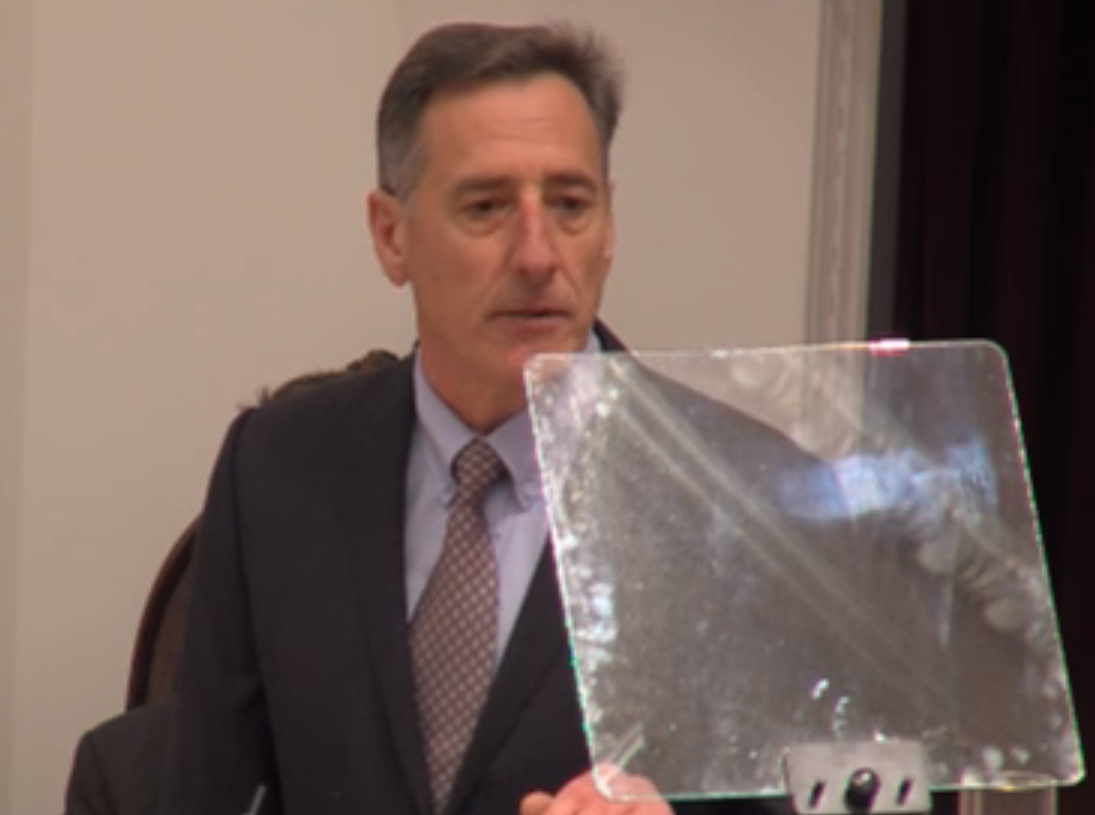
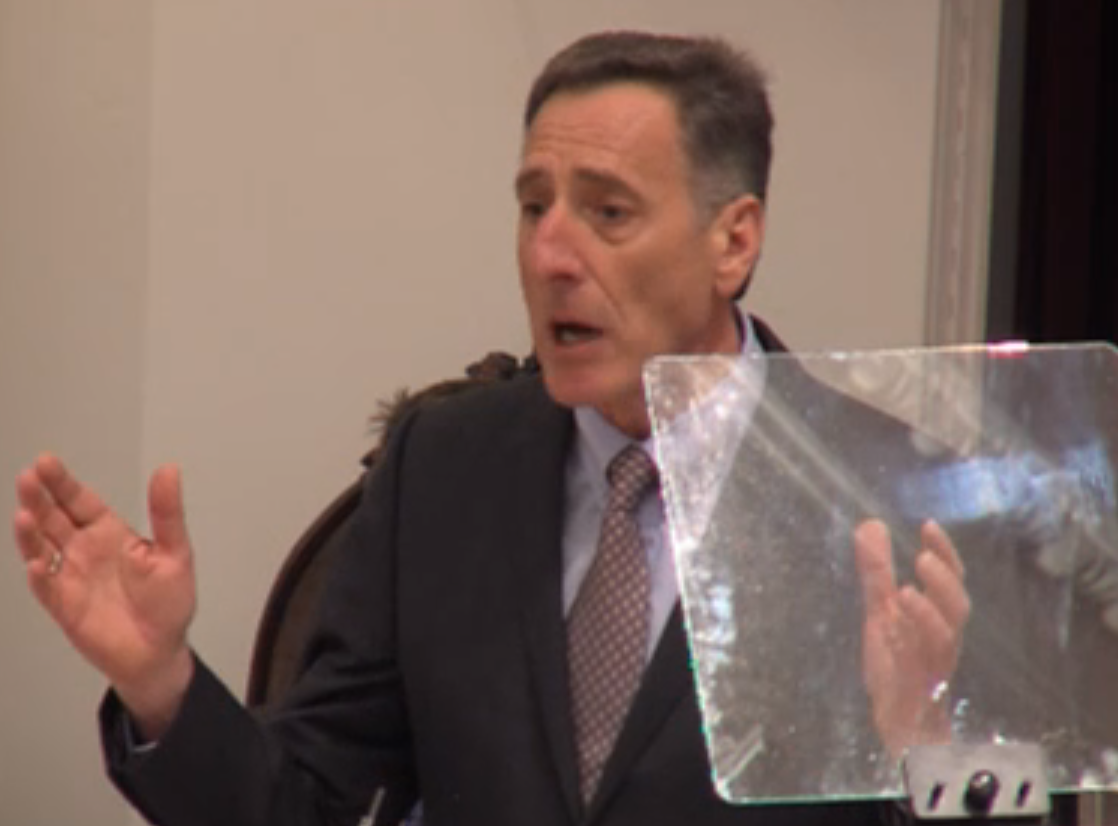
Hey, who switched the teleprompter to Español?

Hey, who switched the teleprompter to Español?

Reactions to the Governor’s budget address…

First, I hope the Republicans are happy. Last week they complained about a lack of attention to some major issues. Today they got a whopping hour and fifteen minutes. Be careful what you wish for.

This speech followed Shumlin’s usual pattern. There’s a whole lot of incrementalism — small, inexpensive approaches to big challenges — and, to spice things up, a handful of bigger proposals almost certain to go nowhere. It strikes many observers as a deliberate tactic: offer an unpalatable solution, and force the legislature to find an alternative. Example from a previous year: his plan for a major cut to the Earned Income Tax Credit.

I’ll give him credit, he’s very good at incrementalism. He finds modest improvements that don’t cost much, if anything. In today’s speech, he was constantly talking of leveraging federal funds, private-sector participation, and partnerships with entities of all sorts. A classic example: his plan to offer “motivated high school seniors” a free two-year Associates’ Degree in engineering technology “with no additional cost to the Education Fund.”

The plan involves the state Agency of Education and participating employers identifying students, and leveraging existing programs plus employer contributions to get them free tuition and a summer internship if they stay and work in Vermont after graduation.

It’s classic Shumlin. It sounds good, it will actually help some people, it’s cheap, and it can be effective as far as it goes.

But it doesn’t touch on the underlying problems: high college costs and stagnant earnings for all but the very wealthy. Even if the incremental stuff works, it seems like small potatoes for those of us who vote Democratic.

How big is the budget gap? It's soooooo big.

How big is the budget gap? It’s soooooo big.

Then there’s the other thing we get: the “big idea” that probably won’t go anywhere. I could mention a few; the double ban on teacher strikes and contract impositions, giving power to the state school board to close schools that fail to meet spending or achievement targets, the payroll tax increase to fund better Medicaid reimbursement.

Indeed, his entire education package seems designed for rejection. For one thing, it seems to do nothing to immediately mitigate rising property taxes. That’ll be lawmakers’ top priority, after last year’s election.

Shumlin’s broader reforms are an odd mix of distant and scary. Neither the teachers’ unions nor the school boards are likely to accede quietly to a plan that will strip them of their ultimate bargaining chips. The idea of eliminating “contradictory incentives” like the small schools grant may be good ideas, but they’ll be tough to support for lawmakers with small school in their districts.

Finally, the idea of Agency of Education “evaluation teams” going into every school to measure achievement and spending performance — with those who fail to meet benchmarks in line for state funding cuts or even closure — is DOA. It’s mandatory consolidation and top-down control via carrot and stick, rather than direct mandate. Kinda the worst of both worlds; no immediate impact, and a whole lot of state interference (as it will be perceived) in local decision-making.

He calls it a “partnership,” but one partner has the ultimate power.

If you think I’m too gloomy on Shumlin’s prospects, just take a look at this reaction statement from House Speaker Shap Smith:

…the Governor acknowledged Vermonters’ concerns about the unsustainable cost of health care, burdensome property tax increases, and the need to clean up our waterways. …I look forward to working with the Administration to make Vermont the best possibly place to work and live, and one that provides opportunity for all Vermonters.

He applauds the Governor for addressing the big issues — but not a peep about the Governor’s proposals. I expect lawmakers to consider Shumlin’s ideas, but he won’t get priority over others’ ideas.

This is all part of the game, as it has been since Shumlin took office. It’ll be even more so after an election that was largely a personal rebuke of the Governor, not the Democrats.

His budget message was a starting point. From here on, it’s a matter of top lawmakers devising proposals of their own that they can convince Shumlin to support.

Multimedia note: if the photos seem a bit blurry, it’s because they’re screengrabs from the Vermont PBS livestream. Workin’ from home today. 

The Shummy Shimmy

Before the November election, I’d planned to write a post-election piece offering my services to the Shumlin administration for the newly-created position of Shitkicker-In-Chief. The duties would include pointing out the flaws in administration reasoning, deflating egos when necessary, and the occasional loud guffaw.

The idea was based on my belief (hahahaha) that the election wouldn’t be close. When Shumlin won by a shoestring, I thought my idea was irrelevant. The election was a more effective shitkicker than I could ever be.

Seems I was wrong, because the Governor has quickly fallen back into to some bad habits. One of his worst is his almost-complete inability to admit that he was wrong about something — even if it’s something trivial. It makes him appear small-minded, overly defensive, duplicitous, and condescending.

This habit is again on display in the foofaraw over releasing documents related to single-payer health care.

For those just joining us, when the governor announced in December that he was ditching single-payer, WCAX’s Kyle Midura asked a provocative question. Here’s the exchange, as reported by Seven Days’ Paul Heintz:

“Will you waive executive privilege for all backdated documents at this point related to this question so we can see what you knew when?” Midura said.

“There is nothing to hide on what we knew when, so we’d be happy to show you any documents you wish to look at,” the governor responded.

Emphasis: “any documents you wish to look at.” And Midura’s use of “this question” is generally seen as referring to Shumlin’s decision on single-payer.

Naturally, multiple media outlets made public-records requests for any related documents. And that’s when Shumlin backtracked: the administration withheld “hundreds of pages of documents related to single-payer,” reports VPR’s Peter Hirschfeld.

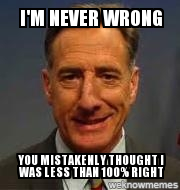
Shumlin never wrongShumlin says he never intended for him comments on Dec. 17 to mean that he’d release all internal communications related to single-payer.

“Now no governor ever divulges inter-staff conversations, but what we did divulge was all the data that led us to the conclusions that we came to,” Shumlin said.

Okay, I can see that point of view. But why did he promise, on Dec. 17, to release everything?

Evasive maneuvers, Mr. Sulu!

So far, we’ve heard two different explanations.

In an email to Heintz, the Governor’s legal counsel Sarah London asserted that Midura’s question referred narrowly to “the specific question of Medicaid reimbursement rates.”

On the other hand, Shumlin told Hirschfeld that he thought the question referred only to documents involved in a lawsuit by Rep. Cynthia Browning.

“Well as you know we had a fairly well-publicized court case … where we were asked to divulge all the data, studies and information about every detail that led us to the disappointing conclusions that we came to about public financing,” Shumlin said. “I assumed that his question was simply, are you going to continue to withhold that data? Or are you going to share it?”

It got even worse when Shumlin tried to clarify his position at a news conference yesterday:

“If you listen to the entire question, I answered it very clearly. And what I said was, the question I understood — I had it played back to me, so I think I got it — was, ‘Are you going to release the documents that, frankly, hadn’t been released before?’ You may recall Cynthia Browning requested them and we went to court and the court ruled in our favor. ‘Are you now going to release those documents? The documents that give us the data, all the dates, what you’ve done, all the studies?’ And I said, ‘Of course, we are. We want Vermonters to have that information.’ If you took the question as something else, you should’ve asked it that way. You didn’t.”

The Shummy Shimmy.

It’s one of his worst features: ducking and diving in a transparent effort to avoid admitting he was wrong.

I guess they could still use a Shitkicker-In-Chief.

Here’s a little free advice. Or consider it part of my S-I-C job application. Here’s what he should have said — and it’s not much different from what he did say.

“I apologize for misspeaking on Dec. 17. I should not have promised to release ‘all documents,’ because every administration needs some measure of privacy in its internal policy discussions. Any chief executive would agree with that.

“We have provided as much documentation as we can. The information we have released should be more than adequate to understanding how we arrived at our decision. I hope you, and the people of Vermont, can appreciate our position.”

There. Was that so hard?

The occasional apology would go a long way toward changing Shumlin’s image for the better. The long-term benefit would far outweigh the immediate discomfort.


Lock up the wimminfolk — the gunslingers are comin’ to town.

Wild BunchTalk about your Statehouse security risks.

Anytime now, you should expect an invasion by “the most sought-after Guns for Hire,” flooding the Statehouse hallways and your TV screens with an all-out barrage of propaganda issue advocacy.

The approaching marauders hale from a D.C. PR firm with the faintly unbelievable name “Goddard Gunster.” On its home page it proudly boasts of being “the most sought-after Guns for Hire,” as Business Week once called them.

GG will work for anyone who can pay its exorbitant bills, but a frequent customer is the American Beverage Association and its fellow peddlers of sugary drinks. They’ve turned to GG whenever a beverage tax or bottle bill or ban on SuperSizing rears its ugly head — from San Francisco to Telluride to New York City to Massachusetts.

And now, after an unsuccessful effort in 2013, we’re about to see another drive for a sugared-beverage tax* in Vermont. Which means, sure as the sun comes up in the east, Goddard Gunster will be ridin’ into town, guns a-blazin’.

*Popularly called “soda tax,” but would apply to any beverage with added sugar.

In 2013, an SBT bill won approval in the House Health Care Committee, which saw it more as a public health measure than a revenue enhancer; but it failed on a 6-5 vote in the Ways and Means Committee. During the three months between the bill’s introduction and its death, Big Sugar and its retail allies spent more than $600,000 fighting the bill. That’s an astounding figure in Vermont terms.

If you don’t believe me, maybe you’ll believe black-hat lobbyist Andrew McLean, who spearheaded Big Sugar’s anti-tax efforts under the Golden Dome:

MacLean concedes his clients spent “a lot of money” on a “very aggressive campaign” to halt the tax.

“I have not been involved in a campaign that’s that expensive,” he says.

This, from a guy who reps many of the biggest business and industry clients in Vermont.

And it’s sure to be even more expensive this year, because the SBT may have a better chance of passing. The reason? Vermont’s massive budget deficit, most recently estimated at $94 million.

There will be cuts to be sure; but cutting all the way to $94 million would be incredibly painful. It would, of necessity, focus primarily on the Agency of Human Services, which consumes the lion’s share of the General Fund budget. That’d be unpalatable to most lawmakers and to a liberal base already put off by Gov. Shumlin’s abandonment of single-payer health care.

So lawmakers will be looking for relatively painless ways to raise revenue. And that could carry the day for the SBT, which would raise about $35 million per year. That’s more than one-third of the budget gap taken care of right there.

The SBT does face a long uphill battle. Gov. Shumlin opposes it, although his stridency appears to be dwindling a bit. House and Senate leadership are cool to the idea, but advocates are hoping they will warm up as the budget pressure increases.

And sure as shootin’, “the most sought-after Guns for Hire” will be ready to ride into town, tossing money around like bullets in a spaghetti Western. The TV ads will be ubiquitous, touting “consumer choice” and featuring Mom ‘n Pop types worried about the tax’s impact on their little corner store. They’ll also be prominently featured in anti-SBT testimony in the Legislature — even though the big money behind the campaign will come from the beverage industry and big retail chains.

If they spent $600,000 two years ago to kill a longshot SBT bill, how much will they spend this year? Your guesses should start at a million bucks. Two mill would not surprise me.

Just think: more money than any political campaign in Vermont history, spent in a few short months over a soda tax.

This may be our first real taste of the post-Citizens United, Wild West world of unfettered money in politics.

Dan the No Longer Libertarian Man

(UPDATE: Per VTDigger, he’s joined the Republican Party. See below.)

Here’s a little piece of political news so shocking that I almost stifled a yawn.

Oooooookay, then. I imagine this will rattle around the Vermont political media for a few hours and then we’ll get back to stuff that actually matters.

Not to disparage the contributions of Mr. Feliciano. But we are talking about a guy who enjoyed a boatload of free publicity, including widespread speculation that he might outpoll Scott Milne, and in the end he barely managed to fend off the bottom-of-the-ballot Nutbar Brigade. He couldn’t even push the Libertarians into automatic ballot status for 2016.

I can see three possible implications. In order of likelihood:

— He’s had enough of politics and will turn his attention back to work and family. 10% chance; once bitten by the political bug, the fever usually persists beyond one election cycle.

— He doesn’t know what’s next, he’s on the outs with the Libertarians anyway, so he’s clearing the decks. 30% chance; it’s neat and clean, but I suspect he has an idea what he wants to do. Which is…

— He’s aiming to run for governor in 2016 as the darling of the right wing. 60% chance. The opening is there, unless Randy Brock re-emerges from the weeds. (Which I doubt.) The right needs a front man with some sort of credibility, and Feliciano was a perfectly cromulent candidate in 2014. He’s got some name recognition, he’s got a foothold in the Vermont political world. He impressed the likes of Darcie Johnston, even if he pretty much failed with the electorate.

There are problems with this scenario, obviously. His “proven appeal” amounts to 4% of the vote, even with all the publicity he got and all the troubles of his Republican counterpart. He’d be aiming to represent a wing of the VTGOP that’s clearly on the outs; if the 2014 election proved anything, it’s that a center-right position is much more appealing to voters than a hard-right stance.

Plus, in a hypothetical primary against Phil Scott, he’d get flattened.

Of course, the fact that the right wing is clearly on the outs makes them desperate enough to see Mr. Four Percent as their knight in fiscally conservative armor.

UPDATE: VTDigger’s Tom Brown reports that Feliciano has joined the Republican Party, saying its larger base would give him a better chance of winning a future campaign. That might be another run for governor; he might also pursue another office:

“It depends on what it is,” he said. “I have to be in a position where I can really influence things and get things done. I would not be good in the middle.”

I think we can all agree on that.

Fear and loathing under the Golden Dome

Funny thing. The more time goes by since last Thursday’s inaugural protest, the more fearsome and dangerous it seems to become.

We haven’t had any single item more outrageous than Sen. Dick McCormack’s employment of that fine old epithet “fascist.” What we have had is a proliferation of exaggerated characterizations and inconsistent rationales for why the Vermont Workers’ Center went too far.

At first, the ire was mainly concentrated on a single incident, in which a lone protester entered the chamber singing and chanting over the benediction. Regrettable and stupid.

But apparently Our Elected Leaders realize that that one incident fails to justify their reaction, because they’ve been using their creative powers to devise new ways the protest crossed some invisible boundary. I suspect that by the end of the month, the protest will be described as a cross between the Chicago riots, the nude scene from “Hair,” and the supercharged zombie attacks from “World War Z.”

The Inaugural Protest. (Not exactly as illustrated.)

The Inaugural Protest. (Not exactly as illustrated.)

Anyone who’s experienced real political turmoil would have to admit that the VWC was remarkably restrained. They did not, as many media outlets have reported, “disrupt” or “interfere with” the proceedings.

I listened on the radio, and I heard very little of the protesters — and I heard no interruptions in the proceedings. If those in attendance couldn’t hear, they could have asked that the sound system be turned up.

Recently, we’ve heard that some lawmakers felt uneasy about proceeding into the House chamber through a crowd, even though police officers lined their path. (And even though there was no hint of any violent intent by the protesters.) Indignant lawmakers have stopped referring to the benediction incident in favor of overly-broad depictions of the protest as loud or disruptive, which is only true if the expectation is library-standard quiet. We’ve heard references to possible fire-code violations — in a building whose last major fire was, I believe, in 1857. (We haven’t heard a peep from the police or the Sergeant At Arms about the fire code; that’s all come from opportunistic Republicans.)

Today we had the unedifying spectacle of Republican lawmakers threatening to walk out of the Governor’s budget address on Thursday should the protesters return, on the transparently specious grounds that they fear a stampede in case of a fire. Hell, those protesters are probably better organized than the assembled dignitaries. I suspect they’d be fully capable of calmly proceeding to the nearest egress.

We’ve also heard a whole lot of blaming the protest for potential security upgrades at the Statehouse. Which is ridiculous. First, because the protesters did not pose a threat to anyone with an ounce of common sense. And second, because enhanced security has been on the table for quite a while now — and will inevitably penetrate the hallowed halls. Because that’s just the way the world is these days. To blame it on that protest is utterly disingenuous.

Most of all, we’ve heard repeated appeals to respect and dignity and civility.

What this is really about is a set of crusty old traditions about the Statehouse. Voices are generally lowered, at what might be termed a “power mumble.” (It’s hell for old radio guys like me, with moderately compromised hearing.) There’s an unspoken expectation that men shall wear button-down shirts and ties. VWC members have one strike against them from the gitgo, since they dare to wear red T-shirts while roaming the sacred halls.

Playing by the unwritten rules is important to Statehouse regulars. The longer they’ve served (McCormack, a total of 22 years), the more wedded to Statehouse mores they become. And the more they resent it when the outside world dares to intrude.

They call it the People’s House, and accuse the protesters of disrupting the People’s business. But they themselves want everyone to treat it like a cross between a museum and a mausoleum.

It’s too bad when democracy — the People’s real business — gets a little messy and intrudes on what some consider sacred space. But I don’t feel sorry for them, not at all.

And those traditions? Throw ’em out with the trash, if you ask me.